

Gorkha rule in Himachal Pradesh lasted from the early 1800s until 1815. Gorkhas from Nepal pushed west through Kumaon and Garhwal into Sirmaur, Kangra and the Shimla hill states. Sikh help to Kangra stopped them in 1809, and the Anglo-Gorkha War ended their rule. This page explains the key events in simple words for HPAS, HP Allied Services, Naib Tehsildar, Patwari and other HPPSC and HPRCA exams.
It is a short version of the chapter "Gorkhas and the Hill States (1790–1816 CE)" (Unit 3, Chapter 5) from Raman Academy's Himachal Pradesh General Studies book. You get the introduction, the key facts and a summary table here. Detailed accounts are in the book.
On this page
Rise of the Gorkhas and the Gorkha Invasion
The Gorkha push to the west took place during the minority of King Rana Bahadur Shah of Nepal. Its main commander in the western Himalayas was Amar Singh Thapa. The Gorkhas took Kumaon in 1790 and fully subdued Garhwal by 1804, opening the road to the western hill states.
In Sirmaur, Raja Karam Prakash, troubled by a rival claimant, asked Amar Singh Thapa for help. The Gorkhas came, but instead of restoring him, Amar Singh Thapa set up Gorkha control over Sirmaur.
Gorkhas versus Raja Sansar Chand
Raja Sansar Chand Katoch's growing power alarmed the other hill rulers, who invited Amar Singh Thapa to step in. The Gorkhas crossed the Satluj in 1805 and defeated Sansar Chand at the Battle of Mahal Morian (1806). He took refuge in Kangra Fort, and years of siege brought famine and displacement to the region.
Gorkha Rule in the Shimla Hill States
After leaving Kangra, the Gorkhas strengthened their hold between the Yamuna and the Satluj. Amar Singh Thapa made Arki, the capital of Baghal, his western headquarters, and his authority covered states such as Baghal, Dhami, Keonthal, Jubbal and Kumharsain. Bushahr was forced to pay tribute after the 1811 campaign.
Anglo-Gorkha War and the Treaty of Sugauli
Gorkha expansion clashed with British interests, and the East India Company declared war on Nepal on 1 November 1814. General David Ochterlony led the successful western campaign, while Rollo Gillespie was killed at Kalanga Fort. Bhakti Thapa fell at Deothal near Malaon in 1815, and Amar Singh Thapa surrendered with honour. Several hill rulers, including those of Hindur and Kahlur, sided with the British.
The settlement was made formal by the Treaty of Sugauli, signed on 2 December 1815 and ratified on 4 March 1816. Gorkha supremacy in the western hills ended, and British predominance began.
Gorkha Rule in Himachal Pradesh: Timeline Table
| Year | Event |
|---|---|
| 1790 | Gorkhas occupy Kumaon |
| 1804 | Garhwal fully subdued; Gorkhas enter Sirmaur and the Shimla hills |
| 1806 | Battle of Mahal Morian – Sansar Chand defeated |
| 1809 | Treaty of Jwalamukhi; Kangra Fort to Ranjit Singh |
| 1811 | Bushahr campaign |
| 1814 | British declare war on Nepal (1 November) |
| 1815 | Bhakti Thapa killed at Deothal; Treaty of Sugauli signed (2 December) |
| 1816 | Treaty of Sugauli ratified (4 March) |
What the Full Chapter in the Book Adds
This page covers only the main events of Gorkha rule. The book chapter also gives:
- The Gorkha commanders and their roles, including Ranzor Singh Thapa
- The full Sirmaur crisis and both Gorkha expeditions
- The Bara Thakurais and the Hindur–Kahlur–Kangra rivalries
- The Bushahr campaign, with its battles and tribute
- Causes of the Anglo-Gorkha War and every British commander and battle centre
- The effects of Gorkha rule and the war on the hill states
Practise MCQs on the Gorkha Period
Test yourself with our free online quizzes:
- Gorkha Invasion, its Nature, Consequences and the Treaty of Sugauli MCQs
- Sikh, Gurkha and British Period MCQs
Read the previous chapter on the Sikh period in Himachal Pradesh, or open the Himachal Pradesh MCQ hub for every topic. Historical treaties are preserved by the National Archives of India.
FAQs on Gorkha Rule in Himachal Pradesh
Who led Gorkha rule in Himachal Pradesh?
Amar Singh Thapa, the principal commander of the Gorkha expansion into the western Himalayas.
Where was Amar Singh Thapa's western headquarters?
At Arki, the capital of Baghal state.
The Battle of Mahal Morian was fought between whom?
Between the Gorkhas under Amar Singh Thapa and Raja Sansar Chand of Kangra, in 1806. Sansar Chand was defeated.
The Treaty of Jwalamukhi (1809) was signed between whom?
Between Raja Sansar Chand and Maharaja Ranjit Singh, on 20 July 1809. Ranjit Singh agreed to expel the Gorkhas in return for Kangra Fort.
Who won the struggle for Kangra between the Gorkhas and the Sikhs?
The Sikhs. Their forces drove the Gorkhas out of the Kangra region in 1809, and the Gorkhas withdrew without capturing Kangra Fort.
When did the Anglo-Gorkha War begin?
The British East India Company declared war on Nepal on 1 November 1814.
When was the Treaty of Sugauli signed?
It was signed on 2 December 1815 and ratified on 4 March 1816, formalising the Anglo-Gorkha settlement.
Which British general led the western campaign against the Gorkhas?
David Ochterlony. Rollo Gillespie was killed at Kalanga Fort.
Where was Bhakti Thapa killed?
At Deothal near Malaon, in 1815.
Get the Complete Himachal Pradesh GK Book
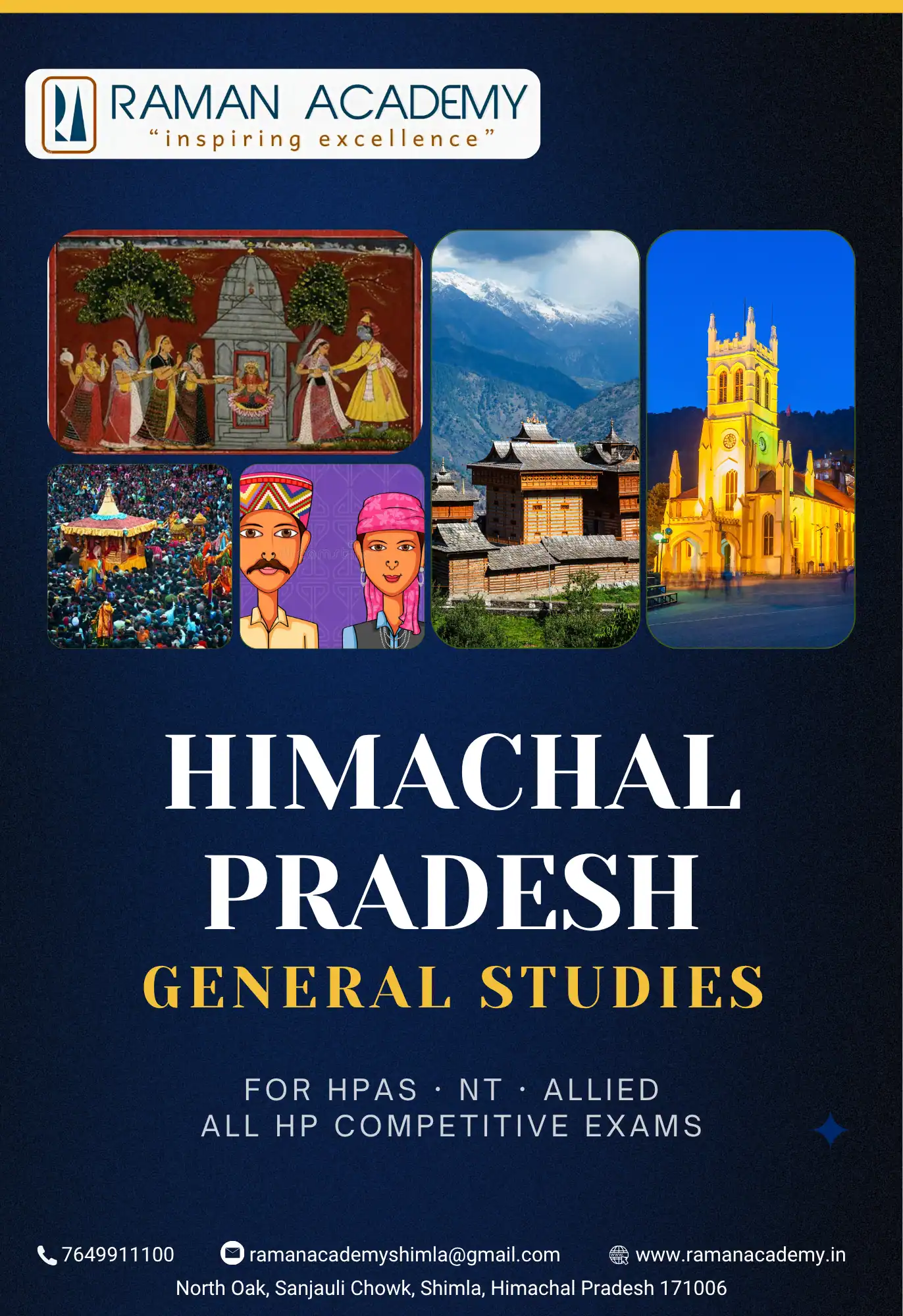
This page gives you about a quarter of the chapter on the Gorkhas and the hill states. The book has the full chapter with the Sirmaur crisis, Hindur–Kahlur–Kangra rivalries, the Bushahr campaign and every commander of the Anglo-Gorkha War, plus every other HP GK topic.
Buy the Himachal Pradesh General Studies Book
