

Description
HP JOA (IT) Computer Book 2026 – Complete Theory + 1,700+ Solved Previous Year Questions
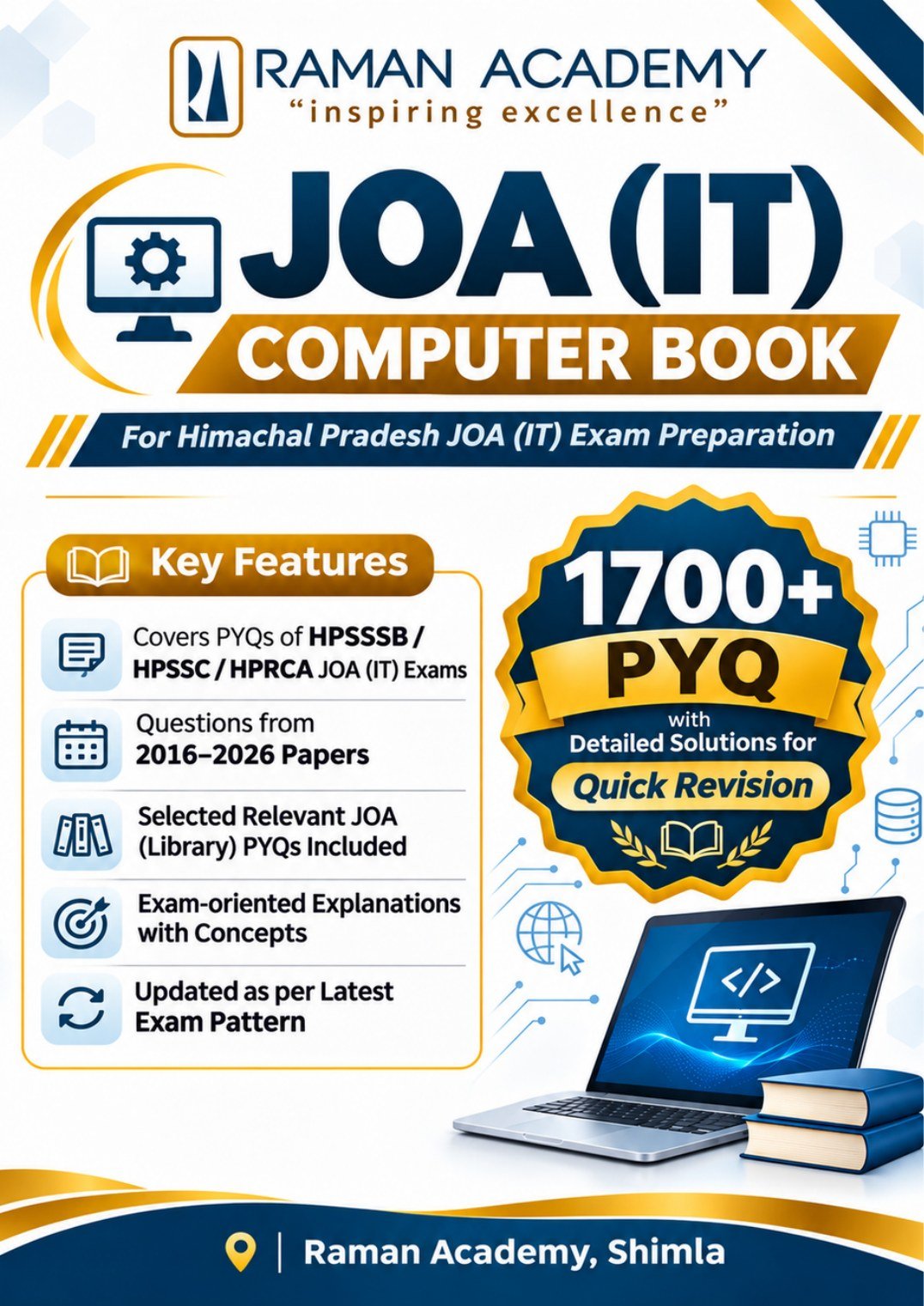
In short: This is Raman Academy’s complete computer book for the HP JOA (IT) – Junior Office Assistant (Information Technology) exam conducted by HPRCA (Himachal Pradesh Rajya Chayan Ayog) and earlier by HPSSC / HPSSSB Hamirpur, HPPSC, HP High Court, HP Vidhan Sabha and HP universities. It has 25 chapters in 439 pages covering the full computer syllabus, and 1,700+ previous year questions (2016–2026) from 25+ HP JOA (IT) papers, including all 8 shifts of HPRCA JOA (IT) 2026. Every question comes with its answer and a short solution that points to the section where it is explained. Available in English and Hindi medium. Price: ₹450.
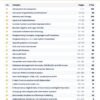
Book Sample (first 10 pages):
At a Glance
| Exam | HP JOA (IT) – Junior Office Assistant (Information Technology), HPRCA and other HP recruiting bodies |
| Subject | Computer – complete theory for the HP JOA (IT) computer section |
| Chapters & pages | 25 chapters, 439 pages |
| Previous year questions | 1,700+ computer PYQs from 25+ HP JOA (IT) papers, 2016–2026, placed chapter-wise and section-wise |
| Latest papers | HPRCA JOA (IT) 2026 – all 8 shifts (28 Sep – 1 Oct 2026), HPPSC 2025, HP Vidhan Sabha 2024 |
| Solutions | Answer key + a short solution for every question, with the section number where the topic is explained |
| Diagrams & tables | 54 labelled figures and hundreds of comparison tables |
| Medium | English or Hindi (select before adding to cart) |
| Format | Printed book |
| Price | ₹450 |
| Delivery | Free delivery across India by India Post Speed Post · dispatched in 1–2 working days |
| Prepared by | Raman Academy, Sanjauli, Shimla (Himachal Pradesh) |
Built From the Actual HP JOA (IT) Papers
The syllabus of this book was made by collecting every computer question asked in HP JOA (IT) exams from 2016 to 2026 and arranging them topic by topic. The notes were then written so that every one of these questions can be answered from the book, plus the related topics that have not been asked yet. You study exactly what HP exams ask – nothing important is left out, and no time is wasted on topics that never come.
How Every Chapter Is Written
All 25 chapters follow the same simple pattern:
- Chapter Overview – what the chapter covers, its exam weight (how many questions have been asked from it and in how many papers), the most-asked topics with question counts, the new HPRCA 2026 pattern for that chapter, and a short how-to-study plan.
- Detailed notes – numbered sections (1, 1.1, 1.1.1) in simple English, with definitions, examples, tables and diagrams.
- Worked examples – step-by-step solutions for calculation questions such as number conversions, 2’s complement, subnetting, CRC, chmod, Excel functions and CPU scheduling.
- Important Full Forms – a full-form table at the end of every chapter.
- Previous Year Questions – all PYQs on that chapter, grouped by section, with the exam and year written after each question.
- Answer Key and Solutions – the correct answer and a short explanation for every question, with a link back to the section, e.g. “(See 1.1)”.
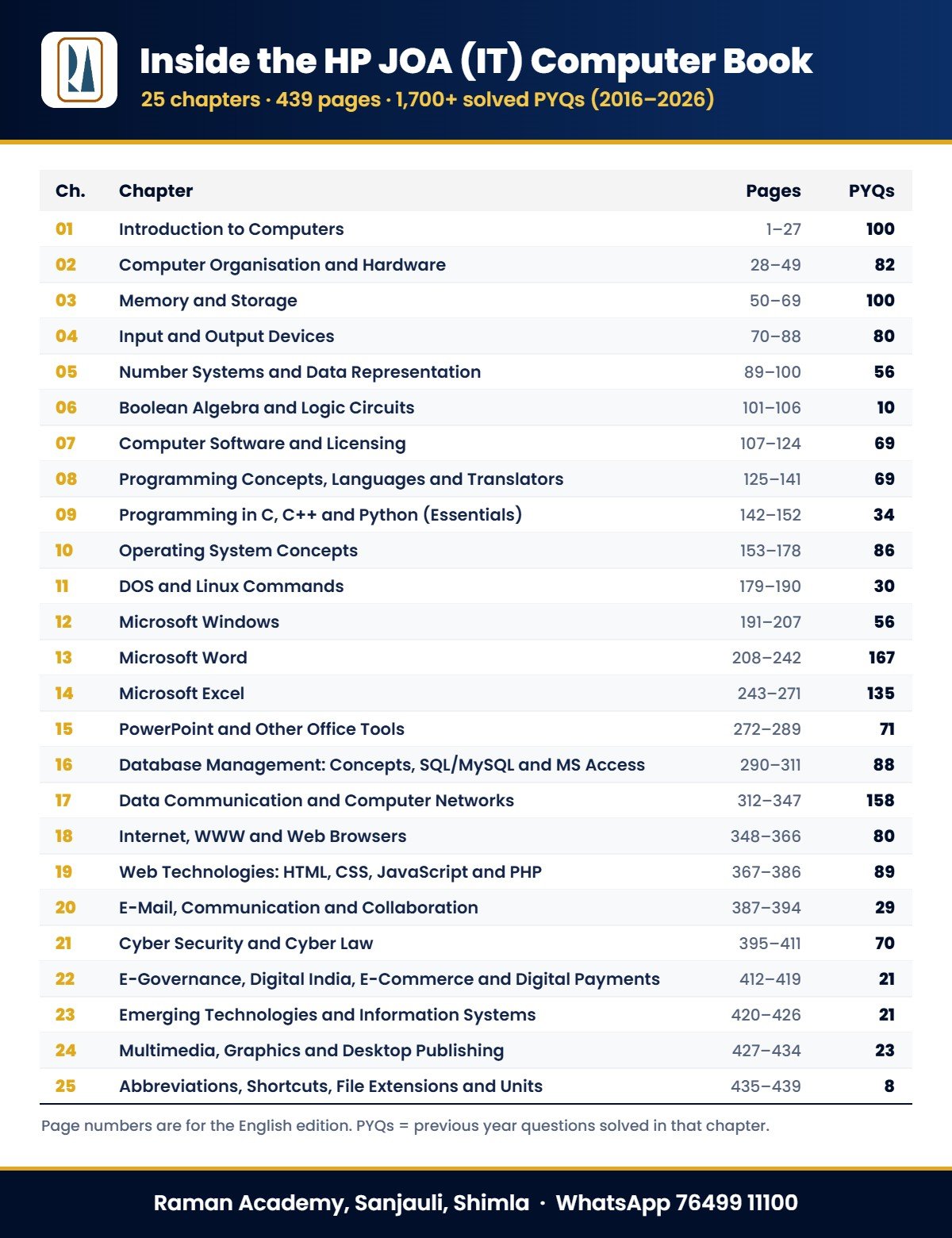
Complete Chapter List
| Ch. | Chapter | Pages | PYQs |
|---|---|---|---|
| 1 | Introduction to Computers | 1–27 | 100 |
| 2 | Computer Organisation and Hardware | 28–49 | 82 |
| 3 | Memory and Storage | 50–69 | 100 |
| 4 | Input and Output Devices | 70–88 | 80 |
| 5 | Number Systems and Data Representation | 89–100 | 56 |
| 6 | Boolean Algebra and Logic Circuits | 101–106 | 10 |
| 7 | Computer Software and Licensing | 107–124 | 69 |
| 8 | Programming Concepts, Languages and Translators | 125–141 | 69 |
| 9 | Programming in C, C++ and Python (Essentials) | 142–152 | 34 |
| 10 | Operating System Concepts | 153–178 | 86 |
| 11 | DOS and Linux Commands | 179–190 | 30 |
| 12 | Microsoft Windows | 191–207 | 56 |
| 13 | Microsoft Word | 208–242 | 167 |
| 14 | Microsoft Excel | 243–271 | 135 |
| 15 | PowerPoint and Other Office Tools | 272–289 | 71 |
| 16 | Database Management: Concepts, SQL/MySQL and MS Access | 290–311 | 88 |
| 17 | Data Communication and Computer Networks | 312–347 | 158 |
| 18 | Internet, WWW and Web Browsers | 348–366 | 80 |
| 19 | Web Technologies: HTML, CSS, JavaScript and PHP | 367–386 | 89 |
| 20 | E-Mail, Communication and Collaboration | 387–394 | 29 |
| 21 | Cyber Security and Cyber Law | 395–411 | 70 |
| 22 | E-Governance, Digital India, E-Commerce and Digital Payments | 412–419 | 21 |
| 23 | Emerging Technologies and Information Systems | 420–426 | 21 |
| 24 | Multimedia, Graphics and Desktop Publishing | 427–434 | 23 |
| 25 | Abbreviations, Shortcuts, File Extensions and Units | 435–439 | 8 |
Page numbers are for the English edition. The PYQ column shows how many previous year questions on that chapter are solved in the book.
What Each Chapter Covers
- Computer fundamentals (Ch. 1–4): IPO cycle and block diagram, history and generations, classification of computers, supercomputers of the world and India, CPU (ALU, control unit, registers), instruction cycle, motherboard, buses, ports, SMPS and UPS, BIOS and CMOS, RAM, ROM, cache and virtual memory, hard disk, SSD, CD/DVD/Blu-ray, keyboard, mouse, scanners, OCR/OMR/MICR, monitors and all types of printers.
- Number systems and logic (Ch. 5–6): binary, octal, decimal and hexadecimal conversions (with fractions), binary arithmetic, 1’s and 2’s complement, BCD, ASCII, Unicode, IEEE 754, logic gates and truth tables, Boolean laws, De Morgan’s theorems, adders, multiplexers and flip-flops.
- Software and programming (Ch. 7–9): system, utility and application software, open source, freeware, shareware and licence types, algorithms and flowcharts, generations of languages, compiler vs interpreter, OOP, data structures, and C, C++ and Python essentials with output-based questions.
- Operating systems (Ch. 10–12): types and functions of an OS, booting, BIOS, UEFI and POST, process scheduling (FCFS, SJF, Round Robin), deadlock, paging, file systems, Linux and Android, internal and external DOS commands, Linux commands and chmod, and Microsoft Windows from the desktop and taskbar to Control Panel and shortcuts.
- MS Office (Ch. 13–15): MS Word (formatting, page layout, mail merge, references, Track Changes), MS Excel (formulas, functions, references, sorting, filtering, What-If Analysis, PivotTables, charts) and PowerPoint (layouts, Slide Master, animations, transitions, views), each with full shortcut key tables.
- Database (Ch. 16): DBMS vs file system, ER and relational model, keys and constraints, normalisation, ACID, SQL (DDL, DML, DCL, TCL, joins), MySQL commands and MS Access.
- Networks and Internet (Ch. 17–20): transmission media, LAN/MAN/WAN, topologies, network devices, OSI and TCP/IP models, protocols and port numbers, IPv4/IPv6, subnetting, Wi-Fi, Bluetooth, 1G–5G, URLs, DNS, browsers, search engines, HTML, CSS, JavaScript, PHP, e-mail (SMTP, POP3, IMAP, Cc, Bcc), cloud storage and social media.
- Security, e-governance and new technology (Ch. 21–24): viruses, worms, Trojans, ransomware, phishing, firewall, VPN, encryption, digital signatures, IT Act 2000, DPDP Act 2023, Digital India, UPI, NEFT, RTGS, e-governance in Himachal Pradesh, cloud computing, AI and ML, IoT, blockchain, ERP and MIS, multimedia, image formats and DTP.
- Quick revision (Ch. 25): computer abbreviations, file extensions, keyboard shortcuts, function keys and units of measurement in one place.
Previous Year Papers Included
The computer questions of these HP JOA (IT) papers are solved inside the chapters:
- HPRCA JOA (IT) 2026 – all 8 shifts (28, 29 and 30 September and 1 October 2026), plus HPRCA JOA (Library) 2026
- HPSSC Hamirpur – 2021 (Post Codes 817 and 903) and 2022 (Post Codes 939 and 1000)
- HPSSSB Hamirpur – 2016 (PC 447), 2017 (PC 556), 2018 (PC 626) and 2021 (PC 477)
- HPPSC – 2025
- HP High Court – 2019, 2021 and 2023
- HP Vidhan Sabha – 2024, including the descriptive Paper 2 with model answers
- HP State Legal Services Authority (HPSLSA) – 2022
- Sardar Patel University (SPU), Mandi – 2022, both shifts
- Atal Medical and Research University (AMRU) – 2022
- Dr YS Parmar University of Horticulture and Forestry (YSPU), Nauni – 2021
Key Features
- 1,700+ solved PYQs (2016–2026) – every question is placed under its chapter and section, so you see exactly what HP exams ask from each topic.
- HPRCA 2026 pattern covered – all 8 shifts of HPRCA JOA (IT) 2026 are solved, and each chapter explains the new scenario-based questions (“a hospital needs a system – which computer?”, “which licence suits a school?”).
- Exam weight for every chapter – see which chapters matter most. MS Word (167 questions), Computer Networks (158) and MS Excel (135) are the most asked.
- Answer + solution for every question – each solution says why the answer is right and gives the section number to revise.
- Tricky official answers explained – where an official answer key looks odd, the book explains which option was taken and why.
- 54 labelled diagrams – block diagram, CPU, instruction cycle, memory hierarchy, hard disk, OSI and TCP/IP layers, topologies, process states, Gantt charts, Word, Excel and PowerPoint windows, CSS box model, encryption and more.
- Worked examples for calculation questions – number systems, binary arithmetic, subnetting, CRC, chmod, array address, postfix, Excel functions and CPU scheduling.
- Shortcut key tables – Windows, MS Word, MS Excel, PowerPoint and browser shortcuts, plus file extensions and full forms.
- Important Full Forms in every chapter – and a separate quick-revision chapter of abbreviations, shortcuts, file extensions and units.
- Model answers for descriptive questions – 2-mark and 5-mark answers for the HP Vidhan Sabha descriptive paper and a ready answer on AI and Machine Learning.
- Up-to-date facts – current facts (supercomputers, tech leaders, Indian chips, Digital India missions, DPDP Act 2023) are given as on October 2026 and marked with a dagger (†).
- Himachal Pradesh e-governance – e-Vidhan, HIMSWAN, Lok Mitra Kendras, PRIASoft and eGramSwaraj.
- Simple language – written for students from any background, including those who have not studied computer science before.
Who Should Buy This Book?
- Candidates preparing for HP JOA (IT) recruitment by HPRCA.
- Candidates for JOA (IT) posts in the HP High Court, HP Vidhan Sabha, HPSLSA and HP universities such as SPU Mandi, AMRU and YSPU Nauni.
- Aspirants of other Himachal exams with a computer section who want PYQ-based computer preparation.
- Hindi and English medium students who want theory and solved papers in one book instead of many.
Book Format & Delivery
- Book: HP JOA (IT) Computer Book – 25 chapters, 439 pages (English edition)
- Medium: English or Hindi
- Format: Printed book
- Price: ₹450 with free delivery
- Dispatch: India Post Speed Post within 1–2 working days; delivery in 2–3 days within Himachal and 4–7 days in the rest of India
- Payment: UPI, debit/credit card or net banking; Cash on Delivery is also available (₹100 handling charge)
- Help: WhatsApp +91-7649911100 (7 AM–10 PM, every day)
Learn the theory. Practise every question HP has asked. Walk into the JOA (IT) exam ready.
Frequently Asked Questions
What is the HP JOA (IT) Computer Book by Raman Academy?
It is a complete computer book for the HP JOA (IT) – Junior Office Assistant (Information Technology) exam. It has 25 chapters in 439 pages covering the full computer syllabus, and 1,700+ previous year questions from 25+ HP JOA (IT) papers (2016–2026), each with its answer and a short solution. It costs ₹450.
How many previous year questions are in the book? Are they solved?
The book has 1,700+ computer questions asked in HP JOA (IT) exams from 2016 to 2026. All of them are solved: each chapter ends with an answer key and a short solution for every question, with the section number where the topic is explained.
Does the book include the HPRCA JOA (IT) 2026 questions?
Yes. The computer questions of all 8 shifts of HPRCA JOA (IT) 2026 (28 September to 1 October 2026) are solved in the book, along with the HPRCA JOA (Library) 2026 paper. Each chapter also explains the new scenario-based questions that HPRCA asked.
Which exams’ previous year papers are covered?
HPRCA 2026 (all 8 shifts), HPSSC Hamirpur 2021 and 2022 (Post Codes 817, 903, 939 and 1000), HPSSSB 2016, 2017, 2018 and 2021, HPPSC 2025, HP High Court 2019, 2021 and 2023, HP Vidhan Sabha 2024, HPSLSA 2022, SPU Mandi 2022, AMRU 2022 and YSPU Nauni 2021.
Which topics does the book cover?
Computer fundamentals, hardware, memory, input and output devices, number systems, Boolean logic, software and licensing, programming (C, C++, Python), operating systems, DOS and Linux commands, Windows, MS Word, Excel and PowerPoint, DBMS and SQL, computer networks, Internet, HTML, CSS, JavaScript and PHP, e-mail, cyber security and cyber law, e-governance and digital payments, emerging technologies, multimedia, and a quick-revision chapter of abbreviations, shortcuts and file extensions.
Is the JOA (IT) Computer Book available in Hindi?
Yes. The book is available in English medium and Hindi medium at the same price of ₹450. Select your medium before adding the book to the cart.
Which chapters are most important for HP JOA (IT)?
By number of questions asked from 2016 to 2026, the most important chapters are MS Word (167 questions), Data Communication and Computer Networks (158), MS Excel (135), Introduction to Computers (100) and Memory and Storage (100). Every chapter’s overview shows its exam weight and most-asked topics.
Can I study from this book without a computer background?
Yes. Each chapter starts from the basics and explains topics in simple language with diagrams, tables and worked examples. Calculation topics such as number systems, subnetting and Excel functions are solved step by step.
Does the book help with descriptive computer questions?
Yes. It gives model answers for the descriptive computer questions of the HP Vidhan Sabha 2024 paper (2-mark and 5-mark questions on hardware and software, templates, MS Office tools, cyber law, and AI and machine learning).
What is the price, and how long does delivery take?
The book costs ₹450 with free delivery across India. It is sent by India Post Speed Post within 1–2 working days and usually arrives in 2–3 days within Himachal Pradesh and 4–7 days in the rest of India. Cash on Delivery is also available with a ₹100 handling charge.

Reviews
There are no reviews yet.