
Results
#1. In the context of Hotspot vulcanism, consider the following statements:
1. It is fed by a region deep inside the earth which acts as a source of Volcanic eruption.
2. They are always located near plate boundaries.
Which of the statements given above is/are correct?
Statement 1 is correct. A hot spot is fed by a region deep within the Earth’s mantle from which heat rises through the process of convection. This heat facilitates the melting of rock at the base of the lithosphere. The melted rock, known as magma, often pushes through cracks in the crust to form volcanoes.
Statement 2 is incorrect. Hot spot volcanism is unique because it does not occur at the boundaries of Earth’s tectonic plates, where all other volcanism occurs.Instead, it occurs at abnormally hot centers known as mantle plumes.
#2. Consider the following statements regarding earthquakes.
1. Earthquakes are not found along the transform plate boundary.
2. Deep-focus earthquakes are more common in mid-oceanic ridges.
Which of the statements given above is/are correct?
Statement 1 is incorrect. Earthquakes are very abundant in subduction zone of convergent plate boundary. Earthquakes are also common along transform faults, such as the San Andreas Fault. Also, earthquakes do occur along the divergent boundaries like the mid- Atlantic ridge.
Statement 2 is incorrect. Shallow focus earthquakes mostly occur on divergent plate boundaries. Mld- oceanic ridges occur on divergent plate boundaries so the earthquakes here are shallow focus. Deep-focus earthquakes are most common on convergent plate boundaries. Therefore, it is found in areas of circum- pacific belt as well as Alpine-Himalayan belt.
#3. Consider the following statements regarding Volcanic Landforms:
1. The lava that cools within the crust are called as plutonic rocks.
2. Sills are the vertical bodies of the intrusive igneous rocks.
3. Laccoliths are found at the top of anticlines or at the base of synclines.
Which of the statements given above is/are incorrect?
Statement 1 is correct — The cooling may take place either on reaching the surface or also while the lava is still in the crustal portion. Depending on the location of the cooling of the lava, igneous rocks are classified as volcanic rocks (cooling at the surface) and plutonic rocks (cooling in the crust).
Statement 2 is incorrect — The near horizontal bodies of the intrusive igneous rocks are called sill or sheet, depending on the thickness of the material. The thinner ones are called sheets while the thick horizontal deposits are called sills.
Statement 3 is incorrect — Laccoliths are large dome shaped intrusive bodies connected to a pipe-like conduit from below. Phacoliths are found at the base of syncline or at the top of anticlines.
#4. These volcanoes are mostly made up of basalt and are not steep. They are characterized by low explosivity. The upcoming lava moves in the form of a fountain. It throws out the cone at the top of the vent and develops into a cinder cone. The type of volcano described is:
Option a is incorrect — The Icelandic type eruption is characterized by effusions of molten basaltic lava that flow from long, parallel fissures. Such outpourings often build lava plateaus. E.g. Deccan Traps, Siberian Traps.
Option b is correct. Hawaiian Volcanoes are a type of Shield volcanoes. ‘These volcanoes are mostly made up of basalt, a type of lava that is very fluid when erupted. For this reason, these volcanoes are not steep. They become explosive if somehow water gets into the vent; otherwise, they are characterized by low explosivity. The upcoming lava moves in the form of a fountain and throws out the cone at the top of the vent and develops into a cinder cone.
Option c is incorrect — Strombolian eruptions are a type of volcanic eruption, named after Stromboli (Lipari Islands, Italy). Strombolian eruptions are driven by the continuous formation of large gas bubbles within the magma. Upon reaching the surface, the bubbles burst with a loud pop, throwing magma in the air.
Option d is incorrect — In Plinian eruptions, dissolved volatile gases stored in the magma are channeled to the top through a narrow conduit (pipe-like structure). The gases erupt into a massive column of the gas plume that reaches up to 2 to 45 km into the atmosphere.
#5. Consider the following statements:
1. Fossils are abundant in both plutonic and volcanic rocks.
2. Volcanic rocks are acidic whereas Plutonic rocks are basic in nature.
3. Volcanic rocks form crystals whereas Plutonic rocks are generally amorphous.
Which of the statements given above is/are incorrect?
Statement 1 is incorrect. In order to become fossilized, an organism must be buried quickly before it is destroyed by erosion or eaten by other organisms. This is why fossils are found almost exclusively in sediment and sedimentary rocks. Plutonic and Volcanic rocks are kind of igneous rocks. Igneous rocks, which form from cooling magma or lava, and metamorphic rocks, which have been altered by heat and pressure, are unlikely to contain fossils (but may contain under special circumstances). Thus, fossils are rare (and not abundant) in plutonic and volcanic rocks. As igneous rocks have their origin under conditions of high temperature thus, they are unfossiliferous.
Statement 2 is incorrect. It is not necessary that volcanic rocks are acidic. It may be acidic or basic in nature depending upon the quantity of silica present. When rocks contain high proportion of silica, they are said to be acidic.
When rocks contain a greater proportion of basic oxides of iron, aluminium, or magnesium, they are said to be basic.
Statement 3 is incorrect. When volcanic rocks make contact with the atmosphere they cool quickly, so the minerals do not have time to form large crystals resulting in a natural amorphous rock with few or no crystals. Whereas Plutonic rocks cools slowly without ever reaching the surface. They have large crystals that are usually visible without a microscope.
#6. Consider the following statements regarding the Pacific ring of fire.
1. It is the region where massive Pacific Plate interacts with less-dense plates surrounding it.
2. Transform faults do not occur in this region.
3. Most of the active volcanoes on the Ring of Fire are found on its western edge.
Which of the statements given above is/are correct?
Statement 1 is correct. It is also known as the Circum- Pacific Belt. It traces the meeting points of many less dense tectonic plates, including the Eurasian, North American, Juan de Fuca, Cocos, Caribbean, Nazca, Antarctic, Indian, Australian, Philippine, and other smaller plates, which all encircle the large Pacific Plate.
Statement 2 is incorrect. Plates overlap at convergent boundaries called subduction zones along much of this ring of fire. A significant exception is the border between the Pacific and North American Plates. This stretch of the Ring of Fire is a transform boundary, where plates move sideways past one another. So, transform faults also form near this ring of fire.
Statement 3 is correct. Most of the active volcanoes on The Ring of Fire are found on its western edge, from the Kamchatka Peninsula in Russia, through the islands of Japan and Southeast Asia, to New Zealand.
#7. With reference to Volcanic arcs and Island arcs which of the following statements is/are correct?
1. Convergence of two oceanic plates lead to the formation of Island arcs.
2. Volcanic arc is formed when two continental plates collide.
3. Volcanoes are absent on Island arc.
Select the correct answer using the code given below:
Statement 1 is correct. When two oceanic plates collide as in the western Pacific Ocean, the volcanoes form a curved line of islands, known as an island arc, that is parallel to the trench, as in the case of the Mariana Islands and the adjacent Mariana Trench.
Statement 2 is incorrect. Volcanic arc is formed when oceanic plate collides with continental plate e.g., volcanoes in Andes of western south America. On the contrary when two continental plates collide volcanic arcs not are formed.
Statement 3 is incorrect. Island arcs are the marine subset of currently active or formerly active volcanoes located near the boundary between two converging tectonic plates. When the crust of the overlying plate is less than —25 km thick, most of the volcanoes lie below sea level. Only the largest volcanoes form islands, which, therefore, constitute an island arc.
#8. With reference to earthquakes, consider the following statements:
1. P-waves creates density differences in the material leading to stretching (rarefaction) and squeezing (compression) of the material.
2. S-waves create troughs and crests in the material through which they pass.
3. Shadow zones of S-waves and P-waves have helped scientists identify the composition of earth’s interior.
Which of the above pairs are correctly matched?
Statement 1 is correct. There are two types of body waves. They are called P and S-waves. P-waves also called as compressional waves as they produce rarefaction and compression when travelling through the medium. P-waves move faster and are the first to arrive at the surface and hence are used to detect earthquakes. ‘Ihe P-waves are similar to sound waves. They can travel through gaseous, liquid and solid materials and travel in longitudinal direction.
Statement 2 is correct. S-waves are also called as transverse waves or shear waves or distortional waves. They are analogous to water ripples or light waves. Transverse waves or shear waves mean that the direction of vibrations of the particles in the medium is perpendicular to the direction of propagation of the wave. Hence, they create troughs and crests in the material through which they pass (they distort the medium).
Statement 3 is correct.Shadow zone is defined as that area where these waves are not detected due to their inability to reach there depending on their characteristic features. The zone between 1050 and 1450 from epicentre was identified as the shadow zone for both the types of waves. S-waves travel in a transverse direction. The entire zone beyond 1050 does not receive S-waves and is shadow zone for S-waves. Differences in arrival times, waves taking different paths than expected (due to refraction) and absence of the seismic waves in certain regions called as shadow zones, allow mapping of the Earth’s interior.
#9. With reference to earthquakes, consider the following statements:
1. An earthquake of magnitude 8 on Richter Scale is twice as great as an earthquake of magnitude 4.
2. The Mercalli scale takes into account the visible damage caused by the event. 3. The epicenter is the point on the earth’s surface vertically above the hypocenter where a seismic rupture begins.
Which of the above statements are correct?
Statement 1 is Incorrect. eear qu e events are sc e either according to the magnitude or intensity of the shock. *Ihe magnitude scale is known as the Richter scale. The magnitude relates to the energy released during the quake. The magnitude is expressed in absolute numbers, 0-10. The Richter Scale is a base-ten logarithmic scale. In other words, an earthquake of magnitude 8 is not twice as great as an earthquake of magnitude 4 but 10,000 times as great.
Statement 2 is correct. The intensity scale called the Mercalli scale, takes into account the visible damage caused by the event. The range of intensity scale is from 1-12. Statement 3 is correct. ‘The point where the energy during the earthquake is released is called the focus or hypocenter of an earthquake. ‘Ihe energy waves travelling in different directions reach the surface. The point on the surface, nearest to the focus, is called epicentre. It is the first one to experience the waves. It is a point directly above the focus.
#10. With reference to volcanic landforms, consider the following statements:
1. Extrusive landforms are formed from the material thrown out to the surface during volcanic activity.
2. Shield Type Volcanic Landforms are mostly made up of basaltic lava and are not steep.
3. A mid-oceanic ridge is an underwater mountain range, formed along convergent plate boundaries.
Which of the above statements are correct?
Statement 1 is correct. Extrusive landforms are formed from material thrown out to the surface during volcanic activity. The materials thrown out include lava flows, pyroclastic debris, volcanic bombs, ash, dust and gases such as nitrogen compounds, Sulphur compounds and minor amounts of chlorine, hydrogen and argon.
Statement 2 is correct.Shield type volcanic landform is formed by the eruption of highly fluid (low viscosity) lava, which travels farther and forms thinner flows than the more viscous lava erupted from a stratovolcano and therefore not steep and mostly made of basaltic lava. Examples of shield volcanoes are Kilauea and Mauna Loa in Hawaii.
Statement 3 is Incorrect. A mid-oceanic ridge occurs along divergent plate boundaries (not convergent plate boundaries), where new ocean floor is created as the Earth’s tectonic plates spread apart. As the plates separate, molten rock rises to the seafloor, producing enormous volcanic eruptions of basalt. “The speed of spreading affects the shape of a ridge — slower spreading rates result in steep, irregular topography while faster spreading rates produce much wider profiles and more gentle slopes. “The mid-ocean ridge is the most extensive chain of mountains on Earth with more than 90 percent of the mountain range lying in the deep ocean.
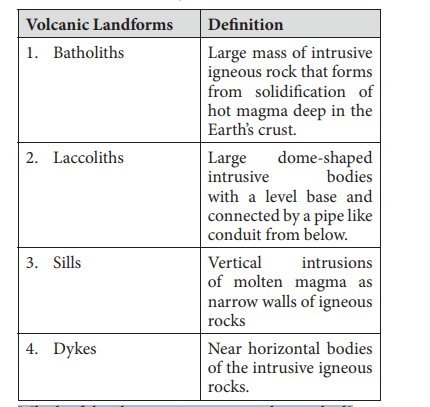
#11. Consider the following pairs:
Which of the above pairs are correctly matched?
Pair 1 is correctly matched. A batholith is a huge mass of igneous rocks usually granite, which after removal of the overlying rocks form a massive and restaurant upland region. Example – Wicklow mountains of Ireland
Pair 2 is correctly matched. Laccolith is an igneous mound with a dome shaped upper surface and a level base fed by a pipe-like conduit from below. Example – Henry Mountains in Utah, USA
Pair 3 and pair 4 are Incorrectly matched. Sills are near horizontal bodies of the intrusive igneous rocks along the bedding planes of sedimentary rocks. If a sill is very thin, it is called a SHEET. Example – Great Whin Sill of N.E. England.
Dykes are vertical intrusions of molten magma as narrow walls of igneous rocks. Example – Cleveland Dyke of Yorkshire England.
All the above are examples of intrusive volcanic landforms. Extrusive landforms include the various types ofvolcanoes that exist on the earth.
#12. Consider the following statements regarding Mid Oceanic Ridges:
1.These are the longest mountain chain on the surface of the earth.
2.These ridges are tectonic in origin.
3.The quake foci in these ridges usually have a shallow depth.
Which of the statements given above is/are correct?
Statement 1 is correct — Mid Oceanic Ridges forms an interconnected chain of mountain systems within the ocean. These are the longest mountain chain on the surface of the earth though submerged under the oceanic waters.
Statement 2 is correct — The rift system at the crest is the zone of intense volcanic activity. The mid-oceanic ridges were found to be most active in terms of volcanic eruptions. The dating of the rocks from the oceanic crust revealed the fact that they are much younger than the continental areas.
Statement 3 is correct – In general, the foci of the earthquake in the areas of mid-oceanic ridges are at shallow depths. While those along the Alpine-Himalayan belt as well as the rim of the Pacific, the earthquakes are deep-seated ones.
#13. In the context of earthquakes and volcanoes, the Ring of Fire is associated with which of the following tectonic plates?
1. Indo-Australian Plate
2. Nazca Plate
3. Philippine Plate
4. North American Plate
Select the correct answer using the code given below:
‘The Ring of Fire, also referred to as the Circum-Pacific Belt, is a path along the Pacific Ocean characterized by active volcanoes and frequent earthquakes. Its length is approximately 40,000 kilometers. It traces boundaries between several tectonic plates. This includes the Pacific, Juan de Fuca, Cocos, Indo-Australian, Nazca, North American, and Philippine Plates. Seventy-five percent of Earth’s volcanoes are located along the Ring of Fire. Ninety percent of Earth’s earthquakes occur along its path.
#14. With reference to earthquakes, which of the following statements is/are correct?
1.They are caused by the movements along the faults which are limited to the Earth’s crust only.
2. Intensity of an earthquake is the evaluation of severity of ground motion at a given location. 3. The line joining the places which experience similar seismic intensity is called Isoseismic line.
Select the correct answer using the code given below:
Statement I1 is incorrect: Earthquakes are generally considered to be a phenomenon which is limited only till the movement along faults at earth’s crust. But in some circumstances the focus of earthquake is as deep as 670 km. This occurs when oceanic crust slips under the continental crust at Wadati-Benioff Zone.
Statement 2 is correct: Intensity of an earthquake is the evaluation of severity of ground motion at a given location. It is measured by a Modified Mercali Scale. Whereas magnitude of an earthquake is related to the energy released at the hypocenter. It is measured in Richter scale.
Statement 3 is correct: Isoseismic line joins the areas which have similar seismic intensity. On the other hand, homoseismal line joins the places where earthquake is experienced at the same time.
#15. With respect to Acidic lava, which of the following statements is/are correct?
1. It is rich in silica and have high viscosity.
2. It is fast moving and so forms a gentle sloping flattened sheild.
3. Pyroclast is a feature of acidic lava volcanic eruption.
Select the correct answer using the code given below:
Statement 1 is correct: Acidic lavas are highly viscous with a high melting point. They are rich in silica, have a light color and low density.
Statement 2 is incorrect: Due to their high viscosity, acidic lavas are slow moving. As a result, the formed by them are steep-sided. It is basic volcanic eruption in which the lava is highly fluid and forms flattened shields or domes.
Statement 3 is correct: Another feature of acidic lavas is that they are explosive in nature. Highly viscous lava sometimes solidifies inside the vents and creates an obstruction to out pouring lava resulting in loud explosions, throwing out many volcanic bombs or pyroclasts. Spine or plug is another feature which is formed due to highly viscous lava.
#16. With reference to “Earthquake waves”, consider the following statements:
1.Primary waves vibrate parallel to the direction of propagation of the wave, while secondary waves vibrate perpendicular to the direction of propagation of the wave.
2. Primary waves travel only through solid materials while secondary waves travel through solid, liquid and gaseous materials.
Which of the statements given above is/are correct?
Statement 1 is correct. Primary waves also called P-waves vibrate parallel to the direction of propagation of the wave, while secondary waves vibrate perpendicular to the direction of propagation of the wave. Primary waves are the first to arrive at the surface. They are similar to sound waves.
Statement 2 is incorrect. Secondary waves also called S-waves travel only through solid materials while Primary waves travel through solid, liquid and gaseous materials.
#17. Which of the following causes may result in an earthquake?
1. Sliding of rocks along the fault line
2. Eruption of a volcano
3. Intense and unsustainable mining activity
4. Explosion of nuclear devices
Select the correct answer using the code given below:
Statement 1 is correct. Sliding of rocks along the fault line – The most common ones are the tectonic earthquakes. These are generated due to sliding of rocks along a fault plane.
Statement 2 is correct. Eruption of a volcano – A special class of tectonic earthquake is sometimes recognized as volcanic earthquake. However, these are confined to areas of active volcanoes.
Statement 3 is correct. Intense and unsustainable mining activity – In the areas of intense mining activity, sometimes the roofs of underground mines collapse causing minor tremors. These are called collapse earthquakes.
Statement 4 is correct. Explosion of nuclear devices – Ground shaking may also occur due to the explosion of chemical or nuclear devices. Such tremors are called explosion earthquakes.
#18. Which of the following are the effects of earthquake?
1. Differential ground movement
2. Landslides
3. Soil liquefaction
4. Avalanches
Select the correct answer using the code given below:
‘The effects of earthquake are as follow —
1. Differential ground movement – ‘The differential movement, also called as surface faulting, can be of the two sides of a fracture at the Earth’s surface. They are of three types – strike-slip, normal, and reverse (or thrust).
2. Landslides — Many times landslides take place in conjunction with earthquakes. The most abundant types of earthquakes induced landslides are rock falls and slides of rock fragments that form on steep slopes.
3. Soil liquefaction — In liquefaction, clay-free soil deposits, primarily sands and silts, temporarily lose strength and behave as viscous fluids rather than as solids. Liquefaction takes place when seismic shear waves pass through a saturated granular soil layer, distort its granular structure, and cause some of the void spaces to collapse.
4. Avalanches — Snow avalanches are moving sources of infrasonic and seismic energy. They can be triggered by many different mechanisms that include the shaking produced by earthquakes.
#19. Which of the following are extrusive volcanic structures?
1. Caldera
2. Batholith
3. Mid oceanic ridge
4. Crater
Select the correct answer using the code given below:
Statement 1 is correct. Caldera: In some volcanoes, the magma chamber below the surface may be emptied after volcanic eruptions. ‘The volcanic material above the chamber collapses into the empty magma chamber, and the collapsed surface appears like a large cauldron-like hollow (tub shaped) called the caldera. It is an extrusive volcanic structure.
Statement 2 is incorrect. Batholith is a large mass of intrusive igneous rock that forms from cooled magma deep in the Earth’s crust.
Statement 3 is correct. Mid oceanic ridge: Found along divergent plate boundaries where basaltic magma continuously oozes out. It is an extrusive volcanic structure.
Statement 4 is correct. Crater is an inverted cone-shaped vent through which the magma flows out. It is an extrusive volcanic structure.
#20. Why there are no volcanoes in the Himalayan region?
In case of formation of present-day South Asia, the collision involved two continental plates and not an oceanic plate. In such cases, due to folding and faulting, even those seismic activity is retained which leads to frequent earthquakes, but the zone of subduction is as deep as 50 to 70 kilometres. The magma from the asthenosphere cannot penetrate such a thick continental crust and hence it stays in the crust, as a result of which there are no volcanoes in India and the entire of South Asia.
#21. Consider the following statements regarding Volcano Explosivity Index:
1.The index measures how much volcanic material is ejected and how long the eruptions last.
2.The index is based on a logarithmic scale.
Which of the statements given above is/are correct?
Statement 1 is correct. “The Volcanic Explosivity Index (VEI) is a relative measure of the explosiveness of volcanic eruptions. Volcano event is measured through simple descriptive index called as volcano explosivity index. ‘This index measures volume of material ejected with height of an eruption column and duration of eruptions.
Statement 2 is correct. ‘Ihe scale is open-ended and logarithmic, or based on 10; therefore, an increase of “1” on the scale indicates an eruption 10 times more powerful than the number before it on the scale.
#22. Consider the following statements with reference to Geysers:
1.Geysers are fountains of hot water and superheated steam.
2.The water usually rises to surface without any explosion.
3. Geysers are well distributed across all continents of the earth.
Which of the statements given above is/are incorrect?
Statement 1 is correct. A geyser is a rare kind of hot spring that is under pressure and erupts, sending jets of water and steam into the air. Geysers are made from a tube-like hole in the Earth’s surface that runs deep into the crust. The tube is filled with water. Near the bottom of the tube is molten rock called magma, which heats the water in the tube. Water in the lower part of the tube, close to the magma, becomes superhot. Gradually, it begins to boil. Some of the water is forced upward. The boiling water begins to steam, or turn to gas. The steam jets toward the surface. Its powerful jet of steam ejects the column of water above it.
Statement 2 is incorrect: The jet of water is usually emitted with an explosion and is often triggered by gases seeping out of the heated rocks.
Statement 3 is incorrect: Almost all the world geysers are confined to 3 areas Iceland, Rotorua district of North Island of New Zealand and Yellow stone park of USA.
#23. Consider the following statements: 1.The Mercalli scale measures the observed effects of the earthquake and describes its intensity.
2.The Richter scale measures the seismic waves, or the energy released, causing the earthquake and describes the quake’s magnitude.
Which of the statements given above is/are correct?
Statement 1 is correct. Mercalli scale is a twelve-point scale for expressing the local intensity of an earthquake, ranging from I (virtually imperceptible) to XII (total destruction). The Mercalli scale bases its measurement on the observed effects of the earthquake and describes its intensity. It is a linear measurement.
Statement 2 is correct. The Richter scale measures the seismic waves, or the energy released, causing the earthquake and describes the quake’s magnitude. ‘The magnitude of an earthquake is determined from the logarithm of the amplitude of waves recorded by seismographs.
#24. With reference to volcanism, consider the following statements:
1. Mountain slopes and valleys near eruption sites are less fertile.
2. Often valuable minerals such as gold and uranium are found near regions having volcanic activity.
Which of the statements given above is/are correct?
Volcanism is the eruption of molten rock from inside the Earth to the surface. Volcanism occurs because of Earth’s internal heat, and is associated with tectonic processes and a part of the rock cycle.
Statement 1 is incorrect. Volcanic eruptions result in ash being dispersed over wide areas around the eruption site. And depending on the chemistry of the magma from which it erupted, this ash will be contain varying amounts of soil nutrients. In addition, eruptions release bits of rock such as potolivine, pyroxene, amphibole, and feldspar, which are in turn rich in iron, magnesium, and potassium. As a result, regions that have large deposits of volcanic soil (i.e. mountain slopes and valleys near eruption sites) are quite fertile.
Statement 2 is correct. In addition to fertile soil, volcanic action also leads to the formation of gems, precious stones and valuable minerals such as gold and uranium. These have a wide array of uses from making jewellery, electronics and weapon manufacture. Volcanism has also led to geothermal energy as an alternative source of energy which contributes a significant quota of electricity production in some countries like Iceland, Kenya, and the Philippines.
#25. In the context of various land movements, the term ‘Lahar’ refers to which of the following?
Option a is incorrect. Soil creep is the slow, downward progression of rock and soil down a low-grade slope. Solifluction is the gradual movement of wet soil or other material down a slope, especially where frozen subsoil acts as a barrier to the percolation of water.
Option b is incorrect. Ballistics refers to rocks or lava lumps ejected during major and minor volcanic eruptions. Ballistic projectiles are one potentially lethal and damaging hazard produced in volcanic eruptions. Ballistics are fragments of lava (bombs) or rock (blocks) ejected in explosive eruptions.
Option c is correct. Debris avalanches are the fast moving, gravity driven currents of partially or fully water land saturated volcanic debris. If the debris flow consists of a significant fraction of clay sized particles it is called a lahar or Mudflow. Lahars are extremely destructive. They can flow tens of metres of debris per second and have been known to be up to 140 metres (460 ft.) deep.
An avalanche is typically triggered when material on slope breaks loose from its surroundings. This materi then quickly collects and carries additional material do the slope. *lhere are various kinds of avalanches, includin rock avalanches (which consist of large segments o shattered rock), ice avalanches (which typically occur the vicinity of a glacier), and debris avalanches (whi contain a variety of unconsolidated materials, such loose stones and soil).
Option d is incorrect. Ground deformation is the melt water flood resulting from a volcanic eruption under a glacier. Ground deformation measurements provide an important indicator about what is happening beneath a volcano. As magma accumulates in an underground reservoir before an eruption, the ground surface typically swells.
#26. In the context of volcanic eruptions, which of the following statements is/are correct?
1. Shield Volcanoes are characterized by highly fluid basaltic lava belows.
2. Composite volcanoes are characterized by explosive eruptions.
Select the correct answer using the code given below:
A volcano is an opening in the earth’s crust through which gases, molten rocks materials (lava), ash, steam etc. are emitted outward in the course of an eruption.
Statement 1 is correct. In shield volcanoes, very high fluid basaltic lava flows. The lava spreads in a thin layer before cooling .These are the largest of all volcanoes of the world. A large, broad cone with sides sloping gently away from the centre are the features of these volcanoes. They become explosive if somehow water gets into the vent; otherwise, they are characterised by low-explosivity.
Statement 2 is correct. Composite volcanoes often result in explosive eruptions. Along with lava, large quantities of pyroclastic material and ashes find their way to the surface. “This material accumulates in the vicinity of the vent openings leading to formation of layers, and this makes the mounts appear as composite volcanoes. Andesitic lava along with pyroclastic material accumulates in the vicinity of the vent openings leading to the formation of layers, and this makes the mounts appear as a composite volcano or a stratovolcano (divided into layers).
#27. Consider the following statements:
1. Evidence of volcanism has been found in every terrestrial planet of our solar system.
2. Majority of volcanic activity on earth occurs along the mid-ocean ridges.
Which of the statements given above is/are correct?
Volcanism is the eruption of molten rock (magma) onto the surface of a planet.
Statement 1 is correct. Planetary scientists have found evidence of volcanism on every terrestrial planet and on many of the moons and even some asteroids. While the Moon and Mercury have relatively small volcanoes, those on Venus, Earth and Mars are large and numerous.
Statement 2 is correct. ‘The mid-ocean ridge is a continuous range of undersea volcanic mountains more than 70,000 km long that stretches through all the ocean basins. It includes a collection of volcanic ridges, rifts, fault zones, and other geologic features.
It is formed and evolved as a result of spreading in Earth’s lithosphere at the divergent plate boundaries. The vast majority of volcanic activity on the planet occurs along the mid-ocean ridge, and it is the place where the crust of the Earth is born.
#28. Which of the following places fall within the Pacific Ring of Fire?
1. Indonesia
2. Mount Fuji
3. Papua New Guinea
4. Bolivia
Select the correct answer using the codes given below
Ring of Fire is a long horseshoe-shaped seismically active belt of earthquake epicentres, volcanoes, and tectonic plate boundaries that fringes the Pacific basin.
Seventy-five percent of Earth’s volcanoes are located along the Ring of Fire. Ninety percent of Earth’s earthquakes occur along its path, including the planet’s most violent and dramatic seismic events. The abundance of volcanoes and earthquakes along the Ring of Fire is caused by the amount of movement of tectonic plates in the area.
Statements 1, 3 and 4 are correct. Bolivia, Chile, Ecuador, Peru, Costa Rica, Guatemala, Mexico, United States, Canada, Russia, Japan, Philippines, Australia, Papua New Guinea, Indonesia, New Zealand, and Antarctica are some of the important places located in the ring of the fire.
Statement 2 is correct. Mount Fuji, Japan’s tallest and most famous mountain is an active volcano in the Ring of Fire. Mount Fuji sits at a “triple junction”, where three tectonic plates (the Amur Plate, Okhotsk Plate, and Philippine Plate) interact.
#29. Which of the following are among the characteristics of ‘acidic’ lava?
1. Low melting point
2. High in silicates
3. Covers longer distances
4. Explosive eruptions
Select the correct answer using the code given below.
Volcanoes are openings, or vents where lava, tephra (small rocks), and steam erupt on to the Earth’s surface.
Acidic magmas have high melting points, high viscosity (stickiness), high in silicates, high gas pressure, but low gas solubility at low containing pressure.
Therefore, acidic volcanism is characterized by explosive eruptions in which large amounts of pyroclastic material are generated.
It creates a steep sided dome. Acidic lava flows are usually associated with Composite volcanoes.
Acidic lava is highly viscous and flows only for a short distance.
Basic lava has low viscosity so, it can flow very easily over long distances.


