
Results
#1. Which one of the following options is incorrect with reference to the Kuka Movement?
Option b is incorrect. The Kuka Movement was founded
in 1840 by Bhagat Jawahar
Mal (also called Sian Saheb) in western Punjab. A major
leader of the movement after him was Baba Ram Singh.
He founded the Namdhari Sikh sect.
#2. In the context of history of labour movements during Indian freedom struggle, which one of the following statements is incorrect?
Option d is incorrect. The Indian National Congress
was sympathetic to labours’ cause. The Gaya session
of the Congress (1922) welcomed the formation of the
AITUC and a committee was formed to assist it. C.R.
Das advocated that the Congress should take up the
workers’ and peasants’ cause and incorporate them in the
struggle for swaraj or else they would get isolated from
the movement.
During the 1937 elections, the AITUC had supported the
Congress candidates.
#3. With reference to the Revolt of the Jungle Mahal, consider the following statements:
1. Economic distress and increased land revenue demands were the reasons for the revolt.
2. The Revolt took place in Midnapore and Bankura districts of Bengal.
3. Chakra Bisoi was the main leader of this revolt. Which of the statements given above is/are correct?
Statements 1 and 2 are correct. Famine, enhanced land revenue demands and economic distress goaded the Chuar aboriginal tribesmen of the Jungle Mahal of
Midnapore district and also of the Bankura district (in
Bengal) to revolt. The Revolt of the Jungle Mahal is also
known as the Chuar uprising (1771-1798).
Statement 3 is incorrect. Most leaders were zamindars.
The most signi cant uprising was under Durjan (or
Durjol) Singh in 1798. Other leaders of the Chuars were
Jagannath Singh, Madhab Singh, Raja Mohan Singh,
Shyam Ganjan, Subla Singh and Lachman Singh of Dulma.
Chakra Bisoi was the leader of the Khond Uprisings
(1837-1856).
#4. With reference to the Ramosi Risings, consider the following statements:
1. The revolt was directed against the policy of annexation followed by the British.
2. An important leader of Ramosi rising was Chittur Singh.
Which of the statements given above is/are correct?
Statement 1 is correct. The Ramosis had not reconciled
to British rule and the British pattern of administration.
ey resented the policy of annexation. After the
annexation of the Maratha territories by the British,
the Ramosis, who had been employed by the Maratha
administration, lost their means of livelihood.
Statement 2 is correct. The Ramosi tribesmen rose under
Chittur Singh in 1822. ey again rose under Umaji Naik
of Poona and his supporter Bapu Trimbakji Sawant in
1825-26. THe disturbance occurred again in 1839 over
deposition and banishment of Raja Pratap Singh of Satara.
#5. is tribal movement was launched by the inhabitants of Chhotanagpur. ese tribesmen resented the large-scale transfers of their land to outsiders. ey also opposed the British judicial and revenue policies, which badly a ected their traditional social conditions. Buddho Bhagat was an important leader of this tribal movement.
Which of the following tribal movements is described above?
The Kols, along with other tribes, are inhabitants of
Chhotanagpur. is covered Ranchi, Singhbhum,
Hazaribagh, Palamau and the western parts of Manbhum.
The trouble in 1831 started with large-scale transfers of
land from Kol headmen to outsiders like Hindu, Sikh and Muslim farmers and money-lenders who were oppressive
and demanded heavy taxes. Besides, the British judicial
and revenue policies badly affected the traditional social
conditions of the Kols.
The Kols resented this and in 1831, under the leadership
of Buddho Bhagat, the Kol rebels killed or burnt about
a thousand outsiders. Only after large-scale military
operations could order be restored.
#6. In the context of modern Indian history, consider the following statements:
1. The Tribal movements in Northeast were launched mainly against the setting up of forest reserves.
2. Kukis’ Revolt took place in Mizoram against a hike in house tax rates.
3. Khasi Uprising was launched against the occupation of tribal region by outsiders.
Which of the statements given above is/are correct?
Statement 1 is incorrect. The movements of the tribes of the north-eastern frontier were not forest-based or
agrarian revolts as these tribals were generally in control
of land and forest area. ( The mainland tribals protested
against setting up of reserved forests and restricting
timber use and grazing).
Statement 2 is incorrect. Kukis’ Revolt (1917-19) took
place in Manipur against British policies of recruiting
labour during the first World War.
Statement 3 is correct. Khasi Uprising (1830s) was
launched against the occupation of the hilly region
between Garo and Jaintia Hills. The region was occupied
by the East India Company as it wanted to build a road
linking the Brahmaputra Valley with Sylhet. For this, a
large number of outsiders including Englishmen, Bengalis
and the labourers from the plains were brought to these
regions. The Khasis, Garos, Khamptis and the Singphos
organised themselves under Tirath Singh to drive away
the strangers.
#7. Arrange the following incidents in chronological order:
1. British Government passes Limitation Law
2. Santhal Rebellion
3. Report by Deccan Riots Commission
4. First revenue settlement is Deccan
Select the correct answer using the code given below:
1. The first revenue settlement system in Bombay,
Deccan was made in the 1820s. It was known as
‘Ryotwari settlement, where the revenue was directly
settled with the ‘ryots’ (peasants).
2. In 1832, a large area of land was demarcated as
Damin-i-Koh, on the slopes of Rajmahal hills and
was given to the Santhals. But with time they found
that their land was slipping away from their hands
as state was levying heavy taxes and moneylenders
were charging high rates of interest on them. Hence,
Santhal Rebellion happened in 1855-56.
3. British Government passed the Limitation Law in 1859, to control the debts mounting on ryots in
Deccan.
4. Deccan Riot Commission was assigned to make a
report on the revolt by ryots in Deccan. The report
was presented in British Parliament in 1878.
#8. In the context of the impact colonial rule on tribals, consider the following statements:
1.The tribal chiefs were allowed to keep their administrative powers but lost the right to their lands.
2. The British effort to settle Jhum cultivators was highly successful.
3. The British extended control over all forests and declared such forests as state property.
Which of the statements given above is/are incorrect?
Under British rule, the functions and powers of the tribal
chiefs changed considerably.
Statement 1 is incorrect. Under British rule, the functions
and powers of the tribal chiefs changed considerably. They
were allowed to keep their land titles over a cluster of villages and rent out lands, but they lost much of their
administrative power and were forced to follow laws
made by British officials in India. They also had to pay
tribute to the British and discipline the tribal groups on
behalf of the British. They lost the authority they had earlier enjoyed amongst their people.
The British were uncomfortable with groups who moved
about and did not have a xed home. They wanted tribal
groups to settle down and become peasant cultivators as
settled peasants were easier to control and administer.
Statement 2 is incorrect. The British effort to settle
jhum cultivators was not very successful. Settled plough
cultivation is not easy in areas where water is scarce, and the soil is dry. In fact, jhum cultivators who took to plough cultivation often suffered, since their elds did not
produce good yields. So, the jhum cultivators in north-east India insisted on continuing with their traditional
practice. Facing widespread protests, the British had
to ultimately allow them the right to carry on shifting
cultivation in some parts of the forest.
Statement 3 is correct. The life of tribal groups, as you
have seen, was directly connected to the forest. So, changes
in forest laws had a considerable effect on tribal lives. The
British extended their control over all forests and declared
that forests were state property. Some forests were
classified as Reserved Forests for they produced timber
which the British wanted. In these forests people were not allowed to move freely, practise jhum cultivation, collect
fruits, or hunt animals.
#9. With reference to the ‘Khurda Uprising’, consider the following statements:
1. A new currency ‘sicca’ was introduced in the region and the revenue had to be paid in this new currency.
2. Salt monopoly was introduced by the British which deprived the traditional salt makers of Odisha their right to make salt.
3.The Zamindars, Ryots and the Paiks joined the uprising under the leadership of Buxi Jagabandhu.
Which of the statements given above is/are correct?
Statement 1 and 2 are correct. Over the years, what had
added to these grievances were (a) the introduction
of sicca rupee (silver currency) in the region, (b) the
insistence on payment of revenue in the new currency,
(c) an unprecedented rise in the prices of food-stuff and salt, which had become far-fetched following
the introduction of salt monopoly because of which
the traditional salt makers of Odisha were deprived
of making salt, and (d) the auction of local estates in
Calcutta, which brought in absentee landlords from
Bengal to Odisha. Besides, the insensitive and corrupt
police system also made the situation worse for the armed
uprising to take a sinister shape.
Statement 3 is correct. The exploitative policies of
Britishers led to an uprising in the region. The Paiks
attacked the police station and other government
establishments. The zamindars and ryots alike joined
the Paiks with enthusiasm. The hereditary Military
Commander of the deposed king, Jagabandhu Bidyadhar
Mahapatra Bhramarabar Rai or Buxi Jagabandhu as he was
popularly known, was one among the dispossessed landholders. The Zamindars, Ryots and the Paiks joined the
uprising under the leadership of Buxi Jagabandhu.
#10. Which of the following methods were used by the peasants during the Pabna revolt of 1870s?
1. Organisation of rent strikes.
2. Formation of agrarian league.
3. Use of large-scale violence to assert their rights.
4. Challenging zamindars in the courts.
Select the correct answer using the code given below:
During the 1870s and 1880s, large parts of Eastern Bengal
witnessed agrarian unrest caused by oppressive practices
of the zamindars. The zamindars resorted to enhanced
rents beyond legal limits and prevented the tenants from
acquiring occupancy rights. They resorted to forcible
evictions, seizure of cattle and crops and prolonged, costly
litigation in courts where the poor peasant found himself
at a disadvantage.
e peasants of Yusufshahi Pargana in Patna district
formed an agrarian league or combination to resist the
demands of the zamindars. Following methods were used
by the peasants during the Pabna revolt of 1870s:
1. Formation of pabna agrarian league. Statement 2 is
correct.
2. Organisation of a rent strike — the ryots refused to
pay the enhanced rents. Statement 1 is correct.
3. Main form of struggle was that of legal resistance and
there was very little violence. Statement 3 is incorrect.
4. Ryots challenged zamindars in the courts to decrease
the enhanced rents. Statement 4 is correct.
5. Funds were raised by ryots to ght the court cases.
#11. Which of the following statements is incorrect about the Indigo Revolt of 1859/60?
Statement a is correct. Leadership for the movement was
provided by the more well-off ryots and in some cases by petty zamindars, moneylenders and ex-employees of
the planters.
Statement b is correct. Indigo plantations had functioned on a system of dadan, advance given by planters to
peasants to buy and sow seeds on their lands, a constant
source of friction.
Statement c is incorrect. A major reason for the success
of the Indigo Revolt was the tremendous cooperation,
organization and discipline of the ryots. Another was the
complete unity among Hindu and Muslim peasants.
Statement d is correct. The Government appointed an
indigo commission to inquire into the problem of
indigo cultivation. Based on its recommendations, the
Government issued a noti cation in November 1860 that
the ryots could not be compelled to grow indigo and that it
would ensure that all disputes were settled by legal means.
But, the planters were already closing down factories and
indigo cultivation was virtually wiped out from Bengal by
the end of 1860.
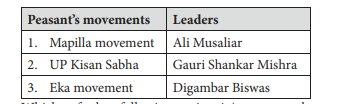
#12. Consider the following pairs of Peasants movements and their associated leaders:
Which of the following pairs is/are correctly matched?
Pair 1 is correctly matched. Malabar (Mappila), 1921,
movement was raised against the oppression of the
landlords, lack of security of tenure, high rent etc. Ali
Musaliar a local priest leader played an important role in
this movement.
Pair 2 is correctly matched. e U.P. Kisan Sabha was set
up in February 1918 through the efforts of Gauri Shankar
Misra and lndra Narain Dwivedi, and with the support of
Madan Mohan Malaviya.
Pair 3 is incorrectly matched. In Bengal, 1859-1860, the
European indigo planters exploited the local peasants by
forcing them to grow indigo on their lands. e planters
forced the peasants to enter into fraudulent contracts.
Digambar Biswas and Bishnu Biswas of Nadia district
played key roles in this revolt.
Eka movement was organized in 1921 on the issues like
high rents, oppression by thikadars who were in charge of
revenue collection and the practice of share-rents. Madari
Pasi was the leader of the movement.
#13. Consider the following statements regarding the Peasants movements of 20th century:
1. These movements were limited in objectives and had no impact on national freedom struggle.
2. Theses movements eroded the power of landed class.
3. These movements were influenced by the Great depression in Industrialized countries.
Which of the statements given above is/are correct?
Statement 1 is incorrect. Peasant’s movements of 19th
century were aimed to solve the particular grievances of
peasants and had limited objectives, but the 20th century movements were deeply influenced and had marked
effects on national freedom struggle.
Statement 2 is correct. Peasant’s movements eroded the power of landed class and thus adding to the
transformation of agrarian structure.
Statement 3 is correct. During the 1930s, the peasant
awakening was influenced by the Great Depression in
the industrialized countries and the Civil Disobedience
Movement which took the form of no-rent, no-revenue
movement in many areas.
#14. He is called the father of trade union movement in India. He edited the first labour weekly ‘Deenbandhu’. His struggle resulted in the constitution of the Factory Labour Commission, of which he was made a member. The work of this Commission led to the enactment of the Factory Act of 1891.
Identify the personality from the above paragraph:
Narayan Meghaji Lokhande can be called the father of the trade union movement in India. He edited the
rst labour weekly Deenbandhu ( e friend of the oppressed) from 1880 to the end of his life in 1897. He founded the rst trade union in India – The Bombay Mill Hands Association (BMHA) – in 1884 and was its president. When the government of India appointed the
factory commission in 1890, Lokhande was appointed an associate member of the commission for the Bombay
presidency.
#15. With reference to the Trade Union Act of 1926, consider the following statements:
1. It recognised trade unions as legal associations.
2. It laid down conditions for registration and regulation of trade union activities.
3. It secured immunity, both civil and criminal, for trade unions from prosecution for legitimate activities.
Which of the statements given above is/are correct?
Statement 1 is correct. The Trade Union Act of 1926 recognised trade unions as legal associations.
Statement 2 is correct. It laid down conditions for registration and regulation of trade union activities in
British India.
Statement 3 is correct. The Act secured immunity, both
civil and criminal, for trade unions from prosecution for
legitimate activities, but put some restrictions on their
political activities.
#16. With reference to the working-class movements in India, consider the following statements:
1. The Moderates did not support the Factory Acts of 1881 and 1891.
2. The Congress supported the formation of the All-India Trade Union Congress.
3. Dadabhai Naoroji started a newspaper ‘Bharat Shramjeevi’ for voicing the demands of the working class.
Which of the statements given above is/are correct?
Statement 1 is correct. The early nationalists, especially
the Moderates, believed that labour legislations would
affect the competitive edge enjoyed by the Indian-owned
industries, so they did not support the Factory Acts of
1881 and 1891.
Statement 2 is correct. The All-India Trade Union Congress was founded on October 31, 1920. The Indian
National Congress president for the year, Lala Lajpat Rai, was elected as the first president of AITUC and
Dewan Chaman Lal as the rst general secretary. The
prominent Congress and swarajist leader C.R. Das presided over the third and the fourth sessions of the
AITUC.
The Gaya session of the Congress (1922) welcomed the
formation of the AITUC and a committee was formed to assist it.
Statement 3 is incorrect. Sasipada Banerjea (and not
Dadabhai Naoroji) started a workingmen’s club and
newspaper Bharat Shramjeevi for voicing the demands
of the working class.
#17. Which of the following statements regarding the tribal and peasants’ movements of 19th century colonial India is/ are correct?
1. Both the movements received active support from intelligentsia.
2. Tribal uprisings directly challenged the British authority while the peasant’s movement did not.
Select the correct option using the code given below:
Statement 1 is incorrect: The peasant movements
received active support from intelligentsia. ExampleIn Indigo Revolt the intelligentsia of Bengal organized a
powerful campaign in support of the rebellious peasantry,
similarly in deccan riots intelligentsia of Bombay
presidency played an important role. But the tribals did
not receive such support from the intelligentsia.
Statement 2 is correct: The tribal uprisings had directly
challenged the colonial political power. They aimed to
overthrow the oppressive dikus and established their rule
instead. As they directly challenged the British power they
were brutally crushed.
The peasant movements at no stage did threaten British
supremacy or even undermine it. As the Britishers
were not being directly challenged, they were willing to
compromise and mitigate the harshness of the agrarian
system though within the broad limits of the colonial
economic and political structure.
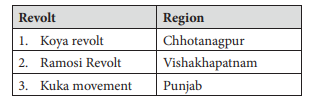
#18. Consider the following pairs of revolts with the associated areas.
Which of the pairs given above is/are correctly matched?
Pair 1 is incorrectly matched. Koya Revolt – eastern
Godavari District (Modern Andhra Pradesh). Khondas
sara chiefs joined Koyas of eastern Godavari district and
revolted against the oppression of Police, money lenders,
new regulations and denial of customary rights over forest
areas.
Pair 2 is incorrectly matched. Ramosi revoltMaharashtra(poona). First Ramosi revolt took place in
1822 under the leadership of Chittu Singh against the new
pattern of British administration. The second phase of
revolt took place between 1825-26 and 1829. They revolted as they lost their means of livelihood due to the annexation of Maratha territories by British.
Pair 3 is correctly matched. Kuka movement- Western
Punjab. is movement was founded in 1840 by Bhagat
Jawahar Mal. is movement converted from religious puri cation campaign to a political campaign when British took Punjab.
#19. Consider the following statements regarding the aftermath of Santhal Uprising:
1. The traditional Manjhi system again became operational in the region.
2. Santhal Pargana Tenancy Act 1876 was passed which forbade the transfer of Adivasi land to non-Adivasis.
Which of the statements given above is/are correct?
Statement 1 is correct. After the Santhal rebellion of 1855,
the Santhals were given land and persuaded to settle in the foothills of Rajmahal. The traditional Manjhi system was
again became operational in the region.
Statement 2 is correct. The movement for self-rule
and Santhal independence, led to the formation of
the Santhal Parganas and the passing of the Santhal
Pargana Tenancy Act, 1876. is forbade the transfer of
Adivasi land to non-Adivasis.
#20. Which of the following statements is/are correct regarding Narkelberia Uprisings?
1. It was mainly against the imposition of beard-tax on the Faraizis.
2. It revolted against the suppression of human sacri ce by the British.
3. It later merged into the Wahabi movement.
Select the correct answer using the code given below:
Statement 1 is correct. It was mainly against the Hindu
landlords who imposed a beard-tax on the Faraizis. It
was led by Mir Nithar Ali (Titu Mir) in 1831 who inspired
the Muslim tenants in West Bengal.
Statement 2 is incorrect. Tribals revolted against the
suppression of human sacrifice in Kondh uprisings not
in Narkelbeeria uprisings.
Statement 3 is correct. is uprising continued and later merged into Wahabi movement.
#21. With reference to Poligar’s revolt, which of the following statements is/are correct?
1. Poligars revolted as they were deprived of their right to collect the Kaval fees.
2. Poligars were the local rulers.
3. Lord Cornawallis commenced military operations against the rebel chiefs.
Select the correct answer using the code given below:
Statement 1 is correct. The poligars of North Arcot rose in rebellion when they were deprived of their right
to collect Kawal fees (Kaval or watch was an ancient
institution of Tamil Nadu. It was a hereditary village
police office with speci ed rights and responsibilities).
Statement 2 is correct. Poligars were the local rulers at
the base of 3-tiered administrative system created by
Vijayanagar emperor Sri Krishnadeva Raya. They have
standing army, palaces, collect local taxes, maintained law
and order, dispensed justice etc.
Statement 3 is incorrect. Lord Wellesley was the Governor
General from the period 1798- to 1805. He commenced
military operations against the rebel chiefs.
#22. With regard to the Tebhaga peasant movement, 1946, which of the following statements is/are correct?
1. It was launched in protest of the Floud commission report which had recommended 50% share of the produce to the landlord.
2. The Jotedars extracted nazranas and salamis from the tenant cultivators.
3. The exploitative system of sharecropping was encouraged by the absentee landlords.
Select the correct answer using the code given below:
Statement 1 is incorrect. The recommendations of
the Bengal Land Revenue Commission also known as
Floud Commission aligned with the demand of the
sharecroppers’ of tebhaga i.e. two thirds’ share to the
share-croppers instead of the one-half share. Thus, the
sharecroppers were encouraged by the Floud Commission
report.
Statement 2 is correct. The Jotedars extracted nazranas
and salamis from the tenant cultivators in return for
extension of share cropping agreements.
Statement 3 is correct. The share cropping system was also practiced by the absentee landlords who were working as white collared employees in the cities.
#23. Which of the following was/were the reasons for the tribal revolts in the mainland India?
1. Settled agriculture by East India Company
2. Decline in shifting cultivation
3. Setting up of reserved forests
Select the correct answer using the code given below:
Option 1 is correct. The land settlements of the British
affected the joint ownership tradition among the tribals
and disrupted their social fabric. As agriculture was
extended in a settled form by the Company government,
the tribals lost their land, and there was an influx of nontribals to these areas.
Option 2 is correct. Shifting cultivation in forests was
curbed and this added to the tribals’ problems. Exploitation
by the police, traders and money-lenders (most of them
‘outsiders’) aggravated the tribals’ sufferings.
Option 3 is correct. The government further extended
its control over the forest areas by setting up reserved forests and restricting timber use and grazing. is was
the result of the increasing demand from the Company for
timber— for shipping and the railways.
#24. With reference to the spread of Marxist and Socialist ideas, consider the following statements:
1. Workers and Peasants Party (WPP) was organized as a left -wing subgroup in Indian National Congress (INC) .
2. The Communist Party of India was formed in Tashkent.
3. Kanpur Communist Conference formalized the foundation of Communist Party of India.
Which of the statements given above is/are correct?
Statement 1 is correct: The Workers and Peasants Party
(WPP) was organized as a left -wing subgroup under the
Indian National Congress in 1925–1929. The prominent
leadership of WPP was S.A. Dange, Muzzafar Ahmed,
P.C.Joshi and Sohan Singh Josh.
Statement 2 is correct: The Communist Party of India was formed in 1920 by M.N. Roy along with Abani
Mukherji in Tashkent, now the capital of Uzbekistan.
Statement 3 is correct: The Kanpur communist
conference held from December 26 to 28, 1925, was the
rst meeting of the communist groups. The conference
formalized the foundation of CPI.
#25. Consider the following statements, with reference to All India Kisan Sabha:
1. N.G. Ranga was the first general secretary of the organization.
2. It strongly influenced the Congress’ election manifesto of 1937.
Which of the statements given above is/are correct?
Statement 1 is correct. The All-India Kisan Sabha
(AIKS) was founded in Lucknow in April 1936 with Swami Sahjanand Saraswati as the president and N.G.
Ranga as the general secretary. A kisan manifesto was
also issued and a periodical under Indulal Yagnik was
started by the Sabha.
Statement 2 is correct. The Congress’ manifesto for
agriculture policies, for the 1937 provincial elections, was strongly influenced by the AIKS agenda. Congress and AIKS also held their sessions together in 1936 at Faizpur. It was Congress’ first session in a village.
#26. Consider the following statements regarding the Trade Union Act, 1926:
1. It dealt with the registration and regulation of trade unions.
2. It recognised trade unions as legal associations.
3. It removed all the restrictions on political activities of trade unions.
Which of the statements given above is/are correct?
The Trade Union Act, 1926:
dealt with the registration of trade unions, their rights and
their responsibilities
recognized trade unions as legal associations.
laid down conditions for registration and regulation of
trade union activities.
secured immunity, both civil and criminal, for trade
unions from prosecution for legitimate activities, but put some restrictions on their political activities.
was applicable not only to the union of workers but also
to the association of employers and extends to whole of
India.
#27. Which of the following is/ are correct with respect to the Trade Disputes Act, 1929?
1. It provides a system for settling industrial disputes.
2. It provided right to strike to the Trade unions.
3. Strikes in public utility services without notice were made illegal.
Select the correct answer using the codes given below.
Statement 1 is correct: TDA, 1929 made compulsory the
appointment of Courts of Inquiry and Consultation
Boards for settling industrial disputes.
Statement 2 is incorrect: It forbade trade union
activity of coercive or purely political nature and even
sympathetic strikes.
Statement 3 is correct: It made illegal the strikes in
public utility services like posts, railways, water and
electricity, unless each individual worker planning to
go on strike gave an advance notice of one month to the
administration.
#28. With reference to Trade Union Act of 1926, consider the following:
1. Trade unions were made immune from prosecution for legitimate activities.
2. It forbade sympathetic strikes which were political in nature.
Which of the statements given above is/are correct?
Statement 1 is correct. The Trade Union Act of 1926 secured immunity for trade unions from prosecution
for legitimate activities. is included for both civil and criminal cases. But there were still some restrictions on
political activities.
Statement 2 is incorrect. The Act did not forbid sympathetic strikes which are political in nature. The
trade union activities of coercive and purely political nature including even sympathetic strikes were forbade
by the Trade Disputes Act of 1929.
#29. With reference to the Public Safety Bill introduced in 1928, which of the following statements is incorrect?
Option a is correct. The Public Safety Bill, 1928 empowered the government to deport undesirable and
subversive foreigners.
Option b is correct. The main objective of the bill was
to contain the spread of socialist and communist ideas.
Option c is incorrect. The Swarajists vocally rejected Public Safety bill and made a case against it.
Option d is correct. One of the important achievements of the Swarajists was the defeat of the Public Safety Bill in the assembly.
#30. This tribal movement was led by the hill tribes of the Western Ghats, who resented the British policy of annexation. They had lost their means of livelihood after the annexation of the Maratha territories by the British. This resulted in their revolt against British under Chittur Singh. The British followed a pacifist policy towards them and even recruited some of them into the hill police.
Which of the following tribal movements is described above?
Option b is correct. The Ramosi risings was led by the
hill tribes of the Western Ghats, who had not reconciled
to British rule and the British pattern of administration.
They resented the policy of annexation. After the annexation of the Maratha territories by the British, the
Ramosis lost their means of livelihood. ey rose under
Chittur Singh in 1822 and plundered the country around
Satara. The disturbance occurred again in 1839 and in
1840-41 also. Generally, the British followed a pacifist
policy towards the Ramosis, and even recruited some of
them into the hill police.
#31. Consider the following statements with respect to Rampa rebellion:
1. Andhra Pradesh was the main centre of the revolt.
2. One of the reasons for the rebellion was the commercial exploitation of forests.
3. The leadership was provided by the muttadars or estate holders.
Which of the statements given above is/are correct?
Statement 1 is correct. The Rampa rebellion led by the hill tribesmen in coastal Andhra revolted in March 1879
against the depredations of the Government-supported
mansabdar and the new restrictive forest regulations. The
rebellion was mainly centred in the Gudem and Rampa hill tracts of Andhra Pradesh.
Statement 2 is correct. The rebellion was against the
commercial use of forests, prohibition of shifting cultivation (podu) , restrictions on the use of forest resources, a new tax on toddy and confiscation of
properties by the outsiders.
Statement 3 is correct. The leadership was provided by
the muttadars or estate holders, who found their power
curbed and rights denied by the intrusion of the new
outside control.
#32. Which of the following statements regarding the Sanyasi Revolt is correct?
Statement a is incorrect: Equal participation of Hindus
and Muslims characterised the uprisings, sometimes
referred to as the Fakir Rebellion.
Statement b is incorrect: The Revolt lasted between 1763-
1800, spanning the tenures of many governors of Bengal.
It was at its peak during Warren Hastings tenure.
Statement c is incorrect: Debi Chaudhurani’s
participation recognises the women’s role in early
resistances against the British. Therefore, though very
limited, there was female participation in this revolt.
Statement d is correct: Anandamath, a semi-historical
novel by Bankim Chandra Chattopadhyay, is based on the
Sanyasi Revolt.
#33. With reference to All India Kisan Sabha (AIKS), consider the following statements:
1. AIKS influenced the position of nationalist movement on abolition of landlordism.
2. AIKS was split on communist and noncommunist lines during the second World War.
3. The Congress manifesto for 1937 provincial elections was influenced by the AIKS agenda.
Which of the statements given above is/are correct?
Statement 1 is correct. The nationalist movement
maintained an ambivalent position vis-à-vis the
landlords. In 1945 the All-India Kisan Sabha demanded the abolition of landlordism with compensation. About this time the Congress also favoured abolition “with compensation” in its Election Manifesto of 1946. us,
the nationalist position on the issue of abolition of
landlordism was influenced by Kisan Sabhas in general
and AIKS in particular.
Statement 2 is correct. Because of a pro-War line adopted
by the communists, the AIKS was split on communist
and non-communist lines during the second World
War. Many veteran leaders like Sahjanand, Indulal Yagnik
and N.G Ranga left the sabha because of it.
Statement 3 is correct. The Congress manifesto
(especially the agrarian policy) for the 1937 provincial
elections was strongly influenced by the AIKS agenda.
#34. With reference to Indian National Trade Union Congress (INTUC), which of the statements given below is/are correct?
1. It was established in 1947 in cooperation with the Indian National Congress.
2. It was influenced by the communist ideas.
3. Vallabhbhai Patel was the president of the inaugural conference in 1947.
Select the correct answer using the code given below:
Statement 1 is correct. Indian National Trade Union Congress (INTUC) was established in 1947 in
cooperation with the Indian National Congress, which
wanted an organization more aligned to its ideology.
Statement 2 is incorrect. INTUC was anti-communistic
in nature. It was influenced by Congress’ ideology of
socialism and non-violence.
Statement 3 is correct. Vallabhbhai Patel was the president of the first conference of INTUC in 1947.
Many Congress leaders like Jawaharlal Nehru, J.B.
Kriplani, Aruna Asaf Ali attended the first conference.
#35. In the context of Mappila Revolt during 1920’s, which of the following statements is/are correct?
1. The revolt took place because of the religious interferences in the region by the British.
2. Mahatma Gandhi addressed Mappila meetings to support the agitators.
Select the correct answer using the code given below:
Statement 1 is incorrect. The main cause of the revolt
was oppression by the landlords. ere were also other
grievances like lack of security of tenure, high rents, renewal fees and other oppressive exactions.
Statement 2 is correct. The revolt was supported by
the local Congress organization. Soon the Mappila
movement merged with the Khilafat agitation. Many
leaders like Mahatma Gandhi, Shaukat Ali and Maulana
Azad addressed Mappila meetings.
#36. Which of the following statements is/are correct regarding Paika Rebellion?
1. There was no other violent uprising in the region after the suppression of the rebellion.
2. It succeeded in getting large reductions in assessments.
Select the correct answer using the code given below:
Statement 1 is incorrect. The Paika Rebellion was an
armed rebellion against the British East India Company’s
rule in 1817. The Paikas rose in rebellion under their
leader Bakshi Jagabandhu. After the Paika revolt, Odisha
continued her freedom struggle by Tapanga in 1827 and the Banapur Rebellion of 1835.
Statement 2 is correct. The Paik Rebellion succeeded
in getting large remissions of arrears, reductions in
assessments, suspension of the sale of the estates of
defaulters at discretion, a new settlement on xed tenures and other adjuncts of a liberal governance.
#37. With reference to the Peasant movements in India, consider the following statements:
1. Hindoo Patriot editor Harish Chandra Mukherji wrote about the plight of the indigo planters.
2. Deccan Agriculturists Relief Act 1879 extended to the districts of Poona, Satara, Solapur and Ahmednagar.
Which of the statements given above is/are correct?
Statement 1 is correct: A signi cant feature of the
Indigo Revolt was the role of the intelligentsia of Bengal
which organized a powerful campaign in support of the
rebellious peasantry. Outstanding in this respect was
the role of Harish Chandra Mukherji, editor of the
Hindoo Patriot. He published regular reports from his
correspondents in the rural areas on planter’s oppression,
official’s partnership, and peasant resistance.
Statement 2 is correct: As a conciliatory measure, the Deccan Agriculturists Relief Act was passed in 1879
extending to the districts of Poona, Satara, Solapur and
Ahmednagar.
#38. What was/were the impact/impacts of American Civil War on the Peasants (ryots) in India?
1. Crash in the cotton prices after the end of the American Civil War.
2. Reduction of land revenue by 50% all over India.
Which of the statements given above is/are correct?
Statement 1 is correct. USA was the largest supplier
of cotton to Britain. Once the civil war broke out, the
demand for cotton from India became high and this led
to a surge in cotton cultivation in India. However, once
the war in America ended, cotton demand sank and
this affected the farmers adversely. Due to slump in
demand, the prices of Cotton crashed.
Statement 2 is incorrect. The British India Government’s
decided to raise the land revenue by 50% in 1867, which
worsened the conditions of the farmers and this angered
farmers.
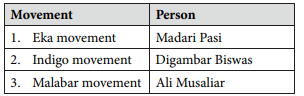
#39. In the context of peasant movements during freedom struggle, consider the following pairs:
Which of the pairs given above is/are correctly matched?
Pair 1 is correctly matched – Eka movement was
organized in 1921 on the issues like high rents, oppression
by thikadars who were in charge of revenue collection and
the practice of share-rents. Madari Pasi was the leader of
the movement.
Pair 2 is correctly matched – In Bengal, 1859-1860, the
European indigo planters exploited the local peasants by
forcing them to grow indigo on their lands. The planters
forced the peasants to enter into fraudulent contracts.
Digambar Biswas and Bishnu Biswas of Nadia district
played key roles in this revolt.
Pair 3 is correctly matched – Malabar (Mappila) , 1921,
movement was raised against the oppression of the landlords, lack of security of tenure, high rent etc. Ali
Musaliar a local priest leader played an important role in
this movement.
#40. Consider the following statements
1. Chuar Uprisings was result of economic distress and high land revenue demand of British.
2. Kol Uprisings of Chottanagpur was led by Buddhu Bhagat.
Which of the statements given above is/are correct?
Statement 1 is correct. Chuar uprising occurred as a
result of famine, economic distress, high land revenue
demand of British etc. Chuars were aboriginal tribesmen
of the Jungle Mahal of Midnapore district. Statement 2
is correct. In 1831, the Kol tribesmen of Chhota Nagpur
who had been exploited by the British led a rebellion
under the leadership of Buddhu Bhagat.
#41. With reference to modern Indian history, which of the following option correctly describe the term ‘Poligars’?
Poligars, in South India, are holders of territory or palayam, consisting of a few villages granted to them by
the rulers—mainly the Nayakas—in return for military service and tribute.
#42. Consider the following statements:
1. Diwan Velu ampi’s revolt in Travancore was against the high land revenue imposed by British.
2. Hill tribesmen of Rampa revolted against government forest regulation.
3. Poligars of Dindigul and Malabar rose up against the oppressive land revenue system under British.
Which of the above statements is/are incorrect?
Statement 1 is incorrect. Diwan Velu ampi”s Revolt
(1808-1809) – The East India Company”s harsh conditions
imposed on the state of Travancore led to the revolt by
ruler Diwan Velu ampi.
Statement 2 is correct. Hill tribesmen of Rampa in
coastal Andhra Pradesh revolted in 1879 against
government supported mansabdars and the new forest
regulation. A large military operation was needed to
defeat the rebels.
Statement 3 is correct. The poligars (or palayakkarargal)
of South India gave a stiff resistance to the British between
1795 and 1805. They rose up against the oppressive land
revenue system under British.
#43. Bakshi Jagabandhu, a famous freedom ghter is associated with
Paikas under the leadership of Bakshi Jagabandhu, the
hereditary chief of the militia army of the Gajapati King
of Khurda fought in rebellion in March 1817.
The Paikas attacked British symbols of power, setting
ablaze police stations, administrative offices and the treasury during their march towards Khurda.
#44. With reference to the Kuka movement, consider the following statements:
1. The movement started as a religious puri cation of Sikhism.
2. It aimed at overthrowing British rule a er British took over Punjab.
3. The movement called for the boycott of educational institutions and laws established by British.
Which of the statements given above is/are correct?
Statement 1 is correct. The Kuka Movement was founded
in 1840 by Bhagat JawaharMal (also called Sian Saheb)
in western Punjab. A major leader of the movement after
him was Baba Ram Singh, who founded the Namdhari
Sikh sect. It started as a group for religious purification
in Sikhism under Ram Singh.
Statement 2 is correct. After the British took Punjab, the
movement got transformed from a religious puri cation
campaign to a political campaign. Kukas wanted to
remove the British and restore Sikh rule over Punjab.
Statement 3 is correct. They advocated wearing handwoven clothes and boycott of English laws and education
and products. So, the concepts of Swadeshi and noncooperation were propagated by the Kukas.
#45. With reference to Santhal Rebellion of 1855, consider the following statements:
1. It was an anti-British rebellion.
2. The Santhals declared the area between Bhagalpur and Rajmahal as autonomous.
3. The rebellion ended with a mutual treaty between the East India Company and Santhals.
Which of the statements given above is/are correct?
Statement 1 is correct. The Santhal rebellion against the
zamindars started due to continued oppression of the
Santhals. Santhals were agricultural people, who had fled
to settle in the plains of the Rajmahal hills (Bihar) . The
rebellion later turned into an anti-British movement.
Statement 2 is correct. Under Sidhu and Kanhu, two
brothers, the Santhals proclaimed an end to Company
rule, and declared the area between Bhagalpur and
Rajmahal as autonomous.
Statement 3 is incorrect. The rebellion was suppressed
by Britishers in 1856. It was only in 1856 after extensive
military operations that the situation was brought under
control. Sido died in 1855, while Kanhu was arrested in
1866. A separate district of Santhal Parganas was created
by the Government to pacify the Santhals.
#46. Which of the following was/were the characteristics of peasant movements after 1857?
1. Limited territorial reach
2. Ending colonialism was their main target
3. Awareness of legal rights
4. Ending completely the exploitation of peasants
5. Formation of long-term organisations
Select the correct answer using the code given below:
The nature of Peasant movements after the revolt of 1857
witnessed a certain shift . Peasants emerged as the main
force in agrarian movements, ghting directly for their
own demands. It had the following characteristics:
1. e demands were centred almost wholly on
economic issues. Ending colonialism was not the
target of these movements.
2. It was not the objective of these movements to end
the system of subordination or exploitation of the
peasants. e struggles were directed towards specific
and limited objectives and redressal of particular
grievances.
3. Territorial reach was limited. They were con ned to
particular localities.
4. They also lacked continuity of struggle or longterm organization. Once the specifc objectives of
a movement were achieved, its organization, as also
peasant solidarity built around it, dissolved and
disappeared.
5. The peasants developed a strong awareness of their
legal rights and asserted them in and outside the
courts.
#47. Which of the following was the primary cause behind the Indigo Revolt of 1859-60?
In Bengal, the indigo planters, nearly all Europeans,
exploited the local peasants by forcing them to grow
indigo on their lands instead of the more paying crops
like rice. The planters forced the peasants to take advance
sums and enter into fraudulent contracts which were then
used against the peasants. The peasant was forced to grow
indigo on the best land and the price paid for the indigo
plants was far below the market price.
#48. Which of the following methods were used by the peasants during the Pabna revolt of 1870s?
1. Organisation of rent strikes
2. Formation of agrarian league
3. Use of large-scale violence to assert their rights
4. Challenging zamindars in the courts
Select the correct answer using the code given below:
During the 1870s and 1880s, large parts of Eastern Bengal
witnessed agrarian unrest caused by oppressive practices
of the zamindars. The peasants of Yusufshahi Pargana in
Patna district formed an agrarian league or combination
to resist the demands of the zamindars. Following
methods were used by the peasants during the Pabna
revolt of 1870s:
1. Formation of pabna agrarian league. Statement 2 is
correct.
2. Organisation of a rent strike—the ryots refused to
pay the enhanced rents. Statement 1 is correct.
3. Main form of struggle was that of legal resistance and
there was very little violence.
4. Ryots challenged zamindars in the courts to decrease
the enhanced rents. Statement 4 is correct.
5. Funds were raised by ryots to ght the court cases.
#49. The revolt occurred in 1899-1900 in the region south of Ranchi. The rebellion began as a religious movement and later gathered political force to fight against introduction of feudal and zamindari tenures. The rebels attacked police stations and churches, and raided the property of moneylenders and zamindars. They claimed Chhotanagpur as their area in 1879.
Which of the following is being referred to in the above passage?
In 1899-1900, the Mundas in the region south of Ranchi
rose under Birsa Munda. The rebellion which began as
a religious movement gathered political force to ght against introduction of feudal, zamindari tenures, and
exploitation by money-lenders and forest contractors.
The ‘Ulgulan’ or the ‘Great Tumult’ as the movement
came to be called, aimed at establishing Munda Raj by
driving out the British. Munda used traditional symbols
and language to rouse people, urging them to destroy
“Ravana” (dikus/outsiders and the Europeans) . Birsa’s
followers attacked police stations and churches, and
raided the property of moneylenders and zamindars. The
Mundas claimed Chhotanagpur as their area in 1879
#50. Which of the following causes were responsible for Munda Uprising?
1. Exploitation by money-lenders and forest contractors.
2. Religious encroachment by outsiders.
3. Replacement of the Khuntkatti system with the Zamindari system
Select the correct answer using the code given below:
Statements 1 and 2 are correct. The rebellion which
began as a religious movement gathered political force to
ght against introduction of feudal, zamindari tenures,
and exploitation by money-lenders, missionaries and
forest contractors.
Statement 3 is correct. Tribal people in Chotanagpur
area, practiced Khuntkatti system (joint holding by tribal
lineages) till mid -19th century. But the advent of the
British and the outsiders replaced the Khuntkatti with
the Zamindari system, which caused indebtedness and
beth-begari (forced labour) among the tribal people.
#51. With reference to the Tana Bhagat movement, consider the following statements:
1. The movement started as a protest against the interference of outsiders.
2. The movement demanded Indian swaraj through massive demonstrations and violence.
Which of the statements given above is/are correct?
Statement 1 is correct. In 1914, Jatra Oraon launched the
Tana Bhagat Movement in Jharkhand. He ordered people to return to the original Oraon religion as in its early appellation of Kurukh Dharam. The movement which
started as a no-rent movement against Dikus (outsiders),
later, got converted as the freedom struggle.
Statement 2 is incorrect. The movement played an
important role in the freedom struggle and followed in
the footsteps of Mahatma Gandhi for the demand of
Indian Swaraj. The Tana Bhagats followed the Gandhian
ideology – the path of demonstration without violence.
#52. With reference to peasant movements, consider the following:
1. Home Rule activists played important role in organization of Kisan Sabha’s in United Provinces.
2. The All-India Kisan Congress/Sabha was founded in 1936 with Swami Sahajanand Saraswati as the President.
Which of the statements given above is/are correct?
Statement 1 is correct: The First World War had hiked
the prices of food and other necessities. is worsened the
conditions of the UP peasants. Mainly due to the efforts
of the Home Rule activists, kisan sabhas were organised
in UP. The United Provinces Kisan Sabha was set up
in February 1918 by Gauri Shankar Mishra and Indra
Narayan Dwivedi.
Statement 2 is correct: All-India Kisan Sabha (AIKS)
was founded in Lucknow in April 1936 with Swami
Sahjanand Saraswati as the president. The AIKS and the
Congress held their sessions in Faizpur in 1936.
#53. Consider the following:
1. Eka Movement or Unity Movement was a peasant movement in the United Provinces.
2.The grassroot leadership of Eka movement came from educated upper-caste leaders.
3. The members of the movement refused to do forced labour and pay only the recorded rent.
Which of the statements given above is/are correct?
Statement 1 is correct: Towards the end of 1921, peasant
discontent resurfaced in some northern districts of the
United Provinces—Hardoi, Bahraich, Sitapur. is led to
the Eka movement.
Statement 2 is incorrect: The grassroot leadership of the Eka Movement came from Madari Pasi and other lowcaste leaders, and many small zamindars.
Statement 3 is correct: The meetings of the Eka or the
Unity Movement involved a symbolic religious ritual in
which the assembled peasants vowed that they would
pay only the recorded rent but would pay it on time;
not leave when evicted;
refuse to do forced labour;
give no help to criminals; a
bide by panchayat decisions.
#54. With reference to the Bardoli Satyagraha, consider the following statements:
1. It was protest against increase in the land revenue by 30 per cent.
2. Special emphasis was placed on the mobilisation of women.
3. Mahatma Gandhi gave Vallabhbhai Patel the title of “Sardar”.
Which of the statements given above is/are correct?
Statement 1 is correct: e Bardoli taluqa in Surat district
had witnessed intense politicisation after the coming of Gandhi on the national political scene. The movement
sparked off in January 1926 when the authorities decided
to increase the land revenue by 30 per cent.
Statement 2 is correct: Under Patel, the Bardoli peasants
resolved to refuse payments of the revised assessment
until the Government appointed an independent tribunal
or accepted the current amount as full payment. Special
emphasis was placed on the mobilisation of women.
Statement 3 is incorrect: The women of Bardoli gave
Vallabhbhai Patel the title of “Sardar”and not Mahatma
Gandhi.
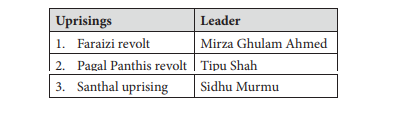
#55. Consider the following pairs:
Which of the pairs given above is/are correctly matched?
Pair 1 is incorrectly matched. The Faraizis were the followers of a Muslim sect founded by Haji Shariat-Allah.
The Faraizi revolt was organized under the son of Haji
Shariat-Allah, Dadu Mian who sought to expel the
English presence from Bengal. Mirza Ghulam Ahmed is
associated with Ahmadiya movement.
Pair 2 is correctly matched. Pagal Panth was a semireligious sect in Bengal. Karam Shah was the founder
of this sect. Tipu Shah, the son of Karam Shah was the political and religious leader of the Pagal Panthis
order who took up the cause of the tenants against the
oppression of the Zamindars.
Pair 3 is correctly matched. The Santhals were the ethnic
group in the Rajmahal Hills who resented against the
oppression by revenue offcials, police, money-lenders,
landlords etc., whom they described as diku (outsiders).
Sidhu Murmu and Kanhu Murmu asserted themselves
as the leaders of this group to ght against both the
British presence and the corrupt zamindari system.
#56. Regarding the Deccan Riots of 1870s, which of the following statements is incorrect?
Statement b is incorrect. The modern nationalist
intelligentsia of Maharashtra supported the peasants’
cause. The Poona Sarvajanik Sabha, led by Justice
Ranade, (and not Satyashodhak Samaj) had organized
a successful campaign among the peasants, against the
land revenue settlement. It also presented in 1873 a case
for a revision of the revenue rates and sent volunteers to
the villages to arouse the Kunbi peasants against the
new rates.
#57. The peasant movements of the 20th century was/ were characterized by
1. Participation of small zamindars.
2. Active participation in Indian National Movement.
3. Influence of communists and Marxists.
Select the correct answer using the code given below:
Option 1 is correct. The grassroot leadership of the
peasant movements came from low-caste leaders, and
many small zamindars e.g., Eka Movement (1921). The
issues involved in eka movement were:
1. High rents – 50% higher than the recorded rates;
2. Oppression of thikadars in charge of revenue
collection; and 3. Practice of share-rents.
Option 2 is correct. The appearance of Mahatma Gandhi
on the Indian political scene brought the peasants into
the broader freedom struggle against British authorities.
is began with Champaran and Kheda Satyagraha
and later Bardoli movement. There was an emergence
of anti-colonialism consciousness among peasant. The
period 1937-39 was the high watermark of the peasant
movements and activity under the Congress provincial
rule. The chief form of mobilisation was through holding
kisan conferences and meetings where demands were
aired and resolutions were passed.
Option 3 is correct. The new generation of political
workers, was increasingly brought under the influence
of the Left ideology propagated by Jawaharlal Nehru,
Subhas Bose, the Communists and other Marxist and
Left individuals and groups. With the decline of the Civil
Disobedience Movement, these men and women began
to search for an outlet of their political energies and many
of them found the answer in organizing the peasants.
ey provided the leadership to the peasant’s movements.
#58. In the context of tribal movements against the British rule, consider the following statements:
1. Tribal movements of north east were agrarian in nature.
2. Mainland tribal movements often favored complete independence from Indian Union.
Which of the statements given above is/are correct?
Statement 1 is incorrect. The movements of the tribes
of the north-eastern frontier were not forest-based or
agrarian revolts as these tribals were generally in control
of land and forest area. The British entered the northeastern areas much later than the non-frontier tribal areas.
Statement 2 is incorrect. North East tribes (and not
mainland tribes) which shared tribal and cultural
links with countries across the border did not concern
themselves much with the nationalist struggle. eir
revolts were often in favour of political autonomy within
the Indian Union or complete independence.
#59. With reference to the Eka movement, consider the following statements:
1. The movement was started against the oppression of thikadars.
2. The movement was led by low-caste leaders and small zamindars.
3. It wanted to abolish the zamindari system.
4.The movement came to an end with the passage of the Awadh Rent (Amendment) Act.
Which of the statements given above is/are correct?
Statement 1 is correct. The Eka movement was started by the peasants in some northern districts of the United
Provinces- Hardoi, Bahraich, Sitapur- towards the end
of 1921. The issues involved were:
1. high rents- 50% higher than the recorded rates
2. oppression of thikadars in charge of revenue
collection
3. practice of share-rents
Statement 2 is correct. The grassroot leadership of the Eka
Movement came from Madari Pasi and other low-caste
leaders, and many small zamindars. Unlike the earlier
Kisan Sabha movement that was based almost solely on
tenants, the Eka Movement included in its ranks many
small zamindars who found themselves disenchanted
with the Government because of its heavy land revenue
demand.
Statement 3 is incorrect. Eka movement that was on in
some of the rural areas of Avadh showed no signs of
wanting to abolish the zamindari system; it only wanted zamindars to stop ‘illegal’ cesses and arbitrary rent
enhancements.
Statement 4 is incorrect. The Kisan Sabha Movement
(and not the Eka movement) declined partly due
to government repression and partly because of the
passing of the Awadh Rent (Amendment) Act. The Eka
movement came to its end by March 1922 due to severe
repression on the part of the authorities. Under such
severe state repression, several of its leaders including
Madari Pasi were forced to go underground.
#60. Which of the following was the reason for Patharughat uprisings of 1894 in Assam?
Patharughat uprising is associated with the peasants’
protests against the increase in land revenue levied by
the colonial administration. After the British annexation
of Assam in 1826, surveys of the vast lands of the state
began. On the basis of such surveys, the British began to
impose land taxes, much to the resentment of the farmers.
In 1893, the British government decided to increase
agricultural land tax reportedly by 70- 80 per cent.
Across Assam, peasants began protesting the move by
organising Raij Mels, or peaceful peoples’ conventions.
Despite these gatherings being democratic, the British
perceived them as breeding grounds for sedition. On
January 28, 1894 when the peasants were protesting
peacefully in Patharughat, a small village in Assam’s
Darrang district, the military opened fire.
#61. With reference to civilian uprisings in history of India, consider the following statements:
1. The economic hardship resulting from heavy taxation was the reason behind Sanyasi rebellion.
2. Wahabi movement was an Islamic revivalist movement under the leadership of Syed Ahmad Khan.
3. The oppressive land revenue system was the reason for the revolt by Poligars in Malabar.
Which of the statements given above are correct?
Statement 1 is correct. Sanyasi revolt was the 18thcentury rebellion against the English East India Company
which was fought by peasants, traders and zamindars of
Bengal who were heavily taxed by the English despite
the great famine of 1770. e revolt was organized under
the leadership of fakirs and sanyasis. is revolt has been
recorded by Bankim Chandra Chatterjee in his book
‘Anandmath’.
Statement 2 is incorrect. The Wahabi movement was
an Islamic revivalist movement under the leadership of
Syed Ahmad Barelvi who was inspired by the teachings
of Abdul Wahab of Saudi Arabia. In the beginning, the
Wahabists declared a jihad against the Sikhs to convert
Dar-ul-Harb (the land of Ka rs) into Dar-ul-Islam (the
land of Islam). Later, after the annexation of Punjab by
the British, the English became the target of the Wahabis.
Statement 3 is correct. Polygars were the administrative
and military governors appointed by the Nayaks rulers of
South India. They revolted against the oppressive land
revenue system under the British during 1801-06. The
Polygar wars (1799-1805) were fought between the East
India Company and the Polygars of Tirunelveli Kingdom in Tamil Nadu.
#62. With reference to tribal and civil movements during Indian freedom struggle, consider the following statements:
1. Both tribal and civil movements were the result of repressive policies of colonial government.
2. Unlike civil movements, tribals movements were bound by ethnic identities.
Which of the above statements is/are correct?
Indian freedom struggle was enriched by various kind of
rebellions and movements. ere were tribal movements like Santhal rebellion as well as Civil movements like the
non-cooperation and the civil disobedience movements.
Statement 1 is correct. The tribals were aggravated by
exploitation of the police, traders and money-lenders
(most of them were (dikus) ‘outsiders’) and hence
revolted. The violence was directed towards the moneylenders and traders who were seen as extensions of the
colonial government. Civil movements like the noncooperation and the civil disobedience movements were
against Government policies. The non-cooperation
movement was a reaction towards the oppressive
policies of the British Indian government such as the
Rowlatt Act of 18 March 1919, as well as towards the
Jallianwala Bagh massacre of 13 April 1919.
Statement 2 is correct. Tribal identity or ethnic ties lay
behind the solidarity shown by tribal movements. A
common cause was the resentment against the imposition
of laws by the ‘foreign government’ that was seen as an
effort at destroying the tribals’ traditional socioeconomic
framework. However, civil movements like the noncooperation and the civil disobedience movements were
massive, broad based and included various section of
society, hence they tended to be more inclusive.
Civil movements like the non-cooperation and the civil
disobedience movements were successful in touching
the sentiments of people towards the nationalist
ideologies. Both played a key role in ensuring that India’s
independence from British rule was guaranteed on 15th
August 1947.
#63. With reference to the Narkelberia Uprising, consider the following statements:
1. It was led by Titu Mir.
2. It was against the local landlords.
3. It went on to merge with the Wahabi movement.
Which of the statements given above are correct?
The Narkelberia Uprising (1782-1831) is often considered
the rst armed peasant uprising against the British, which
soon took on a religious hue.
Statement 1 is correct: The Narkelberia Uprising was led
by Mir Nithar Ali, popularly known as Titu Mir among
the peasants in West Bengal.
Statement 2 is correct: The Narkelberia Uprising was caused by the resentment in the peasants (mostly)
Muslim against the zamindars (mostly Hindus) for
their oppressive behaviour, illegal levy demands and
uneconomic rent racking. The beard tax imposed on
the Faraizis by the zamindars also created resentment
among the peasants, thus causing this rebellion. So, this
movement was directed against the local landlords.
Statement 3 is correct: is movement had religious
overtones and Titu Mir advocated to the peasants to
go back to roots of their religion and live simple lives
with unity amongst themselves so that they may not be
oppressed. So, in time this movement merged with the
Wahabi movement (1830-61), which advocated revival
of Islam along these very lines.
#64. Which of the following factors were responsible for tribal revolt during Indian freedom struggle?
1. Introduction of a new system of land revenue and taxation.
2. Influence of foreign religious missionaries in tribal areas.
3. Restriction on Shifting cultivation in forest areas.
4. Introduction of the system of separate electorates system.
Select the correct answer using the code given below
The tribal people, spread over a large part of India,
organized hundreds of militant outbreaks and insurrections during the 19th century. These uprisings
were marked by immense courage and sacrifice on their
part and brutal suppression and veritable butchery on the part of the rulers. The tribals had cause to be upset for a
variety of reasons:
Statement 1 is correct. The colonial administration
ended their relative isolation and brought them fully
within the ambit of colonialism. It recognized the tribal
chiefs as zamindars and introduced a new system of
land revenue and taxation of tribal products. With the
in ux of non-tribals into the traditional regions of the
tribals, the practice of settled agriculture was introduced.
e tribals were reduced to being landless agricultural
labourers. They became bonded labourers under the
new economic system. The tribal societies had a system of
joint ownership of land which was replaced by the notion
of private property. is led to a loss of land for the tribal
population.
Statement 2 is correct. The work of Christian missionaries
also led to social upheaval in tribal society and this was
also resented by them.
Statement 3 is correct. The tribals’ mainstay was shifting
agriculture, hunting, shing and the use of forest
produce. Colonialism also transformed their relationship
with the forest. They had depended on the forest for food,
fuel and cattle-feed. They practiced shifting cultivation
(jhum, podu, etc.), taking recourse to fresh forest lands
when their existing lands showed signs of exhaustion. The
colonial government changed all this. It usurped the forest
lands and placed restrictions on access to forest products,
forest lands and village common lands. It refused to let
cultivation shift to new areas.
Statement 4 is incorrect. Separate electorates were
introduced in Morley-Minto Reforms under which
Muslims could only vote for Muslim candidates in
constituencies specially reserved for them. is was done
to divide the nationalist ranks and to check the growing
unity among Indians by encouraging the growth of
Muslim communalism. is reason has nothing to do
with tribal uprisings in India.
#65. With reference to the Khurda Uprising in 19th century, consider the following statements.
1. It was directed against the oppressive policies of the ruler of Khurda kingdom.
2. It was fought under the leadership of Buxi Jagabandhu.
3.The Government of India has declared the rebellion as the rst war of Independence.
Which of the above statements is/are correct?
The Khurda uprising of 1817 was led by the ex-militia in
Odisha region, the Paiks.
Statement 1 is incorrect. The uprising was directed
against the British which followed a policy of resuming
service tenures. It bitterly affected the lives of the exmilitia of the state, the Paiks. The severity of the measure
was compounded on account of an unreasonable increase
in the demand of revenue and also the oppressive ways
of its collection. Consequently, there was large scale
desertion of people from Khurda between 1805 and 1817.
Statement 2 is correct. They fought under the leadership
of Buxi Jagabandhu and his close associate Krushna
Chandra Bhramarabar Rai. Buxi Jagabandhu, leading
ve to ten thousand Paiks and men of the Kandh tribe
seized Puri and declared the hesitant king, Mukunda Dev II as their ruler. e priests of the Jagannath Temple also
extended the Paiks their full support. The zamindars and
ryots alike joined the Paiks with enthusiasm.
Statement 3 is incorrect. Recently, the Centre through a
written reply in the Rajya Sabha said the Paika rebellion
cannot be called the first War of Independence. Odisha
had demanded that the rebellion of Odisha be declared
as the rst war of Independence. At present, the Indian
Mutiny or Sepoy Mutiny of 1857 is called the rst war of
Independence against British Rule.
#66. With reference to the Sanyasi Revolt, consider the following statements:
1. The revolt was against the harsh economic order of the British during the Bengal Famine of 1770.
2. Equal participation of Hindus and Muslims mainly characterised the revolt.
3. One of the reasons for failure behind the revolt was no women participation.
4. Anand Math, a novel by Bankim Chandra Chattopadhyay, is based on this revolt.
Which of the above statements are correct?
From 1763 onwards, the Sanyasi revolt or uprising had
engulfed the area of Bengal, Bihar and Uttar Pradesh.
Statement 1 is correct. The disastrous famine of 1770
and the harsh economic order of the British compelled
a group of sanyasis in Eastern India to ght the British
yoke. It was one of the reasons behind the Sanyasi revolt.
Originally peasants, even some evicted from land, these
sanyasis were joined by a large number of dispossessed
small zamindars, disbanded soldiers and rural poor.
Statement 2 is correct. Also, sometimes Sanyasi revolt is
referred to as the Fakir Rebellion, the revolt witnessed
equal participation of Hindus and Muslims.
Statement 3 is incorrect. It was a successful revolt which
got support from women participation as well. Majnum
Shah (or Majnu Shah), Chirag Ali, Musa Shah, Bhawani
Pathak and Debi Chaudhurani were important leaders.
Debi Chaudhurani’s participation recognizes the women’s
role in early resistances against the British.
Statement 4 is correct. Anand Math, a semi-historical
novel by Bankim Chandra Chattopadhyay, is based
on the Sanyasi Revolt. He also wrote a novel Devi
Chaudhurani as he saw the importance of women to
taking out the struggle against an alien true that post
threat to traditional Indian values.
#67. Starting with the earliest, arrange the following tribal revolts against the colonial rule in India in a chronological order based on their timeline.
1. Kol Uprising
2. Warli Revolt
3. Santhal Uprising
4. Bastar Rebellion
Select the correct answer using the code given below:
Correct Order1. Kol Uprising (1831-32)
2. Santhal Uprising (1855)
3. Bastar Rebellion (1910)
4. Warli Revolt (1945)
Kol Uprising:
e Kols, along with other tribes, are inhabitants of
Chhotanagpur. is covered Ranchi, Singhbhum,
Hazaribagh, Palamau and the western parts of Manbhum.
The trouble in 1831 started with large-scale transfers of
land from Kol headmen to outsiders like Hindu, Sikh and
Muslim farmers and moneylenders who were oppressive
and demanded heavy taxes.
Besides, the British judicial and revenue policies badly
affected the traditional social conditions of the Kols.
The Kols resented this and in 1831, under the leadership
of Buddho Bhagat, the Kol rebels killed or burnt about a thousand outsiders. Only after largescale military
operations could order be restored.
Santhal Uprising :
Continued oppression of the Santhals, an agricultural
people, who had ed to settle in the plains of the Rajmahal
hills (Bihar) led to the Santhal rebellion against the
zamindars.
The money-lenders who had the support of the police
among others had joined the zamindars to subject the
peasants to oppressive exactions and dispossession of
lands. The rebellion turned into an anti-British movement.
Under Sidhu and Kanhu, two brothers, the Santhals
proclaimed an end to Company rule, and declared the
area between Bhagalpur and Rajmahal as autonomous.
The rebellion was suppressed by 1856.
Bastar Rebellion:Bastar is located in the southernmost part of Chhattisgarh
and borders Andhra Pradesh, Orissa and Maharashtra.
A number of different communities live in Bastar such as
Maria and Muria Gonds, Dhurwas, Bhatras and Halbas.
e people of Bastar believe that each village was given its
land by the Earth, and in return, they look after the earth
by making some o erings at each agricultural festival. In
addition to the Earth, they show respect to the spirits of
the river, the forest and the mountain.
e Bastar Rebellion, also known as the bhumkal
(earthquake) was an Adivasi rebellion in 1910 against the
British Raj in the princely state of Bastar in central India.
It was led primarily led by Gunda Dhur, a tribal leader, as
well as by a diwan and cousin of the king, Lal Karendra
Singh.
Warli Revolt:
Began in Maharashtra in 1945, it was negatively impacted
from the exploitation of landlords and money-lenders,
nearly 5,000 indentured tribals gathered and refused to
work on landlords’ elds until they received 12 annas a
day in wages.
eir resistance sowed the rst seeds of rights-based
movements among the region’s indigenous communities.
Women played an important role in the revolt and
helped the men in all possible aspects.
#68. With reference to colonial India, which of the following were the major causes of the early (pre 20th century) peasant movements?
1. Laws brought by colonial government enabling commodi cation of land.
2. Introduction of an alien system of courts and laws.
3. Desire to end zamindari system.
4. Rigid land tenures with extremely high rents.
Select the correct option using the code given below:
Peasant’s movements of 19th century were aimed to solve
the particular grievances of peasants and had limited
objectives.
Option 1 is correct: Land in Indian villages used to have
community ownership, and those that were privately
owned were never mortgaged or sold. However
new capitalistic land tenures and revenue systems
introduced by the British such as the Permanent
Settlement and Ryotwari Settlement made land
alienable by the government, or the landlord or the
moneylender (when mortgaged to pay high revenues).
Many peasants thus lost their precious lands to
which they were attached emotionally as well, became
tenants-at-will (economically vulnerable) for which
they resented the British and their Indian agents like the
zamindars and the moneylenders. is led to a number of
peasant movements.
Option 2 is correct: The British introduced a new system
of civil and criminal laws and a new system of courts
to adjudicate cases. All these were too complex for the
peasants to understand and made them feel powerless
against local magnates like the zamindars and the
moneylenders who were literate, understood the laws,
as well unlike them had the money to fight long drawn
legal battles or bribe local functionaries like the thanedar,
etc. Feeling disempowered to get justice against the
zamindars and moneylenders for illegal evictions and
uneconomic rents and levies also made the peasants
angry.
Option 3 is incorrect: The Peasant movements of the
early phase were not very forward looking and did not
think about dismantling unjust feudal agrarian systems
like the zamindari system. They just wanted to go back
to the old pre-British system, where the zamindar was
not an extortionist, rather a paternal gure who would ask
for economic rents and accommodate them in difficult
times. It was much later in the 1930s and 40s that the
peasant movements began envisioning a fairer system
without feudal elements like zamindari.
Option 4 is correct: Before the arrival of the British, the
revenue rates used to be around 1/6th of the produce,
and revenues used to be reduced or cancelled in years of
calamities like drought. However, the British introduced
new systems of land revenues which were extremely
rigid (no exception for calamities) and extremely high
rents which impoverished the peasantry, thus angering
them.
#69. With reference to the Mainland and Northeast Tribal revolts of colonial India, consider the following statements:
1. Tribal revolts of the Northeast did not concern itself with uprooting colonial rule.
2. Mainland tribal revolts were mainly caused due to agrarian distress and disruption of lifestyle.
3. The mainland tribal revolts lasted longer than those in the northeast.
Which of the statements given above is/are correct?
Tribal movements under British rule were the most
frequent, militant and violent of all movements. The
tribal movements can be categorised into mainland tribal
revolts and frontier tribal revolts concentrated mainly in
the north-eastern part of India.
Statement 1 is correct: e tribal revolts in the frontier
regions of Northeast were mainly motivated by the
desire for political autonomy, regardless of the ruling
dispensation in the mainland. They did not care if India
was ruled by Indians or the British, they just wanted their
political autonomy. The forests and agricultural lands
were generally in their control, as the British did not
disturb these areas much, and arrived here much later
compared to the mainland, so there was no question of
resentment on that front.
Statement 2 is correct: The tribal revolts of the mainland
were motivated chiefly by the disruptions created in
the social and economic life of the Tribals by British
interference. The British forced them to give up shifting cultivation and take up oppressive feudal style settled
agriculture where they were burdened by heavy revenue
obligations. The British also restricted their access to the
forest which were central to their social identity as well
as a chief source of their income, thus impoverishing
them. The new cash economy forcibly introduced by
the Britishers led to an influx of outsiders in tribal areas
such as zamindars, moneylenders and traders, all of
whom were oppressive and exploitative. All this created
resentment in the mainland tribals leading to a series
of rebellions like Munda Ulgulan, Santhal Uprising, Ho
rebellion, etc.
Statement 3 is incorrect: The revolts among the tribes
of northeast lasted longer than those by the tribes
of mainland. The Northeast tribes wanted political
autonomy, which they demanded under colonial rule as
well as later from the Indian Union post-independence
too. The British could not defeat them easily as the
terrain was very difficult as well as unknown to them,
leading to protracted wars, for example Khasi uprisings,
Singhpho rebellion, etc.
The revolts of mainland tribes were intense and violent
using old and primitive weapons like battle axes and
bow and arrows. The British succeeded in crushing them
quickly with superior military tech and might, so they
were not long lasting. Later the British would reduce their
resentment by giving them concessions and recognizing
some of their traditional laws and systems.
#70. With reference to the Ahom Revolt, consider the following statements:
1. It was led by a prince named Gomdhar Konwar.
2. The immediate cause of the revolt was agrarian hardships among people under new British systems.
3. It featured a special band of soldiers called the burkandazes.
Which of the statements given above is/ are incorrect?
Statement 1 is correct: The Ahom revolt was led by
the Ahom noblemen and princes such as Dhanjoy
Borgohain, and Jairam Khargharia Phukan, etc under
the leadership of Prince Gomdhar Konwar in 1828.
Statement 2 is incorrect: Agrarian hardships among
Ahom people due to new systems introduced by the
British was not the immediate cause of this rebellion.
The immediate cause of this revolt was the occupation
and attempt of the Britishers to annex the Ahom
kingdom to British territories in India. When the British
had garrisoned Ahom lands in 1824-26 during the first
Anglo-Burmese war, they had promised the Ahom ruler
to leave, as soon as Burma was defeated. However later
they went back on their promise and did not leave the
territory while actively trying to merge it with the British
empire in India. is angered the Ahom nobility who
rose in rebellion.
Statement 3 is incorrect: A special band of soldiers
called Burkandazes (demobilized soldiers of Muslim
armies and Zamindars in Ahom lands in 1770s ) were
a part of Revolt of Moamarias in 1769-99 against the
Ahom rulers (and not a part of the Ahom revolt of 1828).
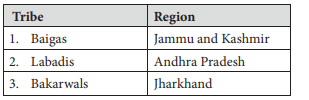
#71. Consider the following pairs:
Which of the pairs given above is/are correctly matched?
Many tribal groups lived by herding and rearing animals.
The Van Gujjars of the Punjab hills and the Labadis of
Andhra Pradesh were cattle herders, the Baigas and Khonds of the central India, the Gaddis of Kulu were
shepherds, and the Bakarwals of Kashmir reared goats.
Statement 1 is incorrect. Baigas are the primitive tribal
communities living in central India. ey mainly live
in Chhattisgarh, Jharkhand, Bihar, Odisha, West Bengal,
Madhya Pradesh and Uttar Pradesh. In 2016, Baiga tribal
become India’s first community to get habitat rights.
Statement 2 is correct. The Labadis of Andhra Pradesh
are cattle herders. With roots in Rajasthan, Banjaras now
live in several states and are known by different names
like Lambada or Labadi in Andhra Pradesh, Lambani in
Karnataka; Gwar or Gwaraiya in Rajasthan etc.
Statement 3 is incorrect. e Bakarwal is nomadic
tribe of majority Sunni Muslims of Gujjar ethnicity
from Jammu and Kashmir. They are goat herders and
shepherds at large and seasonally migrate from one place
to another with their herds.
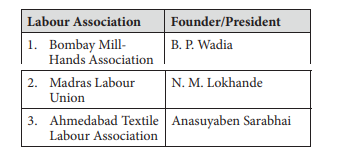
#72. Consider the following pairs:
Which of the above pairs is/are correctly matched?
Pair 1 is incorrectly matched. N.M. Lokhande (and
not B.P. Wadia) was the founder of Bombay MillHands Association. He emerged as the first trade union
leader of India. In the year 1890, Lokhande arranged a
mass rally of 10,000 workers, where two women workers
demanded Sunday as weekly off . Simultaneously, the first
memorandum was submitted to Mill Owners’ Association
who accepted the demand. is event was recognized as
the rst trade union victory in the country. is trade
union rally led to the formation of the first trade union
called ‘Bombay Millhands Association’. However,
the union had no funds, office bearers and committee
members.
Pair 2 is incorrectly matched. The Madras Labour
Union was formed in 1918 by B. P. Wadia (and not N.M.
Lokhande) as its first president.
Pair 3 is correctly matched. Anasuyaben Sarabhai
founded Ahmedabad Textile Labour Association
(Majoor Mahajan Sangh), India’s oldest union of textile
workers, in 1920. She was supported in her work by
Mahatma Gandhi and in 1918, Anasuya managed mill
owners to accede to the demand of Ahmedabad weavers
for a 35% wage hike.
#73. With reference to the impacts of colonial rule on the tribal lives in 19th Century, consider the following statements.
1. The tribal chiefs were not allowed to keep their land titles over a cluster of villages.
2. Tribals were denied entry inside the forest that has been declared as state property.
3. Tribals were recruited in large numbers to work the tea plantations and coal mines.
Which of the statements given above is/are correct?
Statement 1 is incorrect. Under British rule, the functions
and powers of the tribal chiefs changed considerably. ey
were allowed to keep their land titles over a cluster of
villages and rent out lands, but they lost much of their
administrative power and were forced to follow laws
made by British officials in India. They also had to pay
tribute to the British, and discipline the tribal groups on
behalf of the British.
Statement 2 is incorrect. The British extended their
control over all forests and declared that forests were
state property. Some forests were classi ed as Reserved
Forests for they produced timber which the British wanted. In these forests people were not allowed to move
freely, practise jhum cultivation, collect fruits, or hunt
animals. However, later the British officials decided that
they would give jhum cultivators small patches of land
in the forests and allow them to cultivate these on the
condition that those who lived in the villages would have
to provide labour to the Forest Department and look after
the forests. So, in many regions the Forest Department
established forest villages to ensure a regular supply of
cheap labour.
Statement 3 is correct. The plight of the tribals who had to
go far away from their homes in search of work was even
worse. From the late nineteenth century, tea plantations
started coming up and mining became an important
industry. Tribals were recruited in large numbers to
work the tea plantations of Assam and the coal mines
of Jharkhand. They were recruited through contractors
who paid them miserably low wages, and prevented them
from returning home.
#74. With reference to the Munda Uprising, consider the following statements:
1. It was led by tribal leaders Sido and Kanhu.
2. One of its aims was to restore their traditional khunkatti system of land holding.
3. This movement had an element of socioreligious reform as well.
Which of the statements given above is/are correct?
Statement 1 is incorrect: The Munda Rebellion of
1890s-1900 was led by a tribal leader Birsa Munda (not
Sido and Kanhu who led the Santhal Rebellion of 1856).
Statement 2 is correct: One of the main aims of Munda
movement was to go back to their traditional systems
of living and working like the Khunkatti system (joint
holding of land by tribal lineages).
e Britishers were uncomfortable with tribal practices
like jhum (shifting cultivation), so they used superior
might to take over their lands and forcefully introduced
mainstream feudal style zamindari system of settled
agriculture and high rents so that they may get more
revenues. is destroyed the traditional lifestyle of the
tribals in Chotanagpur Plateau and lled them with
resentment.
Statement 3 is correct: Birsa Munda started Munda
movement as a socio-religious reform movement among
the tribals, especially Mundas, of the Chotanagpur
region. He advised them to give up habits like drinking
and eating meat, and live pure and simple lives. He
said that if the Munda people reformed themselves and
strengthened their characters like those of the people in
Lord Rama’s time (Satyug) then the Britishers and other
outsiders (Diku) will not be able to overpower them and
they will re-establish Munda Raj and live their lives with
pride, according to their traditions and customs.
#75. With reference to policy of Indian National Congress (INC) towards Indian princely states, consider the following statements:
1. During early period Indian national Congress (INC) distanced itself from princely states as movement in Princely states could result in religious fragmentation.
2. Indian national Congress (INC) in Gaya Session asked princely states to grant democratic government to masses.
3. Gandhiji advocated for participation of congress in the princely states in the form of ‘constructive work’ such as anti-untouchability movement.
Which of the statements given above is/are correct?
Statement 1 is correct: During early period Indian
national Congress (INC) distanced itself from princely
states as movement in Princely states could result in
religious fragmentation. Movements in princely states
were tied to the appeals based on class, religious and
linguistic identities and could result in more regional and
religious fragmentation of masses.
Statement 2 is incorrect: INC in 1920s started voicing
some sort of struggle for democratic rights of masses
in princely states. It had passed a resolution at Nagpur
Congress Session (1920) asking the princes to grant
democratic government to their subjects.
Statement 3 is correct: Gandhian leadership advocated
and later permitted ‘constructive work’ such as antiuntouchability in the princely states. For example, he
actively supported the Vaikom Satyagarha in Travancore
in 1925, where the demand for the opening of the road
around Vaikom temple for the use of ‘untouchables’ was
raised.
#76. ‘He tried to remove the discrepancies among the various religions of the world. He undertook a serious study of comparative religions and realised in due course that true Hinduism, true Islam and true Christianity are not fundamentally different from each other. He mastered Arabic, Persian, Hebrew, Greek, Latin and 17 other leading languages spoken in the world. He believed in, the progressive role of the British rule in India.
Which social reformer is described above?
He was interested not only in reforming the Hindu
religion, but also tried to remove the discrepancies among
the various religions of the world. He undertook a serious
study of comparative religions and realised in due course
that true Hinduism, true Islam and true Christianity are
not fundamentally different from each other. Besides
Bengali and Sanskrit, Roy had mastered Arabic, Persian,
Hebrew, Greek, Latin and 17 other leading languages
spoken in the world.
Roy started his public life in 1815 with the establishment
of the Atmiya Sabha. It also opposed polygamy and
worked for the removal of caste disabilities. Roy believed
in, the progressive role of the British rule in India and
sought government held in the matter of social reforms,
especially in the form of socially progressive legislations.
For instance, Roy was convinced that without the active
support of the government it would be almost impossible
to eradicate the inhuman practices of sati.
#77. In the context of Indian history, what were the major features of the socio-religious reforms?
1. Revival of native cultural personality.
2. Evolution of national consciousness.
3. Emphasis on the human intellect’s capacity to think and reason.
4. Liberation of the individual from the conformity born out of fear.
Select the correct answer using the code given below.
India in the 19th and 20th century witnessed a series of
reform movements under- taken in various parts of the
country. These movements were oriented toward a restructuring of the Indian society along modem lines.
Statement 1 is correct. e underlying concern of
these reformist efforts was revival of native cultural
personality which had got distorted by various factors
over the years.
Statement 2 is correct. is cultural ideological struggle
was to prove to be an important instrument in the
evolution of national consciousness and a part of Indian
national resolve to resist colonial cultural and ideological
hegemony.
Statement 3 is correct. ese reform movements
emphasised the human intellect’s capacity to think and
reason.
Statement 4 is correct. These movements managed to
contribute towards the liberation of the individual from
the conformity born out of fear and from uncritical
submission to exploitation by the priests and other classes.
#78. Dayananda Saraswati was founder of the Arya Samaj, with reference to him, which of the following statements is/are correct?
1. His vision of India included classless but not casteless society.
2. Satyarth Prakash is his famous work in which he published his views.
3. He was critical about the escapist Hindu belief in Maya.
4. He considered Vedas to be ‘India’s Rock of Ages’.
5. He rejected modernity and displayed a patriotic attitude to national problems.
Select the correct answer using the codes given below:
Swami Dayanand Saraswati was a socio-religious leader
of India who left deep impact on the Indian society. He
founded the Arya Samaj that brought about changes
in the religious perception of Indians. He voiced his
opinions against idolatry and the pointless emphasis on
empty ritualism, and man-made dictates that women are
not allowed to read the Vedas
Statement 1 is incorrect. Dayananda’s vision of India
included classless and casteless society, a united India
(religiously, socially and nationally), and an India free
from foreign rule, with Aryan religion being the common
religion for all.
Statement 2 is correct. Dayananda’s views were published
in his famous work, Satyarth Prakash ( The True
Exposition).
Statement 3 is correct. He strongly criticized the escapist
Hindu belief in Maya (illusion) as the running theme
of all physical existence and the aim of human life as a
struggle to attain Moksha through escape from this evil
world to seek union with God.
Statement 4 is correct. He took inspiration from the
Vedas and considered them to be ‘India’s Rock of Ages’,
the infallible and the true original seed of Hinduism. He
gave slogan ‘Back to the Vedas’.
Statement 5 is incorrect. He accepted modernity and
displayed a patriotic attitude to national problems.
#79. Consider the following pairs:
Which of the pairs given above are correctly matched?
Pair 1 is matched incorrectly. Faraizi Movement: The
movement, also called Fara’idi Movement because of its
emphasis on the Islamic pillars of faith, was founded by
Haji Shariatullah in 1819. The movement was active in
East Bengal, and it aimed at the eradication of social
innovations or un-Islamic practices current among the
Muslims of the region and draw their attention to the
duties as Muslims.
Pair 2 is matched incorrectly. Wahabi Movement: Also
known as Walliullah Movement. The teachings of Abdul
Wahab of Arabia and the preachings of Shah Walliullah
(1702-63) inspired this essentially revivalist response to
Western influences and the degeneration which had set
in among Indian Muslims and called for a return to the
true spirit of Islam.
Pair 3 is matched correctly. Ahmadiyya Movement: The
Ahmadiyya forms a sect of Islam which originated from
India. It was founded by Mirza Ghulam Ahmad in 1889.
It was based on liberal principles. It described itself as
the standard-bearer of Mohammedan Renaissance, and
based itself, like the Brahmo Samaj, on the principles of
universal religion of all humanity, opposing jihad. The
movement spread Western liberal education among the
Indian Muslims.
#80. With reference to education in British period of Indian history, consider the following statements:
1. Raja Rammohan Roy with David Hare founded the Hindu College in Calcutta.
2. The Sanskrit College was opened in Calcutta by Radhakanta Deb to impart education students belonging to the non-Brahmin community.
3. Iswar Chandra Vidyasagar was the first Secretary of Bethune School.
Which of the statements given above is/are correct?
Statement 1 is correct. Rammohan Roy propagated the
introduction and spread of modern education which
could act as a major vehicle for the dissemination of
modern ideas in the country. For its promotion he
provided enthusiastic support to David Hare who, along
with many Indian notables of Calcutta, founded the
famous Hindu College in 1817. He also ran an English
School in Calcutta at his own cost. In 1825 he founded the
Vedanta College which offered both Indian and Western
learning
Statement 2 is incorrect. The foundation of Sanskrit
College was laid in 1824 during the British regime based
on a recommendation by HT James Prinsep and omas
Babington Macaulay.
The institution rose into prominence and glory during
the principalship of Ishwar Chandra Vidyasagar. It was in
1851 that the college first opened its doors for the students
belonging to the non-Brahmin community as well.
Statement 3 is correct. Iswar Chandra Vidyasagar was
the first Secretary of Bethune School.
The College owes its origin to John Elliot Drinkwater
Bethune (1801-1851) who established Calcutta Female
School, the rst school for girls in Calcutta.
#81. With reference to Bharat Mahila Parishad, consider the following statements:
1. Pandita Ramabai Saraswati founded Bharat Mahila Parishad in 1904.
2. It was formed under the parent organization ‘National Social Conference’.
3. The Parishad actively used the technique of Non-violent protest against patriarchal social setup in India.
Which of the statements given above is/are correct?
In the ancient and medieval periods women were largely
connected only to the family. The educational experiments
of the late 19th and early 20th centuries produced a new
woman with interests that went beyond the household.
Statement 1 is incorrect: Ramabai Ranade (not
Pandita Ramabai Saraswati) founded the Ladies
Social Conference (Bharat Mahila Parishad) in 1904 in
Bombay. Pandita Ramabai Saraswati founded the Arya
Mahila Samaj to serve the cause of women.
Statement 2 is correct: Ladies Social Conference
(Bharat Mahila Parishad) was formed under the parent
organisation National Social Conference.
Indian (National) Social Conference was founded by
M.G. Ranade and Raghunath Rao. It was virtually the
social reform cell of the Indian National Congress. Its rst
session was held in Madras in December 1887.
Statement 3 is incorrect: Ladies Social Conference
(Bharat Mahila Parishad) was a part of the National Social
Conference to provide a forum for the discussion of
social issues concerning women’s status in the society. It
was only a platform for discussing women’s issues and
did not venture into any non-violent protest activities.
#82. Which one of the following was not the factor that helped to mitigate Caste-based discrimination during British India period?
The later-Vedic conception of four-fold division of Hindu
society got further subdivided into numerous sub-castes
due to racial admixture, geographical expansion and diversi cation of crafts which gave rise to new vocations
during British India.
Option b is incorrect: Dharma Sabha was formed in 1830
in Calcutta by Radhakanta Deb. The organization was
established mainly to counter the ongoing social reform
movements led by protagonists such as Raja Ram Mohun
Roy and Henry Derozio. More speci cally, the impetus of
forming the organization came from a new law enacted
by the colonial British rule which banned the practice of
sati in the country; the focus of the new association was
to repel the law which was seen as an intrusion by the
British into the religious affairs of the indigenous people
by some sections of the Hindu community.
Option a, c and d are the correct statements that helped
to mitigate Caste-based discrimination in British India.
The British administration introduced the concept of equality before law in a uniformly applied system of law
which dealt a severe blow to social and legal inequalities,
while the judicial functions of caste panchayats were taken
away. The administrative services were made open to all
castes and the new education system was on totally
secular lines.
From the mid-19th century onwards, numerous
organisations and groups such as the Brahmo Samaj,
Prarthana Samaj, Arya Samaj, Ramakrishna Mission,
the eosophists, the Social Conference and individuals
worked to spread education among the untouchables
and remove restrictions imposed on them from entering
temples or using ponds, tanks, etc.
The national movement took inspiration from the
principles of liberty and equality against the forces
which tended to divide the society. The national leaders
and organisations opposed caste privileges, fought for
equal civic rights and free development of the individual.
With increasing opportunities of education and general
awakening, there were stirrings among the lower castes
themselves. is awakening gradually developed into a
powerful movement in defence of their rights and against
upper caste oppression.
#83. Consider the following pairs:
Which of the pairs given above is/are correctly matched?
Pair 1 is correctly matched: Kandukuri Veeresalingam
(1848 – 1919) was a social reformer and writer from
the Madras Presidency, British India. He is considered
as the father of the Telugu Renaissance movement. He
was one of the early social reformers who encouraged
the education of women and the remarriage of widows.
He is often considered as the Raja Rammohan Roy of
Andhra. He was also known by the title Gadya Tikkana,
or ‘the Tikkana of Prose’. Kandukuri Veeresalingam was
inspired by the principles of Brahmo Samaj leaders like
Raja Rammohan Roy, Pandit Ishwar Chandra Vidyasagar,
& Keshab Chandra Sen. He started his own Brahmo
Mandir that led the movement in social refom in
Rajahmundry near bridge in 1887.
Pair 2 is correctly matched: Veda Samaj founded in
Madras in 1864 advocated discarding of caste distinctions and promotion of widow remarriage and women’s
education. It condemned the superstitions and rituals
of orthodox Hinduism and propagated belief in one
supreme God. Chembeti Sridharalu Naidu was the most
popular leader of the Veda Samaj. He translated books of
the Veda Samaj in Tamil and Telugu.
Pair 3 is incorrectly matched: Justice Movement in
Madras Presidency was started by C.N. Mudaliar, T.M.
Nair and P. Tyagaraja to secure jobs and representation
for the non-brahmins in the legislature. In 1917, Madras
Presidency Association was formed which demanded
separate representation for the lower castes in the
legislature.
Pair 4 is incorrectly matched: Aravipuram Movement was
launched by Sri Narayana Guru on Shivaratri day of
1888. On that day, Sri Narayana Guru defied the religious
restrictions traditionally placed on the Ezhava community,
and consecrated an idol of Shiva at Aravipuram.
Sri Narayana Guru, born in a low-caste Ezhava family, had
studied Sanskrit, Malayalam, Tamil and astrology.
#84. Which one of the following statements regarding ‘Raja Rammohan Roy and his contributions towards the society’ is not correct?
Raja Ram Mohan Roy (1772 -1833) was an Indian reformer who was one of the founders of the Brahmo Sabha, the precursor of the Brahmo Samaj, a socialreligious reform movement in the Indian subcontinent.
He was given the title of Raja by Akbar II, the Mughal
emperor.
Option a is correct: As a political activist, Roy
condemned oppressive practices of Bengali zamindars
and demanded fixation of maximum rents. He also
demanded abolition of taxes on tax-free lands. He called
for a reduction of export duties on Indian goods abroad
and abolition of the East India Company’s trading rights.
He demanded the Indianisation of superior services
and separation of the executive from the judiciary.
He demanded judicial equality between Indians and
Europeans and that trial be held by jury.
Option b is correct: After the death of his father in 1803,
Roy moved to Murshidabad where he published his
first book, a Persian treatise with an Arabic preface,
“Tuhfat-ul-Muwahhidin” or “A Gift to Monotheism”. In
addition to acquiring knowledge of the ancient Vedantic
literature, he also studied the Tantric works with the aid of
Hariharananda Tirthaswami.
Option c is incorrect: Raja Rammohan Roy was deeply
opposed to the caste system that prevailed in Indian
society. A humanist and democrat to the core, he wrote
and talked against the caste system. Another important
area that concerned him was Hindu theology. Study of
the Vedas and Upanishads gave him ground to show
that monotheism was the original Hindu belief and
hence he denounced polytheism and idolatry. In fact,
the philosopher did not insist on the creation of a new
religion but merely endeavoured to ‘purify’ the Vedic
religion from the crude and most ignorant superstitions.
Option d is correct: Roy supported education,
particularly education of women. He believed that
English-language education was superior to the
traditional Indian education system, and he opposed
the use of government funds to support schools teaching
Sanskrit. In 1822, he founded a school based on English
education.
#85. With reference to ‘Prarthana Samaj’, consider the following statements:
1. It was established by Atmaram Pandurang in 1867 with the help of Keshub Chandra Sen.
2. The movement discarded the ideas of the bhakti cult of Maharashtra towards liberal principles of social reform.
3. R.G. Bhandarkar and N.G. Chandavarkar were associated with the activities of the Samaj.
4. The samaj focused on education and persuasion rather than confrontation with Hindu orthodoxy.
Which of the statements given above is/are correct?
Statement 1 is correct: Prarthana Samaj or “Prayer
Society” in Sanskrit, was a movement for religious and
social reform in Bombay, India, based on earlier reform
movements. Prarthana Samaj was founded by Atmaram
Pandurang in 31 March 1867 when Keshub Chandra Sen
visited Maharashtra, with an aim to make people believe
in one God and worship only one God.
Statement 2 is incorrect: The Prarthana Sabha was
very attached to the bhakti cult of Maharashtra. Bhakti
movement guided the movement in Maharashtra with
intellectual strength and pragmatism. The movement
drew their nourishment from the Hindu scriptures and
used the hymns of the old Marathi “poet-saints” in their
prayers.
Statement 3 is correct: Mahadeo Govind Ranade (1842-
1901), joined the samaj in 1870, and much of the popularity
of and work done by the society was due to his efforts. His
efforts made the samaj gain an all-India character. Other
leaders of the samaj were R.G. Bhandarkar (1837- 1925)
and N.G. Chandavarkar (1855-1923).
Statement 4 is correct: The Prarthana samaj relied on
education and persuasion and not on confrontation
with Hindu orthodoxy. There was a four-point social
agenda also: (i) disapproval of caste system, (ii) women’s
education, (iii) widow remarriage, and (iv) raising the age
of marriage for both males and females.
#86. With reference to Ramosi Uprising, which of the following statements is/are correct?
1. Ramosis were the tribals of Western ghats who resented against the Britishers.
2. The Britisher did a severe repression and aggressive use of force on the Ramosis.
3. Their complaints were related to the new regulations that denied their customary rights over forest areas.
Choose the correct answer using the options given below:
There were many tribal uprisings across India under the
British rule due to several reasons. Ramosi uprising was
one among them. Features are:
Statement 1 is correct – The Ramosis, the hill tribes of the
Western Ghats, had not reconciled to British rule and the
British pattern of administration. They rose under Chittur
Singh in 1822 and plundered the country around Satara.
Again, there were eruptions in 1825-26 under Umaji Naik
of Poona and his supporter Bapu Trimbakji Sawant, and
the disturbances continued till 1829. The disturbance
occurred again in 1839 over deposition and banishment
of Raja Pratap Singh of Satara, and disturbances erupted
in 1840-41 also. Finally, a superior British force restored
order in the area.
Statement 2 is incorrect – Generally, the British
followed a pacifist policy towards the Ramosis, and
even recruited some of them into the hill police. They
didn’t follow any aggressive policies or brutal use of force
against the Ramosis.
Statement 3 is incorrect – is is related to Tribals like
Koyas of Eastern Godavari track. Their complaints were
oppression by police and moneylenders, new regulations
and denial of their customary rights over forest areas.
Ramosis instead resented the policy of annexation. After
the annexation of the Maratha territories by the British,
the Ramosis, who had been employed by the Maratha
administration, lost their means of livelihood.
#87. Which of the following statements was/were major causes of Civil Uprisings in India?
1. Zamindars wanted to settle personal scores with rulers
2. Contemptuous treatment of native people by the Britishers
3. Interference by the Britishers in the internal feud of rulers
4. Disappearance of traditional patrons of handicrafts
Choose the correct answer using the options given below:
Major Causes of Civil Uprisings
Under the Company rule, there were rapid changes in
the economy, administration and land revenue system
that went against the people. It includes interference
in internal feuds, dethroning some good rulers etc.
(Statement 3 is correct)
Several zamindars and poligars who had lost control over
their land and its revenues due to the colonial rule, had
personal scores to settle with the new rulers. (Statement
1 is correct)
The ruin of Indian handicraft industries due to colonial
policies impoverished millions of artisans whose misery
was further compounded by the disappearance of their
traditional patrons and buyers—princes, chieftains, and
zamindars. (Statement 4 is correct)
The foreign character of the British rulers, who always
remained alien to this land, and their contemptuous
treatment of the native people hurt the pride of the latter.
(Statement 2 is correct)
#88. Which of the following is not a correct factor for tribal insurrection in India?
Tribal movements under British rule were the most
frequent, militant and violent of all movements. The
reasons for the tribal insurrection are as follows:
Option a is incorrect – e land settlements of the British affected the joint ownership tradition among the
tribals and disrupted their social fabric. As agriculture
was extended in a settled form by the Company
government, the tribals lost their land, and there was
an influx of non-tribals to these areas. is led to the
revolts by the tribals against the outsiders also and due to
the loss of lands by the tribals.
Option d is incorrect – The tribes which shared tribal
and cultural links did not concern themselves much
with the nationalist struggle. Their revolts were often in
favour of political autonomy within the Indian Union
and not generally for complete independence.
Option c is correct – Till the middle of the nineteenth
century, the tribals had customary rights in the forest. Their
right to use the forest products was recognized. But the
forest policy (1884) of the British curtailed the tribal rights
to use the forest produce. Moreover, the development of
the communication system i.e. telegraphic, roadways and
railway services and the introduction of the common
administrative system ruined the natural economy of the
forests. These developments -affected the tribals all over the country. The dikus were bene ted from the British
forest policies. The British policies were detrimental to
the tribal interests.
Option b is incorrect – With the expansion of colonialism,
Christian missionaries came to these regions and their
efforts interfered with the traditional customs of the
tribals. The missionaries, perceived as representatives of
the alien rule, were resented by the tribals.
#89. With regard to Jungle Mahal Revolt, which of the following statements is/are correct?
1. This revolt was led by farmers and hunters.
2. Durjan Singh was the leader of the revolt.
3. This revolt primarily occurred in the Chota Nagpur region.
Select the correct answer using the code given below:
The Chuar uprising was also known as the Revolt of Jungle
Mahal. is uprising was a series of revolts that took place
between 1771 and 1809.
Statement 1 is correct: The Chuars were Bhumij
tribes descended from the Mundari main stream.
After leaving the Chotanagpur plateau, they settled in
considerable numbers in the Bengal districts of Midnapur,
Bankura, and Purulia. These people were primarily
farmers and hunters, with some working for local
zamindars. The individuals involved in the uprisings were
all connected to the land in some way: zamindars, paiks,
and common Chuars.
Statement 2 is correct: Leader of the Chuar revolt was
Durjan Singh, a displaced Zamindar who along with his
1500 followers created havoc.
He established his rule over 30 villages and attacked the
East India Company establishments. The British was able
to suppress the rebellion with utmost cruelty and deceit
with the help of local landlords. Around 200 rebels were
executed in the process.
Statement 3 is incorrect: The Chuars lived in Jungle
Mahal of north-western Midnapur. The revolt covered
Midnapur, Bankura, Birbhum and Dhalbhum.
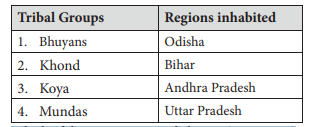
#90. Consider the following pairs:
Which of the pairs mentioned above is/are correct?
Tribal movements under British rule were the most
frequent, militant and violent of all movements. Many
Tribals from different regions rose under different leaders.
Some of them are:
Pair 1 is correct – Bhuyans are an ethnic group found
mainly in many districts of Odisha. The 2011 census
showed their population to be around 220,859. They areclassified as a Scheduled Tribe by the Indian government.
Bhuyan and Juang Rebellions by the Bhuyans, Juangs and
Kals started with the rst uprising was led by Ratna Nayak;
second uprising was led by Dharni Dhar Nayak (1867-68;
1891-93; Kheonjhar, Orissa); against the installation of a
British protege on the throne after the death of their raja
in 1867.
Pair 2 is incorrect – From 1837 to 1856, the Khonds of the
hilly tracts extending from Odisha to the Srikakulam
and Visakhapatnam districts of Andhra Pradesh
revolted against Company rule. Chakra Bisoi, a young
raja, led the Khonds who were joined by the Ghumsar,
Kalahandi and other tribals to oppose the suppression of
human sacrifice, new taxes, and the entry of zamindars into their areas. With Chakra Bisoi’s disappearance, the uprising came to an end.
Pair 3 is correct – The Koyas of the eastern Godavari
track (modern Andhra), joined by Khonda Sara chiefs,
rebelled in 1803, 1840, 1845, 1858, 1861 and 1862. They
rose once again in 1879-80 under Tomma Sora. Their
complaints were oppression by police and moneylenders,
new regulations and denial of their customary rights over
forest areas. After the death of Tomma Sora, another
rebellion was organised in 1886 by Raja Anantayyar.
Pair 4 is incorrect – In 1899-1900, the Mundas in the
region south of Ranchi rose under Birsa Munda. The
Ulgulan was one of the most signi cant tribal uprisings
in the period 1860-1920. The rebellion which began as
a religious movement gathered political force to ght against introduction of feudal, zamindari tenures, and
exploitation by money-lenders and forest contractors.
The Mundas claimed Chhotanagpur as their area in
1879. British armed forces were then deployed. Birsa
was captured and imprisoned. They are not from Uttar
Pradesh but Jharkhand.
#91. Consider the following statements with reference to the stand of Early Moderates on grievances of working-class during freedom struggle:
1. They differentiated between the labour in the Indian- owned factories and those in the Britishowned factories.
2. Early Moderates supported the Factory Acts of 1881 and 1891.
Which of the above given statements is/are correct?
The Indian working class suffered from the same kind
of exploitation witnessed during the industrialization of
Europe and the rest of the West, such as low wages, long
working hours, unhygienic and hazardous working
conditions, employment of child labour, and the absence
of basic amenities.
Statement 1 is correct: The early nationalists, especially
the Moderates were indifferent to the labour’s cause.
They did not take lead in supporting the labour
causes. They differentiated between the labour in the
Indian- owned factories and those in the British-owned
factories. They did not want a division in the movement
on the basis of classes.
Statement 2 is incorrect: Early Moderates believed that
labour legislations would affect the competitive edge
enjoyed by the Indian-owned industries. us, they did
not support the Factory Acts of 1881 and 1891.
#92. Consider the following statements with reference to the All-India Trade Union Congress during Indian freedom struggle:
1. All-India Trade Union Congress (AITUC) was influenced by the British Labour Party.
2. AITUC was a founding member of the World Federation of Trade Unions.
3. AITUC helped in getting the Trade Disputes and Trade Unions Act 1927 passed in the British Parliament.
Which of the statements given above is/are correct?
The All-India Trade Union Congress was founded
on October 31, 1920. The Indian National Congress
president for the year, Lala Lajpat Rai, was elected as the
first president of AITUC.
Statement 1 is correct: The AITUC was influenced by
social democratic ideas of the British Labour Party in the beginning. The Gandhian philosophy of non-violence,
trusteeship, and class-collaboration had great influence
on the labour class movement aided by AITUC.
Statement 2 is correct: The World Federation of Trade
Unions (WFTU) is an international federation of trade unions. WFTU was established in 1945 to replace the
International Federation of Trade Unions. AITUC was
one of the founder organisations of WFTU. Recently in 2020, AITUC celebrated the 75 years of creation of
WFTU.
Statement 3 is incorrect: The Trade Disputes Act 1929
was a British Act of Parliament passed in response to the
General Strike of 1926. AITUC did not support it at
all as it curtailed the rights of working class. Alarmed
at the increasing strength of the trade union movement
under extremist influence, the government resorted
to legislative restrictions. It made illegal the strikes
in public utility services like posts, railways, water and electricity unless notice was given. The Act declared unlawful secondary action and any strike whose purpose
was to coerce the government of the day directly or
indirectly.
#93. Consider the following statements with reference to the Eka Movement:
1. The Eka movement was spread around the districts of Allahabad, Baliya and Meerut in United Province.
2. It involved a ritual of taking vow of resistance with holy water of Ganga.
3. One of the key issues involved was high rents which was 50 per cent higher than the recorded rates.
Which of the statements given above is/are correct?
Eka Movement or Unity Movement was a peasant
movement in United Provinces during the end of 1921.
It was initially started by Congress and the Khalifat
movement and later headed by local leader Madari Pasi.
Statement 1 is incorrect: The Eka Movement was
spread around Hardoi, Bahraich and Sitapur (and not
Allahabad, Baliya and Meerut). The movement which
Madari Pasi built and led was called ‘Eka’ (unity) as it
was derived from his attempt to build a peasant class
consciousness bypassing the differences of religion and
caste.
Statement 2 is correct: All the meetings of the Eka
movement were preceded by the Katha (religious story
recitation), after which the peasants were asked to take
an oath over the Gita to make unity (Eka) and to follow
the charter of the movement. Further, the peasants were
supposed to swear over holy water from Ganga. They
vowed that they would pay only the recorded rent but
would pay it on time. They also decided that they would
not leave when evicted and refuse to do forced labour
among other vows.
Statement 3 is correct: One of the key issues in Eka
Movement was that of high rents. It was around 50 per
cent higher than the recorded rates, which the peasants
refused to pay. It was also a resistance movement against
oppression of thikadars in charge of revenue collection
and practice of share-rents.
#94. Consider the following statements with reference to Peasant Movements in 19th Century in Britishruled India:
1. Peasants’ demands during these movements were centred majorly on economic issues.
2. These peasant movements had continuity of struggle and long-term organisation.
Which of the above given statements is/are correct?
The impoverishment of the Indian peasantry was a direct
result of the transformation of the agrarian structure. In
these struggles against exploitative policies, the peasants
emerged as the main force, ghting directly for their own
demands.
Statement 1 is correct: Peasants emerged as the main
force in agrarian movements, fighting directly for their
own demands. The demands were centred almost wholly
on economic issues. The movements were directed
against the immediate enemies of the peasant—foreign
planters and indigenous zamindars and moneylenders.
The struggles were directed towards specifc and limited
objectives and redressal of particular grievances.
Colonialism was not the target of these movement.
Statement 2 is incorrect: There was a lack of an adequate
understanding of colonialism in these Peasant Struggles
in 19th Century. Their territorial reach was limited and there was no continuity of struggle or long-term
organisation. These struggles, however militant, occurred
within the framework of the old societal order lacking a
positive conception of an alternative society.
#95. Consider the following events during Indian Freedom Struggle:
1. Kukis’ Revolt
2. Zeliangsong Movement
3. Ahom Revolt
4. Heraka Cult
Select the correct chronological order of the abovegiven events starting from the earliest:
The correct order of the events is as followed:
Ahom Revolt (1828), Kukis’ Revolt (1917), Zeliangsong
Movement (1920s), Heraka Cult (1930)
The British had pledged to withdraw from Assam after
the First Burma War (1824–26). But, after the war, instead
of withdrawing, the British attempted to incorporate
the Ahoms’ territories in the Company’s dominion. is
sparked off Ahom rebellion in 1828.
Kukis’ Revolt (1917–19) was in Manipur against British
policies of recruiting labour during the rst World War.
Zeliangsong Movement (1920s) in Manipur was led
by the Zemi, Liangmei and Rongmei tribes. And it was
against the failure of British to protect them during
the Kuki violence in 1917–19. Heraka Cult (1930) in
Manipur was led by Rani Gaidinliu; but the movement
was suppressed.
#96. Consider the following statements with reference to Revolt of Moamarias in British ruled India:
1. It was raised against the authority of Ahom kings of Assam.
2. Moamarias were a group of downtrodden and low caste peasants.
Which of the above given statements is/are correct?
Revolt of Moamarias happened between the period of
1769–99 in Assam region which was then ruled by Ahom
Kings.
Statement 1 is correct: The Moamoria rebellion was
the 18th century uprising in Ahom kingdom of present day Assam that began as power struggle between the
Moamorias (Mataks), the adherents of the Moamara
Sattra, and the Ahom kings.
Statement 2 is correct: is rebellion was primarily
among the Moamoria Paiks against the Ahom kingdom.
e Moamarias were low-caste peasants who followed
the teachings of Aniruddhadeva (1553–1624), and
their rise was similar to that of other low-caste groups
in North India. Their revolts weakened the Ahoms and
opened the doors for others to attack the region,
#97. Consider the following statements with reference to the Civil Rebellion in Awadh during 1799:
1. Wazir Ali assembled an army of several thousand men against British in this rebellion.
2. The Massacre of Benares led to the occurrence of this rebellion.
3. All leaders of rebellion were hanged in public to serve as an example to other rebels.
Select the correct answer using the code given below:
The Civil Rebellion of Awadh occurred in 1799 and it was led by Wazir Ali Khan.
Statement 1 is correct: ough Wazir Ali Khan was
installed by British themselves, his relationship with
Britishers soon went south. He was quickly replaced
by Saadat Ali Khan II and he was granted a pension in
Benares. Ultimately, he rose in rebellion and raised an
army of several thousand men against British in this
rebellion. However, he was defeated by General Erskine.
Statement 2 is correct: In January 1799, Wazir Ali killed
a British resident, George Frederick Cherry, who had
invited him to lunch. Wazir Ali’s guards killed two other
Europeans and even attacked the Magistrate of Benares.
The whole incident became famous as the Massacre of
Benares. These series of events ultimately led to the Civil
Rebellion of Awadh.
Statement 3 is incorrect: After the defeat, Wazir Ali was
granted asylum by the King of Jaipur. Arthur Wellesley
requested the Raja of Jaipur to extradite Wazir Ali. Wazir
Ali was extradited on the condition that he would
neither be hanged nor be put in fetters. After surrender
in December 1799, he was placed in con nement (not
hanged in public) at Fort William, Calcutta.

