
Results
#1. is mass movement involves slow downslope flowing soil mass or fine-grained rock debris completely saturated with water. is process is quite common in moist temperate areas. When the upper portions get saturated and when the lower parts are impervious to water percolation, flowing occurs in the upper parts.
The mass movement described above is:
Option a is incorrect — Soil creep is the slow, downward progression of rock and soil down a low-grade slope. It can also refer to the slow deformation of such materials as a result of prolonged pressure and stress.
Option b is incorrect — Earth flow refers to the movement of water-saturated clayey or silty earth materials down low-angle terraces or hillsides. It is a rapid movement.
Option c is incorrect — Mudflow – In the absence of vegetation cover and with heavy rainfall, thick layers of weathered materials get saturated with water and either slowly or rapidly flow down along definite channels. It looks like a stream of mud within a valley.
Option d is correct – Solifluction is the gradual movement of wet soil or other material down a slope, especially where frozen subsoil acts as a barrier to the percolation of water. It involves slow downslope flowing soil mass or fine-grained rock debris completely saturated or lubricated with water. This process is quite common in moist temperate areas where surface melting of deeply frozen ground and long-continued rain respectively, occur frequently. When the upper portions get saturated and when the lower parts are impervious to water percolation, flowing occurs in the upper parts.
#2. Consider the following statements regarding various mass movements.
1. Solifiuction is a type of mass movement that is common in moist temperate areas.
2. Slump is included in the category of slow movement.
3. Mudflow is common in regions having thick vegetation cover.
Which of the statements given above is/are incorrect?
Statement 1 is correct. Solifluction involves slow downslope flowing soil mass or fine-grained rock debris saturated or lubricated with water. It is quite common in moist temperate areas where surface melting of deeply frozen ground and long continued rain occur frequently. When the upper portions get saturated and when the lower parts are impervious to water percolation, flowing occurs in the upper parts.
Statement 2 is incorrect. There are two classes of mass movements- Slow movements and Rapid movements. Slump is included in the category of Rapid movements. Slump is slipping of one or several units of rock debris with a backward rotation with respect to the slope over which the movement takes place.
Statement 3 is incorrect. Mud Flow is common in regions having no vegetation cover and having heavy rainfall. Thick layers of weathered materials get saturated with water and either slowly or rapidly flow down along definite channels. It looks like a stream of mud within a valley.
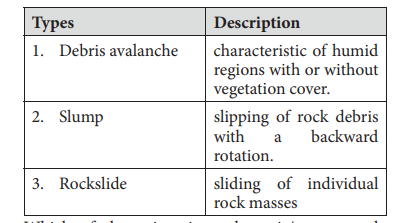
#3. Consider the following pairs of types of mass movements and their descriptions:
Which of the pairs given above is/are correctly matched?
Pair 1 is correctly matched. Debris avalanche, which is more characteristic of humid regions with or without vegetation cover and occurs in narrow tracks on steep slopes. This debris avalanche can be much faster than the mudflow. Debris avalanche is similar to snow avalanche.
Pair 2 is correctly matched. Slump is slipping of one or several units of rock debris with a backward rotation with respect to the slope over which the movement takes place. Rapid rolling or sliding of earth debris without backward rotation of mass is known as debris slide.
Pair 3 is correctly matched. Sliding of individual rock masses down bedding, joint or fault surfaces is rockslide. Over steep slopes, rock sliding is very fast and destructive.
#4. With reference to the mass movements, consider the following statements:
1. Mass movements are very active over weathered slopes rather than over un-weathered materials.
2. Rapid movements are mostly prevalent in humid climatic regions.
Which of the statement given above is/are correct?
Statement 1 is correct. Mass movements transfer the mass of rock debris down the slopes under the direct influence of gravity. It may range from slow to rapid, affecting shallow to deep columns of materials and include creep, flow, slide and fall. Mass movements are very active over weathered slopes rather than over un-weathered materials.
Statement 2 is correct. Rapid mass movements are mostly prevalent in humid climatic regions and occur over gentle to steep slopes. Earthflow, mudflow, debris avalanche are some of the rapid movements.
#5. With reference to landslides, consider the following statements:
1. Landslide is a sudden mass movement of soil.
2. Landslide occur due to loss of balance of land mass with respect to gravity.
Which of the statements given above is/are incorrect?
Statement 1 is correct. The sudden mass movement of soil is called a landslide. These are relatively rapid and perceptible movements. The materials involved are relatively dry. The size and shape of the detached mass depends on the nature of discontinuities in the rock, the degree of weathering and the steepness of the slope.
Statement 2 is correct. Landslides occur due to instability or loss of balance of land mass with respect to gravity. The loss in balance occurred mainly due to excessive water or moisture in the earth mass. Gravity acts on such an unstable landmass and causes the large chunks of surface materials such as soil and rocks to slide down rapidly.
#6. These are the gently inclined rocky floors that form close to the mountains at their foot. These can be with or without a thin cover of debris. These rocky floors formed through the erosion of the mountain front through a combination of lateral erosion by streams and sheet flooding. These erosional landform features are known as:
Due to persistent movement of wind current in one direction weathered mantle from rocks or soil gets blown out. ‘Ihis process may create a shallow depression called as deflation hollows.
Option b is correct. Gently inclined rocky floors close to the mountains at their foot with or without a thin cover of debris are called pediments. Such rocky floors form through the erosion of the mountain front through a combination of lateral erosion by streams and sheet flooding.
Option c is incorrect. Playas are by far the most prominent landforms in the deserts. ‘lhere is a gradual deposition of sediment from basin margins, a nearly level plain forms at the centre of the basin. In times of sufficient water, this plain is covered up by a shallow water body. Such types of shallow lakes are called as playas. Water is retained only for a short duration due to evaporation.
Option d is incorrect. Wind deflation and abrasion wore out the rocks of the deserts leaving behind some remnants of resistant rocks. It is polished beautifully in the shape of a mushroom with a slender stalk and a broad and rounded pear-shaped cap above. Sometimes, the top surface is broad like a tabletop and quite often, the remnants stand out like pedestals.
#7. Which of the following landforms are formed by running water?
1. Gully
2. Cirques
3. Ravine
4. Moraines
Select the correct answer using the code given below:
The landforms created as a result of degradational action (erosion and transportation) or aggradational work (deposition) of running water are called fluvial landforms.
Statement 1 is correct A gully is a landform created by running water. Gullies resemble large ditches or small valleys but are metres to tens of metres in depth and width.
Statement 2 is incorrect A cirque is basically a bowl- shaped depression formed by the erosional activity of a glacier. Alternative names for this landform are corrie and cwm.
Statement 3 is correct A ravine is a landform narrower than a canyon and is often the product of stream cutting erosion. Ravines are typically classified as larger in scale than gullies, although smaller than valleys.
Statement 4 is incorrect Moraines are accumulations of dirt and rocks that have fallen onto the glacier surface or have been pushed along by the glacier as it moves. ‘The dirt and rock composing moraines can range in size from powdery silt to large rocks and boulders.
#8. Which of the following are depositional landforms?
1. Moraines
2. Barchans
3. Hanging valley
4. Sink holes
Select the correct answer using the code given below:
Statement 1 is correct. Moraines – Depositional glaciers: moraines, drumlins, eskers, landform by outwash plain, etc. Moraines are long ridges of deposits of glacial till.
Statement 2 is correct. Barchans – Depositional landform by Wind: Sand dunes, Ripple marks, Barchans, etc. Barchans are Crescent shaped dunes with the points or wings directed away from wind direction i.e., downwind.
Statement 3 is incorrect. Hanging valley is an erosional feature. A characteristic feature of glaciated mountain topography, a hanging valley is a tributary to a main valley which has been deeply scoured by glacial ice, leaving the tributary valley “hanging” above the main valley.
Statement 4 is incorrect. Sinkholes are cavities in the ground that form when water erodes an underlying rock layer. It is an erosional feature.
#9. Consider the following statements:
1. Structural Plains are formed by the deposition of materials brought by various agents of transportation.
2. Erosional Plains are formed by horizontally bedded rocks which are relatively undisturbed by the crustal movements of the earth.
3. Erosional plains are hardly smooth and therefore also called as peneplains.
Which of the statements given above is/are correct?
Statement 1 is incorrect. Structural plains are relatively undisturbed horizontal surfaces of the Earth. They are structurally depressed areas of the world that make up some of the most extensive natural lowlands on the Earth’s surface. Example- Great Plains of USA
The difference between structural plains and depositional plains is that the structural plains are relatively undisturbed plains and depositional plains are continuously happening as forces of deposition like wind, water etc. are constantly at work
Statement 2 is incorrect. Erosional Plains are formed by the continuous and a long-time erosion of all sorts of upland.
Depositional Plains are formed by the deposition of materials brought by various agents of transportation.
Statement 3 is correct. The surface of erosional plains is hardly smooth. These are therefore also called peneplains which mean almost a plain.
#10. With reference to fluvial landforms, consider the following statements:
1. Alluvial fans are formed when streams flowing from higher levels break into foot slope plains of low gradient.
2. Point bars are formed on the concave side of the meanders of large rivers.
3. In the old stage of a river, shallow V-shaped valleys are formed due to high speed of water flow.
Which of the above statements are correct?
Statement 1 is correct. An alluvial fan is a triangle- shaped deposit of gravel, sand, and even smaller pieces of sediment, such as silt. This sediment is called alluvium. Alluvial fans are usually created as flowing water interacts with mountains, hills, or the steep walls of canyons. They are formed when streams flowing from higher levels break into foot slope plains of low gradient.
Statement 2 is Incorrect. Point Bar is formed by alluvium that accumulates in a linear fashion on the inside bends of streams and rivers below the slip-off slope.Point bars are also known as meander bars. They are found on the convex side of meanders of large rivers and are sediments deposited in a linear fashion by flowing waters along the bank.
Statement 3 is Incorrect. Shallow V-shaped valleys are formed in the youthful stage of the river because the river flows at high velocity and has the requisite power to cut valleys in rocks which is not possible in the old stage of river where the flow of water is very slow.
#11. Which of the following country is not part of the drainage basin of the river Nile?
‘The drainage basin of the Nile river covers 1 1 countries: Egypt, Sudan, South Sudan, Eritrea, Ethiopia, Kenya, Congo, Burundi, Rwanda, Uganda and Tanzania.
#12. With reference to different stages of River flow, which of the following statements is/are correct?
1. Rapids and cataracts are more common in youthful stage of river.
2. Meander becomes more pronounced in the mature stage of the river.
3. River Piracy is a common feature observed in valley course.
Select the correct answer using the code given below:
Statement 1 is correct. When a river runs over alternating layers of hard and soft rock, rapids may form. Due to the unequal resistance of hard and soft Rocks the outcrop of hard rock may cause a river to jump or fall down a stream forming rapids. Similar falls of greater dimensions are also referred to as cataracts. Rapids and cataracts may occur at any part of river course, but they are most common in the youthful stage of the river.
Statement 2 is incorrect. A meander is a winding curve or bend in a river. Meanders are the result of both erosional and depositional processes. ‘They are typical of the middle and lower course of a river. This is because vertical erosion is replaced by lateral erosion, plus deposition within the floodplain. In the lower course (old stage) of the river the meanders become more pronounced.
Statement 3 is incorrect. River Piracy is a common feature observed in the mountain course of the river or the youthful stage of river.If a greater gradient stream (Stream A) enlarges its own basin at the expense of the weaker stream (Stream B) due to its greater erosive power. ‘Ihen it is called river piracy i.e., stream A captures or pirates stream B.
#13. Consider the following statements with reference to River systems:
1. In the mountain course the predominant action of river is lateral erosion.
2. Vertical erosion dominates in the valley course.
3. Deposition is the major activity of river in the middle course.
Which of the statements given above is/are incorrect?
Statement 1 is incorrect: In the upper or mountain course the predominant action of river is vertical erosion. The valley developed is deep, narrow and V-shaped. Down cutting takes place so rapidly that lateral erosion cannot keep pace.
Statement 2 is incorrect: In the middle or valley course lateral erosion tends to replace vertical erosion. Active erosion of banks widens the V-shaped valley. The work of the river is predominantly transportation with some deposition.
Statement 3 is incorrect: The work of the river is predominantly transportation with some deposition in the middle or valley course. In the lower or plain course, the work of river is mainly deposition.
#14. Which of the following conditions are favorable for the formation of a ‘delta’?
1. Active vertical and lateral erosion in the upper course of the river.
2. Unsheltered Coast with higher activities of tides.
3. Sea adjoining the delta to be shallow.
4. Presence of strong current running right angles to the river mouth.
Select the correct answer using the code given below:
When a river reaches the sea, the fine materials it has not yet dropped are deposited at its mouth, forming a fan- shaped alluvial area called a delta.
The following are conditions necessary for formation of river delta:
1. Active vertical and lateral erosion in the upper course of the river. The river needs to have enough material to deposit at the river mouth otherwise all materials will be eroded by ocean current or being deposited before they reach the river mouth.
2. Sheltered Coast with low to no activities of tides (tideless)
3. Sea adjoining the delta to be shallow or the load will disappear in the deep waters
4. There should be no strong current running right angles to the river mouth, washing away the diluents.

