
Results
#1. Mahatma Gandhi said that some of his deepest convictions were reflected in a book titled, “Unto this Last’’ and the book transformed his life. What was the message from the book that transformed Mahatma Gandhi ?
Mohandas Gandhi translated Unto is Last into Gujarati in 1908 under the title of Sarvodaya (Well Being of All). He summarised Unto is Last’s teachings in these three points:
1. at the good of the individual is contained in the good of all.
2. at a lawyer’s work has the same value as the barber’s, inasmuch as all have the same right of earning their livelihood from their work.
3. at a life of labour, i.e., the life of the tiller of the soil and the handicraftsman, is the life worth living.
#2. Annie Besant was
1. responsible for starting the Home Rule Movement
2. the founder of the eosophical Society
3. once the President of the Indian National Congress
Select the correct statement/statements using the codes given below:
Statement 1 is correct. Annie Besant along with Bal Gangadhar Tilak had formed and led the Home Rule Movement (1916-1918) . It was based on the lines of Irish Home Rule League aimed at achieving self-government and dominion status within British Empire.
Statement 2 is incorrect. eosophical Society was founded in New York by Madam Blavatsky and Henry Steel Olcott and was later shifted to Adyar Chennai. The founders of this organization were inspired by Indian thought and culture.
Statement 3 is correct. She became the first woman president of Indian National Congress when she presisded over the 1917 Calcutta Session.
#3. The Partition of Bengal made by Lord Curzon in 1905 lasted until [
The Partition of Bengal made by Lord Curzon in 1905 lasted until 1911, when King George V announced to annul the partition of Bengal at the Royal Darbar in Delhi in 1911. It was decided to annul the partition of Bengal in 1911 mainly to curb the menace of revolutionary terrorism.
The Partition of Bengal was a territorial reorganization of the Bengal Presidency implemented by the authorities of the British Raj in 1905. The decision had come after Lord Curzon claimed that Bengal was too large to be governed effectively.
On 22 March 1911, a royal proclamation announced that the Durbar would be held in December to commemorate the coronation in Britain a few months earlier of King George V and Queen Mary and allow their proclamation as Emperor and Empress of India. Without public forewarning, the announcement of the move of India‘s capital from Calcutta to Delhi was also made at the Durbar. King George V also announced to annul the partition of Bengal
#4. The Ghadr (Ghadar) was a
The Ghadar party was found in San Francisco by Lala Hardayal, Sohan Singh Bakhna, Mohammed Barkattullah etc. Shortly after the outbreak of World War I, many of the Ghadrites returned to India and for several months during 1915 carried on terrorist activities in central Punjab. Ghadar Party was associated with the Ghadar mutiny which was meant to overthrow the British rule from India.
#5. The ‘Swadeshi’ and ‘Boycott’ were adopted as methods of struggle for the first time during the
To meet the growing nationalist challenge in eastern India, on 19 July, 1905 the Government of India announced its decision to form the new province of “Eastern Bengal and Assam”, comprising the Chittagong, Dacca and Rajshahi divisions, Hill Tippera (Tripura) , Malda and Assam. The province came into existence on 16 October, 1905, by breaking up Bengal and it Bengali speaking people.
In the beginning the leaders resorted to sharp press campaigns against the partition scheme, numerous public meetings in opposition to it and the drafting of petitions to the Government for annulment. However, they realized t it made no effect on the indifference of the authorities.
This led to a search for new techniques from the middle of 1905 and resulted in the discovery of the boycott of British goods as an effective weapon. The boycott of British products was followed by the advocacy of swadeshi (Indian-made) or exhorting purchasers to buy indigenously produced goods as a patriotic duty. us, Swadeshi and Boycott started against Partition of Bengal in 1905. It also showcase the rich swadeshi tradition of culture, art, literature, music and science.
#6. He wrote biographies of Mazzini, Garibaldi, Shivaji and Shrikrishna; stayed in America for some time; and was also elected to the Central Assembly. He was
Lala Lajpat Rai was proli c writer and authored several works like – “Unhappy India”, “Young India: An Interpretation”, “History of Arya Samaj”, “England’s Debt to India”. He also wrote several biographies of Mazzini (Life of Mazzini) , Garibaldi, Shivaji (Chatrapati Shivaji) and Hindu god Shri Krishna (Yogiraj Shrikrishna) . His purpose in selecting Mazzini and Garibladi was to infuse patriotic sentiment in the youth of Punjab, who had no access to books in English.
In 1917, Rai moved to the United States during the First World War and founded the Indian Home Rule League of America in New York. He stayed in the United States from 1917 to 1920. Rai returned to India in 1920 and in the following year led the special session of the Indian Congress Party that launched the non-co-operation movement. He joined Swaraj Party in 1926 and was elected as its Deputy Leader in the Central Legislative Assembly.
#7. With reference to Swadeshi Movement consider the following statements:
1. It contributed to the revival of the indigenous artisan crafts and industries.
2.The National Council of Education was established as a part of Swadeshi Movement.
Which of the statements given above is/are correct?
Statement 1 is correct. The Swadeshi Movement included boycott and public burning of foreign goods and contributed to the revival of the indigenous artisan crafts and industries. The Swadeshi Movement celebrated our indigenous fabrics, weavers and the country’s artisans. August 7 has been chosen as National Handloom Day as it was the day that the Swadeshi Movement was started in 1905.
Self-reliance or ‘atma shakti’ was encouraged. The swadeshi spirit also found expression in the establishment of swadeshi textile mills, soap and match factories, tanneries, banks, insurance companies, shops, etc.
The Swadeshi Movement had its genesis in the antipartition movement which was started to oppose the British decision to partition Bengal. On August 7, 1905, with the passage of the Boycott Resolution in a massive meeting held in the Calcutta Townhall, the formal proclamation of Swadeshi Movement was made.
Statement 2 is correct. The National Council of Education – Bengal (or NCE – Bengal) was an organisation founded by Indian nationalists in Bengal in 1906 as part of the Swadeshi Movement.
It was set up to organise a system of education— literary, scienti c and technical—on national lines and under national control.
During Swadeshi Movement, a Bengal Institute of Technology was set up for technical education and funds were raised to send students to Japan for advanced learning. Also, the Bengal National College, inspired by Tagore’s Shantiniketan, was set up with Aurobindo Ghosh as its principal.
#8. He wrote biographies of Mazzini, Garibaldi, Shivaji and Shrikrishna; stayed in America for some time; and was also elected to the Central Assembly. He was
Lala Lajpat Rai was proli c writer and authored several works like – “Unhappy India”, “Young India: An Interpretation”, “History of Arya Samaj”, “England’s Debt to India”. He also wrote several biographies of Mazzini (Life of Mazzini) , Garibaldi, Shivaji (Chatrapati Shivaji) and Hindu god Shri Krishna (Yogiraj Shrikrishna) . His purpose in selecting Mazzini and Garibladi was to infuse patriotic sentiment in the youth of Punjab, who had no access to books in English.
In 1917, Rai moved to the United States during the First World War and founded the Indian Home Rule League of America in New York. He stayed in the United States from 1917 to 1920. Rai returned to India in 1920 and in the following year led the special session of the Indian Congress Party that launched the non-co-operation movement. He joined Swaraj Party in 1926 and was elected as its Deputy Leader in the Central Legislative Assembly.
#9. With reference to the book ‘Desher Katha’ written by Sakharam Ganesh Deuskar during the freedom struggle, consider the following statements:
1. It warned against the Colonial State’s hypnotic conquest of the mind.
2. It inspired the performance of swadeshi street plays and folk songs.
3.The use of ‘desh’ by Deuskar was in the speci c context of the region of Bengal.
Which of the statements given above are correct?
Statement 1 is correct and 3 is incorrect. Desher Katha was written by Sakharam Ganesh Deuskar describing about the commercial and industrial exploitation of India by the Britishers. ough the book was written in 1904, it was during anti-partition agitation that it gained wide publicity.
Statement 2 is correct. He became a household name during Swadeshi Movement because of the down to earth writing style and inspired many plays and fold songs during Swadesh Movement. In this book he summarized and popularised the ideas of Dababhai Naoroji, M.G.Ranade, R.C.Dutt and William Digby, and warned in its final chapter against the hypnotic conquest of the mind. e book was proscribed in 1910.
#10. Consider the following freedom fighters:
1. Barindra Kumar Ghosh
2. Jogesh Chandra Chatterjee
3. Rash Behari Bose
Who of the above was/were actively associated with the Ghadar Party?
Indian revolutionaries in the United States of America and Canada had established the Ghadar (Rebellion) Party in 1913. While most of the members of the party were Sikh peasants and soldiers, their leaders were mostly educated Hindus or Muslims.
Some of the prominent Ghadar leaders were: Baba Gurmukh Singh, Kartar Smgh Saraba, Sohan Singh Bhakna, Rahmat Ali Shah, Bhai Parmanand, and Mohammad Barkatullah. Other revolutionaries were active in India and abroad.
In 1915, during an unsuccessful revolutionary attempt, Jatin Mukerjea popularly known as „Bagha Jatin gave his life ghting a battle with the police at Balasore. Rash Bihari Bose, Raja Mahendra Pratap, Lala Hardayat, Abdul Rahim, Maulana Obaidullah Sindhi, Champak Raman Pillai, Sardar Singh Rana, and Madam Cama were some of the prominent Indians Ghadar Leaders who carried on revolutionary activities and propaganda outside India
#11. With reference to Indian freedom struggle, what was ‘Vandematram Movement’?
Swadeshi movement was also called Vandematram movement. It was a movement against the partition of Bengal. In 1905 Viceroy Curzon partitioned Bengal which infuriated all sections of the Congress – the Moderates and the Radicals. Large public meetings and demonstrations were organised and novel methods of mass protest developed. The Swadeshi movement sought to oppose British rule and encourage the ideas of self-help, swadeshi enterprise, national education, and use of Indian languages. To ght for swaraj, the radicals advocated mass mobilisation and boycott of British institutionsand goods.
#12. With reference to the leaders having extremists’ ideologies, consider the following statements:
1. Tilak’s ‘Swaraj’ was aimed at complete Independence of India from foreign rule.
2. Sri Aurobindo developed the theory of passive resistance in India.
Which of the statements given above is/are correct?
Statement 1 is incorrect: There was a lack of consistency among extremist goals in Indian freedom struggle from leaders to leaders—Aurobindo, Tilak, B.C. Pal and Lala Lajpat Rai. For example, Tilak, swaraj meant some sort of self-government, whereas, Aurobindo’s meant for complete independence from foreign rule.
Statement 2 is correct: The new party of the radicals wanted to use new methods against the government to secure political rights for the Indian people. Aurobindo thought that the method of passive resistance, which was used by the Irish nationalists, would be ideal for India. Hence, he developed theory of passive resistance in a series of articles published in the weekly called ‘Bande Mataram”.
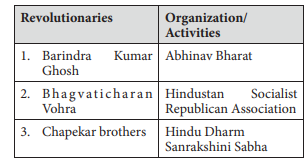
#13. Consider the following pairs:
Which of the pairs given above is/are correctly matched?
Pair 1 is incorrectly matched. First revolutionary groups were organized in 1902 in Midnapore under Jnanendranath Basu and in Calcutta, the Anushilan Samiti (and not Abhinav Bharat) was founded by Promotha Mitter, including Jatindranath Banerjee, Barindra Kumar Ghosh and others.
Whereas V D Savarkar and his brother organized Mitra Mela, a secret society, in 1899 which merged with Abhinav Bharat (after Mazzinni’s ‘Young Italy’) in 1904. Soon Nasik, Poona and Bombay emerged as centres of bomb manufacture.
Pair 2 is correctly matched. Determined to overcome Kakori setback, the younger revolutionaries, inspired by socialist ideas, set out to reorganize Hindustan Republican Association (HRA) at a historic meeting in the ruins of Ferozshah Kotla in Delhi in 1928. Under the leadership of Chandra Shekhar Azad, name of HRA was changed to Hindustan Socialist Republican Association (HSRA). The participants included Bhagat Singh, Sukhdev, Bhagvaticharan Vohra among others.
Pair 3 is correctly matched. Tilak’s speeches, writings and activities inspired the young Chapekar brothers to form Hindu Dharm Sanrakshini Sabha, which was responsible for the assassination of several hated British officers.
#14. With reference to the religious views of Lokmanya Tilak, which one of the following statements is correct?
Option d is correct. Tilak believed in organic, evolutionary and spontaneous reforms. He insisted upon gradual reforms inspired by and rooted in the heritage of the people. He believed that the human society is always in a state of flux and can change only in a gradual manner. Never is there a sudden and total break with the past. If sudden and total break with the past is arti cial, it is always rejected. is in turn creates disorder in society.
#15. In the context of literary history of India, ‘Rajsimha’, ‘Anand Math’ and ‘Devi Chaudhurani’ were written by which among the following?
‘Rajsimha’, ‘Anand Math’ and ‘Devi Chaudhurani’ were written by Bankim Chandra Chattopadhyay.
Bankim Chandra Chatterjee or Chattopadhyay was a famous Bengali writer. His famous novels include Durgeshnandini, Kapalkundala (1866), Mrinalini (1869), Vishbriksha (1873), Chandrasekhar (1877), Rajani (1877), Rajsimha (1881), and Devi Chaudhurani (1884). Bankim Chandra Chatterjee’s most famous novel was Anand Math (1882). Anand Math contained the song “Bande Mataram”, which was later adopted as National Song of India.
#16. With reference to the Pagri Sambhaal Movement of 1907, consider the following statements:
1. Sir Chotu Ram was the founder of the Pagri Sambhaal Movement.
2. It was mainly a farmers’ agitation with a demand to repeal certain laws related to agriculture.
3.The agitation remained non-violent throughout its existence.
Which of the statements given above is/are correct?
Statement 1 is incorrect. Ajit Singh, uncle of freedom ghter Bhagat Singh, was the founder of the Pagri Sambhaal movement of 1907.
Statement 2 is correct. Pagrhi Sambhaal Jatta was a successful farm agitation that forced the British government to repeal three laws related to agriculture back in 1907. e three farm-related acts at the centre of the storm in 1907 were the Punjab Land Alienation Act 1900, the Punjab Land Colonisation Act 1906 and the Doab Bari Act.
Statement 3 is incorrect. The agitation couldn’t remain non-violent. The agitation became violent after Ajit Singh was booked for sedition after his speech at a public meeting in Rawalpindi on April 21, 1921. ere were riots in Rawalpindi, Gujranwala, Lahore, etc. British personnel were manhandled, mud was flung at them, offices and churches were burnt, telegraph poles and wires cut.
#17. “Swaraj or self-government is essential for the exercise of swadharma. Without swaraj there could be no social reform, no industrial progress, no useful education, no ful lment of national life. at is what we seek, that is why God has sent us to the world to fulfil Him.”
Who said the above statement?
Bal Gangadhar Tilak has said that the ‘swaraj is my birthright’ and “Swaraj or self-government is essential for the exercise of swadharma. Without swaraj there could be no social reform, no industrial progress, no useful education, no fulfilment of national life. at is what we seek, that is why God has sent us to the world to ful l Him.”
#18. How the rediscovery of India’s past played a key role in the growth of modern nationalism?
The historical researches by European scholars, such as Max Mueller, Monier Williams, Roth and Sassoon, and by Indian scholars such as R.G. Bhandarkar, R.L. Mitra and later Swami Vivekananda, created an entirely new picture of India’s past. is picture was characterised by well-developed political, economic and social institutions, a flourishing trade with the outside world, a rich heritage in arts and culture and numerous cities. The theory put forward by European scholars, that the Indo-Aryans belonged to the same ethnic group from which other nations of Europe had evolved, gave a psychological boost to the educated Indians. The self-respect and confidence so gained helped the nationalists to demolish colonial myths that India had a long history of servility to foreign rulers.
#19. Consider the following events:
1. Founding of Mitra Mela
2. Deportation of Natu brothers without a trial
3. Enactment of Indian Official Secrets Act
4. Formal proclamation of Swadeshi movement
Which of the following is the correct chronological sequence of the above events?
Event 2. 1897 – e Natu brothers were deported without trial and Tilak and others, imprisoned on charges of sedition.
Event 1. 1899 – Savarkar and his brother organised Mitra Mela, a secret society, in 1899 which merged with Abhinav Bharat (after Mazzinni’s ‘Young Italy’) in 1904.
Event 3. 1904 – Indian Official Secrets Act was enacted to curb freedom of press during tenure of Lord Curzon.
Event 4. On August 7, 1905, with the passage of the Boycott Resolution in a massive meeting held in the Calcutta Townhall, the formal proclamation of Swadeshi Movement was made.
#20. With reference to the militant nationalist in British India, which of the following are the basic tenets of this school of thought?
1. Swaraj to be the goal of national movement.
2. Belief in capacity of the masses to challenge the authority.
3. Organising assassinations of unpopular officials.
4. To be ready for personal sacrifices.
Select the correct answer using the code given below:
Statements 1, 2 and 4 are correct. A radical trend of a militant nationalist approach to political activity started emerging in the 1890s and it took a concrete shape by 1905. They advocated a more militant approach to political work. These included Raj Narain Bose, Ashwini Kumar Datta, Aurobindo Ghosh and Bipin Chandra Pal in Bengal; Vishnu Shastri Chiplunkar and Bal Gangadhar Tilak in Maharashtra; and Lala Lajpat Rai in Punjab. Tilak emerged as the most outstanding representative of this school of thought. The basic tenets of this school of thought were:
1. hatred for foreign rule; since no hope could be derived from it, Indians should work out their own salvation;
2. swaraj to be the goal of national movement;
3. direct political action required;
4. belief in capacity of the masses to challenge the authority;
5. personal sacrifices required and a true nationalist to be always ready for it.
Statement 3 is incorrect. The revolutionaries opted to follow in the footsteps of Russian nihilists or the Irish nationalists. is methodology involved individual heroic actions, such as organising assassinations of unpopular officials and of traitors and informers among the revolutionaries themselves; conducting swadeshi dacoities to raise funds for revolutionary activities; and (during the First World War) organising military conspiracies with expectation of help from the enemies of Britain.
#21. Which of the following statements is incorrect regarding Anti-partition campaign under Moderates?
Statement a is correct. The methods adopted were petitions to the government, public meetings, memoranda, and propaganda through pamphlets and newspapers such as Hitabadi, Sanjibani and Bengalee.
Statement b is correct. In the period 1903-1905, the leadership to Anti partition campaign was provided by men like Surendranath Banerjea, K.K. Mitra and Prithwishchandra Ray.
Statement c is correct. Their objective was to exert suffcient pressure on the government through an educated public opinion in India and England to prevent the unjust partition of Bengal from being implemented.
Statement d is incorrect. Congress volunteer corps emerged as the parallel police during Non Cooperation movement and not the anti-partition campaign under the Moderates.

#22. Consider the following pairs:
Which of the pairs given above is/are correctly matched?
Statement 1 is correct. Banaras Session of congress was under the Presidentship of Gopal Krishna Gokhale. Here a relatively mild resolution condemning the partition of Bengal and the reactionary policies of Curzon and supporting the swadeshi and boycott programme in Bengal was passed.
Statement 2 is correct. Calcutta Session of congress Dadabhai Naoroji was elected as the president and as a concession to the militants, the goal of the Indian National Congress was defined as ‘swarajya or selfgovernment’ like the United Kingdom or the colonies of Australia and Canada. Also, a resolution supporting the programme of swadeshi, boycott and national education was passed. The word swaraj was mentioned for the rst time, but its connotation was not spelt out.
Statement 3 is incorrect. At the Nagpur session (1920) of the Indian National Congress, an important change was made in the Congress creed: now, instead of having the attainment of self-government through constitutional means as its goal, the Congress decided to have the attainment of swaraj through peaceful and legitimate means, thus committing itself to an extraconstitutional mass struggle.
At surat session (1907), moderates lost no time in reiterating Congress’ commitment to the goal of selfgovernment within the British Empire and to the use of constitutional methods only to achieve this goal.
#23. Swadeshi movement put forward several fresh ideas and methods, which of the following was/ were the methods and new forms of struggle used in swadeshi movement?
1. Corps of Volunteers or ‘Samitis’
2. Use of Traditional Popular Festivals and Melas.
3. Non-cooperation and passive resistance.
Select the correct answer using the code given below:
Statement 1 is correct. Samitis such as the Swadesh Bandhab Samiti of Ashwini Kumar Dutta (in Barisal) emerged as a very popular and powerful means of mass mobilization. In Tirunelveli, Tamil Nadu, V.O. Chidambaram Pillai, Subramania Siva, and some lawyers formed the Swadeshi Sangam which inspired the local masses. ese samitis generated political consciousness among the masses through magic lantern lectures, swadeshi songs, providing physical and moral training to their members, social work during famines and epidemics, organization of schools, training in swadeshi crafts and arbitration courts.
Statement 2 is correct. The idea was to use traditional festivals and occasions as a means of reaching out to the masses and spreading political messages. For instance, Tilak’s Ganapati and Shivaji festivals became a medium of swadeshi propaganda not only in western India, but also in Bengal. In Bengal also, the traditional folk theatre forms were used for this purpose.
Statement 3 is incorrect. Non-cooperation and passive resistance remained mere ideas.
#24. Consider the following statements regarding Ghadar movement:
1.The revolutionaries in Ghadar movement were mainly peasants.
2. Its headquarters was established at Vancouver.
3.The Ghadar programme was to bring about a simultaneous revolt in all British colonies.
4. It followed secular approach in preaching militant nationalism.
Which of the statements given above is/are correct?
Statement 1 is correct. The revolutionaries in Ghadar movement were mainly ex-soldiers and peasants who had migrated from the Punjab to the USA and Canada in search of better employment opportunities.
Statement 2 is incorrect. The headquarter of Ghadar was Yugantar Ashram established in San Francisco.
Statement 3 is correct. The Ghadr programme was to organise assassinations of officials, publish revolutionary and anti-imperialist literature, work among Indian troops stationed abroad, procure arms and bring about a simultaneous revolt in all British colonies.
Statement 4 This correct. is movement followed a secular approach in preaching militant nationalism. e weekly newspaper Ghadr was printed in Urdu and Gurumukhi.
#25. Consider the following statements regarding Morley Minto reforms, 1909:
1. It introduced the responsible form of government.
2. One Indian was to be appointed to the viceroy’s executive council.
3. Non official majority was introduced in Central Legislative council.
4. Representation in excess of the strength of their population was accorded to the Muslims.
Which of the statements given above is/are correct?
Statement 1 is incorrect. Responsible government was not introduced by Morley Minto reforms of 1909. Resolutions passed by legislatures may or may not be accepted. Veto power of Governor general still exists.
Statement 2 is correct. One Indian was to be appointed to the viceroy’s executive council (Satyendra Sinha was the rst Indian to be appointed in 1909).
Statement 3 is incorrect. The number of elected members in the Imperial Legislative Council and the Provincial Legislative Councils was increased. In the provincial councils, non-official majority was introduced, but since some of these non-officials were nominated and not elected, the overall non-elected majority remained.
Statement 4 is correct. Besides separate electorates for the Muslims, representation in excess of the strength of their population was accorded to the Muslims. Also, the income qualification for Muslim voters was kept lower than that for Hindus.
#26. Which of the following are the impacts of Home Rule League Movement?
1. August 1917 declaration was influenced by the Home Rule League movement.
2. It was manly confined to educated elites.
3. It lent a new dimension and a sense of urgency to the national movement.
4. It prepared the masses for politics of the Gandhian style.
Select the correct answer using the code given below:
The Home Rule Leagues and the associated activities had some positive effects and contributed to the fresh direction that the freedom struggle was to take in the coming years.
1. The movement shifted the emphasis from the educated elite to the masses and permanently deflected the movement from the course mapped by the Moderates. Hence,
Statement 2 is incorrect. 2. It created an organizational link between the town and the country, which was to prove crucial in later years when the national movement entered its mass phase in a true sense.
3. It created a generation of ardent nationalists.
4. It prepared the masses for politics of the Gandhian style. Hence, Statement 4 is correct.
5. The August 1917 declaration of Montagu and the Montford reforms were influenced by the Home Rule agitation. Hence, Statement 1 is correct.
6. The efforts of Tilak and Annie Besant towards the Moderate-Extremist reunion at Lucknow (1916) revived the Congress as an effective instrument of Indian nationalism.
7. The home rule movement lent a new dimension and a sense of urgency to the national movement. Hence, Statement 3 is correct.
#27. What does the term “bhadralok” with reference to British India refer to?
Bhadralok an elitist social class of ‘gentlefolk’ that emerged through the processes of social changes brought under the impact of British colonial rule. They mostly belonged to the upper and middle caste and classes. It included the clerical, commercial and the new landed class, who built their fortune through their association and transactions with the Europeans. They amassed wealth after coming in contact with the Europeans, and being influenced by them, they became indifferent about religion and culture of their forefathers. Most members of the bhadralok class are upper caste, mainly Brahmins, Kayasthas , Baidyas and later Mahishyas.
#28. What was/were the reason(s) behind Muslim League signing the Lucknow Pact of 1916?
1. Britain’s refusal to help Turkey in the Balkans Wars.
2.The refusal of the British to set up the Aligarh Muslim University with powers to affiliate colleges.
3. Goal of self-government.
Select the correct answer using the code given below:
Statements 1, 2 and 3 are correct. In the Lucknow session of 1916, the Muslim League and Congress came together and presented common demands by them to the government. A major reason for this shift in the League’s position was Britain’s refusal to help Turkey (ruled by the Khalifa who claimed religio-political leadership of Muslims) in its wars in the Balkans (1912-13) and with Italy (during 1911) had angered the Muslims
. Other reasons were:
1. The refusal of the British government in India to set up a university at Aligarh with powers to affiliate colleges all over India also alienated some Muslims. But later in 1920, Aligarh Muslim University (AMU) was established. Aligarh Muslim University (AMU) was established.
2. Annulment of partition of Bengal in 1911 had annoyed those sections of the Muslims who had supported the partition.
3. The Calcutta session of the Muslim League (1912) had committed the League to “working with other groups for a system of self-government suited to India, provided it did not come in conflict with its basic objective of protection of interests of the Indian Muslims”. Thus, the goal of self-government similar to that of the Congress brought both sides closer.
#29. Which of the following statements regarding the Swadeshi movement is/ are correct?
1. ‘Swadesh Geetham’ written by Subramania Bharati was inspired by this movement.
2. Swadeshi Steam Navigation Company was set up V.O. Chidambaram Pillai during the movement.
3. Traditional folk theatres such as jatras were used to disseminate swadeshi messages.
Select the correct answer using the code given below:
Statement 1 is correct: Apart from helping in starting indigenous business enterprises, Subramaniam Bharati also wrote a poem dedicated to the struggle against British rule titled Swadesh Geetham.
Statement 2 is correct: Swadeshi spirit found expression in development of indigenous industries like Swadeshi Steam Navigation Company by V.O. Chidambaram Pillai. The navigation company gave a challenge to the British Indian Steam Navigation Company.
Statement 3 is correct: Traditional folk theatre forms such as jatras were extensively used in disseminating the Swadeshi message in an intelligible form to vast sections of the people, many of whom were being introduced to modern political ideas for the rst time.
#30. With reference to the contributions of Bal Gangadhar Tilak, consider the following statements:
1. He founded the Deccan Education Society in 1884.
2. He wrote “Arctic Home of the Vedas” on the origin of the Indo-Aryan people.
3. His Indian Home Rule League was limited to Maharashtra and Karnataka.
Which of the statements given above is/are correct?
Statement 1 is correct. Bal Gangadhar Tilak, also known as Lokmanya Tilak, was born on 23rd July, 1856 in Ratnagiri, Maharashtra. He founded the Deccan Education Society in 1884 along with Gopal Ganesh Agarkar and others.
Statement 2 is correct. Bal Gangadhar Tilak wrote the book “Arctic Home of the Vedas” in 1903 on the origin of the Indo-Aryan people. . He also wrote Gita Rhasya.
Statement 3 is incorrect. Tilak set up his Indian Home Rule League in April 1916. His league was restricted to Maharashtra (excluding Bombay city), Karnataka, Central Provinces and Berar.
#31. Consider the following statements:
1. Women took active part in processions and picketing during the Swadeshi Movement.
2. Most of the upper- and middle-class Muslims stayed away from the Swadeshi Movement.
Which of the statements given above is/are correct?
Statement 1 is correct. Women, who were traditionally home-centred, especially those of the urban middle classes, took active part in processions and picketing during the Swadeshi Movement.
Statement 2 is correct. Most of the upper- and middle-class Muslims stayed away from the Swadeshi Movement. ough some of the Muslims participated like – Barrister Abdul Rasul, Liaqat Hussain, Guznavi and Maulana Azad.
#32. In the context of Indian National Movement, Hitabadi, Sanjibani and Bengalee were
The methods adopted by the Moderates were petitions to the government, public meetings, memoranda, and propaganda through pamphlets and newspapers such as Hitabadi, Sanjibani and Bengalee. eir objective was to exert sufficient pressure on the government.
1. Hitabadi – Bengali weekly founded by Dwijendranath Tagore in1891.
2. Sanjibani – Krishna Kumar Mitra launched the journal Sanjibani in Bengali Language in the year 1883.
3. Bengalee – The Bengalee was founded in 1862 by Girish Chandra Ghosh as an English language newspaper based in Kolkata. It was taken over by Surendranath Banerjea in 1879.
#33. Consider the following statements regarding Gopal Krishna Gokhale:
1. He declared swaraj as the goal of the Indian National Congress in Calcutta session of 1906.
2. He supported the Age of Consent Bill.
Which of the statements given above is/are correct?
Statement 1 is incorrect. In the Congress session held at Calcutta (1906) under the presidentship of Dadabhai Naoroji, it was declared that the goal of the Indian National Congress was “self-government or swaraj like the United Kingdom or the colonies of Australia or Canada”.
Statement 2 is correct. Gokhale’s one major difference with Tilak centred around the Age of Consent Bill introduced by the British Imperial Government, in 1891–92. e bill raised the marriageable age for girls from 10 years to 12 years. Tilak opposed the Age of Consent Bill.
#34. Which of the following was/were the reason(s) behind the rise of militant nationalism in India?
1. Dissatisfaction with achievements of Moderates
2. Reactionary Policies of Lord Curzon
3. Reaction to increasing westernization
Select the correct answer using the code given below:
Statement 1 is correct. Dissatisfaction with the achievements of Moderates: – Moderates focussed on constitutional reforms methods. However, they could achieve very few steps forward through Indian Council Act 1892.
Statement 2 is correct. Reactionary Policies of Lord Curzon:A sharp reaction was created in the Indian mind by Curzon’s seven-year rule in India which was full of missions, commissions and omissions. He refused to recognise India as a nation, and insulted Indian nationalists and the intelligentsia.
Statement 3 is correct. Reaction of Increasing Westernisation: – The rise of leaders like Vivekanand, Dayanand Sarswati and Bankim Chandra Chatterjee. The new leadership felt the stranglehold of excessive westernisation and sensed colonial designs to submerge the Indian national identity in the British Empire.
#35. In the context of British rule in India, Carlyle Circular is related to
The Carlyle Circular was aimed at limiting the participation of students in the Bengal anti-partition movement. During the Swadeshi Movement, the British threatened to the student-picketers in the form of the withdrawal of grants, scholarships and affiliations of the institutions to which they belonged through the infamous circular of 22 October 1905 issued by Carlyle, the Chief Secretary of the Government of Bengal.
#36. Which of the following statements is/are correct regarding the real motive behind the partition of Bengal?
1. Bengal had become too big to administer.
2. For development of Assam.
3. British desire to weaken the nerve center of Indian nationalist activity.
Select the correct answer using the code given below:
Statement 1 is incorrect. The official reason given for the decision of partition of Bengal was that Bengal with a population of 78 million (about a quarter of the population of British India) had become too big to be administered. It was not the real motive behind the partition of Bengal.
Statement 2 is incorrect. The British Government stated that partition would help in the development of Assam if it came under the direct jurisdiction of the government. It was also not the real motive behind the partition of Bengal.
Statement 3 is correct. The real motive behind the partition of Bengal was seen to be the British desire to weaken Bengal, the nerve centre of Indian nationalism. is it sought to achieve by putting the Bengalis under two administrations by dividing them:
#37. Consider the following statements:
1.The social base of moderates included zamindars.
2.The extremists demanded swaraj as the panacea for Indian ills.
Which of the statements given above is/are correct?
Statement 1 is correct. The moderates found their support base in the Zamindars and the upper-middleclass. The extremists found their support bases among the educated middle-class and lower classes.
Statement 2 is correct. Moderates wanted greater autonomy and self-rule while still under the nominal rule of the British crown. Extremists demanded swaraj as the panacea for Indian ills.
#38. Miliant Nationalism in India was influenced by
1. Defeat of the Italian army by Ethiopians.
2. Boer wars.
3. Japan’s victory over Russia.
4. Establishment of League of Nations.
Select the correct answer using the code given below:
International In uences on Militant Nationalism in India:
Statement 1 is correct. The defeat of the Italian army by Ethiopians (1896) .
Statement 2 is correct. The Boer wars (1899-1902).
Statement 3 is correct. Japan’s victory over Russia (1905).
Statement 4 is incorrect. Era of Militant Nationalism in India was mainly from 1905 to 1909 whereas the League of Nations was established in 1920. League of Nation was established to increase cooperation amongst nations after WW1. It had no bearing on militant nationalism in India.
#39. Which of the following acts were enacted by the British Government in India to repress the Swadeshi Movement?
1. Seditious Meetings Act
2. Official Secrets Act
3. Indian Press Act
Select the correct answer using the code given below:
The legislations passed by the Government to repress the Swadeshi Movement are: 1. The Seditious Meetings Act, 1907.
2. Indian Newspapers (Incitement to Offences) Act, 1908.
3. Criminal Law Amendment Act, 1908
4. The Indian Press Act, 1910.
5. The Official Secrets Act (1904) was passed to curb the freedom of press. us, Official Secrets Act was passed before the Swadeshi Movement.
#40. With regard to Lala Harikishan Lal, consider the following statements:
1. He promoted Swadeshi movement in Punjab.
2. He was one of the founding members of the Punjab National Bank.
3. He was a member of Anushilan Samiti.
Which of the statements given above is/are correct?
Statement 1 is correct. Lala Harkishan Lal promoted Swadeshi Movement in Punjab through the Brahmoleaning group which began the Tribune newspaper.
Statement 2 is correct. The Punjab National Bank founders included several leaders of the Swadeshi movement such as Dyal Singh Majithia and Lala Harkishan Lal, Lala Lalchand, Kali Prosanna Roy, E. C. Jessawala, Prabhu Dayal, Bakshi Jaishi Ram, and Lala Dholan Dass.
Statement 3 is incorrect. Anushilan Samiti was an Indian organisation that supported revolutionary violence as the means for ending British rule in India. Lala Harkishan Lal was not its member.
#41. Which of the following is/are associated with the Swadeshi Movement?
1. Encouragement of ‘atma shakti’
2. Composition of Amar Sonar Bangla
3. Tilak’s Ganapati and Shivaji festivals
Select the correct answer using the code given below.
Statement 1 is correct. During Swadeshi Movement, self-reliance or ‘atma shakti’ was encouraged. is implied re-assertion of national dignity, honour and con dence and social and economic regeneration of the villages.
Statement 2 is correct. Amar Sonar Bangla was composed by Rabindranath Tagore during Swadeshi Movement. It later inspired the liberation struggle of Bangladesh and was adopted by it as its national anthem.
Statement 3 is correct. Tilak’s Ganapati and Shivaji festivals became a medium of swadeshi propaganda not only in western India, but also in Bengal. The idea was to use traditional festivals and occasions as a means of reaching out to the masses and spreading political messages.
#42. By 1908, swadeshi movement was almost over. Which of the following statement is/are incorrect about the reason for its end?
1. Leaders were unable to provide a disciplined focus to the techniques of protesting.
2.The movement was con ned mainly to the upper and middle classes and zamindars.
Select the correct answer using the code given below:
Statement 1 is correct. The movement brought a lot of new techniques of protest which later came to be associated with Gandhian politics. Due to their inability to create an effective organization and party structure they failed to provide a disciplined focus to these techniques.
Statement 2 is correct. The movement largely remained confined to the upper and middle class and zamindars, and failed to reach the masses, especially peasantry.
#43. Consider the following statements:
1. Rash Behari Bose and Sachin Sanyal were tried in Alipore Conspiracy.
2. Kal was a publication which was advocating revolutionary nationalism in Bengal.
3. Ramosi Peasant Force by Vasudev Balwant Phadke was one of the rst revolutionary group in Maharashtra.
Which of the statement given above is/are correct?
Statement 1 is incorrect. Rash Behari Bose and Sachin Sanyal staged a bomb attack on Viceroy Hardinge in 1912. On the other hand, Alipore conspiracy is related to the trial of revolutionary nationalist who threw a bomb at a carriage supposed to be carrying a white judge, Kingsford, in Muzaffarnagar.
Statement 2 is incorrect. Publications which promoted revolutionary activities included Sandhya and Yugantar in Bengal and Kal in Maharshtra.
Statement 3 is correct. The first of revolutionary activities in Maharashtra was organization of Ramosi Peasant Force by Vasudev Balwant Phadke in 1879. It instigated an armed revolt against the British by disrupting communication lines.
#44. In the context of Shimla deputation, consider the following statements:
1.The group demanded for representation of Muslims in excess of their numerical strength.
2. It was a group of Muslim chieftains led by Mohammad Ali Jinnah.
Which of the statements given above is/are correct?
Statement 1 is correct. is group met Lord Minto and demanded for separate electorates for the Muslims and representation in excess of their population in view of ‘the value of the contribution’.
Statement 2 is incorrect. In 1906, Shimla Deputation met Lord Minto, the group was led by Agha Khan (and not Mohammad Ali Jinnah) . The same group quickly took over Muslim League in December 1906.
#45. Consider the following statements regarding the August Declaration of 1917:
1. It was brought by the Secretary of State for India, Edwin Samuel Montagu.
2. It considered the demand by nationalists for selfgovernment as seditious.
Which of the statements given above is/are correct?
Statement 1 is correct. The Secretary of State for India, Edwin Samuel Montagu, made a statement on August 20, 1917 in the British House of Commons. It was known as the August Declaration of 1917.
Statement 2 is incorrect. After the declaration, the demand by nationalists for self-government or home rule could not be termed as seditious since attainment of selfgovernment for Indians now became a government policy.
#46. With reference to the nationalist response to British participation in the First World War, consider the following statements:
1.The Moderates supported the British empire in the war as a matter of duty.
2.The Extremists opposed the British participation in the First World War.
3.The Revolutionaries decided to utilise the opportunity to wage a war on British rule.
Which of the statements given above is/are correct?
The nationalist response to British participation in the First World War was three-fold:
• The Moderates supported the British empire in the war as a matter of duty. Hence, statement 1 is correct.
• The Extremists, including Tilak (who was released in June 1914) , supported the war efforts in the mistaken belief that Britain would repay India’s loyalty with gratitude in the form of self-government. Hence, statement 2 is incorrect.
• The revolutionaries decided to utilise the opportunity to wage a war on British rule and liberate the country. Hence, statement 3 is correct.
#47. Consider the following statement regarding Lucknow Pact:
1. It was reached between the Indian National Congress and the Muslim League at a joint session of both the parties.
2. Lord Chelmsford was the Viceroy of India when the agreement was signed.
3.The Indian National Congress accepted the demand of separate electorates for Muslims.
Which of the statements given above is/are correct?
Statement 1 is correct. The Lucknow Pact was an agreement reached between the Indian National Congress and the Muslim League at a joint session of both the parties held in Lucknow in December 1916.
Statement 2 is correct: Under the tenure of the Viceroy of India – Lord Chelmsford (4 April 1916 to 2 April 1921) , the following events took place:
1. Formation of Indian Home Rule Movement (1916)
2. Lucknow Pact (1916).
3. Montagu-Chamsfors Reforms (1919)
4. Government of India Act (1919)
Statement 3 is correct. Under the Lucknow pact, the Indian National Congress agreed to separate electorates for Muslims.
#48. He wrote biographies of Mazzini, Garibaldi, Shivaji and Shrikrishna; stayed in America for some time; and was also elected to the Central Assembly. He was
Lala Lajpat Rai was not merely an outstanding politician but also an able writer. The biographies he wrote in Urdu are memorable. He wrote the biographies of the patriots Mazzini and Garibaldi who uni ed Italy. He also wrote outstanding books about Indian great men Shivaji, Sri Krishna and Dayananda Saraswati. During World War I, Lala Lajpat Rai lived in the United States of America, where he founded the Indian Home Rule League of America (1917) in New York City. He returned to India in early 1920. In 1923, he contested election to the Central Legislative Assembly and won a seat.
#49. Consider the following statements with reference to Annie Besant
1. She was responsible for starting the Home Rule Movement.
2. She was the founder of the eosophical Society.
3. She was the rst female President of the Indian National Congress.
Which of the statements given above is/are correct?
Statement 1 is correct. Tilak found the rst home rule league at the Bombay provincial congress at Belgaum in April 1916, then a er this Annie Besant founded second home rule league at Adyar Madras in September 1916.
Statement 2 is incorrect. The eosophical Society was founded by Madame H. P. Blavatsky and Colonel Olcott in New York in 1875. Annie Besant had joined the eosophical Society in 1889.
Statement 3 is correct. Annie Besant was the first woman President of the Indian National Congress (INC) She presided over the 1917 Calcutta session of INC.
#50. The Komagata Maru Incident was related to
Komagata Maru was the name of a ship which was carrying 370 passengers, mainly Sikh and Punjabi Muslim would-be immigrants, from Singapore to Vancouver. They were turned back by Canadian authorities after two months of privation and uncertainty. It was generally believed that the Canadian authorities were influenced by the British government. e ship nally anchored at Calcutta in September 1914. The inmates refused to board the Punjab bound train. In the ensuing conflict with the police at Budge Budge near Calcutta, 22 persons died.
#51. With regard to All India Trade Union Congress (AITUC), consider the following statements:
1. It was influenced by social democratic ideas of the British Labour Party.
2. Lala Lajpat Rai was elected as the first General Secretary of AITUC.
Which of the statement given above is/are correct?
Statement 1 is correct. In the beginning, the AITUC
was influenced by social democratic ideas of the British Labour Party. The Gandhian philosophy of non-violence,
trusteeship and class-collaboration had great influence on
the movement.
Statement 2 is incorrect. Lala Lajpat Rai, was elected
as the first president of All India Trade Union Congress (AITUC) and Dewan Chaman Lal as the first general secretary of All India Trade Union Congress (AITUC).

#52. Consider the following pairs:
Which of the pair given above is/are correctly matched?
Pair 1 is correctly matched: Brahm Bandhav Upadhyay started Sandhya Newspaper in Bengal in 1906.
Pair 2 is correctly matched: The Sudharak was started by Gopal Ganesh Agarkar.
Pair 3 is incorrectly matched: The Punjab newspaper was started by Lala Lajpat Rai.
#53. Which of the following factors lead to the formation of Home Rule Movement?
1. Effect of the Irish Home Rule Leagues.
2. Burden of wartime miseries on people.
3. Disillusionment of Moderates with MorleyMinto reforms.
Select the correct answer using the code given below:
Some of the factors that lead to the formation of the Home Rule Movement are as follows:
1. A section of the nationalists felt that popular pressure was required to attain concessions from the government.
2. Annie Besant had decided to enlarge the sphere of her activities to include the building of a movement for home rule on the lines of the Irish Home Rule Leagues.
3. People were feeling the burden of wartime miseries caused by high taxation and a rise in prices, and were ready to participate in any aggressive movement of protest.
4. The Moderates were disillusioned with the MorleyMinto reforms.
#54. Which of the following reasons were responsible for the decline of Home Rule agitation?
1. Communal riots
2. Declaration of 1917
3. Tilak’s absence in India
Select the correct answer using the code given below:
The Home Rule agitation declined because of the following reasons:
1. There was a lack of effective organization.
2. Communal riots were witnessed during 1917-18.
3. Moderates got enthusiasts by the August Declaration of August 1917.
4.The Montagu-Chelmsford reforms which became known in July 1918 further divided the nationalist ranks.
5.The movement was left leaderless as Tilak had to go abroad (September 1918) in connection with a case while Annie Besant vacillated over her response to the reforms and the techniques of passive resistance.
#55. Which of the following option regarding the Ghadar party is correct?
Option a is incorrect: The headquarter of the Ghadar party was situated in San Francisco, on the west coast of the USA.
Option b is correct: The Ghadar was a weekly newspaper, rst published in Urdu and later in Gurmukhi script as well.
Option c is incorrect: The movement was secular, as many leaders including Barkatullah were muslims. Many slogans like Bande Matram were secular as well, and religious symbolism was kept to a minimum.
Option d is incorrect: Rash Behari Bose, the Bengali revolutionary who had become famous by his daring attack on Hardinge, arrived in Punjab in mid-January 1915 to assume leadership of the revolt.
#56. In the context of Indian history, arrange the following events in chronological order:
1. Formation of Home Rule leagues.
2. Arrival of Mahatma Gandhi in India
3. Moderate- Extremist split
4. Komagatamaru incident
Select the correct answer using the codes given below:
• Moderate-Extremist split occurred in the Surat session of Indian National Congress in 1907.
• Komatgatamaru incident happened in 1914.
• Mahatma Gandhi came back to India in January 1915.
• Home Rule leagues were set up in 1916. (Tilak – April 1916 and Annie Besant -September 1916).
#57. With reference to Indian freedom struggle, which of the following statement is correct about Free India Society?
Free India society was a revolutionary society established by V D Savarkar in England. The society used to meet on weekends and discuss the political problems of India.
It also discussed the means and ways to overthrow the British from India. The meetings were also marked by the celebration of Indian festivals.
While organising events for free India society he published his book “ The Indian war of Independence” in 1909. It was a patriotic history of the 1857 war of Independence. It was natural for the book to get banned by the British.
#58. With respect to Ghadar Party which of the following statements is/are incorrect?
1. They organized Punjab political dacoities, which primarily targeted moneylenders and debt records.
2. British passed Defence of India Act primarily to deal with Ghadar movement.
3.The movement had an organized and sustained leadership which made this movement a success.
Select the correct answer using the code given below:
Statement 1 is correct. The movement committed political dacoities to raise fund. As part of it, in Punjab political dacoities had somewhat new social content. Here the raiders targeted the moneylenders and debt records before decamping with the cash.
Statement 2 is correct. To control the Ghadar movement Defence of India Act 1915 was passed. As a result there were large scale detentions without trial, special courts giving extreme sentences, numerous court-marshals of army men.
Statement 3 is incorrect. The movement preached a militant nationalism with a completely secular approach. But politically and militarily, it failed to achieve much because it lacked an organized and sustained leadership. Lala Hardyal was unsuited for the job of an organizer.
#59. With respect to Tilak’s and Besant’s Leagues, which of the following statements are correct?
1. Annie Besant setup her separate league because Congress did not approve her scheme of Home Rule Leagues.
2. Tilak’s league demanded for formation of linguistic states.
3. Many non-brahmins from south India joined Beasant’s league.
Select the correct answer using the code given below:
Statement 1 is correct. Besant failed to get Congress to approve her scheme of Home Rule Leagues. Besant laid condition that if the Congress did not implement its commitments, she would be free to setup her own league-which she nally had to, as there was no response from Congress.
Statement 2 is correct. Tilak’ league was smaller and well organized as compared to Besant’s league. It had only six branches and demands included swaraj, formation of linguistic states and education in the vernacular.
Statement 3 is incorrect. Besant setup her league in Madras and covered rest of India with 200 branches (and not just restricted to Maharashtra) . But the nonbrahmin of south India did not join as they felt home rule would mean rule of Hindu majority, mainly the high caste.
#60. With respect to August Declaration of 1917 which of the following statement is/are correct?
1. It was one of the reasons for the decline of home rule movement.
2. Government alone was to decide the nature and timings of the advances for a responsible government.
Select the correct answer using the code given below:
Statement 1 is correct. Montagu’s statement declared that the long-term goal of British rule in India is selfgovernment. is pacified the moderates who had joined the League after Besant’s arrest. is led to weakening of the movement.
Statement 2 is correct. The statement provide that the government alone would decide the nature and the timing of advance towards a responsible government and Indian were resentful that the British would decide what was good and what was bad for Indians.
#61. With reference to the Anushilan Samiti, consider the following statements:
1. Anushilan samiti was associated with Subhas Chandra Bose.
2. Yugantar was published by its members.
Which of the statements given above is/are correct?
Statement 1 is correct. AFTer the death of C.R Das, the Congress leadership in Bengal got divided into two wings, one led by Subhas Chandra Bose and the other by J.M. Sengupta. The Yugantar group joined forces with the first and Anushilan with the second.
Statement 2 is correct. In 1906, an inner circle within Anushilan (Barindra Kumar Ghosh, Bhupendranath Dutta) started the weekly Yugantar, which openly preached armed rebellion in order to create the necessary revolutionary mentality among the people. It openly preached the cult of violence.
#62. Consider the following statements with respect to Vinayak Damodar Savarkar (Veer Savarkar) :
1. He founded the Indian Independence league.
2. He wrote his famous book ‘Six glorious epochs of Indian History’ in Marathi.
3. He participated in the Swadeshi movement.
Which of the statements given above are correct?
Statement 1 is incorrect. Rash Bihari Bose founded the Indian Independence league. Vinayak Damodar Savarkar founded the Free India Society. He has also founded the Abhinav Bharat Society.
Statement 2 is correct. Six Glorious Epochs of Indian was written by Vinayak Damodar Savarkar in Marathi a few years before his death in 1966.Six Glorious Epochs provides an account of Hindu resistance to invasions of India from the earliest times.
Statement 3 is correct. He participated in the Swadeshi movement. Savarkar was also against foreign goods and propagated the idea of Swadeshi. In 1905, he burnt all the foreign goods in a bonfire on Dussehra.
#63. Consider the following statements about the Alipore Bomb case:
1.The charge under trial was attempt to murder of Magistrate of Muzaffarpur.
2. Deshbandhu Chittaranjan Das was the defense lawyer of the case.
Which of the statement(s) given above is/are correct?
Exp) Option c is correct Statement 1 is correct. The Alipore Bomb Case took place against suspects involved in a bomb attack on April 30, 1908, targeting Magistrate Kingsford of Muzaffarpur. The magistrate could not be killed as he was not in the vehicle, but two British ladies were killed in the attack. Aurobindo Ghosh and 37 others were accused under Alipore Bomb Case, 1908.
Statement 2 is correct. Deshbandhu Chittaranjan Das was called upon to appear on behalf of Aurobindo Ghose in the Alipore Bomb Case in 1908. It was due to his brilliant handling of the case that Aurobindo Ghose was ultimately acquitted.
#64. Who among the following was associated with the Berlin Committee formed in 1914?
The Berlin Committee, later known as the Indian Independence Committee a er 1915, was an organisation formed in Germany in 1914 by Virendranath Chattopadhyay, Bhupendranath Dutta, Lala Hardayal and others with the help of the German foreign office under the ‘Zimmerman Plan’. Its motive was Independence of India.
#65. Consider the following statements:
1. He published the journal named ‘Indian Sociologist’.
2. He founded the India House in London in 1904.
3. He believed in Herbert Spencer’s dictum “Resistance to aggression is not simply justi ed but imperative”.
Identify the personality based on the statements given above:
Shyamji Krishna Varma (4 October 1857 – 30 March 1930) was an Indian revolutionary ghter who founded the Indian Home Rule Society, India House and e Indian Sociologist in London. He was an admirer of Dayanand Saraswati’s approach of cultural nationalism.
He believed in Herbert Spencer’s dictum Resistance to aggression is not simply justified, but imperative.
#66. Which one of the following conspiracy case was associated with the assassination of Viceroy of India, Lord Hardinge?
The Delhi Conspiracy case, also known as the DelhiLahore Conspiracy, refers to a conspiracy in 1912 to assassinate the then Viceroy of India, Lord Hardinge, on the occasion of transferring the capital of British India from Calcutta to New Delhi. Basant Kumar Biswas, Amir Chand, and Avadh Behari were convicted and executed in the trial of this Delhi Conspiracy Case.
#67. Consider the following statements regarding ‘Aurobindo Ghosh’:
1. He was given death sentence which was later commuted to life imprisonment in Alipore conspiracy case.
2. Abhinav Bharat was a secret society of revolutionaries organized by Aurobindo in 1904.
Which of the following statements given below is/ are correct?
The whole Anushilan group was arrested including the Ghosh brothers, Aurobindo and Barindra were tried in the Alipore conspiracy case. Aurobindo was acquitted of all charges with the judge condemning the flimsy nature of the evidence against him. Barindra Ghosh, as the head of the secret society of revolutionaries and Ullaskar Dutt, as the maker of bombs, were given the death penalty which was later commuted to life in prison.
Statement 2 is incorrect. In 1904, V.D. Savarkar organized Abhinav Bharat as a secret society of revolutionaries. In 1909, A.M.T. Jackson, the Collector of Nasik, who was also a wellknown indologist, was killed by Anant Lakshman Kanhere, a member of Abhinav Bharat.
#68. Consider the following statements:
1.The Surat session of the Congress was presided over by Rash Behari Bose.
2. Rash Behari Ghosh established the Indian Independence League.
Which of the statements given above is/are correct?
Statement 1 is incorrect. The Surat Session of Indian National Congress (1907) was presided over the Rash Behari Ghosh (and not Rash Behari Bose). At this session, Congress split into moderates and extremists. He also presided over the Madras session of INC in 1908.
Statement 2 is incorrect. Rash Behari Bose helped in activating the Indian independence struggle in abroad. He along with A M Nair, persuaded the Japanese authorities to support and stand by the Indian nationalists. He performed a key role in establishing the Indian Independence League.
#69. Consider the following statements with reference to the annulment of the Partition of Bengal:
1.The capital of British India was shifted from Calcutta to Delhi.
2. Assam, Bihar and Orissa were separated from Bengal to form new provinces.
Which of the statements given above is/are correct?
Statement 1 is correct. The partition of Bengal was annulled in 1911 as a result of massive protests from different sections but mainly to curb the menace of revolutionary terrorism. e annulment came as a rude shock to the Muslim political elite. It was also decided to shift the capital to Delhi as a sop to the Muslims, as it was associated with Muslim glory, but the Muslims were not pleased.
Statement 2 is correct. Bihar and Orissa were taken out of Bengal and Assam was made a separate province.
#70. Consider the following statements with respect to Khudiram Bose:
1. He attempted to kill the Presidency Magistrate Kingsford.
2. He founded Anushilan Samiti to propound revolutionary activities.
Which of the statements given above is/are correct?
Statement 1 is correct. In 1908, Khudiram Bose and Prafulla Chaki threw a bomb into a carriage in Muzaffarpur in Bihar in an attempt to kill the Presidency Magistrate Kingsford. The bomb, however, killed two English ladies. is misdirected attempt led to the capture of not only Khudiram bose (Prafulla Chaki committed suicide before being caught), but also of the entire Anushilan group. ough Aurobindo Ghosh was acquitted due to lack of evidence, Barindra Ghosh and Ullaskar Dutt served life-terms in prison.
Statement 2 is incorrect. The Anushilan Samiti was founded by Promotha Mitter in 1902, and included Jatindranath Banerjee, Aurobindo Ghosh, Barindra Kumar Ghosh and others. Khudiram Bose later joined the Anushilan Samiti.
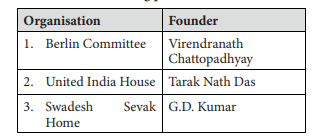
#71. Consider the following pairs:
Which of the pairs given above is/are correctly matched?
Pair 1 is correctly matched. The Berlin Committee for Indian Independence was established in 1915 by Virendranath Chattopadhyay, Bhupendranath Dutta, Lala Hardayal and others with the help of the German foreign office under ‘Zimmerman Plan’. These revolutionaries aimed to mobilise the Indian settlers abroad to send volunteers and arms to India to incite rebellion among Indian troops there and to even organise an armed invasion of British India to liberate the country.
Pair 2 is correctly matched. In 1910, Tarak Nath Das and G.D. Kumar set up the United India House in Seattle in the US, where every Saturday they lectured to a group of twenty- ve Indian labourers.
Pair 3 is correctly matched. G.D. Kumar set up a Swadesh Sevak Home in Vancouver on the lines of the India House in London. It also began to bring out a Gurmukhi paper called Swadesh Sevak which advocated social reform and it also asked Indian troops to rise in revolt against the British.

#72. Consider the following pairs:
Which of the pairs given above is/are correctly matched?
Pair 1 is correctly matched. The Bengalee was founded by Girishchandra Ghosh in 1862 as an English language newspaper. Surendranath Banerjea served as its editor.
Pair 2 is correctly matched. The Bombay Chronicle was an English language weekly newspaper started by Pherozshah Mehta in 1910. It became an important nationalistic voice of its time.
Pair 3 is incorrectly matched. Swadesamitran was a Tamil language newspaper founded by G. Subramania Aiyar in 1882.
#73. Which of the following factors were responsible for the weakening of the Swadeshi movement?
1. Internal squabbles among leaders.
2. Severe repression by the government
3. Difficulty in sustaining mass movements for long time.
Select the correct answer using the code given below:
The Swadeshi Movement had its genesis in the antipartition movement which was started to oppose the British decision to partition Bengal.
Statement 1 is correct. Internal squabbles among leaders, magnified by the Surat split (1907), did much harm to the movement. The movement aroused the people but did not know how to tap the newly released energy or how to nd new forms to give expression to popular resentment.
Statement 2 is correct. There was severe government repression. The government, seeing the revolutionary potential of the movement, came down with a heavy hand. Repression took the form of controls and bans on public meetings, processions and the press. Student participants were expelled from Government schools and colleges, debarred from Government service, ned and at times beaten up by the police.
Statement 3 is correct. It is difficult to sustain a massbased movement at a high pitch for too long. The mass movements cannot be sustained endlessly at the same pitch of militancy and self-sacrifice, especially when faced with severe repression, but need to pause, to consolidate its forces for yet another struggle.
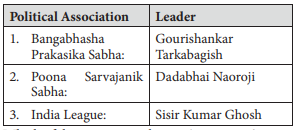
#74. Consider the following pairs:
Which of the pairs given above is/are correct?
Pair 1 is correctly matched. Bangabhasha Prakasika Sabha was started by Gourishankar Tarkabagish, an associate of Raja Ram Mohan Roy in 1836 in Calcutta. The objective of the organization was to promote Bengali education by means of polemics and build up public opinion.
Pair 2 is incorrectly matched. The Poona Sarvajanik Sabha was founded in 1867 by Mahadeo Govind Ranade and Bhawanrao Shriniwasrao Pant Pratinidhi, Ganesh Vasudeo Joshi and S H Chiplunkar, with the object of serving as a bridge between the government and the people.
Pair 3 is correctly matched. The Indian League was started in 1875 by Sisir Kumar Ghosh with the object of “stimulating the sense of nationalism amongst the people” and of encouraging political education.
#75. With reference to the ideology of the Extremist school during Indian freedom struggle, consider the following statements:
1. No hatred against the foreign Rule.
2. Swaraj as the goal.
3. Belief in the capacity of the masses.
4. Believe in the passive resistance against the British Government.
Which of the statements given above is/are correct?
In early twentieth century, a band of nationalist thinkers had emerged. ey advocated for a more militant approach to political work. They worked based upon basic tenets:
Statement 1 is incorrect: One of their tenets was the hatred for foreign rule. It was because since no hope could be derived from it, Indians should work out their own salvation. It was Gandhi’s Satyagraha which was based on idea that even while carrying out his struggle against the wrong-doer, a true satyagrahi would have no ill feeling for the wrong-doer; hatred would be alien to his nature.
Statement 2 is correct: Swaraj was to be the goal of national movement. Different leaders had different meaning of swaraj. For Tilak, swaraj meant some sort of self-government, while for Aurobindo it meant complete independence from foreign rule.
Statement 3 is correct: They believed in capacity of the masses to challenge the authority. erefore, the militant nationalists attempted to transform the anti-partition as well as the Swadeshi Movement into a mass struggle. For which, they called for use of swadeshi product and boycott of foreign goods, government schools and colleges, government service, courts, legislative councils, municipalities, government titles, etc.
Statement 4 is correct: The Extremists gave a call for passive resistance in addition to swadeshi and boycott. It was to include a boycott of government schools and colleges, government service, courts, legislative councils, municipalities, government titles, etc.
#76. Which of the following statements is/are true about the revolutionary activities that took place in Maharashtra?
1. Vasudev Balwant Phadke organised Ramosi peasant force to overthrow the British government in India.
2. Chaphekar brothers were inspired by the work of ‘Mitramela’.
3. Anant Laxman Kanhere assassinated Justice Jackson of Nasik court for awarding life imprisonment to Ganesh Savarkar.
Select the correct answer using the code given below.
The Revolutionaries movements of the Indian national Movement are comprised of the actions of the underground revolutionary factions. The groups of revolutionaries’ movements were mainly active in Bengal, Maharashtra, the United Provinces and Punjab
Statement 1 is correct. The first of the revolutionary activities in Maharashtra was the organisation of the Ramosi Peasant Force by Vasudev Balwant Phadke in 1879, which aimed to rid the country of the British by instigating an armed revolt by disrupting communication lines. It hoped to raise funds for its activities through dacoities. It was suppressed prematurely.
Statement 2 is incorrect. V.D. Savarkar established “Mitramela” in 1900 at Nasik, while Chapekar brothers killed Rand in 1897. It was Savarkar who got encouraged by the sacrifice of Chapekar brothers and established Mitramela.
Statement 3 is correct. In 1908 the Police acquired objectionable documents at Savarkar’s home against British government. On the basis of the documents Ganesh Savarkar was arrested and sentenced to life imprisonment by Justice Jackson. This led the revolutionaries of Abhinav Bharat Society to plan killing of Justice Jackson of Nasik court. As per the plan the 17 years revolutionary – Anant Laxman Kanhere red bullet on Jackson on 21 Dec. 1909 and killed him.
#77. In context to Vinayak Savarkar, consider the following statements:
1. In his early days Savarkar was influenced by the philosophy of Gopal Ganesh Agarkar.
2. He sent delegates to the International Socialist Union at Stuttgart who unfurled India’s flag designed by him.
3. Talwar, an organ of the Abhinav Bharat, was started from Paris.
Which of the statements above is/are correct?
Statement 1 is correct. V. D. Savarkar was a product of renaissance in the Western India and in his early days he was influenced by the philosophy of Gopal Ganesh Agarkar, a rationalist philosopher. Savarkar was not a religious man and throughout his life, he eschewed all religious practices.
Statement 2 is correct. Savarkar reached England in July 1906 ostensibly to study law but really in search of revolutionaries from Russia, Ireland, Egypt and China, to learn how to organise a revolutionary movement. Savarkar immediately set for himself certain tasks.
He presented Mazzini’s philosophy to the Marathi readership through translation and a long preface.
He started a number of Hindu and Sikh festivals in London, as also celebration of the Golden Jubilee of 1857 uprising.
He set up Free India Society, which was open to all, but was meant to be a conduit for Abhinav Bharat. He sent delegates to the International Socialist Union at Stuttgart who unfurled India’s flag designed by him.
Statement 3 is correct. Talwar, an organ of the Abhinav Bharat, was started from Paris in November 1909. In the first issue of Talwar, Savarkar had predicted a war in Europe in 4 or 5 years. The liberation of India was to be achieved by a preparation for war.
#78. Consider the following statements with reference to revolutionary activities abroad:
1.The India House was founded by Shyamaji Krishna Varma in England.
2. An activity centre of Indian revolutionary in Paris was started under leadership of Sardar Singh Rana.
Which of the statements given above is/are correct?
Statement 1 is correct. In 1905, Shyamaji Krishna Varma in England founded the India House at his residence and started the Indian Home Rule Society’s work. India House was the centre of Indian revolutionaries settled in England such as Madanlal Dhingra, V.D. Savarkar, Sardarsingh Rana. The youths who came to the India House were given the information of European revolutionary movements and the training of the handling weapons and pistols.
Statement 2 is correct. In Paris (the capital of France) the revolutionaries had started activity centre under the leadership of Sardar Singh Rana. They did the work of giving scholarship to Indian youths, giving the shelter to the revolutionaries escaped from India and giving them economic help and meeting them with the European revolutionaries.
#79. Consider the following statements with reference to Indian nationalists’ response to British participation in World War-I:
1.The Moderates supported the British as a matter of duty.
2.The Extremists opposed the participation believing that Britain would never repay India’s loyalty by liberating them.
3.The Revolutionaries utilised the opportunity to wage a war on British rule and liberate the country.
Which of the statements above is/are correct?
The World War I lasted from 1914 to 1918. India then a colony of the British was forced into the war to safeguard British interest. During war time, the British Government made an appeal to the Indian leaders to join hands with them in their time of crisis. ere were varied responses from India to British participation in the World war.
Statement 1 is correct. The Congress dominated by moderates who used constitutional means to put up their demands decided to support the Britishers as the matter of duty. It was believed, especially by the Moderates, that the British would be obliged to grant freedom to India after the war. But it was soon realised that this hope would not be ful lled as the war was being fought to retain colonies.
Statement 2 is incorrect. The extremists who resisted British, supported the war efforts in the mistaken belief that Britain would repay India’s loyalty with gratitude in form of self-government. ey didn’t realize that the different powers were ghting the war precisely to safeguard their existing colonies.
Statement 3 is correct. The Revolutionaries carried out activities through the Ghadr party in different parts of world during First world war. In India, they utilised the opportunity to wage a war on British rule and liberate the country from British rule.
#80. With reference to Ghadr Movement, consider the following events:
1.The revolutionaries in Ghadar movement were mainly peasants.
2.The British passed the Defence of India Act to supress the Ghadr Movement.
Which of the above statements is/are correct?
The Ghadar Movement was formed in 1913 by expatriate Indians in North America with shared leadership from Sikhs, Hindus, and Muslims. e goal of the movement was to assist in overthrowing British colonial rule in India.
Statement 1 is correct. The Ghadr Party was a revolutionary group organised around a weekly newspaper The Ghadr with its headquarters at San Francisco and branches along the US coast and in the Far East. These revolutionaries included mainly exsoldiers and peasants who had migrated from the Punjab to the USA and Canada in search of better employment opportunities. They were based in the US and Canadian cities along the western (Paci c) coast.
Statement 2 is correct: The Defence of India Act passed in March 1915 primarily to crush the Ghadr movement. Under the Defence of India Act of 1915, all ‘revolutionary and nationalist’ activities were banned. There were largescale detentions without trial, special courts giving extremely severe sentences, numerous court-martials of army men.
#81. Which of the following was not the reason for failure of the Ghadr Movement?
The Ghadar Movement was formed in 1913 by expatriate Indians in North America with shared leadership from Sikhs, Hindus, and Muslims. The goal of the movement was to assist in overthrowing British colonial rule in India.
Statement a is correct – The movement underestimated the extent of preparation required at every level – Organizational, ideological, financial and tactical strategic. The Ghadrites intended to bring about a revolt in India. To plan something from there, it requires immense planning at all level which was not estimated by the Ghadrites. The Ghadrites fixed February 21, 1915 as the date for an armed revolt in Ferozepur, Lahore and Rawalpindi garrisons. The plan was foiled at the last moment due to treachery.
Statement b is incorrect – The movement was entirely secular and there was no communal angle involved. It preached militant nationalism with a complete secular approach. The movement didn’t advocate any communal slogan or was not for or by any religion. Its members were primarily Sikhs but members of other religions were also present.
Statement c is correct – The movement lacked an organized and sustained leadership. Har Dayal himself was temperamentally totally unsuited to the role of an organizer; he was a propagandist, an inspirer, an ideologue. Even his ideas did not form a structured whole but remained a shifting amalgam of various theories that attracted him from time to time- Further, he departed from the U.S. at a critical stage of the movement.
Statement d is correct – Punjab in 1914 was very different from what the Ghadarites had been led to expect — they found the Punjabis were in no mood to join the romantic adventure of the Ghadar. e militants from abroad tried their best, they toured the villages, addressed gatherings at melas and festivals, all to no avail. The Chief Khalsa Diwan proclaiming its loyalty to the sovereign, declared them to be ‘fallen’ Sikhs and criminals, and helped the Government to track them down.
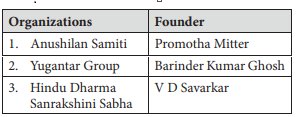
#82. Which of the following organizations are correctly matched with its founder?
Select the correct pair from the codes given below
Pair 1 is correct – The Anushilan Samiti was founded by Promotha Mitter, Jatindranath Banerjee, Barindra Kumar Ghosh and others in Calcutta in 1902.
Pair 2 is correct – Yugantar was a weekly which was started by people like Barinder Kumar Ghosh and Bhupendranath Dutta. In 1907, an abortive attempt was made by the Yugantar group on the life of a very unpopular British official, Sir Fuller (the rst Lt. Governor of the new province of Eastern Bengal and Assam).
Pair 3 is incorrect – Tilak’s speeches, writings and activities inspired the young Chapekar brothers to form Hindu Dharm Sanrakshini Sabha, which was responsible for the assassination of several hated British officers.
#83. With reference to National Council of Education consider the following statements:
1.The National Council of Education was an outcome of the Swadeshi movement.
2. It recommended that the medium of education in schools and colleges should be English.
3. It had set up Bengal Technical Institute for imparting technical education.
Which of the above statements is/are correct?
The National Council of Education was set up in June, 1906 by Satish Chandra Mukherjee and other Indian nationalists. Its main pur pose was to provide education on national lines and under national control.
Statement 1 is correct – The birth of the national schools during swadeshi movement culminated in the formation of the National Council of Education (NCE) in 1906.
Statement 2 is incorrect: The medium of education was recommended to be vernacular. The Council was started in the backdrop of Swadeshi and Boycott Movement when British good were being boycotted.
Statement 3 is incorrect: Bengal Technical Institute was not started by National Council of Education but its sister organization the Society for the Promotion of Technical Education (SPTE) on 25th July, 1906. The NCE spawned most of the national schools in Bengal, particularly in East Bengal, imparting scienti c professional and technical education to its students. In Calcutta the Bengal National College failed to draw students whereas the BTI continued to thrive. By 1910 the differences between the two bodies were resolved.
#84. Consider the following events in the history of India:
1. Establishment of Berlin Committee
2. Formation of Ghadr party
3. Bomb thrown at Lord Hardinge 4. Komagata Maru Incident
Arrange the above-mentioned events in chronological order starting from the earliest?
Statement 1 – The Berlin Committee for Indian Independence was established in 1915 by Virendranath Chattopadhyay, Bhupendranath Dutta, Lala Hardayal and others with the help of the German foreign office under ‘Zimmerman Plan’. These revolutionaries aimed to mobilise the Indian settlers abroad to send volunteers and arms to India to incite rebellion among Indian troops there and to even organise an armed invasion of British India to liberate the country.
Statement 2 – The Ghadr Party was established in 1913. It followed the two revolutionary groups established by similar activists, ‘Swadesh Sevak Home’ at Vancouver and ‘United India House’ at Seattle.
Statement 3 – Rashbehari Bose and Sachin Sanyal staged a spectacular bomb attack on Viceroy Hardinge while he was making his official entry into the new capital of Delhi in a procession through Chandni Chowk in December 1912. (Hardinge was injured, but not killed.) Investigations following the assassination attempt led to the Delhi Conspiracy trial. At the end of the trial, Basant Kumar Biswas, Amir Chand and Avadh Behari were convicted and executed for their roles in the conspiracy.
Statement 4 – Komagata Maru was the name of a ship which was carrying 370 passengers, mainly Sikh and Punjabi Muslim would-be immigrants, from Singapore to Vancouver. They were turned back by Canadian authorities after two months of privation and uncertainty. It was generally believed that the Canadian authorities were influenced by the British government. The ship finally anchored at Calcutta in September 1914. The inmates refused to board the Punjab bound train. In the ensuing conflict with the police at Budge Budge near Calcutta, 22 persons died.
#85. Consider the following statements with reference to the Morley-Minto reforms during British period:
1. It led to the appointment of first ever Indian to the Viceroy’s executive council.
2. It provided for separate electorates to Anglo Indians in the central legislature.
3. It gave legislatures the power to pass resolutions and ask supplementary questions.
Which of the statements given above is/are correct?
The viceroy, Lord Minto, and the Secretary of State for India, John Morley, introduced some reforms to placate the Moderates as well as the Muslims. They worked out a set of measures that came to be known as the MorleyMinto Reforms that translated into the Indian Councils Act of 1909.
Statement 1 is correct. One Indian was to be appointed to the viceroy’s executive council (Satyendra Sinha was the rst Indian to be appointed in 1909).
Statement 2 is incorrect. For the first time, separate electorates for Muslims for election to the central council was established (separate electorates for Anglo Indian were provided in 1919 act of Montague Chelmsford reforms). Besides separate electorates for the Muslims, representation in excess of the strength of their population was accorded to the Muslims. Also, the income quali cation for Muslim voters was kept lower than that for Hindus.
Statement 3 is correct. Powers of legislature (both at the Centre and in provinces) were enlarged and the legislatures could now pass resolutions (which may or may not be accepted), ask questions and supplementary questions, vote on separate items of the budget though the budget as a whole could not be voted upon.
#86. Consider the following statements with reference to activities of Jugantar Party in Bengal:
1. Bagha Jatin was an important leader of Jugantar party.
2.The Party arranged to import arms and ammunition through revolutionaries abroad.
3. It was involved in the ‘German Plot’ to bring about an all-India revolt.
Which of the statements given above is/are correct?
Jugantar Party was the leading revolutionary group in colonial Bengal. An inner circle within the Calcutta Anushilan samiti under Barindrakumar Ghosh and Bhupendranath Datta with the advice of Aurobindo Ghosh started the weekly Jugantar (New Era) in April 1906. The group is named after the Jugantar, the mouthpiece of the advocates of revolutionary nationalism.
Statement 1 is correct. Jatindranath Mukherjee also known as Bagha Jatin came in contact with Aurobindo Ghosh, who openly supported the achievement of Swaraj through violent means. Aurobindo Ghosh made Jatin the leader of a secret society known as Jugantar whose main objective was to recruit young revolutionaries and trained them for conducting raids, robbery, etc.
Statement 2 is correct. During the First World War, the Jugantar party arranged to import German arms and ammunition through sympathizers and revolutionaries abroad.
Statement 3 is correct. The Jugantar Party was linked up with the Bolshevik revolutionary Manabendra Nath Roy alias Narendra Nath Bhattacharya, in Berlin. He took prominent part in the German plot organised by the Jugantar Party during the war. After the World War 1, the Soviet Government supplied him funds for the purpose of instigating revolution in India.
#87. Which of the following factors were responsible for the formation of home rule league movement?
1. Moderates within Congress were disillusioned with the provisions of Morley-Minto reforms.
2. People were burdened with wartime miseries like high taxation and a rise in prices.
3. Tilak was dissatisfied with Moderates method of struggle.
Select the correct answer from the codes given below:
Two Indian Home Rule Leagues were organised on the lines of the Irish Home Rule Leagues and they represented the emergence of a new trend of aggressive politics. Annie Besant and Tilak were the pioneers of this new trend.
Statement 1 is correct. One of the factors leading to the formation of the Home Rule Movement was, the Moderates were disillusioned with the Morley-Minto reforms. Also, a section of the nationalists felt that popular pressure was required to attain concessions from the government.
Statement 2 is correct. Along with above reasons, people were feeling the burden of wartime miseries caused by high taxation and a rise in prices, and were ready to participate in any aggressive movement of protest. The war, being fought among the major imperialist powers of the day and backed by naked propaganda against each other, exposed the myth of white superiority.
Statement 3 is incorrect. Tilak was not dissatisfied with Moderates method of struggle. In fact, Tilak had made conciliatory gestures to the government reassuring it of his loyalty. He wanted a reform of the administration like the Irish Home Rulers and not an overthrow of the government. He also admitted that the acts of violence had only served to retard the pace of political progress in India. He urged all Indians to assist the British government in its hour of crisis.
#88. Consider the following statements with reference to Home Rule league movement:
1.The Russian Revolution of 1917 proved advantageous for the Home Rule league campaign.
2. Muslims and non-brahmins participated in large numbers in the movement.
3. Tilak’s Home Rule league demanded formation of linguistic states.
Which of the statements given above is/are correct?
The Home Rule League campaign aimed to convey to the common man the message of home rule as selfgovernment. It carried a much wider appeal than the earlier mobilisations had and also attracted the hitherto ‘politically backward’ regions of Gujarat and Sindh.
Statement 1 is correct. The Russian Revolution of 1917 proved to be an added advantage for the Home Rule campaign. It helped the league to spread their message more effectively. The aim of home rule league was to be achieved by promoting political education and discussion through public meetings, organizing libraries and reading rooms containing books on national politics, holding conferences, organizing classes for students on politics, carrying out propaganda through newspapers, pamphlets, posters, illustrated post-cards, plays, religious songs, etc.
Statement 2 is incorrect. Anglo-Indians, most of the Muslims and non-brahmins from the South did not join as they felt Home Rule would mean rule of the Hindu majority, and that too mainly by the high caste. However, many of the Moderate Congressmen who were disillusioned with Congress inactivity, and some members of Gokhale’s Servants of India Society joined the agitation.
Statement 3 is correct. Tilak set up his Indian Home Rule League in April 1916. Tilak held his rst Home Rule meeting at Belgaum. Poona was the headquarters of his league. His league was restricted to Maharashtra (excluding Bombay city), Karnataka, Central Provinces and Berar. It had six branches and the demands included swarajya, formation of linguistic states and education in the vernacular.
#89. Sachindra Nath Sanyal, an Indian revolutionary was associated with which of the following events?
1. Ghadar conspiracy.
2. Delhi conspiracy Case.
3. Formation of the Hindustan Republican Association.
4. Young Men’s Association
Select the correct answer using the codes given below.
Statement 1 is correct. The Ghadr leaders were inflamed by the Komagata Maru Incident. ey planned to launch a violent attack to expel the British. Kartar Singh Saraba, Raghubar Dayal Gupta, Rashbehari Bose, and Sachin Sanyal were the prominent leaders involved.
Statement 2 is correct. Rash Behari Bose and Sachin Sanyal staged a bomb attack on Viceroy Hardinge while he was making his official entry into Delhi in a procession in December 1912 (Delhi conspiracy Case). Hardinge was injured but not killed. investigation following the Assassination attempt led to the Delhi conspiracy trial. At the end of the trial Basant Kumar Vishwas Amarchand and Awadh Bihari were convicted and executed for the rows in the conspiracy.
Statement 3 is correct. The constitution for the HRA was drafted by Bismil in 1923 at Allahabad with the blessing of Lala Har Dayal. Other prominent members of the party were Sachindra Nath Sanyal and Jogesh Chandra Chatterjee (who was also a member of the Anushilan Samiti). The HRA formed centres at, besides Allahabad, Agra, Kanpur, Varanasi, Lucknow, Shahjahanpur and Saharanpur. It also had bomb manufacturing units at Calcutta and Deogarh. A manifesto for the party was written by Sanyal titled ‘Revolutionary’.
Statement 4 is correct. Sachindranath Sanyal founded Anushilan Samiti at Benares in 1908, which was later rechristened as Young Men’s Association.
#90. Consider the following statements with reference to colonial rule in India:
1. Calcutta Corporation Act of 1899 increased the number of elected Indian members in Calcutta municipal corporation.
2. Indian Universities Act of 1904 was passed based on the recommendations of the Raleigh commission.
Which of the statements given above is/are correct?
Lord Curzon believed in a strong centralized government and powerful bureaucracy to suppress the growth of nationalism in India.
Statement 1 is incorrect. Lord Curzon was the British statesman and a supporter of the conservative party, served as viceroy of India from 1899 to 1905. With his appointment as the viceroy, he immediately introduced reform and pressed the Calcutta Corporation Act of 1899. It reduced the number of elected members in Calcutta municipal corporation and increased the strength of British members thereby giving British a majority. By the implementation of this act, Calcutta corporation become merely Anglo-Indian house. Indian members were not happy with this act so all the 28 members resigned from the corporation to show their discontent.
Statement 2 is correct. In 1902, Raleigh Commission was set up to go into conditions and prospects of universities in India and to suggest measures for improvement in their constitution and working. The commission precluded from reporting on primary or secondary education. Based on its recommendations, the Indian Universities Act was passed in 1904.
#91. Consider the following statements in the context of Rabindranath Tagore’s views on education system:
1. Tagore’s model of education is based on principles of naturalism, humanism and internationalism.
2. Vishwa Bharati University was founded by Tagore with the objective of exploring the arts, language and music.
3. Shantiniketan was originally built as an ashram by Debendranath Tagore.
Which of the statements given above is/are correct?
Statement 1 is correct: There are four fundamental principles in Rabindranath Tagore’s alternative educational philosophy; naturalism, humanism, internationalism and idealism. Shantiniketan and Visva Bharathi are based on these very principles. Tagore insisted that education should be imparted in natural surroundings.
Statement 2 is correct: e Visva-Bharati University, founded by Rabindranath Tagore in 1921, is the country’s oldest central university. Visva Bharati was established as a center for culture with the objective of exploring the arts, language, humanities, music etc.
Statement 3 is correct: Santiniketan, popularly known today as a university town, was originally an ashram built by Debendranath Tagore, where anyone, irrespective of caste and creed, could come and spend time meditating.
#92. Consider the following statements with reference to Satish Chandra Mukherji:
1. Satish Chandra Mukherji through his ‘Dawn Society’ promoted an education system under indigenous control.
2. He managed the publication of ‘Young India’ following the Mahatma Gandhi’s arrest in 1922.
3. He provided for an alternate system of higher studies by founding ‘Bhagavat Chatuspathi’.
Which of the statements given above is/are correct?
Statement 1 is correct. Satish Chandra Mukherji through his Dawn Society promoted an education system under indigenous control. In 1902 he organised the “Dawn Society” of culture, to protest against the Report of the Indian Universities Commission, representing the inadequate university education imposed by the Government to fabricate clerks for the merchant offices. “ The cry for thorough overhauling of the whole system of University education was in the air.”In 1889, he formulated the scheme for national education.
Statement 2 is correct. Following Mahatma Gandhi’s arrest in 1922; Satish Chandra Mukherji spent two months at the Sabarmati Ashram helping in the management and publication of Young India.
Statement 3 is correct. Satish Chandra’s intense religious temperament laid emphasis on the study of Hindu life, thought and faith. He joined the Presidency College to obtain his MA in 1886 and BL in 1890, and enrolled himself as a pleader of the Calcutta High Court. In 1887, he was appointed a lecturer in history and economics in the Berhampore College. In 1895 he founded the Bhagavat Chatuspathi, a first attempt to an alternate system of higher studies.
#93. Who among the following was associated as the first principal of Bengal National College?
The Bengal National College inspired by Tagore’s Shantiniketan started functioning from 15 August 1906 with Sri Aurobindo as its first Principal. At an early period, he left the organization of the college to the educationist Satish Mukherjee and plunged fully into politics. When the Bande Matram (sedition case) was brought against him, he resigned his post [Aug 1907] in order not to embarrass the College authorities but resumed it again on his acquittal [Sep 1907]. During the Alipore Bomb case he resigned nally [1908] at the request of the College authorities.
• The founding of the Bengal National College gave him the opportunity he needed and enabled him to resign his position in the Baroda service and join the college as its principal.
• National education was another item to which Sri Aurobindo attached much importance. He had been disgusted with the education given by the British system in the schools and colleges and universities, a system of which as a professor in the Baroda College he had full experience. He felt that it tended to dull and impoverish and tie up the naturally quick and brilliant and supple Indian intelligence.
• The movement began well and many national schools were established in Bengal and many able men became teachers, but still the development was insuffcient and the economic position of the schools precarious. Sri Aurobindo had decided to take up the movement personally and see whether it could not be given a greater expansion and a stronger foundation.
Option b is incorrect. Subhash Chandra Bose was influenced by the simple living and high thinking of CR Das in 1921. He became the Principal of National College founded by CR Das for Indian Students. en, he boycotted the arrival of Prince of Wales in Bengal. He was arrested and sent to jail. In 1922, Congress contested elections. He edited the paper Forward to help Congress, Khadi and Charkha. Netaji also worked as Executive Officer in Calcutta Corporation. He was again arrested and sent to jail without trial. People stood to support him against this illegal action of the govt. As a result, he was released in 1927.
Option c is incorrect. Surendra Nath Banerjee founded a nationalist organization called the Indian National Association, through which he led two sessions of the Indian National Conference in 1883 and 1885, along with Ananda Mohan Bose. Banerjee later became a senior member of the Indian National Congress.
Option d is incorrect. Ananda Mohan Bose was an Indian politician, academician, social reformer and lawyer during the British Raj. He co-founded the Indian National Association, one of the earliest Indian political organizations, and later became a senior leader of the Indian National Congress. In 1874, he became the first Indian Wrangler (a student who has completed the third year of the Mathematical Tripos with first-class honors) of the Cambridge University. He was also a prominent religious leader of Brahmanism and with Sivanath Sastri a leading light of Adi Dharm.

#94. Which of the following pairs is/are correctly matched?
Select the correct answer using the code given below:
Pair 1 is incorrectly matched. One of the establishments set up during the swadeshi movement period was the Swadeshi Bhandar, which became a reputed textile rm. It was started by Rabindranath Tagore in 1897.
Pair 2 is correctly matched. Swadesh Bandhab Samiti was founded by Ashwini Kumar Dutta. It aimed to promote the consumption of indigenous products and boycott foreign goods. Samitis such as the Swadesh Bandhab Samiti of Ashwini Kumar Dutta (in Barisal) emerged as a very popular and powerful means of mass mobilisation.
Pair 3 is correctly matched. ‘Father of Indian chemistry’ Acharya Prafulla Chandra Ray, had started Bengal Chemical Works by 1892, with a capital of about Rs 700. By 1901, Ray transformed his initiative into Bengal Chemicals and Pharmaceutical Works Pvt Ltd, with a capital of Rs 2 lakh.
#95. Which of the following demands were made in the Lucknow Pact (1916) signed between Indian National Congress and All India Muslim League?
1. Conferment of self-government on Indians.
2. Shift of burden of salary of Secretary of State from Indian Treasury to British Treasury.
3. Half of the seats of the Viceroy’s Executive Council should be reserved for Indians
Select the correct answer using the code given below:
Lucknow Pact (1916) which resulted in the truce between the Muslim League and the Indian National Congress was one of the most signi cant developments during freedom struggle. It resulted in the presentation of following demands by them to the government: Government should declare that it would confer selfgovernment on Indians at an early date.
The Salaries of the Secretary of State for India should not be drawn from Indian funds and should be paid by the British treasury. The post of Secretary of State for India was created in 1859, as the Act for Better Government of India, 1858 mentioned, India was to be governed by and in the name of the Crown through a secretary of state and a council of 15.
Half the members of the viceroy’s and provincial governors’ executive councils should be Indians. Satyendra Sinha was the rst Indian to be appointed to the viceroy’s executive council in 1909.
The representative assemblies at the central as well as provincial level should be further expanded with an elected majority and more powers given to them.
The term of the legislative council should be ve years. Hence, all statements 1, 2 and 3 are correct.
#96. With reference to the works of Bal Gangadhar Tilak, consider the following statements:
1. He started Shivaji and Ganpati festivals to propagate militant nationalism.
2. He authored a book named ‘Gita Rahasya’.
3. He was opposed to the Western model of education.
Which of the statements given above is/are correct?
Statement 1 is correct: In the period of 1890s, in order to propagate a spirit of militant nationalism, Tilak started the celebration of Ganapati and Shivaji festivals and also extensively used his journals Kesari and Maharatta for this purpose.
Statement 2 is correct: Tilak’s greatest work was the “Gita-Rahasya.” It is a philosophical enquiry into the teachings of the Gita. While reinterpreting the Gita, he laid stress on the concept of Karma-Yoga. instead of renunciation (as its central message).
Statement 3 is incorrect: Tilak opposed the reformer’s thoughtless imitation of the west. Tilak never reconciled with the idea that all that is western is necessarily good. However, Tilak was open minded and was prepared to accept whatever good the west had to offer. For instance, in his scheme of National Education he included western sciences and technology. His scheme of National Education was a ne blend of all that is good in the western and eastern traditions of knowledge, tradition and culture. It was a concrete expression. of Tilak’s own model of social reform
#97. Which of the following statements is/are true with reference to Mahatma Gandhi’s experiences with Satyagraha in South Africa?
1. It assured Gandhi of the immense capacity of masses to participate and sacrifice in a movement.
2. Gandhi understood that sometimes it is important to take decisions unpopular with the people.
3. He was able to evolve his own style of leadership and politics and new techniques of struggle.
Select the correct answer using the code given below:
Gandhi evolved the technique of Satyagraha during his stay in South Africa. It was based on truth and nonviolence. He combined some elements from Indian tradition with the Christian requirement of turning the other cheek and the philosophy of Tolstoy, who said that evil could best be countered by non-violent resistance.
Statements 1, 2 and 3 are correct: Mahatma Gandhi learned following experiences through his stay in South Africa –
(i) Gandhi found that the masses had immense capacity to participate in and sacrifice for a cause that moved them.
(ii) He was able to unite Indians belonging to different religions and classes, and men and women alike under his leadership.
(iii) He also came to realise that at times the leaders have to take decisions unpopular with their enthusiastic supporters.
(iv) He was able to evolve his own style of leadership and politics and new techniques of struggle on a limited scale, untrammeled by the opposition of contending political currents.
#98. Consider the following statements with reference of Meerut Conspiracy case during Indian Freedom Struggle:
1. Meerut Conspiracy Case is associated with burning a factory owned by Englishmen.
2. It resulted in the conviction of S.A. Dange and Shaukat Usmani.
3. It strengthened the working-class movement.
Which of the statements given above is/are correct?
The Meerut Conspiracy Case was a controversial court case that was initiated in British Raj against several trade unionists in 1929. Statement 1 is incorrect: The Case was not associated with burning the factory owned by Englishmen. The main charges were that in 1921 S.A. Dange, Shaukat Usmani and Muzaffar Ahmed joined a conspiracy to establish a branch of the Comintern in India. However, the initial arrests were made for organizing an Indian railway strike.
Statement 2 is correct: In March 1929, the government arrested 31 labour leaders, and the three-and-a-half-year trial resulted in the conviction of Muzaffar Ahmed, S.A. Dange, Joglekar, Philip Spratt, Ben Bradley, Shaukat Usmani, and others.
Statement 3 is incorrect: The trials of Meerut Conspiracy got worldwide publicity but weakened (not strengthened) the working-class movement. After 1931, there was also a dip in the working-class movement because of a split in 1931 in which the corporatist trend led by N.M. Joshi broke away from the AITUC to set up the All-India Trade Union Federation.
#99. With reference to the revolutionary activities during the British rule in India, consider the following statement.
1. Praful Chaki was tried and hanged in the Muzaffarpur Bomb Conspiracy Case.
2. Narender Goswami was shot dead for betrayal of his own associates during the Alipore Conspiracy Case.
3. Pullin Das organised the Barrah Dacoity to raise funds for revolutionary activities.
Which of the statements given above is/are correct?
Following are the few revolutionary activities that were carried out in di erent parts of India before and during the First World War.
Statement 1 is incorrect. In Muzzafarpur Bomb Conspiracy Case (1908), Prafulla Chaki shot himself dead while Khudiram Bose was tried and hanged. In 1908, Prafulla Chaki and Khudiram Bose threw a bomb at a carriage supposed to be carrying a Calcutta Chief Magistrate Douglas Kingsford, in Muzaffarpur. But Kingsford was not in the carriage. erefore, unfortunately, two British ladies, got killed.
Statement 2 is correct. During the Alipore conspiracy case trial, Narendra Gosain (or Goswami), had turned approver and Crown witness. erefore, he was shot dead by two co-accused, Satyendranath Bose and Kanailal Dutta in jail in this case.
Statement 3 is correct. In 1908, Barrah dacoity was organised by Dacca Anushilan under Pulin Das to raise funds for revolutionary activities. He was a legendary Lathi player, and the undisputed leader of the Anushilian Party. With him as the guide, the conspiracy was hatched to raid the house of a notorious Zamindar in a village, called Barrah (in Dhaka District, presently the capital of Bangladesh)
#100. “He is known as the ‘Father of Revolutionary oughts’ in India. He was among the first to criticize Mahatma Gandhi or the ‘Gandhi cult’. He was the founder of the journal ‘Bande Mataram’. His prominent books include ‘Nationality and Empire’, ‘Indian Nationalism’ and ‘Swaraj and the Present Situation”.
Which of the following personalities is the above paragraph referring to?
Bipin Chandra Pal was a well-known freedom ghter of India and was famous as one of the triumvirates of the three militant patriots popularly known as ‘Lal-Bal-Pal’. He is known as the ‘Father of Revolutionary oughts’ in India.
Bipin Chandra Pal joined the Brahmo Samaj in 1902. He published a number of journals, weekly and books to spread Swaraj. His prominent books include ‘Nationality and Empire’, ‘Indian nationalism’, ‘Swaraj and the Present Situation’, ‘ The Soul of India’, ‘ The Basis of Social Reform’, ‘ The Hinduism’ and ‘ The New Spirit’.
He also started journals like ‘Paridarsak’, ‘New India’, ‘Bande Mataram’ and ‘Swaraj’. He was also the founder editor of the English weekly ‘India’ in 1901 and as the founder editor of the English daily ‘Bande Mataram’ in the year 1906 which was banned later by the government.
He was among the first to criticize Mahatma Gandhi or the ‘Gandhi cult’ as it sought to replace the present government by no government or by the priestly autocracy of the Mahatma
#101. Which of the following policies of Lord Curzon can said to be responsible for the growth of militant nationalism in British India?
1. Calcutta Corporation Act
2. Illbert Bill Controversy
3. Refusal to recognise India as a nation
4. Enactment of Official Secrets Act Select the correct answer using the codes given below:
A sharp reaction was created in the Indian mind by Curzon’s seven-year rule in India which was full of missions, commissions and omissions. His policies directly led to the growth of Militant Nationalism in India.
Option 1 is correct. Curzon believed in a strong centralized government and powerful bureaucracy. Calcutta Corporation Act, 1899 reduced the number of elected legislatures and increased the number of nominated officials to deprive Indians from selfgovernance.
Statement 2 is incorrect: Ilbert Bill proposed in 1883 that sought to allow senior Indian magistrates to preside over cases involving British subjects in India. It was during the viceroy, Lord Ripon tenure and before Lord Curzon’s tenure. The bill, severely weakened by compromise, was enacted by the Indian Legislative Council on Jan. 25, 1884.
Statement 3 is correct: Curzon refused to recognise India as a nation, and insulted Indian nationalists and the intelligentsia by describing their activities as “letting off of gas”. He spoke derogatorily of Indian character in general. Administrative measures adopted during his rule—the Official Secrets Act, the Indian Universities Act, the Calcutta Corporation Act and, above all, the partition of Bengal—left no doubt in Indian minds about the basically reactionary nature of British rule in India.
Option 4 is correct. The Indian Official Secrets Act, 1904 was enacted when Lord Curzon was the Viceroy of India Act which restricted the freedom of the press. is Act had provisions for declaring the leakage of information by someone illegal and punishable.
#102. Consider the following statements:
1. Sudesha Geetham was written by Subramania Bharati to arouse nationalism during Swadeshi phase.
2. Jagdish Chandra Bose established the Bengal Chemical Swadeshi store in protest of the British as a part of the Swadeshi Movement.
Which of the statements given above is/are correct?
Statement 1 is correct: Subramania Bharati was a poet, freedom ghter and social reformer from Tamil Nadu. His songs on nationalism and freedom of India helped to rally the masses to support the Indian Independence Movement in Tamil Nadu. He published the sensational “Sudesa Geethangal” in 1908 to arouse nationalism during Swadeshi phase.
Statement 2 is incorrect: Prafullachandra Roy (not J C Bose) established Bengal Chemical Swadeshi store in protest of the British as a part of the Swadeshi Movement. He established the rst modern Indian research school in chemistry (post classical age) and is regarded as the father of chemical science in India.
#103. Which one of the following was not the plausible reasons for partitioning of Bengal Province by Britishers in 1905?
Option a, b and c can be the plausible reasons for partitioning of Bengal Province by Britishers in 1905: The British government’s decision to partition Bengal had been made public in December 1903. The idea was to have two provinces: Bengal comprising Western Bengal as well as the provinces of Bihar and Orissa, and Eastern Bengal and Assam. Bengal retained Calcutta as its capital, while Dacca became the capital of Eastern Bengal.
Option b is correct. The official reason given for the decision was that Bengal with a population of 78 million (about a quarter of the population of British India) had become too big to be administered. So, the move will promote better administration in the region.
Option c is correct. It was also stated that partition would help in the development of Assam if it came under the direct jurisdiction of the government. is was true to some extent, but the real motive behind the partition plan was seen to be the British desire to weaken Bengal, the nerve centre of Indian nationalism.
Option a is correct. Trying to woo the Muslims, Curzon, the viceroy at that time, argued that Dacca could become the capital of the new Muslim majority province, which would provide them with a unity not experienced by them since the days of old Muslim viceroys and kings. us, it was clear that the government was up to its old policy of propping up Muslim communalists to counter the Congress and the national movement. The policy of divide and rule was visible as Bengal was divided on the basis of religion, as the western half was to be a Hindu majority area (42 million out of a total 54 million) and the eastern half was to be a Muslim majority area (18 million out of a total of 31 million).
Option d is incorrect. Better financial and trade management is not the reason for partitioning of Bengal Province by Britishers in 1905.
#104. Consider the following statements:
1.The moderate nationalist led by Surendranath Banerjee were not in favour of extending Swadeshi movement outside of Bengal.
2.The Indian National Congress in 1905 declared that the goal of the Indian National Congress was “self-government or Swaraj.
Which of the statements given above is/are correct?
Statement 1 is correct: The moderate nationalist opinion (which was represented by persons like Surendranath Banerjee, Krishnakumar Mitra and Narendra Kumar Sen) still had abiding faithing in the British sense of justice, and were not in favour of stretching the Swadeshi agitation too far.
The militant nationalists led by Tilak, Lajpat Rai, Bipin Chandra Pal and Aurobindo Ghosh wanted the movement to be taken outside Bengal to other parts of the country and go beyond a boycott of foreign goods to become a full-fledged political mass struggle with the goal of attaining swaraj. But the Moderates, dominating the Congress at that time, were not willing to go that far.
Statement 2 is incorrect: The Indian National Congress, meeting in 1905 under the presidentship of Gokhale, resolved to (i) condemn the partition of Bengal and the reactionary policies of Curzon, and (ii) support the antipartition and Swadeshi Movement of Bengal.
A big step forward was taken at the Congress session held at Calcutta (1906) under the presidentship of Dadabhai Naoroji, where it was declared that the goal of the Indian National Congress was “self-government or swaraj like the United Kingdom.
#105. With reference to Ashwini Kumar Dutta, consider the following statements:
1. Swadesh Bandhab Samiti was formed by him as a means of mass mobilisation during Swadeshi phase.
2. Bengal National College was set up under him as Principal on the inspiration of Tagore’s Shantiniketan.
3. He has written books on Bhaktiyoga and Karmayoga with a philosophical outlook.
Which of the statements given above is/are correct?
Ashwini Kumar Dutta (25 January 1856 – 7 November 1923) was a Bengali educationist, philanthropist, social reformer and patriot.
Statement 1 is correct: Ashwini Kumar Dutta founded the Swadesh Bandhab Samiti to promote the consumption of indigenous products and boycott foreign goods. It used to mobilise masses during Swadeshi movement.
Statement 2 is incorrect: Bengal National College, inspired by Tagore’s Shanti Niketan, was set up with Aurobindo Ghosh as its principal. Aswini Kumar Dutta was also the founder of Brojomohan college named after his father.
Statement 3 is correct: Ashwini Kumar Dutta has written a number of books in Bengali on religion, philosophy, and patriotism; Bhaktiyoga, Karmayoga, Prem, Durgotsavtattva, Atmapratistha and Bharatgeeti
#106. Which of the following factors led to the Surat split of Congress?
1. Despite Extremists demand, Moderates were not ready to declare self-government as the goal of Indian National Congress at Calcutta session.
2. Moderates did not agree to Extremists request of placing Aurobindo Ghosh as president of Indian National Congress at Calcutta session.
3. Moderates decided to subdue the resolutions taken at Calcutta session of Indian National Congress.
Select the correct answer using the code given below:
Surat Split is an important event in the modern history of India. It took place in 1907 when the Moderates parted company with the Extremists. The Extremist camp was led by Lal-Bal-Pal and the Moderate camp was led by Gopala Krishna Gokhale.
Statement 1 is incorrect. At Calcutta session of Indian National Congress (INC), the goal of the Indian National Congress was de ned as ‘swarajya or self-government like the United Kingdom or the colonies’. The word swaraj was mentioned for the first time, but its connotation was not spelt out. Also a resolution supporting the programme of swadeshi, boycott and national education was passed.
Statement 2 is incorrect: At Calcutta session of Indian National Congress (INC), the Extremists wanted either Tilak or Lajpat Rai as the president, while the Moderates proposed the name of Dadabhai Naoroji. Finally, Dadabhai Naoroji was elected as the president
Statement 3 is correct: The Extremists, emboldened by the proceedings at the Calcutta session, gave a call for wide passive resistance and boycott of schools, colleges, legislative councils, municipalities, law courts, etc. The Moderates, encouraged by the news that council reforms of 1909 were on the anvil, decided to subdue the Calcutta programme of INC. The Moderates saw in the council reforms an opportunity to realise their dream of Indian participation in the administration.
#107. With reference to August Declaration of 1917, consider the following statements:
1. Indians resented that the decision regarding responsible government was to be taken by the Britishers alone without any time frame.
2. Gandhi described the scheme as a post-dated cheque.
3. Attainment of self-government for Indians now became a government policy.
Which of the above-mentioned statements is/are correct?
The Secretary of State for India, Edwin Samuel Montagu, made a statement on August 20, 1917 in the British House of Commons in what has come to be known as the August Declaration of 1917. Features of the declarations were:
Statement 1 is correct – The objections of the Indian leaders to Montagu’s statement
were two-fold— (i) No specific time frame was given. (ii) The government alone was to decide the nature and the timing of advance towards a responsible government, and the Indians were resentful that the British would decide what was good and what was bad for Indians.
Statement 2 is incorrect – is was the statement given by Gandhi against the Crips Mission and its recommendations. Gandhi described the scheme as “a post-dated cheque”. Nehru pointed out that the “existing structure and autocratic powers would remain and a few of us will become the viceroy’s liveried camp followers and look after canteens and the like”.
Statement 3 is correct – From now onwards, the demand by nationalists for self-government or home rule could not be termed as seditious since attainment of selfgovernment for Indians now became a government policy. Unlike Morley’s statement in 1909 that the reforms were not intended to give self-government to India. Also, in the use of the term ‘responsible government’ was implied the condition that the rulers were to be answerable to the elected representatives, and not only to the imperial government in London.
#108. With reference to Swadeshi Movement and Home Rule League Movement, which of the following statements is/are correct?
1. Neither the Swadeshi Movement nor the Home Rule League Movement got any support from the Congress.
2. Both the movements were non-communal and garnered support from all the classes and religions in India.
3. Unlike the Swadeshi Movement which used only constitutional methods, Home Rule League Movement relied on passive resistance.
Choose the correct answer using the options given below:
There were several movements against the Britishers like Swadeshi, Home Rule League, Non-Cooperation, Civil Disobedience, Quit India Movement etc. The difference between the two earliest movements Swadeshi and Home Rule League are:
Statement 1 is incorrect – The Home rule was a separate organization altogether built out by Annie Besant and Gangadhar Tilak. Although Besant failed to get the Congress to approve her scheme of Home Rule Leagues, the Congress did commit itself to a programme of educative propaganda and to a revival of local-level Congress committees. While the Swadeshi and Boycott movement was declared at the Calcutta Townhall in 1905. The Indian National Congress, meeting in 1905 under the presidentship of Gokhale, resolved to (i) condemn the partition of Bengal and the reactionary policies of Curzon, and (ii) support the anti-partition and Swadeshi Movement of Bengal.
Statement 2 is incorrect – In the Home rule league, Anglo-Indians, most of the Muslims and non-brahmins from the South did not join as they felt Home Rule would mean rule of the Hindu majority, and that too mainly by the high caste. Similarly, the nature of the Swadeshi Movement, with leaders evoking Hindu festivals and goddesses for inspiration, tended to exclude the Muslims. Most of the upper- and middleclass Muslims stayed away or, led by Nawab Salimullah of Dacca, supported the partition on the plea that it would give them a Muslim-majority East Bengal. To further government interests, the All-India Muslim League was propped up on December 30, 1905 as an anti-Congress front, and reactionary elements like Nawab Salimullah of Dacca were encouraged.
Statement 3 is incorrect – The Home rule league also used the method of Passive resistance in the later period post 1918. Also, since beginning it organized political rallies, focussed on mass rallies and was not through the conscience of the Britishers.
#109. Which of the following personalities renounced his/her knighthood in response to the arrest of Annie Besant during Home Rule League Movement?
The government repressed the Home Rule League and arrested several leaders including Annie Beasant. is invited nationwide protest. The leader who renounced knighthood was Sir S. Subramaniya Aiyar.
In a dramatic gesture, Sir S. Subramaniya Aiyar renounced his knighthood while Tilak advocated a programme of passive resistance. The repression only served to harden the attitude of the agitators and strengthen their resolve to resist the government. Montagu, the Secretary of State for India, commented that “Shiva …cut his wife into fifty-two pieces only to discover that he had fifty-two wives. is is what happens to the Government of India when it interns Mrs Besant.” Annie Besant was released in September 1917.
#110. Who among the following was the GovernorGeneral at the time of annulment of partition of Bengal?
The British government’s decision to partition Bengal had been made public in December 1903. However, looking at the reaction of people, it was annulled in 1911. The Governor General under which it was done was Lord Hardinge II.
Option a is incorrect – Works of Lord Curzon (1899- 1905)
(i) Appointment of Police Commission (1902) under Sir Andrew Frazer to review police administration.
(ii) Appointment of Universities Commission (1902) and passing of Indian Universities Act (1904).
(iii) Establishment of Department of Commerce and Industry.
(iv) Calcutta Corporation Act (1899). (v) Ancient Monuments Preservation Act (1904).
(vi) Partition of Bengal (1905).
(vii) Curzon-Kitchener controversy. (viii) Younghusband’s Mission to Tibet (1904).
Option b is correct: Lord Hardinge II 1910-1916
(i) Creation of Bengal Presidency (like Bombay and Madras) in 1911. (ii) Annulment of Partition and Transfer of capital from Calcutta to Delhi (1911).
(iii) Establishment of the Hindu Mahasabha (1915) by Madan Mohan Malaviya.
(iv) Coronation durbar of King George V held in Delhi (1911).
Option c is incorrect: Lord Mountbatten 1947-1948
(i) June ird Plan (June 3, 1947) announced.
(ii) Introduction of Indian Independence Bill in the House of Commons.
(iii) Appointment of two boundary commissions under Sir Cyril Radcliff for the partition of Bengal and Punjab.
Option d is incorrect: Works of Lord Minto II 1905- 1910
(i) Popularisation of anti-partition and Swadeshi Movements.
(ii) Split in Congress in the annual session of 1907 in Surat.
(iii) Establishment of Muslim League by Aga Khan (1906).
#111. With reference to Home Rule Leagues, which of the following statements is/are correct?
1. While Tilak’s league was con ned to Bombay and Madras Province, Annie Beasant’s league covered the rest of the country.
2. Tilak and Besant set up their separate leagues because of the seditious charges on Tilak.
3. Annie Beasant’s league was more loosely organized than Tilak’s league.
Choose the correct answer using the options given below:
Two Home Rule Leagues were launched—one by Balgangadhar Tilak and the other by Annie Besant, both with the aim of beginning a new trend of aggressive politics.
Statement 1 is incorrect – Tilak set up his Indian Home Rule League in April 1916. Tilak held his rst home Rule meeting at Belgaum. Poona was the headquarters of his league. His league was restricted to Maharashtra (excluding Bombay city), Karnataka, Central Provinces and Berar. Annie Besant set up her All-India Home Rule League in September 1916 in Madras (now Chennai) and covered the rest of India (including Bombay city).
Statement 2 is incorrect – It was not because of the seditious charges or anything as Tilak had already served the sentence for sedition. Tilak and Besant set up their separate leagues to avoid any friction. As Annie Besant said, some supporters of Tilak were not at ease with her and similarly, some of her own supporters were not at ease with Tilak. However, both leagues coordinated their efforts by con ning their work to their speci c areas. They cooperated where they could.
Statement 3 is correct – League of Annie Besant had 200 branches, was loosely organised as compared to Tilak’s league and had George Arundale as the organising secretary. Besides Arundale, the main work was done by B.W. Wadia and C.P. Ramaswamy Aiyar. League of Tilak had six branches and the demands included swarajya, formation of linguistic states and education in the vernacular.
#112. With reference to Gandhi’s response to World War I, which of the following statements is/are correct?
Option a is incorrect – In the Second World War, Jawaharlal Nehru was not ready to accept the opinion of either Gandhi or of the socialists. He was clear in his mind about the difference between democratic values and fascism. He believed that justice was on the side of Britain, France and Poland, but he also believed that Britain and France were imperialist powers, and that “the war was the result of the inner contradictions of capitalism maturing since the end of World War I”. He, therefore, advocated no Indian participation till India itself was free. However, at the same time, no advantage was to be taken of Britain’s difficulty by starting an immediate civil disobedience movement.
Option b is correct – In the spring of 1917 Germany had inflicted crushing defeats on both the British and French troops in France. Russia’s war effort had broken down and the Revolution was threatening its government. ough America had entered the war, no American troops had yet reached the battle front. The Viceroy of India Lord Chelmsford, invited various Indian leaders to attend a War conference. Gandhi was also invited. He accepted the invitation and went to Delhi. The Viceroy was very keen that Gandhi should support the resolution on recruiting. Gandhi had supported the government’s resolution on recruiting soldiers from India.
Option c is incorrect – The revolutionaries decided to utilise the opportunity to wage a war on British rule and liberate the country.
Option d is incorrect – Gandhi stuck to the belief he held at that time that ‘absolutely unconditional and whole-hearted co-operation with the government on the part of educated India will bring us within sight of our goal of Swaraj as nothing else will’. He launched the NonCooperation Movement after the rst world war and not during the war
#113. Which of the following is/are the correct criticisms of Lucknow Pact of 1916?
1. It led to Congress’s acceptance of separate electorate for Muslims.
2. It called for reservation of seats in legislatures for Muslims, Sikhs and depressed classes.
3.The pact turned most of the young Muslims to lean towards imperialist power.
Choose the correct answer using the options given below:
Another signi cant development to take place at Lucknow was the coming together of the Muslim League and the Congress and the presentation of common demands by them to the government. Known as Lucknow Pact, the features of these were:
Statement 1 is correct – While the League agreed to present joint constitutional demands with the Congress to the government, the Congress accepted the Muslim League’s position on separate electorates which would continue till any one community demanded joint electorates. The acceptance of the principle of separate electorates by the Congress implied that the Congress and the League came together as separate political entities. is was a major landmark in the evolution of the twonation theory by the Muslim League.
Statement 2 is incorrect – The pact called for a fixed proportion of seats but only for Muslims and not Sikhs or depressed classes. The Muslims were granted a xed proportion of seats in the legislatures at all-India and provincial levels. While the leaders of the two groups came together, efforts to bring together the masses from the two communities were not considered.
Statement 3 is incorrect – The pact was signed at a time when the Muslim League, now dominated by the younger militant nationalists, was coming closer to the Congress objectives and turning increasingly antiimperialist. e change in attitude of the young Muslims was because Britain’s refusal to help Turkey, Annulment of partition, Refusal of British government in India to set up a university at Aligarh with powers to affiliate colleges all over India also alienated some Muslims. Etc.
#114. Which of the following events were impacted by the Komagata Maru Incident?
1. Home Rule League Movement
2. Ghadr Movement
3. Formation of Shore Committee
4. Zimmerman Plan
Select the correct answer using the code given below:
Komagata Maru was the name of a ship which was carrying 370 passengers, mainly Sikh and Punjabi Muslim would-be immigrants, from Singapore to Vancouver. The Canadian authorities over-turned the ship.
Statement 1 is incorrect – The Home Rule Movement was the Indian response to the First World War in a less charged but a more effective way than the response of Indians living abroad which took the form of the romantic Ghadr adventure. It didn’t have any impact of the Komatga Maru Incident. The League campaign aimed to convey to the common man the message of home rule as self-government.
Statement 2 is correct – The moving spirits behind the Ghadr Party were Lala Hardayal, Ramchandra, Bhagwan Singh, Kartar Singh Saraba, Barkatullah, and Bhai Parmanand. The Ghadrites intended to bring about a revolt in India. Their plans were encouraged by two events in 1914—the Komagata Maru incident and the outbreak of the First World War. The Ghadr programme was to organise assassinations of officials, publish revolutionary and anti-imperialist literature, work among Indian troops stationed abroad, procure arms and bring about a simultaneous revolt in all British colonies.
Statement 3 is correct – Komagata Maru incident took place in 1914 wherein a total of 376 passengers chartered a Japanese ship called Komagata Maru. The ship was not allowed to disembark in Vancouver. Canadian authorities did not grant permission to the ship to land in Vancouver. Shore Committee was set up under the leadership of Hussain Rahim, Sohan Lal Pathak, and Balwant Singh to fight for the rights of the passengers.
Statement 4 is incorrect – During the First World War, the Jugantar party arranged to import German arms and ammunition through sympathizers and revolutionaries abroad. Jatin asked Rashbehari Bose to take charge of Upper India, aiming to bring about an all-India insurrection in what has come to be called the ‘German Plot’ or the ‘Zimmerman Plan’. is is not related to Komagata Maru incident.
#115. Which of the following are the conditions laid by Gandhiji for accepting the office of President of the All-India Home Rule League?
1. It will accept Hindustani as the national lingua franca.
2. It will be a non-party organization, auxiliary to the congress.
3. It must follow him in his civil-disobedience methods.
4. It will denounce untouchability in all its forms and promote integration of Dalits.
Choose the correct answer using the options given below:
The home rule movement was the Indian response to the First World War in a less charged but in a more e ective way. Gandhiji was made the president of the Home Rule League.
Conditions laid by Gandhiji for being the president were as follows:
He would engage the league, if he can carry the members with him, in activities such as the promotion of Swadeshi, Hindu-Moslem unity, with special reference to Khilafat, Acceptance of Hindustani as the national “lingua franca” and linguistic redistribution of provinces. (Statement 1 is correct) He proposes to treat the Home Rule League as a non-party organisation and considers the Congress of which the League is an auxiliary as a national organisation providing a platform for all parties. (Statement 2 is correct)
While he will not expect the League to follow him in civil disobedience methods, he expects the principles of uncompromising truth and honesty in political life accepted and acted upon by the All-India Home Rule League. (Statement 3 is incorrect)
Statement 4 is incorrect – Gandhiji launched the campaign against untouchability in 1933 first from jail and then outside the jail. While in jail, he set up the All India Anti-Untouchability League in September 1932 and started the weekly Harijan in January 1933.
#116. Consider the following Personalities and the revolutionary activities/ organisation associated with them: Personalities Revolutionaries activities/ organisation
1. Vasudev Balwant Phadke Ramosi Peasant Force
2. Chapekar brothers Assassination of CurzonWyllie
3. Bagha Jatin Zimmerman plan.
4. Sachindra Nath Sanyal Kakori train robbery
Which of the pairs given above is/are correctly matched?
Pair 1 is correct. The first of the revolutionary activities in Maharashtra was the organisation of the Ramosi Peasant Force by Vasudev Balwant Phadke in 1879. It aimed to rid the country of the British by instigating an armed revolt by disrupting communication lines. It hoped to raise funds for its activities through dacoities.
Pair 2 is incorrect: Chapekar brothers i.e. Damodar and Balkrishna were associated with murdering of Plague commissioner of Poona Rand and one Lt. Ayrest in 1897.
Pair 3 is correct: During the 1st world war, the Jugantar party arranged to import German arms through a series of dacoities came to be known as “Taxicab dacoities” and “Boat dacoities” for an All India revolution. However, the plot was leaked by a traitor. Bagha Jatin and others were located by the police. ere was a gun ght, in which either these revolutionaries were killed or arrested. us, German plot failed and Jatin was shot dead in Balasore in September 1915.
Pair 4 is correct: Sachindra Nath Sanyal was detained for the Kakori train robbery and eventually he was sentenced to life after the trial. He was imprisoned in the Cellular Jail in the Andamans, a dreaded prison. During his imprisonment, he wrote the renowned book Bandi Jeevan, meaning A Life of Captivity
#117. “He had planned to avenge the death of Lala Lajpat Rai and shot dead Saunders, the police official responsible for the lathicharge in Lahore. He helped in the establishment of the Punjab Naujawan Bharat Sabha. He threw bombs in the Central Assembly Hall, and shouted ‘Inquilab Zindabad’. He went on 116-day hunger strike to protest discrimination in treatment between prisoners of India and foreigners.”
Which of the following personalities the above paragraph is referring to?
Bhagat Singh was an outstanding revolutionary and martyr of the Indian anti-colonial movement. He represented the youth who were dissatis ed with Gandhian politics. Bhagat Singh studied the European revolutionary movement and was attracted to anarchism and communism. He became a con rmed atheist, socialist and communist.
He along with Sukhdev had planned to avenge the death of Lala Lajpat Rai and plotted to kill the Superintendent of Police James Scott in Lahore.
A year later, he and Batukeshwar Dutt threw bombs in the Central Assembly Hall in Delhi, and shouted ‘Inquilab Zindabad’. He did not resist his arrest.
During his stay in jail, he aggressively propagated the idea of India’s freedom. He went on 116-day hunger strike to protest discrimination in treatment with prisoners of India and foreigners
He was critical of the individual terrorism which was prevalent among the revolutionary youth of his time and realised the need for mass mobilisation by the Communist Party. In his nal writings he argued that the party had to organise the workers and the peasantry
#118. Consider the following statements:
1.The members of Anushilan Samiti were primarily students.
2. Kal and Sandhya were the two secret societies working in Bengal during 1900s.
3. Barrah Dacoity was organised by Rashbehari Bose.
4. Barisal conference was held to promote the cause of Hindu- Muslim unity.
Which of the statements given above is/are correct?
Statement 1 is correct: e Anushilan Samiti was one of the secret revolutionary organisations. The purpose of the Samiti was to propound revolutionary violence as a means to end British colonialism in India. It was established in the year 1902 by Pramathanath Mitra. The Samiti had two prominent and somewhat independent arms in the East and West Bengal identi ed as the Dhaka Anushilan Samiti centred in modern day Bangladesh and the Jugantar group, situated in erstwhile Calcutta. The members of Anushilan Samiti were primarily school and college students who belonged to the Hindu Bhadralok or the upper-class Bengali households.
Statement 2 is incorrect: Kal in Maharashtra and Sandhya in Bengal were the newspapers advocated revolutionary terrorism after 1905.
Statement 3 is incorrect: In 1908, Barrah dacoity was organised by Dacca Anushilan under Pulin Das to raise funds for revolutionary activities in 1908.
Statement 4 is correct: The Bengal Provincial Conference of 1906 was held at Barisal some six months after the ‘Partition’ was put into effect. The venue was fixed at a district town in East Bengal. Barisal was the headquarters of Buckerganj district. is venue was selected in anticipation of Hindu- Muslim unity. Sri Aurobindo took part in the Barisal Conference and this procession was heavily dispersed by the police charge.
#119. Which of the following statements is incorrect regarding the Berlin Committee for Indian Independence?
1. It was established in Germany before the World War I by Shyamji Krishna Varma.
2. It aimed to organised an armed invasion of British India.
3. It worked to organise a Provisional Government of India in Kabul.
Select the correct answer using the code given below:
During the First World War, Berlin became an organisational hub for Indian nationalist and revolutionary activities.
Statement 1 is incorrect. Berlin Committee for Indian Independence was established in 1915 by Virendranath Chattopadhyay, Lala Hardayal and others under Zimmerman Plan. is organisation was established with the aim to promote the cause of Indian Independence. In the beginning the organisation was called the BerlinIndian Committee. Later, this Berlin-Indian Committee played an instrumental part in the Hindu-German Conspiracy.
Statement 2 is correct: Revolutionaries aimed to mobilise the Indian settlers abroad to send volunteers and arms to India. It mainly aimed to incite rebellion among Indian troops there & to organize an armed invasion of British India to liberate the country.
Statement 3 is correct: The committee is also known to have spread missions to Istanbul, Persia, Baghdad, and Kabul to work among Indian troops and Indian prisoners of war and to incite rebellion among Indian troops there & to organize an armed invasion of British India to liberate the country. One mission under Raja Mahendra Pratap singh, Barkatullah and Obaidullah Sindhi went to Kabul to organise a Provisional Government of India.
#120. Consider the following statements about Madam Bhikaji Cama:
1. She was the rst Indian lady to unfurl the Indian flag abroad.
2. She founded the ‘Paris Indian Society’.
3. She was the publisher of the well-known magazine “Bande Mataram”.
Which of the statements given above is/are correct?
Madam Bhikaji Cama was a noted Indian independence activist. Coming from an affluent Parsi family, Bhikaji was drawn towards the nationalist cause at an early age. Exiled in Europe for years, she worked with prominent Indian leaders.
Statement 1 is correct: She was the first person to unfurl the Indian flag abroad, calling it the “Flag of Indian Independence” while attending the second Socialist Congress at Stuttgart, Germany.
Statement 2 is correct: While staying in London, she was told that she will be allowed to return to India only if she signs a statement promising not to take part in nationalist movement. She refused to oblige, and sometime later in 1905, she shifted to Paris. The same year she co-founded the ‘Paris Indian Society,’ as a branch of Indian Home Rule Society (IHRS), along with Munchershah Burjorji Godrej and S. R. Rana. She gave shelter to many world revolutionaries in her Paris home which was also visited by Lenin.
Statement 3 is correct: She joined hands with notable nationalist members living in exile and penned down revolutionary literary works for the national movement and published them in Switzerland and the Netherlands before distributing them. One such literary work was the Indian nationalist publication from Paris, ‘Bande Mataram.’ It was set up in response to the British ban on the nationalist poem ‘Vande Mataram,’ written by Bankim Chandra Chatterjee.
#121. Consider the following statements regarding the Ghadr movement:
1. Ghadr revolutionaries were mainly peasants and ex-soldiers.
2. Ghadr party followed mainly the Sikh religious ideology in its strong sense.
3. Sachin Sanyal was associated with this movement.
4. It published a weekly paper, the Ghadr in English only
Which of the statements given above is/are correct?
Ghadar Party was established by the Punjabi Sikhs of the United States and Canada in June 1913. The main aim of the party was to free India from the British Rule.
Statement 1 is correct. The Ghadr Party was a revolutionary group organized around a weekly newspaper ‘ The Ghadr’ with its headquarters at San Francisco. These revolutionaries included mainly ex-soldiers and peasants who had migrated from the Punjab to the USA and Canada in search of better employment opportunities.
Statement 2 is incorrect: Ghadar party’s ideology was secular in its strong sense. According to Sohan Singh Bhakna, “We were not Sikhs or Punjabis. Our religion was patriotism”
Statement 3 is correct: 21 February 1915 was fixed for an all-India revolt and Vigorous preparations were made for that purpose. Rash Behari Bose, Sachindra Sanyal, Ganesh Pingale and Kartar Singh Srabha prepared a master plan for that purpose. Some revolutionaries were killed, and several others were arrested. They were also hanged. The all-India revolt failed because on Kirpal Singh passed on all the secret plans to the Government.
Statement 4 is incorrect: Ghadr movement published a weekly paper, Ghadar, in Urdu, Hindi, Punjabi and in other languages of India.
#122. With regard to steps taken by British government to curb the menace of revolutionary activities, which of the following statements is/are correct?
1.The Defence of India Act was enacted to curb the Swadeshi and Boycott movement.
2.The partition of Bengal was annulled by Lord Hardinge to curb the menace of revolutionary terrorism.
3. Newspaper (Incitement to offences) Act was aimed to curb extremist nationalist activity.
4. Criminal Law amendment Act of 1908 was imposed during the Swadeshi and Boycott movement.
Select the correct answer using the code given below:
The British administration aimed to curb the armed revolution movement by the political terrorists.
Statement 1 is incorrect: The Defence of India Act 1915, also known as the Defence of India Regulations Act, was an Emergency Criminal Law instituted by the Governor General of India in the year 1915. The British Government enacted it with the objective of restricting the revolutionary and nationalist activities and endeavours and German supported threats, during the aftermath of World War I. It was enacted mainly to smash Ghadr movement.
Statement 2 is correct: The partition of Bengal was cancelled by Lord Hardinge to curb the menace of revolutionary terrorism. But it displeased Muslim political elite.
Statement 3 is correct: Newspaper (Incitement to Offences) Act, 1908 aimed against Extremist nationalist activity. The Act empowered the magistrates to confiscate press property which published objectionable material likely to cause incitement to murder/ acts of violence.
Statement 4 is correct: Various Government Acts was passed for repression of Swadeshi Movement like Seditious Meetings Act (1907), Criminal Law (Amendment) Act (1908), Indian Newspapers (Incitement to Offences) Act (1908), Explosive Substances Act (1908), Indian Press Act (1910).
#123. With regard to revolutionary activities in Punjab during 1907-1917, which of the following statements is/are correct?
1. Lala Lajpat Rai organized the extremist Anjuman-i-Mohisban-i-Watan in Lahore.
2. Extremism in Punjab died down quickly after 1907.
3. Rise in land revenue and irrigation tax are the factors responsible for Punjab extremism.
Select the correct answer using the code given below:
The 1st phase of revolutionary activities formed as a fallout of the Swadeshi and boycott movement. After the decline of the movement the patriotic energies of younger nationalists looked for new expression but were disillusioned to nd new form of struggle.
Statement 1 is incorrect: Ajit Singh (Bhagat Singh’s uncle) organised the extremist Anjuman-i-Mohisban-iWatan in Lahore with its journal, Bharat Mata. Lala Lajpat Rai brought out Punjabee (with its motto of self-help at any cost).
Statement 2 is correct: After 1907, Ajit Singh and a few other associates Su Ambaprasad, Lalchand, Bhai Parmanand, Lala Hardayal developed into full-scale revolutionary terrorists. So revolutionary activities in Punjab did not die down. Infact Extremism died down quickly after the Government struck in May 1907 with a ban on political meetings and the deportation of Lajpat Rai and Ajit Singh.
Statement 3 is correct: The Punjab extremism was fuelled by issues such as frequent famines coupled with rise in land revenue and irrigation tax, practice of ‘begar’ by zamindars and by the events in Bengal.


