
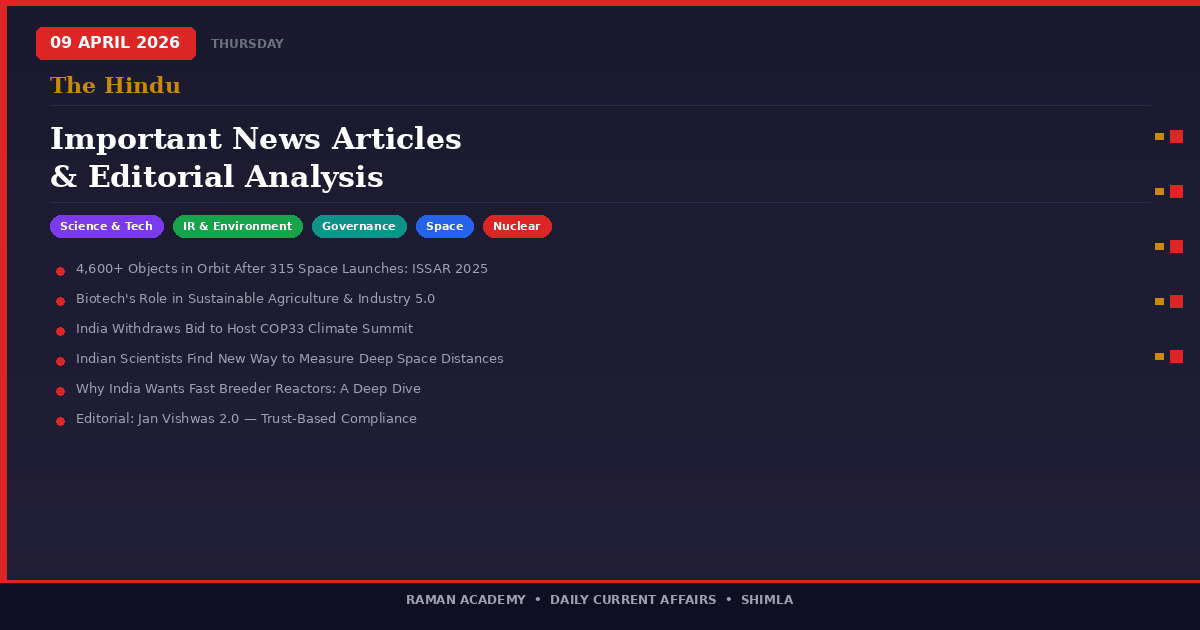
Important News Articles & Editorial Analysis
Over 4,600 Objects Placed in Orbit in 2025 After 315 Space Launches: ISSAR Report
The Indian Space Situational Assessment Report (ISSAR) by ISRO’s IS4OM provides a comprehensive audit of the orbital environment. In 2025, a record 315 successful launches deployed 4,651 objects into orbit, driven largely by commercial mega-constellations (Starlink, Kuiper). While 1,911 objects re-entered, the net annual growth of space objects reached 74.5%.
The Indian Scenario
🇮🇳 Strategic Significance for India
- Project NETRA: Network for space object Tracking and Analysis — India’s early warning system to protect satellites from debris
- Space Diplomacy: India chairs the UN working group on Long-term Sustainability (LTS) of Outer Space Activities
- Debris Free Space Mission (DFSM) 2030: Progress toward zero-debris launches using the POEM platform and de-orbiting technologies
- IN-SPACe: As India opens space to private players (NGEs), maintaining a clean orbital environment is critical for commercial success
Challenges
Kessler Syndrome: The 74.5% net growth brings us closer to a cascading collision scenario making orbits unusable. Resource Intensity: 1,000+ annual manoeuvres require significant fuel and ground station coordination, shortening satellite lifespan. Solar Cycle 25: Intense solar activity accelerated orbital decay and re-entry frequency.
Conclusion: The ISSAR 2025 report is a call to action for global space governance. India is transitioning from a “launch provider” to a “custodian of the space environment.” To ensure the Final Frontier remains a global common, India must continue leading through transparent reporting and technological innovations in debris mitigation.
Prelims Practice
Q: Which of the following best describes Kessler Syndrome?
Click to reveal answer
Mains Practice
Q: The rapid commercialization of outer space has transformed orbital space into a congested domain. Discuss in the context of ISSAR 2025 findings. Suggest measures for sustainable space governance. (150 Words)
Biotech’s Role in Sustainable Agriculture
“Green Biotechnology” involves using scientific techniques like genetic engineering, molecular markers, and tissue culture to modify living organisms for better productivity. In the era of Industry 5.0, the focus has shifted from mass production to human-centric, sustainable, and resilient innovation.
🇮🇳 Government Initiatives
- BioE3 Policy (2024): Biotechnology for Economy, Environment, and Employment — targets high-performance biomanufacturing and climate-resilient agriculture
- Biotech-KISAN: Farmer-centric scheme connecting scientists with farmers for biotech solutions
- Bio-RIDE Scheme: Unified program (₹9,197 crore) supporting biotech R&D and entrepreneurship
- GEAC: Apex body under MoEFCC regulating commercial release of GM crops in India
Challenges: Biosafety concerns (gene flow to wild relatives), monopoly by large seed corporations threatening “Seed Sovereignty,” and regulatory delays (as with GM Mustard) due to lack of long-term ecological impact data.
Conclusion: Biotechnology is the “force multiplier” required to achieve SDG 2 (Zero Hunger). The future lies in balancing high-tech innovation with traditional farming wisdom, ensuring that the benefits of Industry 5.0 reach the last mile — the marginal farmer.
Prelims Practice
Q: Which of the following best describes Biofortification?
Click to reveal answer
Mains Practice
Q: Green Biotechnology is central to achieving climate-resilient agriculture in India. Discuss with suitable examples. (150 Words)
India Withdraws Bid to Host Climate Summit (COP33) in 2028
India has officially withdrawn its candidacy to host COP33 in 2028. PM Modi had originally proposed hosting during COP28 in Dubai (2023). A formal communication to the UNFCCC on April 2, 2026, cited a “review of commitments for 2028” as the primary reason.
Analysis: Why the Withdrawal?
COP Hosting Roadmap (2025–2028)
| Year | Edition | Host Country | Status |
|---|---|---|---|
| 2025 | COP30 | Brazil (Belém) | Focused on the Amazon & Climate Finance |
| 2026 | COP31 | Türkiye & Australia | Shared Presidency: Türkiye hosts; Australia leads negotiations |
| 2027 | COP32 | Ethiopia | African Group representative |
| 2028 | COP33 | TBD (Likely South Korea) | India has withdrawn; South Korea is frontrunner |
🇮🇳 Strategic Implications
- Missed Leadership: Critics argue India lost a chance to replicate its G20 Success and demand accountability from developed nations for historical emissions
- Pragmatic Realism: India avoids the “host’s burden” — pressure to sign onto pledges (Global Cooling Pledge, strict methane curbs) that could hinder industrial growth
- Viksit Bharat @2047: Climate action is being aligned with the developed-economy goal, ensuring green transitions don’t compromise development
Conclusion: India’s withdrawal reflects a “Pragmatic Green Strategy.” While it steps back from the logistical spotlight, its updated NDCs show continued commitment to the Paris Agreement. The focus has shifted from hosting the conversation to executing the transition. India’s challenge will be maintaining climate negotiation influence without the hosting chair’s leverage.
Prelims Practice
Q: Which of the following best describes “Emissions Intensity”?
Click to reveal answer
Mains Practice
Q: India’s withdrawal from COP33 reflects a shift from climate diplomacy to climate pragmatism. Critically analyze. (150 Words)
Indian Scientists Find New Way to Measure Distances in Deep Space
Measuring galactic distances is difficult because the “fog” of the Interstellar Medium (ISM) distorts pulsar signals. The new Indian study (published in the Monthly Notices of Royal Astronomical Society) provides a way to see through this fog by combining Dispersion and Scattering — a “two-soldier approach.”
Significance
| Application | Significance |
|---|---|
| Mapping the Milky Way | Creates a 3D map of electron density, crucial for all radio astronomy |
| Gravitational Wave Research | Pulsar Timing Arrays need exact pulsar distances to detect spacetime “ripples” |
| Extragalactic Potential | Can be applied to Fast Radio Bursts (FRBs) to map the universe’s “web” |
| Indigenous Capability | Showcases depth of IIT-K, RRI, and NCRA in complex astrophysical data analysis |
Conclusion: By systematically applying the k-factor (a parameter for scattering variations), Indian researchers have turned a “noise” problem (scattering) into a “signal” solution. As India prepares for the Square Kilometre Array (SKA), such mathematical refinements will be the backbone of its contribution to global space science.
Prelims Practice
Q: With reference to Pulsars, consider:
Which is/are correct?
Click to reveal answer
Mains Practice
Q: Interstellar Medium acts both as an obstacle and a tool in astrophysics. Discuss in the context of recent Indian research. (150 Words)
Why India Wants Fast Breeder Reactors: A Deep Dive
The PFBR criticality at Kalpakkam (April 6, 2026) is the second stage of Dr. Homi J. Bhabha’s vision, dictated by India’s resource constraints: roughly 25% of the world’s Thorium reserves but very limited Uranium.
Three-Stage Nuclear Programme
| Stage | Reactor | Fuel | Key Output |
|---|---|---|---|
| I | PHWR | Natural Uranium | Electricity + Plutonium-239 |
| II | FBR | MOX (Plutonium + U-238) | Electricity + More Plutonium + U-233 |
| III | AHWR | Thorium-232 + U-233 | Electricity + Sustainable Fuel Cycle |
FBR vs. PHWR: Key Differences
| Feature | PHWR | FBR |
|---|---|---|
| Neutron Speed | Slow (Thermal) | Fast |
| Moderator | Heavy Water (D₂O) | None |
| Coolant | Heavy Water | Liquid Sodium |
| Fuel Efficiency | Low (~1%) | High (10–60%) |
| Primary Goal | Power + Initial Pu production | Power + Fuel Multiplication |
The Road Ahead
Low-Power Physics Experiments → AERB Approval → Grid Integration (500 MWe) → Scaling Up (two more commercial FBRs), accelerating the transition to Stage III Thorium reactors.
Conclusion: The FBR is India’s “Strategic Bridge” — turning limited Uranium into a vast pool of Plutonium, which is the only key to unlocking Thorium’s massive energy potential. While delays and costs have been significant, the successful criticality confirms India’s technological sovereignty and commitment to a “closed fuel cycle” ensuring long-term energy security without reliance on volatile global uranium markets.
Prelims Practice
Q: With reference to the PFBR, consider:
Which is/are correct?
Click to reveal answer
Mains Practice
Q: Explain the working principle of a Fast Breeder Reactor (FBR). How does it differ from a Pressurised Heavy Water Reactor (PHWR)? (250 Words)
Jan Vishwas 2.0: Trust-Based Compliance
Jan Vishwas 2.0 is the second iteration of a reform process aimed at decriminalizing minor, technical, and procedural defaults. By moving from a “fear-based” compliance model to a “trust-based” one, the government aims to reduce the compliance burden on businesses (especially MSMEs) and unclog the judicial system.
Jan Vishwas 1.0 vs. 2.0
| Feature | Jan Vishwas Act, 2023 (1.0) | Jan Vishwas Bill, 2026 (2.0) |
|---|---|---|
| Scope | 183 provisions across 42 Acts | 784 provisions across 79 Acts |
| Ministries | 19 Ministries | 23 Ministries |
| Core Action | Decriminalized minor offences | Decriminalized 717 provisions; removed obsolete laws |
| Approach | Replaced fines with penalties | Introduced graded enforcement (warnings, lower penalties for 1st timers) |
Key Pillars of the Reform
Challenges
Institutional Capacity: Executive officers must be trained as fair adjudicators to prevent penalties becoming a new harassment tool. Uniformity: Different ministries and states must apply decriminalized rules consistently. Retrospective Clarity: Clear guidelines needed on how pending cases will be transferred or closed.
Conclusion: Jan Vishwas 2.0 is more than a legal amendment — it is a behavioral shift in the state-citizen relationship. By removing the “shadow of the jailhouse” from the boardroom, India positions itself as a modern, investor-friendly economy. Success will depend on ground-level implementation — ensuring that reduced “criminalization” is matched by increased “regulatory clarity.”
Mains Practice
Q: Decriminalization of minor economic offences is a necessary but not sufficient condition for ‘Ease of Doing Business’ in India. Critically analyze in the context of the Jan Vishwas 2.0 Bill. (150 Words)
