
1. Makhananomics: Boosting the Makhana Industry – Economy
Why in News?
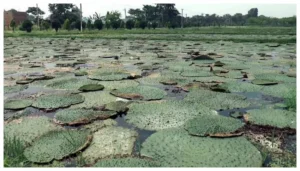
In a recent rally at Samastipur, Bihar, Prime Minister Modi called the creation of the National Makhana Board a “revolutionary step” for farmers. The move aims to promote makhana (foxnut) cultivation, branding, and export, especially from Bihar, which produces 90% of India’s makhana.
This push—dubbed “Makhananomics”—seeks to link makhana production with rural livelihoods, agribusiness, and export growth, while also resonating with local politics ahead of Bihar’s Assembly elections.
What is Makhana?
-
Botanical Name: Euryale ferox
-
Common Name: Foxnut, Gorgon nut
-
Grown in: Freshwater wetlands and ponds
-
Uses: Snack food, health supplement, Ayurvedic medicine
-
Nutritional Value: High in protein, low in fat, rich in antioxidants
-
Global Status: Increasingly marketed as a superfood
Key Production Insights
-
India’s Share: ~90% of global makhana production
-
Bihar’s Contribution: 80–90% of Indian production
-
Core Districts: Darbhanga, Madhubani, Purnea, Katihar, Saharsa
-
Market Size:
-
Global value: $43.56 million (2023)
-
Projected to reach $100 million by 2033
-
Challenges in the Makhana Industry
Export Disparity
-
Despite high production, Bihar’s export value is low
-
States like Punjab and Assam dominate value-added exports due to better processing infrastructure
Supply Chain Fragmentation
-
Dominated by middlemen, reducing profits for farmers
-
Lack of organized cooperatives or farmer-producer companies
Labour-Intensive & Low Productivity
-
Manual processing increases cost and time
-
Limited adoption of mechanized shelling or drying technologies
Inadequate Infrastructure
-
Poor cold chain and processing units in Bihar
-
Lack of quality certification and branding at the farmer level
Government Interventions
National Makhana Board
-
Launched with an initial ₹100 crore budget
-
Objectives:
-
Improve production, processing, and value addition
-
Expand branding and export capability
-
Integrate farmer cooperatives and SHGs
-
Mithila Makhana GI Tag
-
Received Geographical Indication (GI) status in 2022
-
Helps protect regional identity and improve market positioning
Minimum Support Price (MSP) Proposal
-
The Bihar government has demanded an MSP for makhana, similar to pulses or oilseeds, to ensure fair pricing for producers
Integrated Food Processing Zones
-
Planned near production hubs
-
Will include cold chains, quality testing, packaging, and export logistics
Significance for India’s Rural Economy
| Aspect | Impact |
|---|---|
| Farm Income | Boosts income for small & marginal farmers in Bihar |
| Women Empowerment | Many SHGs led by women are involved in makhana processing |
| Export Potential | Global demand rising for healthy snacks |
| Agro-based Industry | Contributes to food processing and rural employment |
| Doubling Farmer Incomes | Aligns with national goals for rural prosperity |
Way Forward
-
Strengthen FPOs & Cooperatives to bypass intermediaries
-
Invest in mechanization to reduce labor intensity and improve efficiency
-
Link with e-NAM and global platforms for transparent pricing
-
Research & Innovation – Introduce drought-resistant varieties, improve post-harvest tech
-
Export Ecosystem – Enable certifications, traceability, and direct export channels
-
Capacity Building – Train farmers in grading, branding, and compliance
Exam Connect – Possible Questions
Prelims
1. “Makhana” or foxnut, widely cultivated in India, is botanically derived from which plant?
A. Nelumbo nucifera
B. Euryale ferox
C. Trapa natans
D. Eichhornia crassipes
Answer: B. Euryale ferox
2. Which of the following statements about Makhana is/are correct?
1.It is largely cultivated in saline coastal wetlands of Gujarat.
2.Bihar is the largest producer of makhana in India.
3.Makhana has received a Geographical Indication (GI) tag.
Options:
A. 1 and 2 only
B. 2 and 3 only
C. 1 and 3 only
D. All of the above
Answer: B. 2 and 3 only
Mains
1. “The success of India’s makhana sector depends not just on production but on processing and value addition.” Critically evaluate the role of the National Makhana Board in this context.
2. Analyze the potential of regional crops like makhana in transforming rural economies. What policy steps are needed to integrate such crops into India’s mainstream agri-export ecosystem?
2. Kamlang Tiger Reserve – Eco-tourism and Conservation in Arunachal Pradesh – Environment

Why in News?
The Deputy Chief Minister of Arunachal Pradesh has announced new plans to develop eco-tourism infrastructure, including a nature trail and angling spot, in the Kamlang Tiger Reserve (Lohit district). The initiative seeks to promote sustainable tourism and generate local employment while conserving the region’s rich biodiversity.
Location and Geography
-
State: Arunachal Pradesh
-
District: Lohit
-
Region: Eastern Arunachal, near the Myanmar border
-
Biodiversity Hotspot: Part of the Eastern Himalayan Biodiversity Hotspot
-
Named After: Kamlang River, which flows through the reserve
Geographical Boundaries
-
South: Namdapha National Park (adjacent)
-
North: Lang River
-
West: Lati River
-
East: Tawe River
Ecological Features
Landscape & Climate
-
Terrain: Dense tropical and subtropical forests, rivers, and grasslands
-
Climate: Subtropical with high rainfall
-
Vegetation Zones:
-
Moist evergreen tropical forests (lower altitudes)
-
Subtropical forests (higher elevations)
-
Flora
-
Important Tree Species:
-
Ammora wallichi (Amari)
-
Gmelina arborea (Gamari)
-
Terminalia chebula (Haritaki/Hillika)
-
Fauna Highlights
-
Big Cats Present:
-
Tiger (Panthera tigris)
-
Snow Leopard
-
Clouded Leopard
-
Common Leopard
-
-
Endangered Species:
-
Hoolock Gibbon (India’s only ape species)
-
Himalayan Palm Civet
-
-
Other Wildlife:
-
Hornbills
-
Giant Squirrels & Flying Squirrels
-
Capped Langur
-
Stump-Tailed Macaque
-
Deer, Civets, and various birds and primates
-
Local Communities
-
Inhabitants Around Reserve:
-
Hishmi tribe
-
Digaru Mishmis
-
Mizos
-
-
The tourism push aims to engage local communities through eco-guides, homestays, and craft markets, creating community-based conservation models.
Tourism & Conservation Goals
Objectives of the Development Plan
-
Develop eco-tourism infrastructure: Nature trails, angling zones, visitor facilities
-
Boost local livelihood opportunities
-
Ensure low-impact tourism that aligns with conservation goals
-
Position Kamlang as an eco-tourism hub of eastern Arunachal Pradesh
Conservation Significance
| Feature | Importance |
|---|---|
| Biodiversity hotspot | One of India’s richest ecological regions |
| High species diversity | Home to all four major big cats |
| Connectivity | Adjacent to Namdapha National Park, enabling species movement |
| Tribal integration | Promotes participatory conservation and respect for local customs |
| Climate resilience | Acts as a natural buffer against floods and climate impacts |
Way Forward
-
Introduce community-managed tourism cooperatives
-
Establish capacity-building programs for locals
-
Implement wildlife impact assessments before tourism expansion
-
Strengthen wildlife corridors between Kamlang and Namdapha
-
Develop eco-sensitive guidelines for tourism in fragile areas
Exam Connect – Possible Questions
Prelims
1. The Kamlang Tiger Reserve is located in which of the following Indian states?
A. Assam
B. Arunachal Pradesh
C. Nagaland
D. Sikkim
Answer: B. Arunachal Pradesh
2. Which of the following big cats are found in the Kamlang Tiger Reserve?
1.Tiger
2.Snow Leopard
3.Clouded Leopard
4.Asiatic Lion
Options:
A. 1, 2, and 3 only
B. 1 and 4 only
C. 1, 2, and 4 only
D. All of the above
Answer: A. 1, 2, and 3 only
Mains
1. Discuss the ecological significance of the Kamlang Tiger Reserve in the context of India’s biodiversity conservation efforts. How can eco-tourism be leveraged for inclusive development in such areas?
2. Protected areas often face the dual challenge of wildlife conservation and community development. Critically evaluate this dilemma in the context of tiger reserves in northeast India.
3. Election Commission Orders Political Parties to Label AI-Generated Content – Polity
Why in News?
The Election Commission of India (ECI) has issued an advisory requiring all political parties to clearly label any AI-generated or manipulated content (videos, images, or audio clips) shared online. The directive is a response to the growing misuse of deepfakes and synthetic content that can mislead voters and undermine free and fair elections.
This move comes after high-profile cases of AI-generated political content went viral, sparking concerns over misinformation and voter manipulation.
Key Takeaways
-
Mandatory Labeling: All AI-generated or altered content shared by political parties must carry clear, visible labels.
-
Content Metadata: Content must include metadata stating the creator or responsible entity.
-
Record-Keeping: Political parties must maintain internal records of such content for ECI verification.
-
Legal Alignment: The move aligns with draft amendments to IT Rules, 2021, proposed by MeitY (Ministry of Electronics and IT).
Additional Details
Labeling Guidelines:
-
Visual Media: The watermark or label must cover at least 10% of the screen area.
-
Audio Content: A label must be present for the first 10% of the total duration.
-
Metadata Requirement: Each AI-generated file must include:
-
The creator’s identity
-
The date and time of creation
-
A disclaimer about its synthetic nature
-
Objectives of the Advisory
| Objective | Explanation |
|---|---|
| Electoral Fairness | Prevent the use of fake content to manipulate voter perceptions. |
| Transparency | Ensure voters can distinguish real from synthetic media. |
| Accountability | Make political parties responsible for digital communication. |
| Misinformation Control | Curb the spread of doctored content during campaigns. |
Context: Deepfakes and Elections
-
Deepfakes are hyper-realistic fake videos or audio created using AI and machine learning.
-
While deepfakes may have entertainment or educational applications, they pose serious threats during elections by:
-
Mimicking leaders’ voices or actions
-
Spreading fake speeches or fabricated political endorsements
-
Triggering social unrest or polarization
-
Legal & Policy Framework
-
Section 79 of the IT Act, 2000: Grants intermediaries safe harbor, but with obligations to remove unlawful content.
-
Proposed Amendments to IT Rules, 2021:
-
Mandatory AI labeling across platforms
-
Platforms must detect, verify, and flag synthetic media
-
ECI’s Stand
“AI can be transformative, but if misused, it risks disrupting the democratic process through algorithmic bias, misinformation, and voter manipulation.” — Election Commission
Way Forward
-
Platform Cooperation: Social media platforms must integrate AI detection tools and act swiftly on flagged content.
-
Voter Awareness: Educating the public on identifying deepfakes and verifying sources.
-
Regulatory Coordination: Ensuring coordination between ECI, MeitY, and social media companies.
-
Strict Enforcement: Penalizing non-compliance to deter misuse.
Exam Connect – Possible Questions
Prelims
1. The recent advisory by the Election Commission regarding AI-generated content mandates which of the following?
1.Labeling of AI-generated political content
2.Disclosure of creator identity and timestamp
3.Mandatory use of blockchain to store political media
Options:
A. 1 and 2 only
B. 2 and 3 only
C. 1 and 3 only
D. 1, 2, and 3
Answer: A. 1 and 2 only
2. Which ministry is responsible for drafting rules related to online content regulation in India?
A. Ministry of Law and Justice
B. Ministry of Information and Broadcasting
C. Ministry of Electronics and Information Technology
D. Ministry of Home Affairs
Answer: C. Ministry of Electronics and Information Technology
Mains
1. The rise of deepfake and AI-generated content poses a serious challenge to electoral integrity. Discuss how India’s institutional and legal mechanisms are responding to this threat.
2. Should India introduce a comprehensive law to regulate AI and synthetic media during elections? Examine in the context of the Election Commission’s latest advisory.
4. SWAMIH Fund Exemption by Reserve Bank of India – Economy
Why in News?
The Reserve Bank of India (RBI) has exempted the SWAMIH Fund from its recently revised regulatory norms applicable to Alternate Investment Funds (AIFs). This strategic exemption is designed to strengthen the fund’s capacity to resolve stalled housing projects, especially in the affordable and mid-income segments.
Key Takeaways
-
The SWAMIH Fund (Special Window for Affordable and Mid-Income Housing) was established in 2019 to revive stuck real estate projects.
-
Managed by SBICAP Ventures Ltd, it is classified as a Category-II AIF.
-
RBI’s exemption will ease financing constraints and facilitate faster disbursal of funds to developers.
What is the SWAMIH Fund?
| Feature | Details |
|---|---|
| Full Form | Special Window for Affordable and Mid-Income Housing |
| Launched by | Ministry of Finance (2019) |
| Managed by | SBICAP Ventures Ltd (a subsidiary of SBI Capital Markets) |
| Classification | Category-II Alternate Investment Fund (AIF) |
| Purpose | Acts as a lender of last resort to fund stalled/delayed housing projects |
| Target Segment | Affordable & Mid-Income Housing |
Eligibility for SWAMIH Assistance
A real estate project must fulfill the following:
-
Be registered under RERA (Real Estate Regulation and Development Act, 2016)
-
Be classified as Non-Performing Asset (NPA) or undergoing insolvency (e.g., IBC process)
-
Be stalled or delayed (as certified by competent authority)
-
Primarily cater to affordable or mid-income housing categories
RBI’s Regulatory Context
Recently, the RBI introduced tighter rules for AIFs, including restrictions on:
-
Investing in stressed assets
-
Exposure to borrowers already under default or insolvency
-
Layered investment structures
These were aimed at preventing misuse of AIFs for evergreening of loans and regulatory arbitrage.
Why Exempt SWAMIH?
Unlike profit-oriented AIFs, SWAMIH is a sovereign-backed social impact fund, focused on public interest and housing welfare. Exempting it ensures its operational flexibility.
Achievements (as of 2024)
-
Sanctioned over ₹16,000 crore across 290+ projects
-
Revived housing for over 1.5 lakh homebuyers
-
Projects located in Tier 1 and Tier 2 cities, helping bridge the urban housing gap
Significance
| Dimension | Impact |
|---|---|
| Housing Sector | Revives delayed projects, reduces unsold inventory |
| Job Creation | Stimulates construction sector employment |
| Banking Sector | Reduces NPA burden via project completion |
| Consumer Relief | Helps distressed homebuyers get possession of homes |
| Financial Sector | Shows flexibility in regulations for public-interest AIFs |
Challenges
-
Land and legal disputes still delay some projects
-
One-time funding: No provision for future distress
-
Need for better transparency and monitoring in fund disbursal
Way Forward
-
Expand scope to include rental housing and urban affordable housing initiatives
-
Foster state-level cooperation for faster approvals and clearances
-
Replicate SWAMIH-like models in other sectors like infrastructure or logistics
Exam Connect – Possible Questions
Prelims
1. The SWAMIH Fund recently seen in the news is primarily aimed at:
A. Promoting solar energy manufacturing
B. Supporting delayed real estate projects in affordable housing
C. Financing rural infrastructure projects
D. Enhancing digital literacy in urban slums
Answer: B. Supporting delayed real estate projects in affordable housing
2. Which of the following is true about Category-II Alternate Investment Funds (AIFs)?
1.They can include private equity and debt funds.
2.They are allowed to borrow for investment purposes.
3.SWAMIH Fund is categorized under this class.
Options:
A. 1 only
B. 1 and 3 only
C. 2 and 3 only
D. 1, 2, and 3
Answer: B. 1 and 3 only
Mains
1. How can targeted funds like SWAMIH help resolve the crisis in the real estate sector? Discuss the role of regulatory flexibility in achieving developmental goals.
2. Examine the significance of Alternate Investment Funds (AIFs) in India’s capital markets. Should their regulation differ based on purpose and risk profile?
5. MAHA MedTech Mission – Economy

Why in News?
The Anusandhan National Research Foundation (ANRF), in collaboration with the Indian Council of Medical Research (ICMR) and the Bill & Melinda Gates Foundation, has launched the MAHA-MedTech Mission (Mission for Advancement in High-Impact Areas).
It aims to revolutionize India’s medical technology sector by promoting affordable, high-quality indigenous MedTech innovations.
Key Takeaways
-
Aims to reduce import dependency and boost domestic innovation in medical technology.
-
Funding will be linked to milestones, ensuring accountability and measurable outcomes.
-
Focuses on affordability, accessibility, and scale in MedTech development.
-
Will leverage public-private partnerships and strengthen industry-academia collaboration.
Objectives of the Mission
-
Innovation Acceleration: Support R&D in MedTech focused on India’s healthcare priorities.
-
Affordable Access: Fund solutions that reduce the cost of medical equipment and care.
-
Self-Reliance: Promote indigenous development to reduce import dependence.
-
Commercialization Support: Bridge the gap from lab to market with regulatory and IP support.
Funding & Support Structure
| Element | Details |
|---|---|
| Project Funding | ₹5 crore – ₹25 crore (up to ₹50 crore in exceptional cases) |
| Duration | 5 years |
| Support Tools | – Patent Mitra (IPR & tech transfer) – MedTech Mitra (regulatory handholding) – Clinical Trial Network (for validation) – Mentorship from industry leaders |
National Relevance
| Aspect | Significance |
|---|---|
| Health Sector | Enhances access to diagnostics, imaging, and therapeutic devices |
| Startup Ecosystem | Boosts Indian MedTech startups with funding and mentoring |
| Economic Impact | Reduces import bill and builds a globally competitive MedTech export sector |
| Public Health | Supports development of tech for diseases like TB, diabetes, maternal health, etc. |
Why is MedTech Critical for India?
-
India imports ~80% of its medical devices (as of 2023).
-
Healthcare inequality is high—affordable diagnostics and devices are lacking in rural areas.
-
Rising non-communicable diseases (e.g. cancer, cardiovascular) require scalable tech-based interventions.
-
Boosts Atmanirbhar Bharat in the healthcare technology sector.
Expected Outcomes
-
Support 50+ impactful MedTech innovations
-
Create export-ready technologies
-
Strengthen Make in India for Health
-
Catalyze MedTech research clusters in Tier 2/3 cities
-
Facilitate job creation in R&D, design, and manufacturing
Exam Connect – Possible Questions
Prelims
1. The MAHA MedTech Mission recently launched in India primarily aims to:
A. Promote organic farming in high-altitude regions
B. Develop and commercialize indigenous medical technologies
C. Digitize government health records nationwide
D. Provide universal free health insurance
Answer: B. Develop and commercialize indigenous medical technologies
2. Consider the following statements about the MAHA MedTech Mission:
1.It is a 10-year mission supported by WHO and ICMR.
2.It provides milestone-based funding of up to ₹50 crore.
3.It includes support for patent protection and clinical validation.
Which of the above statements is/are correct?
A. 1 and 2 only
B. 2 and 3 only
C. 1 and 3 only
D. All of the above
Answer: B. 2 and 3 only
Mains
1. Discuss how the MAHA MedTech Mission can help India reduce its dependency on imported medical devices and ensure affordable healthcare access.
2. What are the challenges in India’s medical technology ecosystem? How can missions like MAHA bridge the gap between innovation and implementation?
6. ICGS Ajit and ICGS Aparajit – Boosting India’s Maritime Security – Defence & Security
Why in News?
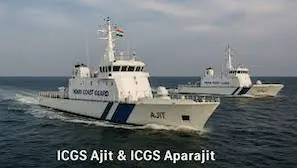
The Indian Coast Guard (ICG) recently commissioned ICGS Ajit and ICGS Aparajit, two indigenously built Fast Patrol Vessels (FPVs) constructed by Goa Shipyard Limited (GSL). These vessels mark a significant milestone in India’s coastal security and maritime law enforcement capabilities.
Key Takeaways
-
These are the 7th and 8th vessels in a series of 8 FPVs built by GSL under the Make in India initiative.
-
Designed for multi-mission roles, especially fisheries protection, anti-smuggling, and coastal patrol.
-
Strengthens India’s maritime reach, especially in island territories and the Exclusive Economic Zone (EEZ).
Technical Specifications
| Feature | Description |
|---|---|
| Builder | Goa Shipyard Limited (GSL) |
| Length | 52 meters |
| Displacement | 320 tonnes |
| Propulsion | Controllable Pitch Propellers (CPP) – allowing high efficiency and manoeuvrability |
| Speed | Capable of operating at high speeds for rapid response missions |
| Range | ~1500 nautical miles |
Operational Roles
These FPVs will perform:
-
Anti-smuggling and anti-piracy operations
-
Search and Rescue (SAR) missions
-
Coastal surveillance and patrolling of India’s vast EEZ
-
Marine pollution control and environmental protection
-
Fisheries protection and regulation enforcement
-
Escort duties and law enforcement support
Indian Coast Guard: Brief Overview
| Category | Description |
|---|---|
| Established | 1978 under the Coast Guard Act, 1978 |
| Headquarters | New Delhi |
| Administrative Control | Ministry of Defence |
| Motto | “Vayam Rakshamah” (We Protect) |
| Primary Duties | Maritime safety, Search and Rescue (SAR), marine environment protection, and enforcement of maritime laws |
Strategic Significance
-
Enhances coastal and EEZ monitoring in light of rising security threats.
-
Boosts fleet readiness and rapid response capacity for maritime threats and disasters.
-
Aids in ensuring sustainable resource use through fisheries protection.
-
Reinforces Make in India and indigenous defence production.
Exam Connect – Possible Questions
Prelims
1. The Indian Coast Guard functions under the administrative control of which of the following ministries?
A. Ministry of Home Affairs
B. Ministry of Shipping
C. Ministry of Defence
D. Ministry of External Affairs
Answer: C. Ministry of Defence
2. Which of the following are correct features of the newly inducted Fast Patrol Vessels (FPVs) – ICGS Ajit and ICGS Aparajit?
1.Built by Goa Shipyard Limited
2.Equipped with Controllable Pitch Propellers
3.Primarily used for submarine warfare
A. 1 and 2 only
B. 1 and 3 only
C. 2 and 3 only
D. All of the above
Answer: A. 1 and 2 only
Mains
1. Discuss the role of the Indian Coast Guard in ensuring India’s maritime security. How does the induction of indigenously built Fast Patrol Vessels enhance its operational efficiency?
2. Evaluate the significance of indigenous defence manufacturing in strengthening India’s national security and economy, citing recent examples.
