
1. Ayushman Bharat and Universal Health Coverage (UHC) – Polity

Why in News?
The National Health Authority’s (NHA) Annual Report 2024–25 has revealed a key trend under Ayushman Bharat–Pradhan Mantri Jan Arogya Yojana (AB-PMJAY):
While government hospitals form the majority of empanelled institutions, most patients prefer private hospitals, raising issues around costs, public trust, and health equity.
Key Findings from NHA Report
-
Empanelled Hospitals: Out of 31,005 empanelled hospitals:
-
45% are private, yet they deliver 52% of hospitalisations
-
Receive 66% of total treatment costs (₹1.29 lakh crore)
-
-
Treatment Patterns:
-
Most common procedures: Haemodialysis (14%), fever (4%), gastroenteritis (3%), animal bites (3%)
-
Top specialties in 2024–25: General Medicine, Ophthalmology, General Surgery
-
-
Digital Health Integration:
-
60% of the population has an ABHA number (14-digit health ID)
-
50 crore health records linked
-
38% of facilities and 26% of health personnel registered digitally
-
-
Patient Mobility: The portability feature allows treatment across states, enhancing access and flexibility.
About Ayushman Bharat – PM-JAY
| Feature | Description |
|---|---|
| Objective | Financial protection for secondary & tertiary care for poor/vulnerable groups |
| Launched | 2018 (replacing NHPS and subsuming RSBY – 2008) |
| Target Beneficiaries | ~55 crore people (~12 crore families), based on SECC-2011 data |
| Senior Citizens | All individuals 70+ eligible, regardless of income (approx. 6 crore) |
| Funding Pattern | Centre:State = 60:40 (90:10 for NE & Hill States), 100% for UTs |
| Benefits | ₹5 lakh per family/year for hospitalisation (secondary & tertiary) |
Key Components of Ayushman Bharat
1.Ayushman Arogya Mandirs (AAMs)
Formerly Health & Wellness Centres (HWCs), targeting:
-
Free primary care
-
Non-communicable diseases (NCDs)
-
Mental health, oral, eye, ENT services
-
Palliative & rehabilitative care
2.Pradhan Mantri Jan Arogya Yojana (PM-JAY)
-
Focused on hospital-based care
-
Empanelment of public and private hospitals
3.Implementation Structure:
-
National Health Authority (NHA) – Central body under Union Health Ministry
-
State Health Authority (SHA) – Appointed CEO manages implementation
-
District Implementation Unit (DIU) – Headed by DC/DM
Achievements So Far
-
35.4 crore Ayushman cards issued
-
49% of cards issued to women; 3.61 crore hospitalisations
-
21% reduction in out-of-pocket expenditure (OOPE)
-
District hospital revenue saw net benefits worth USD 26.1 million annually (projected to rise to USD 41.8 million)
Key Challenges to Universal Health Coverage in India
1. Inadequate Public Health Financing
-
India’s public health expenditure is just 1.84% of GDP, below the 2.5% target in National Health Policy 2017
-
High OOPE (39.4%) still burdens poor families
2. Limited Coverage & Missing Middle
-
“Missing middle” – those who are not poor enough for AB-PMJAY, and not rich enough for private insurance
-
Neglect of outpatient and diagnostic care, which form a large share of OOPE
3. Rural-Urban Divide
-
Most doctors and facilities are concentrated in urban areas
-
Severe shortages of public health staff in rural and tribal regions
4. Weak Primary Healthcare
-
Primary care neglected → overburdened tertiary hospitals
-
System still treatment-oriented, not preventive
5. Regulatory Gaps in Private Sector
-
Inconsistent quality, overcharging, and unethical practices in private hospitals
-
Poor enforcement of Clinical Establishments Act, 2010
Measures Needed to Achieve Universal Health Coverage
| Strategy | Action Plan |
|---|---|
| Increase Public Spending | Raise health spending to 2.5% of GDP with focus on primary healthcare and Arogya Mandirs |
| Expand Coverage | Bring in the missing middle via affordable insurance and outpatient care coverage |
| Strengthen Workforce | Build medical/nursing colleges in underserved areas, incentivize rural postings |
| Use Digital Health Tech | Leverage ABHA, telemedicine, and AI for outreach and disease monitoring |
| Governance & Regulation | Implement Clinical Establishments Act, enforce standard treatment guidelines, and strengthen data systems |
Prelims
1.Which of the following statements regarding Ayushman Bharat–PMJAY is correct?
A. It provides free primary care only
B. It covers all Indian citizens under health insurance
C. It provides ₹5 lakh health coverage per family for secondary and tertiary care
D. It is implemented by the Ministry of Social Justice
Answer: C. It provides ₹5 lakh health coverage per family for secondary and tertiary care
2.The “ABHA number” under Ayushman Bharat refers to:
A. A mobile helpline for health grievances
B. A 12-digit Aadhar-based bank account number
C. A 14-digit digital health ID for managing personal health records
D. An identity number for Ayush doctors
Answer: C. A 14-digit digital health ID for managing personal health records
Mains
1.”Ayushman Bharat has advanced India’s goal of Universal Health Coverage, but critical gaps remain.” Discuss with reference to access, equity, and digital health integration.
2.What are the key barriers to achieving Universal Health Coverage in India? Suggest structural and policy reforms to make healthcare equitable, accessible, and affordable.
2. India–Middle East–Europe Economic Corridor (IMEC): Strategic Opportunity Amidst Geopolitical Uncertainty – International Relations
Why in News?
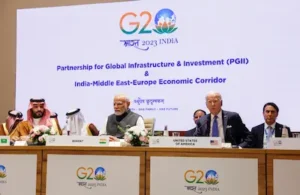
The India–Middle East–Europe Economic Corridor (IMEC), launched at the G20 Summit 2023 in New Delhi, aims to enhance multi-modal connectivity between India, the Middle East, and Europe.
However, its feasibility is being challenged by escalating conflicts in West Asia, emerging Arctic sea routes, and maritime insecurity.
What is IMEC?
| Aspect | Details |
|---|---|
| Launched | 2023 G20 Summit (New Delhi) |
| Through | Memorandum of Understanding (MoU) |
| Segments | 1. Eastern Corridor: India → Gulf region 2. Northern Corridor: Gulf → Europe |
| Signatories | India, USA, Saudi Arabia, UAE, France, Germany, Italy, European Union |
| Linked to | G7’s Partnership for Global Infrastructure and Investment (PGII) |
| Infrastructure | Ports, railways, roads, energy pipelines, undersea digital cables |
| Alternative to | China’s Belt and Road Initiative (BRI) – with emphasis on transparency, sustainability, and sovereignty |
Strategic & Economic Significance for India
-
Reduces transport time & logistics cost for Indian exports
-
Enhances connectivity with Europe, India’s largest trading partner
-
Offers alternative to Suez Canal & China-dominated trade routes
-
Supports India’s energy security via deeper ties with the Gulf
-
Counters Pakistan’s regional influence
-
Aligns with One Sun One World One Grid (OSOWOG) and India’s green hydrogen goals
Key Challenges to IMEC
1. Geopolitical Instability in West Asia
-
October 2025 Hamas–Israel conflict disrupts regional security
-
Strained Israel–Saudi Arabia/Jordan ties threaten infrastructure projects
2. Shifting Trade Routes due to Climate Change
-
Melting Arctic sea routes offer shorter Asia–Europe connections
-
May reduce IMEC’s cost-competitiveness
3. Red Sea & Maritime Insecurity
-
Houthi rebel attacks disrupt shipping in the Red Sea
-
Forces rerouting via Cape of Good Hope, increasing costs
-
IMEC could face similar risks in conflict-prone regions
4. Exclusion of Key Regional Players
-
Turkey, Egypt, Iran excluded — could lead to rival corridors
-
Pakistan’s growing ties with Arab states may counterbalance IMEC
5. Funding & Implementation Issues
-
Goal: $600 billion by 2027
-
No clear funding roadmap or cost-sharing mechanism
-
Requires high-speed rail, energy pipelines, digital infra across multiple nations
6. Uncertain Peace Prospects in Gaza
-
Future escalations could halt or delay key corridor segments
India’s Strategic Response: Way Forward
| Priority | Strategy |
|---|---|
| Multilateral Governance | Establish an IMEC Secretariat for coordination, dispute resolution, and monitoring |
| Geopolitical Outreach | Engage key players (Turkey, Egypt, Iran, Qatar) for expanded cooperation |
| Secure Investment | Use public-private partnerships, green bonds, and sustainable finance to mobilize funds |
| Trade & Security Risk Mitigation | Diversify routes, use platforms like IORA and GCC to address piracy & cyber threats |
| Technological Leadership | Promote ABHA-linked e-health, UPI payments, undersea cables, smart infrastructure |
Prelims
1.Which of the following countries is not a signatory to the India–Middle East–Europe Economic Corridor (IMEC)?
A. India
B. Saudi Arabia
C. Turkey
D. United States
Answer: C. Turkey
2.The India–Middle East–Europe Economic Corridor (IMEC) was launched during which summit?
A. BRICS Summit 2022
B. G7 Summit 2021
C. G20 Summit 2023
D. SCO Summit 2023
Answer: C. G20 Summit 2023
Mains
1.“The India–Middle East–Europe Economic Corridor (IMEC) presents a new geopolitical pathway for India.” Examine the corridor’s strategic potential and key challenges to its implementation.
2.Discuss how India can balance geopolitical risks and economic opportunities in its pursuit of regional connectivity through the IMEC initiative. Suggest measures to enhance the corridor’s long-term viability.
3. Strengthening Rural Growth Through Enhanced Agricultural Credit – Indian Economy
Why in News?
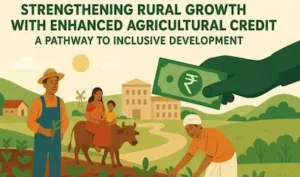
The Union Finance Minister, during a review of the Karnataka Grameena Bank (KaGB) in Ballari, urged rural banks to expand agricultural credit disbursement to meet the evolving financial needs of “New Rural India”.
This reflects the government’s emphasis on making credit more inclusive, affordable, and aligned with rural diversification.
Understanding Agricultural Credit in India
Sources of Agricultural Credit:
-
Public Sector Banks
-
Regional Rural Banks (RRBs)
-
Cooperative Banks
-
NABARD (National Bank for Agriculture and Rural Development)
Types of Agricultural Credit:
| Credit Type | Purpose |
|---|---|
| Short-Term | Working capital needs (seeds, fertilizers, pesticides) |
| Medium-Term | Equipment, irrigation, animal husbandry |
| Long-Term | Land development, farm infrastructure |
Why Enhanced Agricultural Credit is Crucial
-
Rising Input Costs: Sharp increase in prices of seeds, fertilizer, and mechanisation.
-
Changing Rural Economy: Shift towards dairy, fisheries, agri-tech, food processing — all needing customised financial products.
-
Exclusion of Small & Marginal Farmers: 85% of Indian farmers are smallholders, many still depend on informal moneylenders.
-
Support for FPOs & Rural MSMEs: These entities need working capital to scale operations and integrate into value chains.
-
Climate and Technology Transition: Credit is essential for shifting to climate-resilient, mechanised, and digital agriculture.
Key Government Measures to Boost Agricultural Credit
| Scheme | Objective |
|---|---|
| Kisan Credit Card (KCC) | Timely credit access for farmers, including animal husbandry and fisheries |
| Priority Sector Lending (PSL) | Mandates banks to allocate 18% of ANBC to agriculture |
| Interest Subvention Scheme (ISS) | Provides concessional interest rates during delayed crop cycles |
| NABARD Refinance Support | Low-cost refinance for banks lending to agri-projects |
| FPO Formation | Target to create 10,000 FPOs with NABARD & SFAC support |
| Digital Initiatives | Digital KCC, Agristack, JAM trinity for streamlined, leak-proof delivery |
Key Challenges in Agricultural Credit
-
Regional Disparities: South and West receive majority credit; East & Northeast underserved
-
Short-Term Bias: Majority of loans are short-term, limiting long-term asset creation
-
Exclusion of Tenant & Landless Farmers: Lack of land titles prevents formal loan access
-
Rising NPAs in RRBs & Coops: Poor recovery and weak institutional capacity
-
Inefficient Credit Delivery: Bureaucratic delays, lack of tech use, and poor credit assessment
Way Forward: Reforms to Strengthen Rural Credit Ecosystem
| Focus Area | Reform Strategy |
|---|---|
| Strengthen Rural Financial Institutions | Capital support, tech infrastructure, robust risk management for RRBs & Co-ops |
| Credit for Allied Activities | Target dairy, fisheries, food processing, and solar-based rural projects |
| Inclusion of Marginal, Tenant, & Women Farmers | Use Joint Liability Groups (JLGs), SHGs, and gender-specific products |
| Technology Integration | AI-driven credit scoring, satellite-based land verification, Aadhaar-linked records |
| Policy Synchronisation | Coordinate among Finance Ministry, NABARD, States, and Banks for consistent delivery |
Prelims
1.Which of the following is not a formal source of agricultural credit in India?
A. Regional Rural Banks
B. Cooperative Banks
C. Moneylenders
D. NABARD
Answer: C. Moneylenders
2.Under the Priority Sector Lending norms, what is the minimum share of bank lending required for the agriculture sector?
A. 10% of ANBC
B. 18% of ANBC
C. 22% of ANBC
D. 25% of ANBC
Answer: B.18% of ANBC
Mains
1.Discuss the challenges in the agricultural credit delivery system in India. Suggest structural reforms needed to enhance access and affordability of rural credit.
2.In the context of a diversifying rural economy, examine how strengthening formal credit infrastructure can promote inclusive rural development.
4. India–Mongolia Strategic Partnership: Strengthening Regional Cooperation – International Relations
Why in News?
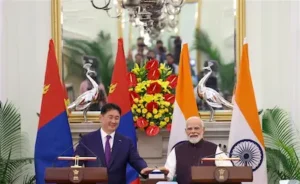
The President of Mongolia visited India to mark:
-
70 years of diplomatic ties (1955–2025), and
-
10 years of Strategic Partnership (2015–2025).
This high-level visit resulted in key agreements and initiatives across defence, energy, culture, and development, reinforcing India’s Act East and Act West policies.
Key Outcomes of the Visit
Defence and Security
-
India will establish a Defence Attaché in Ulaanbaatar.
-
Capacity-building program for Mongolia’s border security forces.
-
Enhancement of joint military exercises like Nomadic Elephant and Khaan Quest.
Energy Cooperation
-
Reaffirmation of the $1.7 billion Oil Refinery Project funded by India’s Line of Credit.
-
Largest Indian overseas development project—crucial for Mongolia’s energy independence.
Economic Partnership
-
Focus on critical minerals, rare earths, coking coal.
-
Exploring trade routes via Vladivostok (Russia) and Tianjin (China) to bypass logistical constraints.
Cultural and Religious Connectivity
-
MoU between Ladakh Autonomous Hill Development Council and Arkhangai Province.
-
India to send:
-
Sanskrit teacher to Gandan Monastery
-
Holy relics of Lord Buddha’s disciples to Mongolia
-
Digitize one million Mongolian manuscripts
-
-
Renovation of Bogd Khan Palace supported by India.
Development and Skill Cooperation
-
Support for:
-
India-Mongolia Friendship School
-
Atal Bihari Vajpayee Centre of Excellence for IT
-
Cultural exchange, disaster management, immigration cooperation
-
Mongolia: Key Geo-Cultural Facts
-
Landlocked between Russia (north) and China (south)
-
Harsh climate: cold desert (Gobi), avg. annual rainfall ~4 inches
-
Known as the “Land of the Eternal Blue Sky”
-
Culture: Nomadic herding, yurts (gers), Naadam Festival, Bactrian camels, Mongolian horses
-
Rich paleontological history—first dinosaur egg discovered in the Gobi
India–Mongolia Relations: A Historical Overview
| Aspect | Details |
|---|---|
| Ancient Linkages | Buddhist monks & traders from India visited Mongolia as early as 552 BC |
| Diplomatic Ties | India established relations in 1955; first country outside Socialist bloc to do so |
| Global Support | India supported Mongolia’s UN membership and inclusion in the Non-Aligned Movement |
| Trade | Total trade (2024): USD 111 million Exports: pharmaceuticals, machinery Imports: raw cashmere wool |
| People-to-People | Scholarships, CEPs, cultural events (e.g., Melody of Ganga dance competition) |
| Defence Exercises | Annual Nomadic Elephant and participation in Khaan Quest |
Challenges in India–Mongolia Relations
-
Geographical Constraints:
-
Landlocked: Routes must pass through China or Russia, increasing trade costs.
-
-
Low Trade Volume:
-
Bilateral trade remains below potential; Mongolia heavily dependent on China.
-
-
Geopolitical Pressure:
-
India’s growing presence may be seen as a threat by China and Russia.
-
-
Project Implementation Risks:
-
Delays, cost overruns, and local political changes may impact major projects like the Oil Refinery.
-
Recommendations for Strengthening the Partnership
| Area | Strategy |
|---|---|
| Critical Minerals | Collaborate on coal gasification, joint ventures in copper, uranium extraction |
| Strategic Connectivity | Launch direct flights (Delhi–Ulaanbaatar); implement India Stack in Mongolia |
| Defence Ties | Expand joint training in peacekeeping, counterterrorism, and cold-desert warfare |
| Cultural Diplomacy | Promote Buddhist heritage restoration, joint festivals, cinema co-productions |
| Agriculture & Food Security | Share India’s Amul model, cold chain logistics, drought-resistant crops |
Prelims
1.The joint military exercise ‘Nomadic Elephant’ is held between India and which of the following countries?
A. Kazakhstan
B. Russia
C. Mongolia
D. Uzbekistan
Answer: C. Mongolia
2.Which of the following is the primary objective of India’s $1.7 billion oil refinery project in Mongolia?
A. Promote Indian exports
B. Assist China in energy transition
C. Enhance Mongolia’s energy self-reliance
D. Create employment for Indian workers abroad
Answer: C.Enhance Mongolia’s energy self-reliance
Mains
1.“India–Mongolia relations reflect a blend of civilizational bonds and contemporary strategic interests.” Discuss the key pillars of this relationship and challenges in its expansion.
2.Analyze how India’s strategic engagement with Mongolia supports its broader objectives of diversifying global partnerships and countering regional dependency.
5. Pradhan Mantri Formalisation of Micro Food Processing Enterprises (PM-FME) Scheme – Indian Economy
Why in News?
The Union Finance Minister has announced the release of ₹3,791.1 crore to States and Union Territories under the PM-FME Scheme, signalling a strong push to formalize India’s micro food processing sector as part of the Atmanirbhar Bharat Abhiyan.
About the PM-FME Scheme
| Feature | Details |
|---|---|
| Launched | 29 June 2020 |
| Total Outlay | ₹10,000 crore (2020–21 to 2025–26) |
| Type | Centrally Sponsored Scheme under Atmanirbhar Bharat |
| Objective | Support micro food enterprises, promote ‘Vocal for Local’, and bring informal rural units into the formal economy |
Salient Features of PM-FME
1. Common Infrastructure Support
-
For FPOs, SHGs, Cooperatives, and Govt. agencies
-
35% credit-linked subsidy, up to ₹3 crore
2. Individual Unit Support
-
For individuals, NGOs, Pvt. Ltd. firms, SHGs, etc.
-
35% subsidy, up to ₹10 lakh for setting up or upgrading processing units
3. One District One Product (ODOP) Approach
-
Focuses on district-level specialization and value chain development
-
Covers 713 districts in 35 States/UTs with 137 identified ODOPs (e.g., mango, turmeric, millet)
4. Seed Capital for SHGs
-
₹40,000 per member (max ₹4 lakh per SHG)
-
For working capital and basic tools
5. Branding & Marketing Support
-
50% grant to SHGs, FPOs, SPVs for branding, labelling, and promotion
6. Capacity Building
-
Training modules under Food Processing Entrepreneurship Development Programme
-
Focus on technical, managerial, and marketing skills
7. Cost Sharing Pattern
| Region | Centre:State Ratio |
|---|---|
| General States | 60:40 |
| NE & Himalayan States | 90:10 |
| UTs (without legislature) | 100% Central funding |
Significance of the Scheme
-
Formalises the unorganised food sector, which accounts for over 74% of the food processing industry
-
Empowers women entrepreneurs and SHGs
-
Boosts rural employment, value addition, and export potential
-
Promotes traditional food products and local supply chains
Complementary Government Initiatives in the Food Processing Sector
| Initiative | Key Objective |
|---|---|
| PM Kisan Sampada Yojana | Financial support for infrastructure like cold chains, agro-processing clusters |
| PLI Scheme for Food Processing | Incentives to increase manufacturing scale and global competitiveness |
| Priority Sector Lending (PSL) | Ensures credit access to food/agro-processing units |
| 100% FDI via Automatic Route | Encourages foreign investment in food processing |
| Special Food Processing Fund (NABARD) | ₹2,000 crore fund to support agro-processing projects |
| Mega Food Park Scheme | Provides integrated infrastructure for food processing industries |
Prelims
1.Under the PM-FME scheme, what is the maximum subsidy provided to an individual entrepreneur for upgrading or establishing a food processing unit?
A. ₹5 lakh
B. ₹10 lakh
C. ₹1 crore
D. ₹25 lakh
Answer: B. ₹10 lakh
2.Which of the following schemes is based on the ‘One District One Product’ (ODOP) approach?
A. PM-Kisan
B. PM-Fasal Bima Yojana
C. PM-FME
D. PM-SAMPADA
Answer: C. PM-FME
Mains
1.Discuss the significance of the PM-FME scheme in formalising India’s unorganised food processing sector. How does it align with the objectives of Atmanirbhar Bharat?
2.Examine how schemes like PM-FME can empower rural entrepreneurs, especially women and Self-Help Groups, in the context of India’s food processing potential.
