
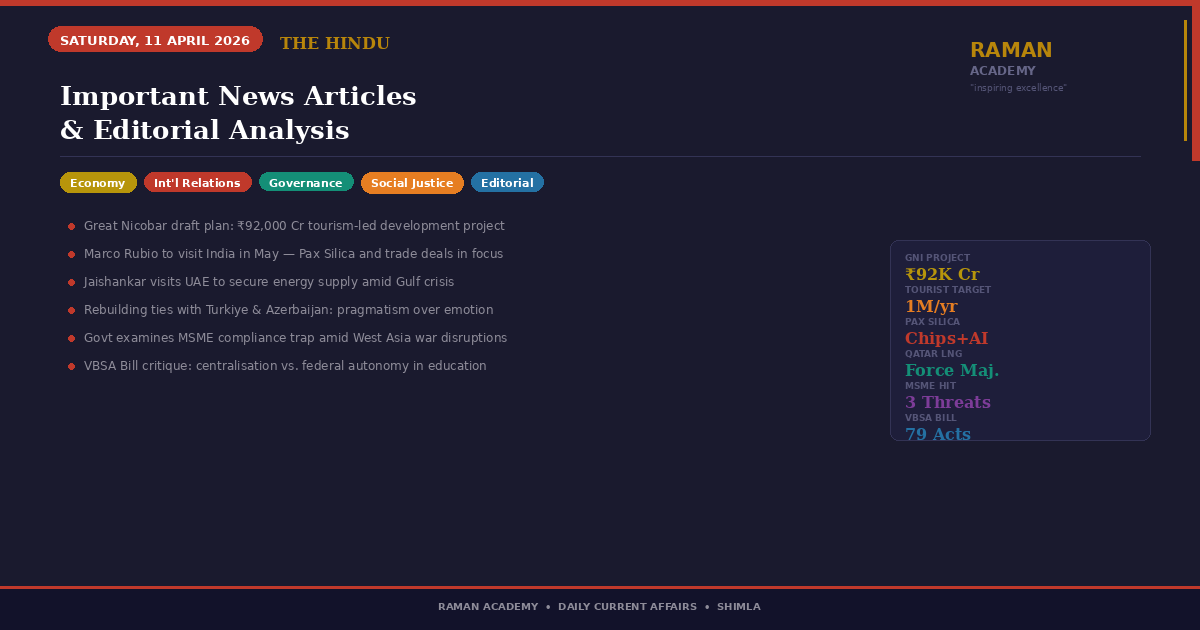
Important News Articles & Editorial Analysis
Great Nicobar Draft Plan Projects Tourism as Primary Growth Driver
The Great Nicobar Island (GNI) project, valued at approximately ₹92,000 crore, is one of India's most ambitious infrastructure undertakings. The recently notified Draft Master Plan 2024–2047 marks a shift in the project's narrative, positioning tourism as the primary economic engine alongside its strategic maritime goals.
Core Components of the Master Plan
| Anchor Project | Details |
|---|---|
| ICTP | International Container Transshipment Port at Galathea Bay — to capture global cargo traffic from the Malacca Strait |
| Greenfield Airport | Designed for civilian tourism and strategic military use (dual-use) |
| Integrated Township | Clusters: Administrative, Multi-modal Logistic, and Tourism/Entertainment |
| Green Energy | 450-MVA gas and solar-based power plant |
Tourism as the Growth Driver
Key Dimensions: Challenges & Controversies
A. Environmental Impact
- Deforestation: Diversion of ~130 sq. km of forest land and felling of nearly 9.64 lakh trees.
- Biodiversity Loss: Galathea Bay is a critical nesting site for the Giant Leatherback Turtle. Also threatens the Nicobar Megapode and Nicobar Macaque.
- Geological Risk: The island is in a high-seismic zone (Zone V), making large infrastructure vulnerable to earthquakes and tsunamis.
B. Tribal Rights and Social Concerns
C. Strategic vs. Sustainable Development
Its proximity to the Strait of Malacca (a global maritime choke point) gives India a significant "eyes and ears" advantage in the Indo-Pacific. However, the Draft Master Plan's "urbanisable" focus (40.8% of the project area) conflicts with the island's status as a UNESCO Biosphere Reserve.
📝 Prelims Practice
Q. With reference to the Great Nicobar Island Project, consider the following statements:
Which of the statements given above are correct?
Click to reveal answer
📝 Mains Practice
Discuss the significance of the Great Nicobar Project in the context of India's Blue Economy and Indo-Pacific strategy. Highlight associated ecological risks. 150 Words
Marco Rubio to Visit India in May to Strengthen Ties
The upcoming visit of U.S. Secretary of State Marco Rubio to India in May 2026 marks a high-stakes diplomatic effort to recalibrate a relationship strained by maritime conflicts in the Middle East and complex trade disputes.
Key Diplomatic Engagements
Foreign Secretary Vikram Misri visited Washington D.C. (April 8–10, 2026), laying the groundwork for Rubio's trip:
| Meeting With | Key Focus |
|---|---|
| Marco Rubio (Secretary of State) | Comprehensive Global Strategic Partnership — trade and defense |
| Kash Patel (FBI Director) | Counterterrorism, narcotics, organized crime |
| Allison Hooker & Christopher Landau | Quad, regional security, volatile Persian Gulf situation |
Strategic & Economic Friction Points
The "Pax Silica" Initiative
India joined Pax Silica in February 2026 — a U.S.-led strategic framework (launched Dec 2025) for securing supply chains of the "compute era."
- Pillars: Semiconductors, Critical Minerals, and Artificial Intelligence (AI)
- Objective: Reduce global reliance on Chinese dominance in rare earth refinement and legacy chip manufacturing
📝 Prelims Practice
Q. The term "Pax Silica", recently in news, refers to:
Click to reveal answer
📝 Mains Practice
The India–U.S. relationship in recent years has been described as "Transactional Strategicism." Critically examine this statement in the context of trade disputes and strategic convergence. 150 Words
Jaishankar to Visit UAE in Bid to Boost Energy Security
EAM S. Jaishankar's visit to the UAE (April 11–12, 2026) comes at a critical juncture as India manoeuvres through a volatile Middle Eastern security landscape to safeguard its energy interests.
Strategic Context: Energy Crisis in the Gulf
Diversification Strategy: Jaishankar's trip follows Petroleum Minister Hardeep Singh Puri's mission to Doha. The objective: secure alternative long-term supply commitments and stabilise the energy basket.
Key Objectives of the UAE Visit
| Objective | Details |
|---|---|
| Energy Security | Increase UAE's share in India's Strategic Petroleum Reserves (SPR); secure LNG shipments |
| Persian Gulf Stability | Seek UAE's "stabilising role" to prevent maritime escalations choking the Strait of Hormuz |
| Economic Synergy | Build on CEPA to boost non-oil trade; advance IMEC despite regional instability |
Key Dimensions: Regional Geopolitics
- "Look West" to "Act West" Evolution: India is shifting from passive buyer to strategic partner invested in the Gulf's internal security.
- Iran-U.S. Dynamics: U.S. pressure has forced India to lean more heavily on "moderate" Arab states like the UAE and Saudi Arabia.
- Ceasefire Uncertainty: Creates a narrow window for India to lock in supply contracts before potential resumption of hostilities.
📝 Prelims Practice
Q. Consider the following statements regarding Strategic Petroleum Reserves (SPR):
Which of the statements are correct?
Click to reveal answer
📝 Mains Practice
Analyze how geopolitical instability in West Asia impacts India's foreign policy priorities and energy security. 150 Words
Rebuilding Ties: India Must Approach Foreign Relations with More Pragmatism, Less Emotion
The recent decision to hold Foreign Office Consultations with Turkiye and Azerbaijan marks a pivotal recalibration of Indian foreign policy, transitioning from the post-Operation Sindoor "emotional" freeze to strategic pragmatism.
Historical Context: Operation Sindoor & Its Aftermath
Economic & Social Blowback: Influence-led boycotts caused a significant drop in trade and tourism. During the June 2025 evacuation from Iran, India purposefully bypassed Turkish and Azerbaijani land routes in favour of Armenia and Turkmenistan.
The Current Shift: Pragmatism over Emotion
The visit of Secretary West (Sibi George) to Baku and the invitation to the Turkish Deputy Foreign Minister signify a "thaw" driven by:
- Breaking the "Camps" Narrative: Moving away from the "India-Armenia-Greece" vs. "Pakistan-Azerbaijan-Turkiye" trilateral rivalry that restricts India's maneuvering space.
- Decoupling Pakistan: Asserting that bilateral relations with third countries will not be permanently hyphenated with their stance on Pakistan or Kashmir.
- Economic Realities: Persistent diplomatic freezes hinder India's broader connectivity projects and trade interests in Eurasia.
Key Analytical Pillars
| Dimension | Analysis |
|---|---|
| Strategic "De-hyphenation" | India historically manages relations with rivals (e.g., Iran & Saudi Arabia). Re-engagement ensures Pakistan doesn't dictate India's footprint in West and Central Asia. |
| Digital Diplomacy Challenge | Official demarches now quickly spiral into online boycotts and hyper-nationalist rhetoric — the "Escalation Ladder" problem. |
| Geopolitical Balancing | India must balance defence ties with Armenia (Pinaka rocket sales) without permanently alienating Azerbaijan. |
📝 Prelims Practice
Q. The concept of "de-hyphenation" in India's foreign policy refers to:
Click to reveal answer
📝 Mains Practice
De-hyphenation is central to India's ability to act as an independent pole in a multipolar world. Discuss with suitable examples. 150 Words
Govt. Examining Compliance Burden on MSMEs Due to War
Recent inter-ministerial meetings chaired by the Commerce Secretary underscore a growing crisis for India's MSMEs. As the West Asia conflict persists, MSMEs face an unprecedented "Compliance Trap" threatening their export competitiveness.
The MSME "Compliance Trap"
Triple Threat: Types of Shipping Disruptions
| Disruption Type | Compliance / Economic Impact |
|---|---|
| Cargo Diversion (Back-to-Town) | Shipments returned to India require complex procedures; critically, these do not qualify for government RELIEF schemes — exporters bear all costs |
| Route Termination | Shipping lines drop cargo at intermediate safe ports; exporters must navigate third-country regulations to reach final destination |
| Tariff Quota Misses | European markets have quarterly quotas (e.g., steel). A few days' delay misses a window, forcing 90 days of warehousing until the next opens |
Economic & Policy Analysis
- RELIEF Scheme Gap: "Back-to-town" cargo falls into a regulatory gray area where no incentives or tax drawbacks apply — doubling losses for MSMEs.
- Export Competitiveness: MSME agility is being stifled by regulatory uncertainty, risking India's share of global engineering and textile markets.
- Digital Divide in Trade: Urgent need for Trade-Tech adoption — simplified HS code management and invoice tracking via digital public infrastructure.
📝 Prelims Practice
Q. Which of the following best describes "tariff quota"?
Click to reveal answer
📝 Mains Practice
Examine how supply chain disruptions and regulatory complexities affect the export competitiveness of MSMEs in India. 250 Words
An Alternative to the Viksit Bharat Shiksha Adhisthan Bill
The Viksit Bharat Shiksha Adhisthan (VBSA) Bill, currently under the scrutiny of a Joint Parliamentary Committee (JPC), aims to codify the National Education Policy (NEP 2020) into a statutory framework. However, critics argue the Bill risks centralising Indian higher education and undermining federal principles.
1. Core Criticisms of the VBSA Bill
A. Constitutional & Federal Concerns
B. Bureaucratic vs. Academic Autonomy
- Usurpation of Power: Authority shifts from UGC to government-controlled councils. Unlike the UGC Act (which requires consultation before inspection), the VBSA Bill allows discretionary inspections.
- Erosion of Autonomy: Bodies like IITs, IIMs, and State-funded universities lose governing independence to a centralised bureaucratic structure.
C. Social Justice & Ideological Shifts
- Equity Deficit: Criticised for not explicitly enforcing affirmative action (SC/ST/OBC reservations) or inter-regional justice.
- Ideological Undercurrents: Critics argue it promotes a monolithic "Bhartiya Knowledge" vision, potentially marginalising India's multi-cultural intellectual history.
2. The Proposed "Alternative Framework"
An alternative governance model treats education as a "Shared Responsibility" between the Centre and States:
| Reform Area | Alternative Proposal |
|---|---|
| Rebalancing Councils | 50:50 power sharing with State Higher Education Councils (SHECs). Manak Parishad (Standards Council) shaped by regional/industrial needs — not "one-size-fits-all" from Delhi. |
| Financial Autonomy (HEGC) | A Higher Education Grants Council to replace Ministry control. Block grants instead of loans; generous funding for State institutions to correct "historical discrimination." |
| Assessment Reform | Shift from "Output-based" metrics (patents/publications) to "Outcome-centric" evaluation (social impact, national innovation). Oppose outsourcing accreditation to private agencies. |
3. Key Analytical Comparison
| Feature | Current VBSA Bill (Critique) | Alternative Proposal |
|---|---|---|
| Governance | Top-down, Bureaucratic | Deliberative, Participatory (Senates/Councils) |
| Federalism | Unitary (Centre-led) | Shared (Centre-State partnership) |
| Inclusivity | Vague on Reservations | Explicit Affirmative Action |
| Focus | Hyper-globalization / Rankings | National Innovation & Social Justice |
📝 Mains Practice
Centralization of regulatory powers may undermine academic autonomy in higher education institutions. Discuss with reference to recent education reforms. 150 Words
