
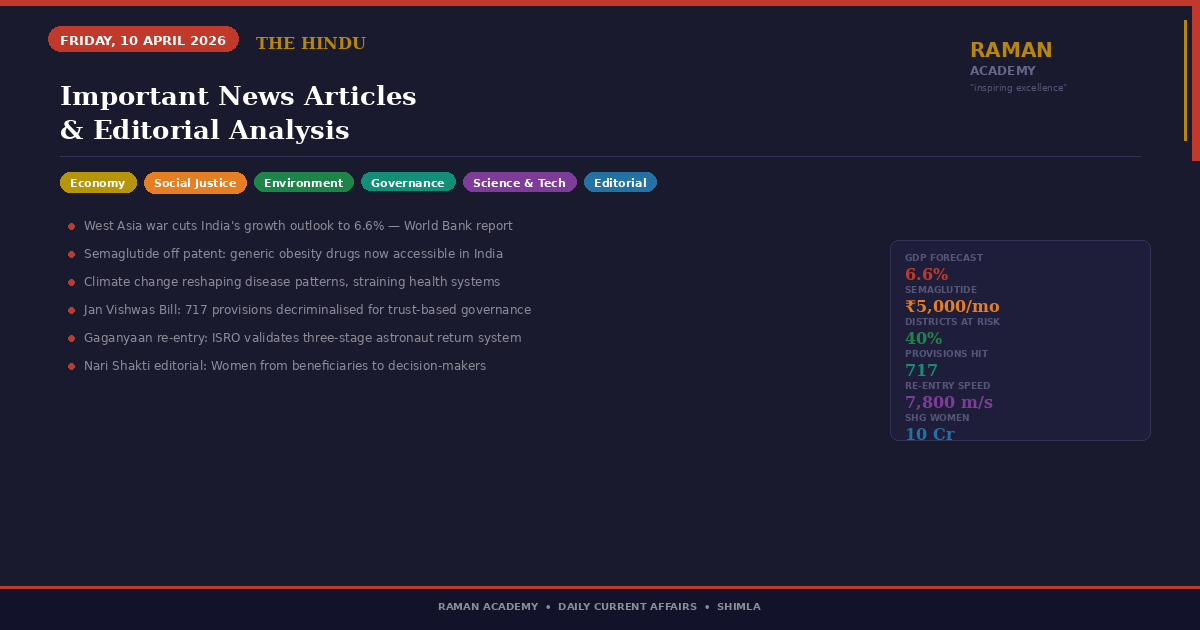
Important News Articles & Editorial Analysis
West Asia War Cuts India's Growth Outlook to 6.6%
India's economic trajectory, while resilient, faces significant external pressure due to the prolonged conflict in West Asia. The World Bank's downward revision of India's growth forecast to 6.6% for FY27 underscores deep structural linkages between India and the Gulf region. The slowdown is primarily attributed to disruptions in global energy markets, increased input costs, and a potential dip in remittances.
Key Highlights of the World Bank Report
Dimensions of Impact: Why West Asia Matters to India
| Dimension | Key Details |
|---|---|
| Energy Security | India imports 85–90% of crude oil and 50% of natural gas; much transits via the Strait of Hormuz. Higher oil prices cause cost-push inflation and may breach the fiscal deficit target of 4.5% of GDP. |
| Remittances | India is the world's largest remittance recipient; the Gulf accounts for ~38% (~$50 billion). Disruptions impact households in Kerala, UP, and Bihar. |
| Trade & Infrastructure | The Gulf is a major market for Indian engineering goods, textiles, and agri-products. The IMEC corridor and Chabahar Port investments are jeopardised. |
Challenges and Risks
- External Balance: A widening Current Account Deficit (CAD) puts pressure on the Indian Rupee.
- Diaspora Vulnerability: Safety of over 9 million Indians in the region is a diplomatic and humanitarian concern.
- Fertilizer Subsidies: Supply disruptions spike farming costs, necessitating higher government intervention.
🇮🇳 Way Forward for India
- Energy Diversification: Accelerate renewables and expand Ethanol Blending to reduce oil dependency.
- Strategic Petroleum Reserves: Expand SPR capacity beyond current 9.5 days of emergency cover.
- Private Sector-Led Growth: Create a business-enabling environment to offset external shocks.
- Diplomatic Multi-alignment: Maintain ties with Iran, Israel, and Arab states to secure sea lanes and diaspora safety.
📝 Prelims Practice
Q. The India-Middle East-Europe Economic Corridor (IMEC) primarily aims to:
Click to reveal answer
📝 Mains Practice
Discuss how disruptions in global energy markets can affect India's agricultural sector. Highlight the role of fertilizer subsidies in this context. 150 Words
Semaglutide Is Off Patent: What Does This Mean for Obesity in India?
The expiration of Semaglutide's patent in India marks a pivotal shift in the country's battle against the "twin epidemics" of obesity and Type 2 Diabetes. Local pharma giants can now produce generic versions, transforming metabolic healthcare from a luxury niche to a broad-based clinical tool.
The "Democratization" of Weight Loss
Addressing the "Thin-Fat" Phenotype
India faces a unique challenge: many Indians appear "thin" or have a normal BMI but possess high levels of visceral (internal) fat and high insulin resistance. GLP-1 receptor agonists like Semaglutide are particularly effective for this profile as they improve metabolic health by targeting insulin resistance and reducing fatty liver.
How Semaglutide Works
Semaglutide mimics a natural hormone called Glucagon-like peptide-1 (GLP-1) and acts through three pathways:
| Target | Mechanism |
|---|---|
| Brain | Acts on the hypothalamus to suppress appetite and increase satiety |
| Stomach | Slows gastric emptying — food stays longer, extending feelings of fullness |
| Pancreas | Stimulates glucose-dependent insulin secretion to manage blood sugar |
Clinical Context: Bridging the Treatment Gap
| Level | Intervention | Limitation |
|---|---|---|
| Level 1 | Lifestyle modifications (Diet/Exercise) | Often insufficient for morbid obesity |
| Level 2 (New) | Semaglutide — 10–15% body weight loss | Requires medical supervision |
| Level 3 | Bariatric Surgery | Invasive and expensive |
Critical Caveats
- Not a "Quick Fix": It is a disease-modifying agent, not a cosmetic shortcut.
- Muscle Loss Risk: Rapid weight loss can lead to muscle wasting — patients need high protein and resistance training.
- Rebound Effect: Without permanent lifestyle changes, weight regain is highly likely.
- Medical Supervision: Side effects (nausea, rare pancreatitis risk) require prescription-only use.
Summary: A Tool, Not a Cure
| Pros of Generic Semaglutide | Challenges for India |
|---|---|
| 60–70% reduction in monthly cost | High risk of off-label/unmonitored cosmetic use |
| Improved cardiovascular & liver health | Need for long-term adherence to avoid weight regain |
| Accessible alternative to bariatric surgery | Risk of muscle loss without proper protein/exercise |
📝 Prelims Practice
Q. Which of the following best describes the term "Thin-Fat Phenotype" often seen in India?
Click to reveal answer
📝 Mains Practice
Discuss the mechanism of action of GLP-1 receptor agonists and evaluate their role in managing obesity and Type 2 Diabetes in India. 150 Words
Climate Change Reshaping Disease Patterns, Straining Health Systems
A report from Dasra highlights a critical shift: climate change is no longer just an environmental issue — it is a "health-risk multiplier" fundamentally altering India's epidemiological profile.
The Changing Disease Landscape
The Vulnerability Gap: Socio-Economic Dimensions
| Vulnerable Group | Specific Health / Economic Impact |
|---|---|
| Outdoor Workers | Lost 160 billion labour hours (2021); high risk of heatstroke and dehydration |
| Pregnant Women | 16% increase in preterm births during heatwaves; air pollution linked to pre-eclampsia |
| Children / Infants | Limited thermoregulation leads to rapid dehydration; PM2.5 linked to stunted lung function |
| Rural Populations | "Disaster-induced isolation" — floods cut off access to primary healthcare and life-saving vaccines |
Structural Challenges to Resilience
- Data Fragmentation: Lack of disaggregated, local data correlating weather events with hospital admissions.
- Funding Skew: Most climate funding goes to mitigation (renewables/EVs) rather than adaptation (climate-resilient hospitals).
- Infrastructure Fragility: Healthcare centres in the 40% "high-risk" districts are not built to withstand cyclones or floods.
🇮🇳 Way Forward: Building a Climate-Resilient Health System
- Decentralised Heat Action Plans (HAPs): District-specific protocols protecting informal workers.
- Climate-Smart Infrastructure: Retrofitting PHCs with solar power and flood-resistant medicine storage.
- Integrated Surveillance: Link IDSP with IMD weather alerts for predictive outbreak management.
- Nature-Based Solutions: Increase urban green cover to reduce Urban Heat Island effects.
📝 Prelims Practice
Q. With reference to the National Action Plan on Climate Change and Human Health (NAPCCHH), consider the following statements:
Which of the statements given above is/are correct?
Click to reveal answer
📝 Mains Practice
Climate change is a health-risk multiplier. Discuss this statement with suitable examples from India's changing disease profile. 150 Words
What Does the Jan Vishwas Bill Do?
The Jan Vishwas (Amendment of Provisions) Bill, 2025-26 represents a strategic pivot from a "command and control" punitive model toward "trust-based governance." Building on the 2023 Act, it affects 79 Central Acts and over 780 provisions.
Core Objectives: Three Pillars of Regulatory Rationalization
What Is Being Proposed?
The Bill targets 717 provisions for decriminalization, replacing jail terms with monetary penalties.
| Feature | Description |
|---|---|
| Graded Response | Warnings and Advisory Notices for first-time or minor defaults instead of immediate prosecution |
| Administrative Adjudication | Cases move from Magistrate Courts to Adjudicating Officers within ministries for faster resolution |
| Compounding of Offences | Expanded scope to settle matters out of court by paying a specified sum, avoiding a criminal record |
| Calibrated Fines | Scaled based on gravity and frequency; periodically revised to remain deterrent |
| Appellate Safeguards | Businesses can challenge Adjudicating Officer decisions to prevent bureaucratic overreach |
Impact on Business Ecosystem
- Formalization: Reduced fear of "Inspector Raj" encourages informal businesses to register in the formal economy.
- Investment Climate: A predictable civil-penalty regime attracts FDI by lowering compliance risk.
Potential Challenges
- Administrative Discretion: Bureaucratic power to fine businesses could lead to corruption if unmonitored.
- Institutional Capacity: Many ministries may lack trained Adjudicating Officers for fair handling.
- Monetary Burden: Excessively high fines could be just as crippling for small businesses as jail terms.
📝 Prelims Practice
Q. Which of the following best describes the concept of "compounding of offences"?
Click to reveal answer
📝 Mains Practice
Discuss how decriminalization of minor business offences can contribute to improving the Ease of Doing Business in India. 150 Words
How Will Gaganyaan Astronauts Return Safely to Earth?
As India approaches its maiden human spaceflight mission, Gaganyaan, ISRO has successfully completed the second Integrated Air Drop Test (IADT-02), validating the deceleration systems needed to bring the "Gaganyatris" home safely.
The Three-Stage Return Journey
| Stage | Mechanism | Details |
|---|---|---|
| 1. Aerobraking | Atmospheric drag | Module enters at ~7,800 m/s; atmospheric drag sheds over 95% of velocity as heat |
| 2. Parachutes | Multi-stage system by DRDO's ADRDE | Deployed at ~12 km altitude at subsonic speeds; drogue chutes stabilize, then main chutes deploy |
| 3. Splashdown | Sea landing + Navy recovery | Landing in Bay of Bengal; Indian Navy uses "International Orange" flotation bags and strobe lights |
Why Parachutes Alone Are Not Enough
Understanding the Landing "Footprint"
The landing zone forms an ellipse rather than a circle:
- Downrange Variation: At hypersonic speeds, tiny changes in atmospheric density or entry angle cause large along-path shifts.
- Crossrange Stability: Very little lateral energy keeps the width narrow.
📝 Prelims Practice
Q. Consider the following statements regarding spacecraft re-entry:
Which of the statements given above is/are correct?
Click to reveal answer
📝 Mains Practice
Discuss the scientific principles behind aerobraking and its significance in human spaceflight missions. 250 Words
Nari Shakti, India's Defining Reform for the Next Decade
The concept of Nari Shakti (Women Power) has transitioned from a rhetorical goal to a core pillar of India's developmental strategy. The past decade built robust empowerment infrastructure; the next decade must shift women from being "beneficiaries" to "decision-makers."
Key Pillars of the Empowerment Infrastructure
| Sector | Key Initiatives & Impact |
|---|---|
| Financial Inclusion | PM Jan Dhan Yojana: 55% of 57 crore accounts held by women; MUDRA Loans: 70% directed to women entrepreneurs |
| Social Welfare | Ujjwala Yojana: 10.5 crore households got clean cooking gas, reducing "time poverty" and respiratory risks |
| Health & Education | Ayushman Bharat & Surakshit Matritva Abhiyan reducing maternal vulnerability; Beti Bachao Beti Padhao improving sex ratios and enrollment |
| Economic Agency | 90 lakh Self-Help Groups (SHGs) involving nearly 10 crore women driving grassroots entrepreneurship |
The Paradigm Shift: Policy Penetration and "Saturation"
Nari Shakti Vandan Adhiniyam: The Game Changer
The Women's Reservation Act is identified as the most consequential reform for the coming decade:
- Lived Experience in Governance: Women's representation in legislatures ensures policy design is informed by community realities.
- The Multiplier Effect: More women leaders create a pipeline for future leaders, making reform self-reinforcing.
- STEM Advantage: India has one of the highest proportions of women in STEM — the next step is translating this into leadership in healthcare, tech, and enterprise.
🇮🇳 Way Forward: Implementation Priorities
- Capacity Building: Invest in mentorship and administrative support for women leaders to govern effectively.
- Simplified Access: Reduce scheme complexity for faster delivery.
- Feedback Loops: Create systems where policy evolves based on real-time needs across socio-economic strata.
📝 Mains Practice
What is meant by "policy saturation"? Analyze the challenges in achieving last-mile delivery of women-centric schemes in India. 150 Words
