
Results
#1. Which of the following element is most abundantly found in the Earth’s crust?
The earth is composed of various kinds of elements. About 98% of the total crust is made up of eight elements as oxygen, silicon, aluminium, iron, calcium, sodium, potassium, and magnesium. Earth’s crust consists of 46% Oxygen, 28% Silicon, 8% Aluminium, 5% Iron and the rest others. Oxygen mostly occurs in combined forms like silicates, metal and non- metal oxides and hydroxides.
#2. With reference to Earth’s Geomagnetism consider the following statements:
1. It is caused by a giant bar magnet placed approximately along the axis of rotation of the
2. Earth’s magnetic field is generated in the earth’s outer core.
3. It plays an important role in protecting the planet from solar winds and cosmic radiation.
4. ‘The magnetic field of Mars is stronger than that of Earth.
5. Currently, earth’s magnetic north pole is moving from its current position in Canada towards
Select the correct answer using the code given below:
Statement 1 is incorrect. Earth’s Geomagnetism is not caused by a giant bar magnet placed along the axis of rotation of the earth and deep in the interior. The magnetic field is aroused due to electrical currents produced by the convective motion of metallic fluids (consisting mostly of molten iron and nickel) in the outer core of the earth. This is known as the dynamo effect.
Statement 2 is correct. Earth’s magnetic field is generated in the earth’s outer core. ‘The Earth consists of a solid iron core. Surrounding the iron core is an ocean of hot, liquid metal. The liquid metal that flows in Earth’s core creates electrical currents, which in turn creates our magnetic field.
Statement 3 is correct. The Earth’s magnetic field plays an important role in protecting the planet from solar winds and cosmic radiation that are harmful. It is the magnetosphere that protects us from harmful radiation.
Statement 4 is incorrect. Mars doesn’t have flowing liquid metal in its core and thus it doesn’t produce the same dynamo effect. This leaves the planet with a very weak magnetic field, allowing for its atmosphere to be stripped away by solar winds, leaving it uninhabitable.
Statement 5 is correct. According to British Geological Survey, the earth’s magnetic north pole is moving from its current position in Canada towards Siberia.
#3. The Earth’s radius at the equator is larger than at the poles. Which one of the following is the primary reason for this?
Option a is correct. ‘Ihe radius at the equator is larger than at the poles due to the long- term effects of the earth’s rotation. ‘The difference in radius is due to the centrifugal force of the earth’s rotation which causes the bulging at the equator and compression at the Poles. “The Earth is about 43 km (27 mi) wider at the equator than pole-to-pole.
Option b is incorrect. The Revolution of Earth around the sun does not causes bulging at the equator. The revolution affects the occurrence of different seasons on Earth.
Option c is incorrect. ‘This is one of the effects of the bulging of the Earth at equator. The poles are closer to the center due to the equatorial bulge, and thus have a stronger gravitational field. This is due to the fact that the radius at the equator is larger than at the poles.
Option d is incorrect. Earth’s tilted axis causes the seasons and not the bulging. Throughout the year, different parts of Earth receive the Sun’s most direct rays. So, when the North Pole tilts toward the Sun, it’s summer in the Northern Hemisphere. And when the South Pole tilts toward the Sun, it’s winter in the Northern Hemisphere. It is also the reason behind variations in the length of day and night throughout the Earth. Earth’s axis is tilted 23.5 degrees.
#4. What is ‘Mars Opposition’, sometimes seen in news?
Opposition is the event when the sun, Earth and a planet (Mars in this case) are lined up, with the Earth in the middle.
Opposition can happen only for planets that are farther away from the sun than the Earth. In case of Mars, roughly every two years, the Earth passes between sun and Mars, this is when the three are arranged in a straight line.
Option c is incorrect. Solar conjunction is an event which occurs every 26 months, when Mars and Earth are on opposite sides of the Sun, communication between the two planets is disrupted.
#5. Which one of the following statements is correct regarding the ‘Heat Budget of the Earth’?
Option a is Incorrect. Earth do not receive even radiation across its surface during any given day of a year. There are variations in the amount of radiation received at the earth’s surface. Some part of the earth has surplus radiation balance while the other part has deficit. Between 40 degrees north and south and the regions near the poles have a deficit. The There is a surplus of net radiation balance surplus heat energy from the tropics is redistributed pole wards and as a result the tropics do not get progressively heated up due to the accumulation of excess heat or the high latitudes get permanently frozen due to excess deficit.
Option b is Incorrect. About half of the total insolation received by earth is absorbed by its surface. If insolation received at the top of the atmosphere is 100 units, then 47 unit is absorbed by earth’s surface. Option c is correct. ‘Ihe earth as a whole does not accumulate or loose heat. It maintains its temperature. ‘Ihis happen because the amount of heat received in the form of insolation equals the amount lost by the earth through terrestrial radiation.
Option d is Incorrect. Only about one-third of the total insolation is reflected back to space even before reaching the earth’s surface.Out of 100 units of total insolation received by earth, 35 units are reflected back to space even before reaching the earth’s surface. Of these, 27 units are reflected back from the top of the clouds and 2 units from the snow and ice-covered areas of the earth. The reflected amount of radiation is called the albedo of the earth.
#6. Consider the following statements with reference to Earth’s geology:
1.The Mid-Oceanic ridges are some of the most active volcanic regions.
2.The oceanic crust is much older than the continental crust.
Which of the statements given above is/are correct?
Statement I is correct. A mid-ocean ridge or mid- oceanic ridge is an underwater mountain range, formed by plate tectonics. ‘Ihis uplifting of the ocean floor occurs when convection currents rise in the mantle beneath the oceanic crust and create magma where two tectonic plates meet at a divergent boundary. The mid-oceanic ridges are some of the most active regions in terms of volcanic eruptions.
Statement 2 is incorrect. ‘The continental crust is much older than the oceanic crust. As the continental crust is rarely destroyed and recycled in the process of subduction, some sections of continental crust are nearly as old as the Earth itself.
Oceanic crust is thinner and denser than continental crust.
#7. Consider the following statements:
1. All longitudes have equal length whereas length of latitudes varies depending upon their location
2. Two longitudes remain equidistant at all places whereas distance between latitudes varies depending upon their location
3. Latitudes determines the amount of insolation received whereas longitude determines the local time at any place.
Which of the statements given above is/are correct?
Statement 1 is correct – Longitudes are imaginary semi- circles starting from north pole and ending at south pole. All longitudes are equal in length irrespective of their location. Latitudes on the other hand are imaginary parallel lines which make a circle around theEarth. ‘Ihe equator represents the OOLatitude. All parallel circles from the equator to the poles are called parallels of latitudes. As we move away from the equator, the length of the parallels of latitudes decreases
Statement 2 is Incorrect — ‘Ihe distance between two longitudes is maximum at the equator and decreases steadily pole wards until it becomes zero at the poles, where all meridians meet. Whereas latitudes are equidistant from each other.
Statement 3 is correct —Amount of insolation received at a particular place depends on its latitudinal position. Insolation in the tropics is greater than at the poles. Latitudes are used to classify Earth into various heat zones depending upon the insolation — Torrid zone, Temperate zone and Frigid zone.
Longitudes are used to measure local time of the place. At a particular time, sun is overhead all the places on a longitude. Thus all the places will have same local time. By convention, Greenwich Meridian which is also known as Prime Meridian is taken as reference. All the longitudes towards East of Greenwich is ahead of Greenwich time and those on the west are behind.
#8. Consider the following statements:
1. Earth’s rotational axis makes an angle of 23.5° with the orbital plane of the earth.
2. Earth’s inclination causes variation in the length of day and night.
3. Axial parallelism of Earth’s Axis causes Perihelion and Aphelion
Which of the statements given above is/are Incorrect?
Statement I is Incorrect – Earth’s rotational axis makes an angle of 23.50 with the normal, i.e. it makes an angle of 66.50 with the orbital plane of the earth (ecliptic plane). The plane in which Earth revolves around the sun is called as orbital plane.
Statement 2 is correct — Due to Earth’s axial tilt (or obliquity), day and night are not evenly divided. Hemisphere that is tilted towards the Sun is warmer because sunlight travels moredirectly to the Earth’s surface so less gets scattered in the atmosphere. That means that when itis summer in the Northern Hemisphere, it is winter in the Southern Hemisphere. The hemispheretilted towards the Sun has longer days and shorter nights. ‘That’s why days are longer during thesummer than during the winter. If the Earth’s axis were perpendicular to its orbital plane aroundthe Sun, all places on Earth would experience equal amounts of day and night (i.e. 12 hours ofday and night, respectively) every day during the year and there would be no seasonal variability.So the primary cause of changing of length of day and night is the inclination of Earth’s Axis.
Statement 3 is Incorrect — Throughout its revolution around the sun, Earth’s axis maintains the same alignment relative to the plane of the elliptic and to Polaris. In each position earth is revolving with the axis oriented parallel to itself. This condition is known as axial parallelism. This parallelism of axis of the Earth is the responsible for apparent movement of the sun over the tropics.
Perihelion and Aphelion positions occurs because Earth is revolving around the sun in an elliptical orbit with sun at one of its focus. At Perihelion position, sun is nearer to the earth, this occurs is month of January. At Aphelion position, sun is farthest from the Earth, this occurs in the month of July.
#9. Consider the following statements regarding the magnetic field of Earth:
1. Magnetic field is due to convective motion of metallic fluids in the outer core of the earth. 2. The magnetic poles of the earth do not change their position with time.
Which of the statement(s) given above is/are correct?
Statement I is correct:Themagnetic field is due to electrical currents producedby convective motion of metallic fluids (consisting mostly of molteniron and nickel) in the outer core of the earth. This is known as thed amo effect.
Statement 2 is Incorrect:lhe magnetic poles inside the earth change position with time. In a span of 240 years from 1580 to 1820 AD, over which recordsare available, the magnetic declination at London has been found to change by 3.50. On the scaleofa million years, the earth’s magnetic fields has been found to reverse its direction.
#10. Consider the following statements about composition of Earth’s Crust:
1.The metals in the earth’s crust are usually found in elemental form.
2. Oxygen has the highest concentration amongst the elements found in the crust.
Which of the statement(s) given above is/are correct?
Statement 1 is Incorrect: The elements in the earth’s crust are rarely found exclusively. They are usually combined with other elements to make various substances. These substances are recognized as minerals.
Statement 2 is correct:Oxygen is found in highest proportion (46.6%) in Earth’s crust. Next comes Silicon (27.72%), Aluminium (8.13%), Iron (5%) and Calcium (3.63%).
#11. Which of the following statements are correct regarding the rocks of Earth’s Crust?
1. Igneous rocks are formed outof recrystallizationand reorganization of existing rocks.
2. Sedimentary rocks are formed through the process of lithi cation.
3. Metamorphic rocksform under the action of pressure,volume and temperature changes.
Select the correct answer using the code given below:
Statement 1 is Incorrect: Igneous —in Latin means ‘Fire’. Igneous Rocks aresolidified form of magma and lava. When magma in its upwardmovement cools and turns into solid form it iscalled igneous rock. The process of cooling andsolidification can happen in the earth’s crustor on the surface of the earth.Granite, gabbro, pegmatite,basaltand tuff are some ofthe examples of igneous rocks.
Statement 2 is correct:Sedimentary rocks are formed from sediments transported by exogenous agencies. These sediments are depositedin the form of layers and turn into rocksthrough compaction. This process is known as lithification. Sedimentary rocks are also called stratified rocks. Sandstone, conglomerate, limestone, shale, loess are examples of Sedimentary rock.
Statement 3 is correct:The word metamorphic means ‘change of form’. Metamorphic rocksform under the action of pressure,volume and temperature changes. Metamorphism is a process by which alreadyconsolidated rocks undergo recrystallization and reorganisation of materials within originalrocks.Marble and Gneiss are examples of these rocks.
#12. With respect to Igneous rocks, which of the following statements is/are correct?
1. Felsic igneous rocks are denser and darker in color than Mafic rocks.
2. They occur in strata and have a rich fossil presence.
3. As compared to volcanic rocks, plutonic rocks have a larger crystal size.
Select the correct answer using the code given below:
Statement 1 is incorrect. Felsic igneous rocks are made up of acidic lava and have high portion of silica which makes them less dense and lighter in color as compared to mafic rocks.
Mafic rocks are made of basic lava and have higher
portion of aluminum and iron.
Statement 2 is incorrect. Igneous rocks normally have a crystalline structure. They do not occur in strata. They do not contain any fossils either. This is because they are formed directly from lava or magma, not sediment. Sedimentary rocks have a rich fossil presence.
Statement 3 is correct. Volcanic rocks (extrusive igneous rocks) are formed due to solidification of lava at the surface of Earth. “They solidify rapidly and as a result it has a small crystal size. Basalt is a common example of it. Whereas in plutonic rocks (intrusive igneous rocks), solidification of magma is at great depths and rate of cooling is much slow as a result of which size of crystal is very large. Granite is an example of the plutonic rocks.
#13. With respect to rock cycle, consider the following statements:
1. Sun plays an important role in the rock cycle on Earth.
2. For a planet to have an active rock cycle, hot core is needed to drive mantle convection.
3. Granite undergoes metamorphism and form Gneiss.
Which of the statements given above is/are correct?
Statement I is correct. The rock components of the crust are slowly but constantly being changed from one form to another and the processes involved is known as the rock cycle. It is driven by two forces: earth’s internal heat and hydrological cycle- movement of water which is powered by sun. Thus, sun plays an important role in the rock cycle on earth.
Statement 2 is correct. Rock cycle is still active on Earth because our core is hot enough to keep the mantle moving, this leads to slow and significant changes on earth’s crust. In case of moon, the rock cycle is virtually dead because the core is no longer hot enough to drive mantle convection.
Statement 3 is correct. Granite is an igneous rock. Under the influence of favorable conditions of temperature and pressure it undergoes metamorphism and form Gneiss.
#14. Consider the following statements with reference to sedimentary rocks:
1. Sedimentary rocks are formed at earth’s surface by the hydrological system.
2. Formation of sedimentary rocks involves the weathering of preexisting rocks.
3. Sedimentary rocks contain fossils.
4. Sedimentary rocks typically occur in layers.
Which of the statements given above are correct?
Statement I is correct. Sedimentary rocks are formed at Earth’s surface by the hydrologic system. They form from fragments derived from other rocks and by precipitation from water.
Statement 2 is correct. Their formation involves the weathering of preexisting rock, transportation of the material away from the original site, deposition of the eroded material in the sea or in some other sedimentary environment, followed by compaction and cementation.
Statement 3 is correct. Fossils are the preserved remains of ancient plants and animals. Sedimentary rocks contain fossils because, unlike other rocks, they form at temperatures and pressures that do not destroy animal and plant remains.
Statement 4 is correct. They typically occur in layers, or strata, separated one from the other by bedding planes and differences in composition.
#15. This discontinuity forms the boundary between the crust and the upper mantle. Its average depth is more beneath the continental surfaces and shallower beneath the ocean basins. Change in rock composition is thought to be the cause of this discontinuity
Which of the following discontinuity is being best described in the above paragraph?
Seismic discontinuities are the regions in the earth where seismic waves behave a lot different compared to the surrounding regions due to a marked change in physical or chemical properties.
Option a is correct- Mohorovicic discontinuity forms the boundary between the crust and the upper mantle (asthenosphere). It occurs at an average depth of about 8 kilometers beneath the ocean basins and30 kilometers beneath continental surfaces. The cause of this discontinuity is thought to be a change in rock composition from rocks containing feldspar (above) to rocks that contain no feldspars (below).
Option b is incorrect — Gutenberg discontinuity lies between mantle and the outer core.
Option c is incorrect — Lehmann discontinuity lies between outer and inner core.
Option d is incorrect — Conrad discontinuity is the transition zone between the upper and the lower part of the lithosphere. It is observed in various continental regions at a depth of 15 to 20 km; however, it is not found in oceanic re ions.
#16. With reference to gases in atmosphere consider the following statements:
1. Argon is found naturally in atmosphere.
2. Carbon Dioxide is the second most abundant gas after Nitrogen.
Which of the statements given above is/are correct?
Statement 1 is correct. Argon is found naturally in atmosphere it makes up 0.93% of the Earth’s atmosphere and is the third most abundant atmospheric gas.
Statement 2 is Incorrect. Carbon dioxide is the fourth most abundant (not second) gas in atmosphere.
#17. Consider the following statements:
1.The thickness of troposphere is greater at the poles than at the equator.
2. The stratosphere contains majority of the ozone layer.
3. In thermosphere temperature decreases rapidly with increasing height.
Which of the statements given above is/are correct?
Statement 1 is incorrect. The thickness of troposphere is greater at the equator as the heated air rises to greater heights.
Statement 2 is correct. Most ozone (about 90%) is found in the stratosphere, which begins about 10— 16 kilometers (6—10 miles) above Earth’s surface and extends up to about 50 kilometers (31 miles) altitude. The stratospheric region with the highest ozone concentration is commonly known as the “ozone layer”. The ozone layer extends over the entire globe with some variation in altitude and thickness.
Statement 3 is incorrect. In thermosphere temperature increases rapidly with increasing height. Temperature at its upper limit reaches up to 1700-degree C.
#18. Which of the following statements is/are incorrect with reference to Diastrophic forces of nature?
1.They are very slow forces whose effects are observable only after thousands of years. 2. They are a part of Exogenetic forces. 3. They are restricted to a small area under the influence of local weathering agents.
Select the correct answer using the code given below:
Statement 1 is correct: Diastrophic forces are caused due to energy originating from within the Earth. They operate very slowly and their effects become recognizable only after thousands and millions of years.
Statement 2 is incorrect: Diastrophic force is a subpart of Endogenetic forces along with sudden forces. These are created by forces deep inside the earth’s surface. It is also sub-divided into epeiriogenetic and orogenetic movements.
Statement 3 is incorrect: Diastrophic forces are also called as constructive forces which affect larger areas of globe and produce meso-level reliefs e.g. mountains, plateaus, plains lakes, big faults, etc.
1. Sudden Forces
• Volcanic Eruption
• Earthquakes
2. Diastrophic forces
• Eperiogenetic forces- emergence and submergence
• Orogenetic forces- tensional forces (cracking and faulting) and compressional forces (wraping and folding)
#19. Consider the following events with reference to the formation of planets:
1. Formation of localized clump of gases
2. Accumulation of hydrogen gas to form nebula
3. Formation of Planetesimals
4. Formation of rotating disc of gases around core
What is the correct chronological order of the above events, starting from the earliest time?
The sequence of events during the formation of stars
and planets are
1. Formation of Galaxy started by accumulating
hydrogen gas in the form of a very large cloud called
nebula.
2.Growing nebula develops localized clumps of gases.
These clumps continue to grow into even denser
gaseous bodies, giving rise to formation of stars.
3.The gravitational force within lumps leads to the
formation of a core to the gas cloud and a huge
rotating disc of gas and dust develops around the gas
core.
4.Gas cloud start getting condensed and the matter
around the core develops into small rounded
objects which form planetesimals by the process of
cohesion.
These larger number of small planetesimals accrete to
form a few large bodies in the form of planets.
#20. With reference to the “solar system”, consider the following statements:
1.The atmosphere of Jovian Planets is thin as compared to Terrestrial planets.
2.The terrestrial planets have lower gravity as compared to Jovian planets.
3.The terrestrial planets have relatively higher densities as compared to Jovian planets.
Which of the statements given above is/are correct?
Mercury, Venus, Earth and Mars are called as the inner planets as they lie between sun and the belt of the asteroids. They are also called as Terrestrial Planets (earth like). The rest four are called as Jovian or Gas Giant planets. Jovian means Jupiter like.
Statement 1 is incorrect. Jovian planets have thick atmosphere mainly consisting of Hydrogen and Helium as the solar winds were not all that intense to cause removal of gases from the Jovian planets.
Statement 2 is correct. The terrestrial planets are smaller and thus have lower gravity. This is the reason that it could not hold the escaping gases and thus have rocky surfaces.
Statement 3 is correct. The terrestrial planets are made up of rocks and metals and so they have relatively higher densities as compared to Jovian planets.
#21. Consider the following events during the “evolution of the earth”:
1. Degassing
2. Differentiation
3. Photosynthesis
4. Loss of primordial atmosphere.
What is the correct chronological order of the above events, starting from the earliest time?
Ihe sequence of events is
1. It is the of Differentiation through which earth forming material got separated into different layers, like Crust, Mantle, Outer Core and Inner Core.
2. Then started the formation of atmosphere in which the first stage is marked by the loss of Primordial atmosphere i.e., loss of hydrogen and helium present in early atmosphere by solar winds.
3.This was followed by the Process of Degassing, in which the gases were outpoured from the interior of earth. The early atmosphere largely consisted of water vapour, nitrogen, carbon dioxide, methane, ammonia and very little of oxygen. Continuous volcanic eruptions contributed water vapour and gases.
4.As the earth cooled, the water vapour released started getting condensed. The carbon dioxide in the atmosphere got dissolved in rainwater and the temperature further got decreased causing more condensation and more rains. The rainwater falling onto the surface got collected into the depressions and gave rise to oceans. And then life began to evolve along with the process of photosynthesis.
#22. Consider the following statements:
1. If a small asteroid or large meteoroid survives its fiery passage through earth’s atmosphere and lands on earth’s surface, it is then called a meteor.
2. If a meteoroid enters the Earth’s atmosphere and vaporizes, it becomes a meteorite.
Which of the statements given above is/are correct?
Statement I is incorrect. If a small asteroid or large meteoroid survives its fiery passage through earth’s atmosphere and lands on earth’s surface, it is then called a meteorite.
Statement 2 is incorrect. If a meteoroid enters the Earth’s atmosphere and vaporizes, it becomes a meteor; a shooting star.
#23. In the context Earth’s inner structure, the Gutenberg discontinuity separates
The Gutenberg discontinuity separates and divides the lower mantle from the outer core. The lower mantle above the Gutenberg line is solid, but the outer core below the line is liquid molten. Seismic waves change their activity and secondary waves completely disappear below this boundary. Beneath this boundary zone, the molten outer core is much denser than the mantle above as a result of the heavy amounts of iron it contains, and below this layer is the inner core, which is composed of extremely hot solid nickel and iron.
#24. With reference to Tillite rocks, consider the following statements:
1.These are igneous rocks formed out of magma.
2.These rocks provide evidence for the theory of Continental Drift .
Which of the statements given above is/are correct?
Statement 1 is incorrect. Tillite is the sedimentary rock formed out of deposits of glaciers. At the base the Gondwana system there is thick tillite indicating extensive and prolonged glaciation. The glacial tillite provides unambiguous evidence of paleoclimates,
Statement 2 is correct. The Gondwana system of sediments from India is known to have its counter parts in six different landmasses of the Southern Hemisphere. The base of the system has thick tillite. Counter parts of this succession are found in Africa, Falkland Island, Madagascar, Antarctica and Australia besides India. Overall resemblance of the Gondwana type sediments clearly demonstrates that these landmasses had remarkably similar histories. Thus, it supports the theory of Continental Drift.
#25. In the context of Alfred Wegener’s Continental Drift theory, the ‘pole-fleeing force’ is:
According to Wegner, two types of forces are responsible for the drifting of continents:
• equatorward due to the interaction of forces of gravity, pole-fleeing force (due to centrifugal force caused by earth’s rotation) and buoyancy (ship floats in water due to buoyant force offered by water), and
• westwards due to tidal currents because of the earth’s motion (earth rotates from west to east, so tidal currents act from east to west, according to Wegener).
• Polar fleeing force: The polar-fleeing force relates to the rotation of the earth. Earth is not a perfect sphere; it has a bulge at the equator. This bulge is due to the rotation of the earth (greater centrifugal force at the equator). Centrifugal force increases as we move from poles towards the equator. This increase in centrifugal force has led to pole fleeing, according to Wegener.
#26. Which one of the following statements about the Great Red Spot is correct?
The Great Red Spot is a persistent high-pressure region in the atmosphere of Jupiter, producing an anticyclonic storm that is the largest in the Solar System.
It is a storm in Jupiter’s southern hemisphere with crimson-coloured clouds that spin counter clockwise at wind speeds that exceed those in any storm on Earth. It is currently about 1.3 times as wide as our planet.
#27. Consider the following statements regarding the Sea floor spreading: 1.The age of rock increases as one moves away from the centre of mid oceanic ridge. 2.The deep trenches have deep-seated earthquakes while in the mid-oceanic ridge areas, the quake foci usually have shallow depths.
Which of the statements given above is/are correct?
Statement 1 is correct. The newest, thinnest crust on Earth is located near the centre of mid-ocean ridge—the actual site of seafloor spreading. “Ihe age, density, and thickness of oceanic crust increases with distance from the mid-ocean ridge.
Statement 2 is correct. “The mid oceanic ridges are subjected to frequent shallow earthquakes due to up thrust of the lava. Whereas at the convergent plate boundaries, deep focus earthquakes are found. ‘Therefore at deep trenches deep seated earthquakes are found.
#28. Consider the following statements:
1.Tectonic Plate theory lacked a geological mechanism to explain how the continents could drift across the earth’s surface.
2. Wegener’s hypothesis provided this missing geological mechanism to explain movement of continents.
Which of the statements given above is/are correct?
Statement 1 is incorrect: ‘The mobile rock beneath the rigid plates of the Earth is believed to be moving in a circular manner. The heated material rises to the surface, spreads and begins to cool, and then sinks back into deeper depths. ‘This cycle is repeated over and over to generate what scientists call a convection cell or convective flow. Heat within the earth comes from two main sources: radioactive decay and residual heat. The slow movement of hot, softened mantle that lies below the rigid plates is the driving force behind the plate movement. Thus, Plate tectonic provided the mechanism to explain movement of continents
Statement 2 is incorrect: Wegener suggested that the movement responsible for the drifting of the continents was caused by pole-fleeing force and tidal force. The polar-fleeing force relates to the rotation of the earth. The tidal force is due to the attraction of the moon and the sun that develops tides in oceanic waters. However, most of scholars considered these forces to be totally inadequate. Therefore, it lacked a geological mechanism to explain how the continents could drift across the earth’s surface.
#29. Consider the following statements with reference to tectonic plates:
1.The Lithosphere includes the crust and uppermost part of the mantle.
2. Lithospheric plates include both continental and oceanic lithosphere.
3.The Lithospheric plates move over the Asthenosphere.
Which of the statements given above are correct?
Statement 1 is correct. The internal structure of the earth begins with the crust and the uppermost part of the mantle which is called Lithosphere. Its thickness range varies between 5-100 km in oceanic parts and about 200 km in the continental areas.
Statement 2 is correct. A tectonic plate, also called Lithospheric plate, is a massive, irregularly-shaped slab of solid rock generally composed of both continental and oceanic lithosphere. A plate may be referred to as the continental plate or oceanic plate depending on which of the two occupy a larger portion of the plate. Pacific plate is largely an oceanic plate whereas the Eurasian plate may be called a continental plate.
Statement 3 is correct. Lithospheric plates move horizontally over the Asthenosphere as rigid units. ‘The upper portion of the mantle is called asthenosphere. The word astheno means weak. It is considered to be extending up to 400 km. It is the main source of magma. The lower mantle extends beyond the asthenosphere. It is in solid state.
#30. Consider the following statements regarding albedo:
1. Albedo is the proportion of sunlight that is re ected back into space.
2. Decreased albedo leads to greater melting of ice.
3. Albedo of water bodies is greater than albedo of land.
Which of the statements given above are correct?
Statement 1 is correct — Albedo of a surface is the proportion of sunlight that the surface can reflect back into space. The reflected amount of radiation by Earth as a whole is called the albedo of the earth. Earth’s albedo is about 0.3 or 30%.
Statement 2 is correct — Greater is the albedo, more amount of heat is reflected back However, as albedo decrease, more and more heat is absorbed which causes greater local warming, which in turn leads to further ice melt. ‘Ihis in turn sets a loop and decreases albedo further.
Statement 3 is incorrect – Albedo of land is much greater than albedo of oceans and water bodies. Water bodies and oceans tends to absorb most of the heat that falls on them, thus they have lower albedo (6%). Whereas land, depending on texture and topography reflects far more amount of heat as compared to water bodies and thus have higher albedo (10-40%).
#31. Consider the following statements:
1. Mid oceanic ridges are found near Convergent plate boundary.
2. Volcanic Island arcs are found near Divergent plate boundary.
Which of the statements given above is/are incorrect?
Statement 1 is incorrect: Mid-Ocean ridges occur along
divergent plate boundaries, where new ocean floor is
created as the Earth’s tectonic plates spread apart. As
the plates separate, molten rock rises to the seafloor,
producing enormous volcanic eruptions of basalt.
Statement 2 is incorrect: When two oceanic plates collide against each other, the older and therefore heavier of the two subducts beneath the other, initiating volcanic activity in a manner similar to that which occurs at an oceanic-continental convergent plate boundary and forming a volcanic island arc.
#32. The Nazca Plate is located between the
The Nazca plate include convergence towards the east with the South-American plate and divergence with the Antarctic, Pacific and Cocos Plates.
#33. Which of the following are direct source of information about the Earth’s interior?
1. Volcanic eruption
2. Magnetic field
3. Gravitation
4. Mining
Select the correct answer using the code given below:
I and 4 are correct. They are Direct sources of information about the Earth’s interior -Volcanic eruptions, Deep earth mining.
2 and 3 are incorrect. They are indirect sources of information about the earth’s interior. Indirect sources — Seismic waves, Meteorites, Gravitation, Radio activities etc.
#34. Consider the following statements about the Earth’s crust:
1. Silicon is the most abundant element found in earth’s crust.
2. Oceanic crust is generally denser than continental crust.
Which of the statements given above is/are correct?
Statement 1 is incorrect. Oxygen is the most abundant element found in earth’s crust followed by silicon. About 98 per cent of the total crust of the earth is composed of eight elements like oxygen, silicon, aluminium, iron, calcium, sodium, potassium and magnesium, and the rest is constituted by titanium, hydrogen, phosphorous, manganese, sulphur, carbon, nickel and other elements.
Statement 2 is correct. Continental crust is broadly granitic in composition and, with a density of about 2.7 grams per cubic cm, is somewhat lighter than oceanic crust, which is basaltic (i.e., richer in iron and magnesium than granite) in composition and has a density of about 2.9 to 3 grams per cubic cm.a
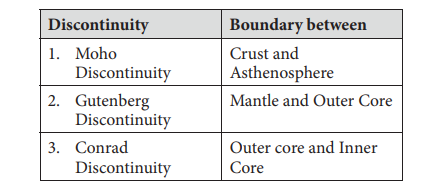
#35. Consider the following pairs with respect to discontinuities found in earth’s crust:
Which of the pairs given above is/are correctly matched?
Pair I is correctly matched. Mohorovicic (Moho) discontinuity forms the boundary between the crust and the asthenosphere (upper reaches of the mantle) where there is a discontinuity in the seismic velocity. It occurs at an average depth of about 8 kilometres beneath the ocean basins and 30 kilometres beneath continental surfaces. The cause of the Moho is thought to be a change in rock composition from rocks containing feldspar (above) to rocks that contain no feldspars (below).
Pair 2 is correctly matched. Gutenberg Discontinuity lies between the mantle and the outer core, about 2,880 kilometers (1,798 miles) beneath Earth’s surface.
Pair 3 is incorrectly matched. Conrad discontinuity lies between the hydrosphere and crust whereas Lehmann discontinuity lies between outer and inner core.
#36. Consider the following statements about the interior of Earth:
1. Oceanic crust does not contain the rocks of SIAL.
2. Outer core is liquid because of the very high pressure.
3. Secondary waves or S waves are absent in asthenosphere.
Which of the statements given above is/are correct?
Statement 1 is correct: “Crust” describes the outermost shell of a terrestrial planet. Oceanic crust, is mostly composed of different types of basalts. Geologists often refer to the rocks of the oceanic crust as “sima”. Sima stands for silicate and magnesium, the most abundant minerals in oceanic crust. Rocks of Sial is absent in oceanic crust.
Statement 2 is incorrect: The outer core of the Earth is in liquid state while the inner core is in solid state. Ihe metallic nickel—iron outer core is liquid because of the high temperature. However, the intense pressure, which increases towards the inner core, dramatically changes the melting point of the nickel—iron, making it solid.
Statement 3 is incorrect: The mantle contains a weaker zone called asthenosphere. It is from this that the molten rock materials find their way to the surface. Asthenosphere or low velocity zone because P and S waves travel more slowly in this region and the S waves are attenuated or weakened. “Thus, S waves travels through it.
#37. Which of the following factors contributed to the formation of lithosphere?
1. Increase in density of earth during primordial stage
2.The Big Splat
3. Degassing
Select the correct answer using the code given below:
1. Increase in density of earth during primordial stage – During the primordial stage of earth, the earth was mostly in volatile stage. So due to gradual increase in density, the temperature inside the earth has increased. As a result, the material inside started getting separated depending upon their densities. This allowed heavier metals to sink towards the center of the earth and the lighter ones to move towards the surface. This process is called differentiation. With the passage of time, it cooled further and solidified and condensed into a smaller size. This led to the development of the outer surface in the form of a crust.
2. ‘The Big Splat – During the formation of moon, due to giant impact called the “big splat” the earth was further heated up and then again, the process of differentiation started which resulted into layering of materials depending upon different densities.
3.Degassing – Degassing is not the reason behind the formation of lithosphere. It is the reason behind the evolution of atmosphere by which gases and water vapor were released from the interior of the earth.
#38. Which of the following evidence was not used by Wegener for supporting the continental drift theory?
Evidence which supports the continental drift theory are
1. Rich placer deposits of gold were found in the Ghana coast but its source was not found. But the gold bearing veins in Brazil indicate that these were derived from the Brazilian plateau.
2.Rocks of the same age were found across the continent like the earliest marine deposits along the coastline of South America and Africa are of the Jurassic age.
3.Identical fossil remains were found on different continents for example, the Glossopteris fossil was found in Australia, Antarctica, India, South Africa, and South America—all the southern continents. However, the Slow movement of hot mantle below the continent was not the findings of Wegener theory but of Arthur Holmes who said that this is the main driving force behind the plate movement.
#39. Consider the following statements regarding Polar lights (Auroras).
1. These are formed in the stratospheric layer of atmosphere.
2. Auroras are least visible during the height of sunspot activities.
3. Colors of the aurora vary depending on the altitude.
Which of the statements given above is/are incorrect?
Statement 1 is incorrect. Aurora occurs in the thermosphere layer. The thermosphere starts just above the mesosphere.
Statement 2 is incorrect. Sunspots are the coldest part of the sun and appear as dark blobs on its white-hot surface. Solar flares and coronal mass ejections are associated with sunspots. Bright, consistent auroras are most visible during the height of sunspot activity.
Statement 3 is correct. The colors of the aurora vary, depending on altitude and the kind of atoms involved. If ions strike oxygen atoms high in the atmosphere, the interaction produces a red glow. A green-yellow hue, occurs as ions strike oxygen at lower altitudes. Reddish and bluish light that often appears in the lower fringes of auroras is produced by ions striking atoms of nitrogen. Ions striking hydrogen and helium atoms can produce blue and purple auroras.
#40. Which of the following best describes the event ‘Laschamps Excursion’?
The magnetic north pole (where a compass needle points to) does not have a permanent location. Instead, it usually wobbles around close to the geographic north pole (the point around which the Earth spins) over time due to movements within the Earth’s core. For reasons still not entirely clear, magnetic pole movements can sometimes be more extreme than a wobble. One of the most dramatic of these pole migrations took place some 42,000 years ago and is known as the Laschamps Excursion, named after the village where it was discovered in the French Massif Central.
A geomagnetic excursion, like a geomagnetic reversal, is a significant change in the Earth’s magnetic field. Unlike reversals, an excursion is not a “permanent” re- orientation of the large-scale field, but rather represents a dramatic, typically a (geologically) short-lived change in field intensity. Excursion events typically only last a few thousand to a few tens of thousands of years.
#41. With reference to geomorphic processes, consider the following statements:
1.The movement of the lithospheric plates due to the convectional currents in the mantle is the cause behind endogenic processes.
2. An example of endogenic processes include diastrophism which refers to deformation of the Earth’s crust.
Which of the above statements is/are correct?
Statement 1 is correct. In general terms, the endogenic forces are mainly land building forces and the exogenic processes are mainly land wearing forces.’The ultimate source of energy behind endogenic movements is earth’s internal heat which is a result of mainly radioactive decay. Differences in temperature and pressure (temperature gradients or geothermal gradients and pressure gradients) among various layers of the earth give rise to density differences and these density differences give rise to conventional currents. The Earth’s rotation (Coriolis effect) can influence where convection currents travel. Thus, the movement of the lithospheric plates due to the convectional currents is the cause behind endogenic movements.
Statement 2 is correct. Diastrophism and volcanism are endogenic geomorphic processes since they help in the building of newer landforms on earth.
All processes that move, elevate or build up portions of the earth’s crust are collectively referred to as diastrophism. They include: (i) orogenic processes that help in mountain building through process of folding of the crust; (ii) epeirogenic processes involving uplifting of the earth’s crust; (iii) earthquakes (iv) plate tectonics involving horizontal movements of plates of the earth’s crust. Thus there is deformation of the Earth’s crust.
#42. Consider the following statements with reference to the Indian plate movement:
1.The Indian plate’s movement in the northern direction is a type of convergent boundary interaction.
2. The boundary between Indian and the Antarctic plate is a type of divergent boundary.
Which of the statements given above is/are correct?
Statement 1 is correct. The Indian plate’s movement in the northern direction is a type of convergent boundary interaction. ‘Ihe Indian plate is moving northward and collides with the Eurasian plate. The subduction zone along the Himalayas forms the northern plate boundary in the form of continent-continent convergence.
Statement 2 is correct. The boundary between Indian and the Antarctic plate is a type of divergent boundary. It runs in through West-East direction and merging into the spreading site, a little south of New Zealand. The Indo-African boundary is also divergent.
#43. Consider the following statements:
1. Direct sources provide the complete information about the interior of the Earth.
2. Meteors are direct sources of information about the interior of the Earth.
Which of the statement(s) given above is/are correct?
Statement 1 is Incorrect:Direct sources only provide a part of the information. The interior of the earth can be understood onlyby indirect evidences as neither any one has noranyone can reach the interior of the earth. Direct and Indirect sources jointly provide us a large picture about the interior of the Earth.
Statement 2 is Incorrect:Meteors that reach the earth are the indirect source of information about Earthk interior. Although they do not come from the interior of Earth, the material and thestructure observed in the meteors are similar to that of the earth.
Increase in pressure and temperature with depth, gravitation, magnetic field, and seismic activity are the other sources ofobtaining indirect information.
Gold mines, Deep Ocean Drilling Project, Volcanic eruptions are Direct sources of information about interior of the Earth.
#44. Consider the following statements:
1. In the absence of atmosphere, earth’s surface temperature would increase considerably.
2. Earth’s magnetic field is the result of convection currents in its deep inner core.
Which of the statements given above is/are correct?
“The atmosphere is a layer of gases that surround the Earth. Carbon dioxide (C02), methane (CH4), and ozone (03), are kinds of greenhouse gases.
Statement 1 is incorrect. Greenhouse gases collect in the Earth’s atmosphere. Without the greenhouse effect, Earth’s average temperature would drop (and not increase). Now, it is about 57 degrees Fahrenheit (14 degrees Celsius). It could drop to as low as O degrees Fahrenheit (minus 18 degrees Celsius). ‘Ihe weather would go from amild to very cold and at such low temperature life would not be able to exist.
Statement 2 is incorrect. Earth’s magnetic field is generated in the earth’s outer core. ‘The temperature of the outer core ranges from 4400 oc in the outer regions to 6000 oc near the inner core. There is lower pressure in the outer core than the inner core which means the metal in the outer core is fluid. This differences in temperature, pressure and composition within the outer core cause convection currents in the molten iron of the outer core as cool, dense matter sinks while warm, less dense matter rises. “This flow of liquid iron generates electric currents, which in turn produce magnetic fields.
#45. With reference to characteristics of the Sun, consider the following statements:
1. It was formed due to collapse of nebula under its own gravity.
2. Its core generates energy by converting hydrogen into helium through nuclear fusion.
3. It emits steady stream of charged particles called solar winds.
4. Solar flares are large eruptions of electromagnetic radiation from the Sun.
Which of the statements given above is/are correct?
At about 864,000 miles (1.4 million kilometres) wide, the sun is 109 times wider than Earth, and it accounts for more than 99.8 percent of the solar system’s total mass. Statement I is correct. The sun was formed more than 4.5 billion years ago when a cloud of dust and gas called a nebula collapsed under its own gravity. As it did, the cloud spun and flattened into a disk, with sun forming at its centre. The disk’s outskirts later accreted into our solar system, including Earth and the other planets.
Statement 2 is correct. Deep in the sun’s core, nuclear fusion converts hydrogen to helium, which generates energy. Particles of light called photons carry this energy to the top layer of the solar interior, the convection zone. There, hot plasmas rise and fall, which transfers energy to the sun’s surface, called the photosphere.
Statement 3 is correct. The steady stream of charged particles that is radiated by the sun in addition to light and heat are known as the solar wind. “Ihe wind blows about 280 miles (450 kilometres) a second throughout the solar system, extending the sun’s magnetic field out more than 10 billion miles. Beyond that distance, the solar wind gives way to the colder, dense material that drifts in between stars, forming a boundary called the heliopause.
Statement 4 is correct. Solar flares are large eruptions of electromagnetic radiation from the Sun lasting from minutes to hours. It is a tremendous explosion on the Sun that happens when energy stored in ‘twisted’ magnetic fields (usually above sunspots) is suddenly released. ‘Ihey heat material to many millions of degrees and produce a burst of radiation across the electromagnetic spectrum, including from radio waves to x-rays and gamma rays.
#46. Which of the following statements correctly de nes the term ‘’Orion arm’’?
‘The Orion Arm is the minor spiral arm of the Milky Way Galaxy and is probably some light-years wide. *Ihe Solar System (including the Earth and the Sun) is located in the Orion Arm – about one-third from the centre (26,0 light years from the centre) of the Milky Way galaxy. Our Milky Way galaxy is the island of stars. Our solar system lies between two prominent spiral arms, in what astronomers once thought was a mere bridge of stars, gas, and dust clouds. In recent decades, research advances have revealed that we live in our very own spiral arm of the galaxy, albeit a relatively minor one. Our spiral arm is the Orion-Cygnus Arm, or simply, the Orion Arm or Local Arm.
The Orion Arm gets its name from the constellation Orion the Hunter, which is one of the most prominent constellations of Northern Hemisphere winter (Southern Hemisphere summer).
#47. Which of the following is the most accurate reason for the occurrence of di erent seasons on Earth?
On earth, the four seasons—spring, summer, fall, and winter—follow one another regularly. Each has its own light, temperature, and weather patterns that repeat yearly. The revolution of the earth and the inclination of the earth’s axis in a fixed direction cause seasons. Earth’s axis is an invisible line that runs through its center, from pole to pole. As the earth spins on its axis, producing night and day, it also moves about the sun in an elliptical (elongated circle) orbit that requires about 365 1/4 days to complete. The earth’s spin axis is tilted with respect to its orbital plane. This is what causes the seasons. When the earth’s axis points towards the sun, it is summer for that hemisphere. When the earth’s axis points away, winter can be expected.
#48. Consider the following statements:
1Statement :The troposphere is thickest at the equator and comparatively thinner at the Poles.
Statement 2: Heat difference on Earth’s surface cause the convectional currents to rise at greater heights at warmer places.
Which one of the following is correct in respect of the above statements?
‘The troposphere is the lowermost layer of the atmosphere. Its average height is 13 km and extends roughly to a height of 8 km near the poles and about 18 km at the equator.
Option a is correct. The troposphere is thickest at the equator, and much thinner at the North and South Poles because equator is warmer and heat is transported to great heights by strong convectional currents. Thus, convection currents transport heat to greater heights at the equator than the poles due to heat difference on Earth. ‘This also implies that the warmer the weather, the thicker is the troposphere.
#49. With reference to the troposphere, consider the following statements:
1.The majority of the mass of entire atmosphere is contained in this layer.
2. It is always calm with little turbulence.
3. Most of the Earth’s clouds are located in this layer.
Which of the statements given above is/are correct?
The Earth’s atmosphere is divided into five layers based on characteristics like temperature. These layers are – troposphere, stratosphere, mesosphere, thermosphere and exosphere. The troposphere is the lowest atmospheric
Statement 1 is correct. ‘The majority of the mass of the entire atmosphere is contained in the troposphere— between approximately 75 and 80 percent.
Statement 2 is incorrect. Stratosphere (and not troposphere) is calm with little turbulence. Strong horizontal winds blow in the stratosphere, but there is little turbulence. This is ideal for planes that can fly in this part of the atmosphere. In contrast, the troposphere tends to change suddenly and violently. Air masses, areas of high- pressure and low-pressure systems, are moved by winds in the troposphere. These weather systems lead to daily weather changes as well as seasonal weather patterns and climate systems, such as El Nino.
Statement 3 is correct. Most of the water vapour in the atmosphere, along with dust and ash particles, are found in the troposphere. ‘Ihus, most of Earth’s clouds are located in this layer. Clouds, from low-lying fog to thunderheads to high-altitude cirrus, form in the troposphere. This is the most important layer for all biological activities. All changes in climate and weather take place in this layer. ‘Ihe temperature in this layer decreases at the rate of IOC for every 165m of height.
#50. Which of the following is the reason for the bulging of the equator?
‘The Earth has a rather slight equatorial bulge: it is about 43 km (27 mi) wider at the equator than pole-to-pole. The bulging of the equator and flattening at the poles is due to the rotation of the Earth which creates the centrifugal force. Centrifugal force increases as one moves from poles towards the equator and is therefore greater at the equator. This increase in centrifugal force has led to pole fleeing. As a result, a person on the equator is over 13 miles farther from Earth’s center than a person on the North Pole is. That difference is more than double the distance between sea level and the top of Mount Everest, but on a planetary scale, this bulge is virtually imperceptible. Centrifugal force is the force which is perpendicular to the axis of the Earth on excluding the equator.
#51. Which of the following is the primary feature of the Earth’s atmosphere, that protects us from meteoroids?
Meteoroids are lumps of rock or iron that orbit the sun, just as planets, asteroids, and comets do. Meteoroids, especially the tiny particles called micrometeoroids, are extremely common throughout the solar system.
Mesosphere protects the Earth from meteoroids. It is the third layer of the atmosphere which lies above the stratosphere. ‘The mesosphere extends from the stratopause (the upper boundary of the stratosphere) to about 85 kilometres (53 miles) above the surface of the Earth. Meteorites burn up in this layer on entering from the space. The mesosphere has the coldest temperatures in the atmosphere, dipping as low as -120 degrees Celsius (-184 degrees Fahrenheit, or 153 kelvin).
#52. With reference to Black Holes, consider the following statements:
1. It is formed when a massive star collapses.
2.They have such strong gravitational force that even light cannot escape it.
3.There is no black hole in our solar system.
Which of the statements given above is/are correct?
A Black hole is a cosmic body of extremely intense gravity.
Statement 1 is correct. Black holes are created when a massive star reaches the end of its life and implodes, collapsing in on itself. It is formed by the collapse of individual stars that are relatively small, but incredibly dense. A black hole takes up zero space, but does have mass — originally, most of the mass that used to be a star.
Statement 2 is correct. According to Einstein’s general theory of relativity, the gravity of a black hole is so intense that nothing can escape it — not even light cannot get out. “The gravity is so strong because matter has been squeezed into a tiny space and is extremely dense. They get “bigger” as they consume matter near them. The bigger they are, the larger a zone of “no return” they have, where anything entering their territory is irrevocably lost to the black hole. This point of no return is called the event horizon.
Statement 3 is correct. No black hole is present in the or is close to the Solar system for the Earth and therefore Earth will not fall into a black hole. ‘Ihe newly discovered black hole is about 1,011 light-years from our solar system in the star system HR 6819.
Besides, black holes do not go around the Universe swallowing stars and planets. Suppose a black hole were to take the place of the Sun. The black hole would have the same gravity as the sun. Earth would still not fall into it and would orbit the black hole as it would orbit the Sun.
#53. Consider the following statements:
Assertion (A) : eoretically, it is possible to reach the edge of Universe.
Reason (R) : Dark flow of matter limits the boundary of Universe.
Select the correct answer using the code given below:
Assertion is alse.As araswecante , there is no geto the universe. Space spreads out infinitely in all directions. Furthermore, galaxies fill all of the space through-out the entire infinite universe. Since universe is technically expanding faster than the speed of light as the space between galaxies is also expanding. It drives the edge of the universe further and further from us every single second. ‘Therefore, it is theoretically impossible to ever reach the “edge” of the universe, since it will always be moving away faster than we could ever move towards it.
Reason is false.
Astronomers have found that whole clusters of galaxies are moving in convoy towards a single point in the sky. *Ihis unexpected motion appears to be separate from the expansion of the universe and the researchers even suggest that a force beyond the visible universe is the reason. The discovery has been named “dark flow”.
Cosmologists have observed two distinct effects caused by invisible entities in the universe: dark matter is known to affect the rotation of galaxies and dark energy seems to be causing the expansion of the universe to accelerate. In simple terms, the space between galaxies is also expanding, which drives the edge of the universe further and further.
#54. For which of the following reasons the Pluto was reclassified as a ‘dwarf planet’?
There are three criteria of the International Astronomical Union (IAU) for a full-sized planet are:
It is in orbit around the Sun.
It has sufficient mass to assume hydrostatic equilibrium (a nearly round shape).
It has “cleared the neighbourhood” around its orbit.
Pluto meets only two of these criteria. It has not managed to clear its neighbourhood. Clearing the neighbourhood means that the planet has become gravitationally dominant so that there are no other bodies of comparable size other than its own satellites or those otherwise under its gravitational influence, in its vicinity in space. But Pluto shares its orbital neighbourhood with Kuiper belt objects such as the plutinos.
There are no such criteria of fulfilling the minimum mass. Eris is also considered a dwarf planet, but it is even more massive than Pluto. So, if Pluto is considered as a planet, then Eris should also be granted planet status as well.
#55. Consider the following statements regarding the effects of acid rains:
1. Soils deficient in naturally occurring limestone are more affected by acid rain.
2. Buildings made of granite and sandstone are less likely to be affected by acid deposition as compared to buildings made up of limestone.
Which of the statements given above is/are correct?
Acid rain, or acid deposition, is a broad term that includes any form of precipitation with acidic components, such as sulfuric or nitric acid that fall to the ground from the atmosphere in wet or dry forms. This can include rain, snow, fog, hail or even dust that is acidic.
Statement 1 is correct. Soils deficient in limestone are more affected by Acid rain. Due to naturally occurring limestone, soil is slightly basic (which has a pH of greater than 7). Bases counteract acids, these soils tend to balance out some of the acid railfi acidity. Some of the Rocky Mountains and parts of the north-western and south- eastern United States, where limestone does not naturally occur in the soil, acid rain can harm the environment.
Statement 2 is correct. Granite and sandstone are primarily composed of silicate minerals, which are resistant to acid attack. A few sandstones are less resistant because they contain a carbonate cement that dissolves readily in weak acid. Limestone and marble are primarily composed of the mineral calcite (calcium carbonate), which dissolves readily in weak acid. So, buildings made of granite and sandstone are less likely to be affected by acid deposition as compared to buildings made up of limestone.
#56. Which of the following sources contribute to Space radiation?
1. Solar flares
2. Sun’s corona
3. Cell phones
4. Sun’s photosphere
5. Van Allen radiation belts.
6. Exploding stars
7. Microwave ovens
Select the correct answer using the code given below:
Space radiation is different from the kinds of radiation we experience on Earth. Space radiation is comprised of atoms in which electrons have been stripped away as the atom accelerated in interstellar space to speeds approaching the speed of light — eventually, only the nucleus of the atom remains i.e. this radiation consists primarily of ionizing radiation which exists in the form of high-energy, charged particles. While radiation on Earth consists of non- ionizing radiation
There are three naturally occurring sources of space radiation- (1) particles trapped in the Earth’s magnetic field (2) particles shot into space during solar flares (solar particle events) (3) galactic cosmic rays (from Supernova or exploding stars), which are high-energy protons and heavy ions from outside our solar system. All of these kinds of space radiation represent ionizing radiation. The photosphere is also the source of solar flares. CME (Coronal mass ejections) are huge bubbles of plasma (ionized atomic matter with high kinetic energy) threaded with a magnetic field that is ejected from the Sun’s corona (outer atmosphere). The inner radiation belt, or Van Allen Belt, consists of ionizing radiation in the form of very energetic protons—by-products of collisions.
Cell phones and microwave ovens emit a type of radiation called radiofrequency radiation. It’s a form of electromagnetic radiation and Electromagnetic radiation is non-ionizing radiation. So, these are not the sources of space radiation.
#57. “It consists of Hydrogen and Helium, as these are the most common and stable compounds in the Universe. These massive collections of hydrogen gas are pulled together by gravity to form star nurseries through the process of fusion.” “It consists of Hydrogen and Helium, as these are the most common and stable compounds in the Universe. These massive collections of hydrogen gas are pulled together by gravity to form star nurseries through the process of fusion.”
The information given in above paragraph refers to which of the followingThe information given in above paragraph refers to which of the following:
Nebulae are clouds of gas and dust which form in interstellar space. They range in size from millions of miles across to hundreds of light years across. Nebulas are mostly composed of hydrogen along with smaller amounts of other gases and dust particles. Stars and planetary systems are formed from the gas and dust within nebulae under their own weight through fusion. Like humans, stars are also born at a certain time and place, and their birthplaces are what astronomers call nebulae or star nurseries.
Planetary Nebula form when a star runs out of fuel to burn. The star blows off its layers of gas in the shape of a ring or bubble. It is a type of nebula. They are made of gas and plasma.
Pulsar- It is a rotating neutron star, that is highly magnetized and it emits a beam of electromagnetic radiation.
Quasar- It stands for quasi-stellar object and that refers to any of the celestial objects that are similar to a star in appearance but has a comparatively high redshift.
#58. Which of the following is the reason behind the gaseous nature of Outer planets?
The outer planets are Jupiter, Saturn, Uranus, and Neptune. These gas giants are made up primarily of hydrogen and helium, the same elements that make up most of the Sun. ‘The inner planets, or terrestrial planets, are the four planets closest to the Sun: Mercury, Venus, Earth, and Mars. Statement a is incorrect. Inner planets have lower gravity as compared to Outer planets. So higher gravity can hold the escapmg gases much stronger as compared to Inner planets.
Statement b is incorrect. ‘Ihe presence of rings does not decide the gaseous nature of planets. In fact, all four Outer planets have rings, although only Saturn’s rings are easily visible from Earth. Rings are composed of countless small pieces of rock and ice, each orbiting its planet like a tiny moon.
Statement c is correct. As a result of their enormous gravity, Outer planets captured a large amount of hydrogen and other gasses from the surrounding nebula and thus these are gaseous in nature.
Statement d is incorrect. The cores of all four Outer planets or all inner planets are made of some combination of rock, metal and hydrogen compounds. The deeper you go, the hotter and denser it gets. An increase in temperature and density means an increase in pressure. “Thus, these are not the deciding factors for the gaseous nature of outer planets.
#59. Consider the following statements is/are correct regarding the Moon of Earth:
1.There is absence of atmosphere on the Moon.
2. Meteoroids that pass close to the Moon are easily vaporized.
3. Impact crater on the lunar surface is mainly due to plate tectonics.
Which of the statements given above is/are incorrect?
‘The Moon is Earth’s only natural satellite and the fifth largest moon in the solar system. The Moon’s presence helps stabilize our planet’s wobble and moderate our climate. The Moon’s distance from Earth is about 240,000 miles (385,()00km).
Statement 1 is incorrect. Recent studies confirm that our moon does indeed have an atmosphere consisting of some unusual gases, including sodium and potassium, which are not found in the atmospheres of Earth, Mars or Venus. It’s an infinitesimal amount of air when compared to Earth’s atmosphere.
Statement 2 is incorrect. As Moon has very thin atmosphere, meteoroids can easily strike its surface as nothing is obstructing its path. As a result, tiny craters are quite common on lunar rocks. However almost all the meteoritic material is vapourised in Earth’s atmosphere, leaving a bright trail fondly called “shooting stars.”
Statement 3 is incorrect. Impact crater on the lunar surface is mainly due to the attacking of its surface by meteors and not due to plate tectonics. Plate tectonics isCell phones and microwave ovens emit a type of radiation called radiofrequency radiation. It’s a form of electromagnetic radiation and Electromagnetic radiation is non-ionizing radiation. So, these are not the sources of space radiation.
#60. Which one of the following factors/processes is related to the formation or modification of the present atmosphere of earth?
1. Loss of primordial atmosphere
2. Degassing
3. Volcanic eruptions
4. Photosynthesis
5. Solar winds
Select the correct answer using the code given below:
“The present composition of earth’s atmosphere is chiefly contributed by nitrogen and oxygen. The process which is involved in the formation or modification of the present atmosphere are as following:
Loss of Primordial atmosphere- It is the first stage. ‘Ihe early atmosphere, with hydrogen and helium, is supposed to have been stripped off as a result of the solar winds. This happened not only in case of the earth, but also in all the terrestrial planets, which were supposed to have lost their primordial atmosphere through the impact of solar winds.
Then the composition of atmosphere is modified by the process of photosynthesis. Oceans began to have the contribution of oxygen through the process of photosynthesis.
Solar winds contributed in stripping the planets of hydrogen and helium.
Degassing- is the process through which gases like water vapour, nitrogen, methane, ammonia, carbon dioxide, very little free oxygen are outpoured from the interior.
Volcanic eruptions —contributed to the evolution of water vapour and gases to the atmosphere.
#61. Which of the following is not the correct reason behind the habitable nature of earth?
Statement a is correct. ‘Ihe goldilocks zone is the distance that a planet must be from its star in order to support liquid water. If a planet is too close to its sun, it will be too hot — the water will evaporate. If it’s too far, it will be too cold, and the planet will freeze. Earth, as it just so happens, lies in that goldilocks zone where water can exist in its liquid state. A planefs location in this habitable zone plays a big role in what the planet will look like — whether that is a dry, desert-like planet, or a humid ice planet.
Statement b is correct. Unlike Venus or Mars, the Earth has an active plate tectonic system, which continuously produces and destroys the crust. ‘Ihe same system also gives us active water, oxygen and carbon dioxide cycles, as material is subducted down into the Earth’s interior, and eventually re-erupted from volcanoes. However, while tectonics give the Earth active water and gas cycles, the tectonic system itself moves too slowly to be the process that activel maintains the climate.
Statement c is incorrect. The high-mass stars emit too much ultraviolet radiation. The lifetime of a high-mass star is too short. High-mass stars live only a few million years, and life probably cannot arise until a planet is at least a couple hundred million years old. Smaller stars like the Sun survive far longer than do high-mass stars. Thus, it is not a reason for habitable nature of earth.
Statement d is correct. Earth has a molten core, which is responsible for producing our Earth’s magnetosphere. Our magnetosphere protects us from the sun’s harmful rays that otherwise would spell disaster for any life on Earth. Because of this, Earth’s magnetic field played a vital part in making Earth a habitable planet.
#62. Which of the following is/are the similarities between earth and other terrestrial planets?
1.They are made up of Rocks and metals.
2.They have relatively higher densities.
3.They have thicker atmosphere than Jovian planets.
Select the correct answer using the code given below:
Our Solar system consists of eight planets. The nebula, from which our Solar system is supposed to have been formed, started its collapse and core formation some time 5-5.6 billion years ago and the planets were formed about 4.6 billion years ago.
Statements 1 and 2 are correct. Our solar system consists of the sun (the star), 8 planets, more than 200 moons, millions of smaller bodies like asteroids and comets and huge quantity of dust-grains and gases. Out of the eight planets, mercury, Venus, earth and mars are called as the inner planets as they lie between the sun and the belt of asteroids the other four planets are called the outer planets. Alternatively, the first four are called Terrestrial, meaning earth-like as they are made up of rock and metals, and have relatively high densities.
Statement 3 is incorrect.
The rest four planets are called Jovian or Gas Giant planets. Jovian means Jupiter-like. Most of them are much larger than the terrestrial planets and have thick atmosphere, mostly of helium and hydrogen (thick atmosphere is found in Jovian planets). All the planets were formed in the same period sometime about 4.6 billion years ago.
#63. Consider the following statements with reference to earth’s crust formation:
1.The oceanic crust originates from the Midoceanic Ridges and spreads towards the continents.
2. Outgassing refers to release of previously dissolved, trapped and frozen gas along the midocean ridge.
Which of the statements given above is/are incorrect?
Statement 1 is correct. About 70% of the earth’s crust is covered by oceans. The oceanic crust originates from the Mid-oceanic Ridges and spreads towards the continents and then it goes down to magma again and it melts. This could be the reason that we always find the younger oceanic crust and it is not more than 200 million years old. All of the oceanic crusts are made up of basalt rock which is a volcanic rock. Some deposits of continental sediments near the continents and organic depositions in the deep-sea zone are also found there. Oceanic crusts are heavier and its density is 3.0 g/cm3. Primary wave (P) travels through this layer at a speed of 7 km/s. Mineral compositions of the rocks are mainly silica and magnesium. This layer is known as Sima.
Statement 2 is correct. Outgassing is the release of gas, previously dissolved, trapped, frozen or absorbed in some material (e.g., rock). It occurs mainly along mid- ocean ridges, subduction zones and at magma hotspots. Pockets of carbon dioxide exist in the Earth’s crust. Volcanic eruptions and earthquakes can release these gas pockets.
#64. Consider the following statements with reference to Lithosphere:
1. Lithosphere is composed of the crust and the portion of the upper mantle.
2.The main mineral constituents of lithosphere are silica and alumina.
Which of the statements given above is/are correct?
The lithosphere is the rigid, outermost shell on Earth.
Statement I is correct. It is composed of the crust and the portion of the upper mantle that behaves elastically on time scales of thousands of years or greater.
The outermost shell ofa rocky planet, the crust, is defined on the basis of its chemistry and mineralogy. This includes the crust and the uppermost mantle, which constitute the hard and rigid outer layer of the Earth. The uppermost part of the lithosphere that chemically reacts to the atmosphere, hydrosphere, and biosphere through the soil- forming process is called the pedosphere.
Statement 2 is correct. The lithosphere comprises two distinct parts: ‘Ihe upper part consists of granite rocks and forms the continents and its main mineral constituents are silica and alumina and referred to as the Sial with an average density of 2.7 The lower part is a continuous zone of denser basaltic rocks forming the ocean floor, comprising mainly silica, iron and magnesium and is therefore called sima with an average density of 3.0.The sial and sima together form the earth’s crust which varies in thickness from only 3-4 miles beneath the oceans to as much as 30 miles under some parts of the continents.
#65. Tectonic activity is responsible for which of the following?
1. Earthquakes
2. Volcanoes
3. Oceanic crust
Select the correct answer using the code given below:
Statement 1 is correct. An earthquake is shaking of the earth. It is a natural event. It is caused due to release of Energy due to the tectonic activity beneath the earth. This generates waves that travel in all directions. The release of energy occurs along a fault. A fault is a sharp break in the crustal rocks. Rocks along a fault tend to move in opposite directions. As the overlying rock strata press them, the friction locks them together. However, their tendency to move apart at some point of time overcomes the friction. As a result, the blocks get deformed and eventually, they slide past one another abruptly. This causes a release of energy, and the energy wave’s travel in all directions.
Statement 2 is correct. Volcanoes form when one tectonic plate moves under another. Usually a thin, heavy (denser) oceanic plate sub ducts, or moves under, a thicker continental plate. When this happens, the ocean plate sinks into the mantle. A volcano is a place where gases, ashes and/or molten rock material – lava — escape to the ground. “Ihe mantle contains a weaker zone called asthenosphere. It is from this that the molten rock materials find their way to the surface. The material in the upper mantle portion is called magma.
Statement 3 is correct. Oceanic crust is formed at sea-floor spreading centres, and continental crust is formed through arc volcanism and accretion of terrines through tectonic processes. Oceanic crust is denser than continental crust owing to their different compositions. As a result of this density stratification, oceanic crust generally lies below sea level (for example most of the Pacific Plate), while continental crust buoyantly projects
above sea level.
#66. What will happen when the Earth’s Plate Tectonics movement stops?
1.The height of Mt Everest will get reduced gradually.
2.The Formation of the new continental and oceanic crust will be stopped.
Select the correct answer using the code given below:
According to plate tectonic theory fold mountains are formed due to collision of two convergent plates. Fold mountains are formed along the destructive plate boundaries. It is obvious that the process of mountain building is associated with destructive plate boundaries of two convergent plates. ‘Ihe plate tectonic theory envisages the formation of mountains due to compression of sediments caused by the collision of two convergent plate boundaries.
Statement I is correct. The Himalayan Mountain range was formed as the Indian tectonic plate collided into the Eurasian plate about 50 million years ago. ‘Ihe process continues even today, which causes the height of the mountain range to rise every year. ‘Ihe peak of Mt Everest rises in height by approximately 2 cm each year due to plate tectonics.
However, in the absence of such plate movements, there is a possibility that the height of Mt Everest may gradually reduce as a result of erosion. Erosion would wear the mountains down and with no tectonic activity to refresh them, over a few million years they would erode down to low rolling hills. So, as a result the whole planet would be much flatter in such a case.
Statement 2 is correct. According to the Plate Tectonic ‘Iheory, the oceanic crust has its origin at the mid oceanic ridges. The oceanic crust originates from the Mid-oceanic Ridges and spreads towards the continents and then it goes down to magma again and it melts.
As with oceanic crust, continental crust is created by plate tectonics. At convergent plate boundaries, where tectonic plates crash into each other, continental crust is thrust up in the process of orogeny, or mountain-building. Thus, in the absence of plate tectonics movement there will be no new formation of oceanic and continental crust.
#67. Consider the following statements with reference to evolution of earth:
1. Gravitational compression and radioactive decay contributed to the molten state of earth in its initial stage of evolution.
2. Asteroids that slammed into Earth and other inner planets contained a signi cant amount of water in their minerals.
Which of the statements given above is/are correct?
Pacific Plate), while continental crust buoyantly projects above sea level. hundred million years after Ihe Earth look form, an outer crust developed.
From the outset, heat and gravity shaped the evolution of the planet.
Statement 1 is correct. The materials that accreted into the early Earth were probably added piecemeal, without any particular order (though some models call on sequential accretion of metallic and then silicate materials). ‘Ihe early Earth was very hot from gravitational compression and Radioactive decay (much more than today). The early Earth was probably partially or largely molten. The denser metallic liquids sank to the centre of the Earth and less dense silicate liquids rose to the top. In this way the Earth very quickly differentiated into a metallic, mostly iron core and a rocky silicate mantle.
Statement 2 is correct. It is believed that during the early formation of Earth, asteroids were continuously bombarding the planet, and could have been carrying with them an important source of water. Scientists believe the asteroids that slammed into Earth contained a significant amount of water in their minerals.Some suggest that nearly 30 per cent of the water contained initially in the asteroids would have remained in the fragmented sections of rock on Earth, even after im act.
#68. Which of the following elements are present in the inner core:
1. Iron
2. Nickel
3. Siderophiles
4. Sulphur
Select the correct answer using the code given below:
‘The solid spheroid that comprises the inner core of the Earth is made of different metals, specifically, mostly iron and nickel. Siderophiles, or elements that dissolve in iron, are also found in the inner core. These elements include gold, cobalt, and platinum. Most of the Earth’s sulphur is in the core as well.
Formation of the Inner Core:: The inner core and other layers of the Earth were formed during the accretion of the planets in the solar system by the separation of lighter silicate minerals and more dense metallic minerals. The light elements naturally rose to the top of the planet, while the denser ones coalesced in the center and created the inner core. This process was largely exothermic, or heat releasing, causing the entire Earth to heat by some 20000C.The inner core has the following characteristics:
• It is a solid spheroid
• It is approximately 52000C (98000F).
• It generates its own magnetic field.
• It has a radius of 1220 km
#69. In the context Earth’s inner structure, the Gutenberg discontinuity separates
‘The Gutenberg discontinuity separates and divides the lower mantle from the outer core. The lower mantle above the Gutenberg line is solid, but the outer core below the line is liquid molten. Seismic waves change their activity and secondary waves completely disappear below this boundary. Beneath this boundary zone, the molten outer core is much denser than the mantle above as a result of the heavy amounts of iron it contains, and below this layer is the inner core, which is composed of extremely hot solid nickel and iron.
#70. With reference to the interior structure of the earth, consider the following statements:
1. It is from the outer core that molten rock materials reach the surface of Earth in the form of lava. 2.e transfer of heat and material in the mantle helps determine the landscape of Earth.
Which of the statements given above is/are correct?
Earth consists of three main layers: the crust, the mantle, and the core. ‘Ihe core accounts for almost half of Earth’s radius, but it amounts to only 16.1% of Earth’s volume. Most of Earth’s volume (82.5%) is its mantle, and only a small fraction (l .4%) is its crust.
Statement 1 is incorrect. The layer below the solid crust is mantle. It has higher density than that of the crust. The mantle contains a weaker zone called asthenosphere. It is from this layer that the molten rock materials find their way to the surface. The material in the upper mantle portion is called magma. Once it starts moving towards the crust or it reaches the surface, it is referred to as lava. The material that reaches the ground includes lava flows, pyroclastic debris, volcanic bombs, ash and dust and gases such as nitrogen compounds, sulphur compounds and minor amounts of chlorene, hydrogen and argon.
Statement 2 is correct.The transfer of heat and material in the mantle helps determine the landscape of Earth. Activity in the mantle drives plate tectonics, contributing to volcanoes, seafloor spreading, earthquakes, and or en mountain-buildi ).
#71. Consider the following events during the “evolution of the earth”:
1. Degassing
2. Differentiation of earth forming material.
3. Photosynthesis
4. Loss of primordial atmosphere.
What is the correct chronological order of the above events, starting from the earliest time?
The correct chronological sequence of the above events is –
It is the process of Differentiation through which earth forming material got separated into different layers, like Crust, Mantle, Outer Core and Inner Core.started the formation of atmosphere in which the first stage is marked by the loss of Primordial atmosphere i.e., loss of hydrogen and helium present in early atmosphere by solar winds.
This was followed by the Process of Degassing, in which the gases were outpoured from the interior of earth. ‘The early atmosphere largely consisted of water vapour, nitrogen, carbon dioxide, methane, ammonia and very little of oxygen. Continuous volcanic eruptions contributed water vapour and gases.
As the earth cooled, the water vapour released started getting condensed. The carbon dioxide in the atmosphere got dissolved in rainwater and the temperature further got decreased causing more condensation and more rains. “Ihe rainwater falling onto the surface got collected into the depressions and gave rise to oceans. And then life began to evolve along with the process of photosynthesis.
#72. In context of plate tectonics theory, which among the following landform feature(s) is/are present along a subduction zone?
1. Deep ocean trench
2. Forearc basin
3. Chain of volcanic island arcs
4. Accretionary wedges
Select the correct answer using the code given below:
Exp) Option d is correct The location on which sinking of a tectonic plate occurs is called a subduction zone. There are three ways in which convergence can occur. These are:
between an oceanic and continental plate;
between two oceanic plates; and
between two continental plates.
Deep ocean trenches, Fold mountains with active volcanoes, island arcs, and seismic fault lines are examples of features that can form along converging plate tectonic boundaries. Other features include accretionary wedges, forearc basins, backarc basins and remnant arcs.
Statement 1 is correct. Oceanic trenches are formed at subduction zones. Oceanic plates meet continental plates in the water, so trenches are formed as the oceanic plate goes under the continental plate. These trenches can be very deep if the plate that is subducting (going down) is an older and colder plate. Younger oceanic plates are less dense and the angle will be shallower.
Statement 2 is correct. Forearc basins are between the island arc and the trench, whereas the backarc is behind the island arc. These basins catch sediment (dirt and small rocks that wash away in rain) runoff from the island arcs.
Statement 3 is correct. Volcanic arcs form parallel to subduction zones. As one plate descends under anotherplate, it heats up and becomes magma. The magma will rise through the crust until it reaches the surface. This magma creates a chain of volcanoes or a volcanic arc near the boundary of the top plate- ‘lhere are two types of arcs: island arcs and continental arcs.
Statement 4 is correct. Accretionary wedges are pieces of the subducting plate that have broken off at the trench.
#73. Consider the following statements:
1. Plate Tectonics has empowered geologists to predict an earthquake a few days in advance.
2.The point on the surface of the earth which first experiences the earthquake waves is called the epicentre.
Which of the statements given above is/are correct?
An earthquake is an intense shaking of Earth’s surface. ‘The shaking is caused by movements in Earth’s outermost layer.
Statement 1 is incorrect. As for now, we cannot predict when an earthquake will happen. The only thing scientists can do is to forecast an earthquake: they know that on certain segments of certain faults an earthquake is due, because of the past earthquake records (in corals and sediments), and because of the strain built-up by the plates’ motions. Knowing whether that earthquake will happen tomorrow, in ten years or in a hundred years is currently impossible.
Statement 2 is correct. When the blocks of earth get deformed and eventually, slide past one another abruptly, it causes a release of energy, and the energy waves travel in all directions. The point where the energy is released is called the focus of an earthquake, alternatively, it is called the hypocentre. The energy waves travelling in different directions reach the surface. The point on the surface, nearest to the focus, is called epicentre. It is the first one to experience the waves. It is a point directly above the focus.


