
Results
#1. With reference to Polar Vortex, consider the following statements:
1. It is a whirling cone of high pressure over the poles.
2. When it becomes strong, a wave of cold air is pushed southwards always.
3. The term vortex refers to counterclockwise flow of air.
Which of the statements given above is/are correct?
Statement 1 is incorrect. Polar vortex is described as a whirling cone of low pressure over the poles.
Statement 2 is incorrect. Normally, when the vortex is strong and healthy, it helps to keep a current of air (the jet stream) travelling around the globe in almost a circular path. ‘This current keeps the cold air up north and warm air down south. When the vortex becomes weak there is a lack of a strong low-pressure system, resulting in jet stream losing the hold to keep it in line, and becoming wavy and all of a sudden, a river of cold air is pushed down south.
Statement 3 is correct. The term vortex refers to counterclockwise flow of air that keeps the colder air near the poles.
#2. Consider the following statements regarding Sudden Stratospheric Warming (SSW):
1. It occurs due to disruption and weakening of the Polar vortex.
2. It can aflect the shape of the jet stream in the upper Troposphere.
3. It is connected to extreme warm events on the Earth’s surface.
Which of the statements given above is/are correct?
Statement 1 is correct — Every year in winter, strong westerly winds circle the pole high up in the stratosphere. This is called the stratospheric polar vortex and it circulates cold air high over the Arctic. In some years, the winds in the polar vortex temporarily weaken. The cold air then descends very rapidly in the polar vortex and this causes the temperature in the stratosphere to rise very rapidly, as much as 500C over only a few days; hence the term sudden stratospheric warming.
Statement 2 is correct — As the cold air from high up in the stratosphere disperses, it can affect the shape of the jet stream as the cold air sinks from the stratosphere into the troposphere. It is this change in the jet stream that causes our weather to change.
Statement 3 is incorrect — Extreme cold, winter snow events have all been connected to the surface effects of sudden stratospheric warming. Eg. Extreme cold events in the year 2009-10, 2013 as well as ‘beast from the east’ in 2018.
#3. Consider the following statements:
1.The actual amount of water vapor present in the atmosphere is known as relative humidity.
2. When the temperature of the air is reduced below its dew point, condensation occurs.
3. On cooling the air, its relative humidity increases.
Which of the statements given above is/are correct?
Statement 1 is incorrect — The actual amount of water vapor present in the atmosphere is known as absolute humidity. The percentage of moisture present in the atmosphere as compared to its full capacity at a given temperature is known as the relative humidity. With the change of air temperature, the capacity to retain moisture increases or decreases and the relative humidity is also affected.
Statement 2 is correct — Condensation takes place: (i) when the temperature of the air is reduced to dew point with its volume remaining constant; (ii) when both the volume and the temperature are reduced; (iii) when moisture is added to the air through evaporation.
Statement 3 is correct — When a particular air mass is cooled, its water holding capacity decreases. Thus, with decreasing temperature the relative humidity of air increases. If its temperature is further decreased to the dew point temperature, the air becomes saturated, i.e Relative humidity becomes 100%.
#4. With reference to cyclone consider the following statements:
1. It helps in balancing global heat distribution.
2. It facilitates Ecological Succession in ecosystem.
3. It is responsible for seed dispersal of plant species.
Which of the statements given above is/are correct?
Statement 1 is correct. Cyclone helps in balancing global heat distribution. Cyclone maintains the temperature balance between the poles and the equator.
Statement 2 is correct.
1. Cyclone facilitates Ecological Succession in ecosystem.
2.For example, A cyclone flattens a deciduous forest which may seem as an act of destruction but such disturbances are a natural and necessary part of ecosystem function.
3.’The defoliation of mature canopy trees allows sunlight to reach the previously dark understory, permitting shade-intolerant species to proliferate.
4.’Thus, it helps the shade-tolerant trees to create a canopy again.
5.Such cycling of vegetation communities or succession promotes biodiversity by giving more species the chance to occupy a given ecosystem and maintaining landscape mosaics of greater complexity.
Statement 3 is correct. Cyclones help in the dispersal of seeds of plant species.
#5. Consider the following statements:
1.Thunderstorms and Tornadoes are atmosphere’s adjustments where unstable atmosphere returns to stable state.
2. understorms are common in middle latitudes whereas Tornadoes are common in high latitudes.
Which of the statements given above is/are correct?
Statement 1 is correct. Thunderstorms and Tornadoes are atmosphere’s adjustments where restless atmosphere returns to stable state. They are of short duration, occurring over a small area but are violent. In Thunderstorms and Tornadoes, the potential and heat energies are converted into kinetic energy.
Statement 2 is incorrect. Thunderstorms and Tornadoes are both common in mid latitudes. In fact, Tornadoes are severe thunderstorms having spiralling wind descending like a trunk of an elephant with great force, with very low pressure at the centre, causing massive destruction on its way.
#6. In the context of role of Tropical easterly jet stream on Indian Monsoons, consider the following statements:
1.These streams play an important role in the reversal of upper air circulation patterns.
2. The streams steer the tropical depressions into India. 3. The tracks of these streams in India are the areas of highest rainfall in India.
Which of the statements given above is/are correct?
Statement 1 is correct — The Easterly jet streams are held responsible for the burst of monsoon in India as formation of these streams results in the reversal of upper air circulation patterns from high pressure to low pressure.
Statement 2 is correct – ‘The easterly jet stream steers the tropical depressions into India. ‘These depressions play a significant role in the distribution of monsoon rainfall over the Indian subcontinent.
Statement 3 is correct — The tracks of these depressions steered by easterly jet streams are the areas of highest rainfall in India. The frequency at which these depressions visit India, their direction and intensity, all go a long way in determining the rainfall pattern during the southwest monsoon period.
#7. In the context of naming of tropical cyclones, consider the following statements:
1. Names are selected from the list of names prepared by the South Asian Forum for Environment.
2. Names of cyclones in Bay of Bengal are suggested by Bay of Bengal littoral countries only.
3. Cyclone Tauktae is the name suggested by Myanmar.
Which of the statements given above is/are correct?
Statement 1 is incorrect —Cyclones are officially named by one of the World Meteorological Organization’s (WMO) warning centres based across the globe. The WMO/ United Nations Economic and Social Commission for Asia and Pacific Panel on tropical cyclones names the cyclone for Bay of Bengal and Arabian sea region since 2000.
Statement 2 is incorrect — Names of cyclones in the regions are suggested by India along with 12 other countries. Other nations that are part of this network include Bangladesh, Maldives, Myanmar, Oman, Iran, Pakistan, Sri Lanka, Qatar, Thailand, Saudi Arabia, United Arab Emirates and Yemen. Thus, it is not just the Bay of Bengal littoral countries.
Statement 3 is correct – The name ‘Tauktae’ has been suggested by Myanmar. The name comes from the Burmese language and it means a ‘gecko’ or a very hitch- pitched lizard.
#8. Consider the following statements about animals of the colder climate/polar region:
1. To survive the harsh winters of Antarctica, male Emperor Penguins have adapted to make milk.
2. During hibernation there is a drop-in breathing rate and temperature of an animal.
3. Large Tundra animals have hollow hairs which trap air close to the body and keep them warm.
4. Penguins breed during the Antarctic winter.
Which of the statements given above is/are correct?
Statement 1 is correct. As part of the adaptations to survive the harsh climate male Emperor Penguins can make “milk” in the esophagus which can be used to feed chicks in the winter before the female arrives back from fishing.
Statement 2 is correct. Certain animal species have evolved an adaptation that allows them to weather long stretches of time when food is scarce — they enter a state known as hibernation. The animal’s heart and breathing rates slow down, and its body temperature drops. Depending on the species, days or even weeks may pass without the animal waking to drink, eat or relieve itself.
Statement 3 is correct. Large Tundra animals like Musk Ox and Polar Bear, hairs are unique in that they’re hollow. These hollow hairs help to trap air close to the body where it keeps the animals warm.
Statement 4 is correct. Penguins breed during the depths of the Antarctic winter, so the chicks are large enough to become independent during the summer abundance of food.
#9. Which of the following is incorrect about the Koeppen’s scheme regarding climatic regions of India?
Option a is incorrect. The Koeppen’s scheme of Climatic classification is based upon annual and monthly values of temperature and precipitation, not only precipitation.
Option b is correct. The scheme accepts the native vegetation as the best expression of totality of a climate. Therefore, many of the climatic boundaries are based upon vegetation. Koeppen has expressed the view that the effectiveness of precipitation in vegetation growth depends not only upon precipitation, but also upon the intensity of evaporation and transpiration.
Option c and d are correct. The scheme identifies five major climatic types. Eg. Tropical Climates, where mean monthly temperature throughout the year is above 18-degree Celsius.
Each type is further sub-divided into sub-types on the basis of seasonal variations in the distributional pattern of rainfall and temperature. The small letters demote: f (sufficient precipitation), m (rain forest despite a dry monsoon season), w (dry season in winter), h (dry and hot), c (less than four months with mean temperature over 100C), and g (Gangetic plain).
Both, the Gangetic plains and most of the North East India, are classified under ‘Cwg’ climatic region: Monsoon with dry winter.22)
#10. While moving from equator towards poles, which of the following factors experience an increase?
1. Coriolis Force
2. Dawn and Twilight
3. Seasonal variation in day length
4. Insolation
Select the correct answer using the codes given below:
Point 1 is correct. At the equator, the Coriolis force is zero. It increases as we move away from equator.
‘The Coriolis force acts perpendicular to the pressure gradient force. ‘Ihe pressure gradient force is perpendicular to an isobar. At the equator the wind blows perpendicular to the isobars. Thus, the Coriolis force is zero at equator and it increases moving towards poles.
Point 2 is correct. At the equator, sun rises and sets in a vertical path which makes the period of refracted light short. But in higher latitudes, the sun rises and sets in an oblique path and the period of refracted light is longer. Period of dawn and twilight increases while moving from equator to poles.
Point 3 is correct. Length of the day almost remains constant on the equator throughout the year, while there is a drastic change in the length of the day on poles. In the northern hemisphere in summer, there is light for the whole day in midsummer on 21st June and in winter, the sun never rises for the whole day. There is a larger variation in day’s length while moving from equator towards poles.
Point 4 is incorrect. Insolation decreases with increase in latitude. The amount of insolation received depends upon the angle of inclination of the rays. ‘This depends on the latitude of a place. The higher the latitude the less is the angle they make with the surface of the earth resulting in slant sun rays. The area covered by vertical rays is always less than the slant rays. If more area is covered, the energy gets distributed and the net energy received per unit area decreases. Thus, the amount of insolation received decreases while moving form equator towards poles,
#11. Weather front formation is characterised by which of the following factors?
1. Two contrasting air masses.
2. Prominent in middle latitudes.
3. Steep temperature gradient.
4. Negligible change in pressure.
5. Shift in wind direction.
Select the correct answer from the codes given below:
Option 1 is correct – When two different air masses meet, the boundary zone between them is called a front. The process of formation of the fronts is known as frontogenesis.
Option 2 is correct — ‘The fronts are more prominent in middle latitudes. They are uncommon in lower and polar latitudes.
Option 3 is correct – ‘The fronts are characterized by a steep gradient in temperature. They bring abrupt changes in temperature and cause the air to rise to form clouds and cause precipitation.
Option 4 is incorrect — When a sudden change in temperature occurs through a front, the pressure also changes steeply.
Option 5 is correct — A front experiences wind shift since the wind motion is a function of pressure gradient and Coriolis force.
#12. Consider the following statements, with reference to the relief rain:
1.The leeward slope of the mountain receive greater rainfall.
2.The winds capacity to take in moisture increases on the leeward slope of the mountain.
Which of the statements given above is/are correct?
Statement 1 is incorrect. Relief rain, also known as orographic rain, results when the saturated air mass comes across a mountain, it is forced to ascend and as it rises, it expands; the temperature falls, and the moisture is condensed. The chief characteristic of this sort of rain is that the windward slopes receive greater rainfall. The area situated on the leeward side gets less rainfall and is known as the rain-shadow area.
Statement 2 is correct. After giving rain on the windward side, when these winds reach the other slope, they descend, and their temperature rises. This results in increased capacity of winds to take in moisture and hence, these leeward slopes remain rainless and dry.
#13. Consider the following statements regarding the difference between Fog and Mist:
1. Fog contains more moisture than the mist.
2. Mists are frequent over mountains and fogs are prevalent where warm currents of air meet cold currents.
3. Fog has visibility of less than 1km.
Which of the statements given above is/are correct?
Statement 1 is incorrect. Mist contains more moisture than the fog. Because, in mist each nucleus contains a thicker layer of moisture than the fog.
Statement 2 is correct. Mists are frequent over mountains as the rising warm air up the slopes meet a cold surface. Fogs are drier than mist and they are prevalent where warm currents of air come in contact with cold currents. Fogs are mini clouds in which condensation takes place around nuclei provided by the dust, smoke, and the salt particles.
Statement 3 is correct. Fog has visibility less than 1 Km and mist has visibility of Ikm and above. Because of the fog and mist, the visibility becomes poor to zero.
#14. Which of the following statement is correct?
Option a is incorrect. In the mesosphere, temperature decreases with the increase in altitude. In this layer, once again, temperature starts decreasing with the increase in altitude and reaches up to minus 1000 C at the height of 80 km.
Option b is incorrect. ‘The ionosphere is located between 80 and 400 km above the mesopause. It contains electrically charged particles known as ions, and hence, it is known as ionosphere. Radio waves transmitted from the earth are reflected back to the earth by this layer.
Option c is correct. The stratosphere is found above the tropopause and extends up to a height of 50 km. One important feature of the stratosphere is that it contains the ozone layer. This layer absorbs ultra-violet radiation and shields life on the earth from intense, harmful form of energy.
Option d is incorrect. The zone separating the troposphere from stratosphere is known as the tropopause. The temperature here is nearly constant, and hence, it is called the tropopause.
#15. Which of the following conditions are necessary for the formation of dew:
1. High relative humidity.
2. Steady air flow.
3. Cold and long nights.
4. Dew point below freezing point.
Select the correct answer using the code given below:
Statement 1 is correct. High relative humidity is necessary for the formation of dew. It means the current volume of air is near to saturation.
Statement 2 is incorrect. Calm air is necessary for dew formation as it helps to maintain the volume of air constant in temperature and moisture, with less disturbances by outside air flow.
Statement 3 is correct. Cold and long nights help to reduce the temperature and clear sky results in fast convection of warm air from surface to the upper atmospheres. This leads to cold and moisture laden air to subside near the earth surface.
Statement 4 is incorrect. For the formation of dew, the dew point needs to be above the freezing point. If the dew point is at or below the freezing point then it results in formation of frost.
#16. Which of the following statements is/are correct regarding Temperature inversion?
1. Visibility may be greatly reduced below the inversion layer.
2. It causes very heavy rainfall.
3. It improves the air quality below the inversion layer.
Select the correct answer using the code given below:
Statement 1 is correct. In regions where a pronounced low-level inversion is present, convective clouds cannot grow high enough to produce showers. And, at the same time, visibility may be greatly reduced below the inversion by the accumulation of dust and smoke particles.
Statement 2 is incorrect. Convection clouds cannot move high upwards to produce showers. So, there is less rainfall during temperature inversion.
Statement 3 is incorrect. The air trapped under the inversion includes the moisture, smoke and pollutants released into the air mass. The air quality under an inversion layer deteriorates as the pollutants accumulate.
#17. Which of the following could be considered as the most appropriate reason behind the naming of Westerlies as Roaring Forties, Furious Fifties, and Shrieking sixties in the southern hemisphere?
Wester ies are e as Roaring Forties, Furious Fifties, and Shrieking sixties in the southern hemisphere because of the degree of storminess in the latitudes in which they flow. They flow with storminess because large expanse of oceans does not obstruct their flow and so, they flow with a much greater force and regularity in the Southern hemisphere. Westerlies are more variable in the northern hemis here.
#18. Consider the following statements regarding Anti-cyclones.
1. They can form only in winter, not in summer.
2. Clockwise movement of wind occurs in northern hemisphere.
3. Anticyclones normally results in fine weather.
Which of the statements given above is/are correct?
Statement 1 is incorrect. Anticyclones can be formed both in summer and winter.
Statement 2 is correct. Winds in Anti-cyclone blow outwards and also subjected to deflection but they blow clockwise in the northern hemisphere and anticlockwise in southern hemisphere due to high pressure at the center.
Statement 3 is correct. Anticyclone normally herald fine weather because of gentle pressure gradients. Skies are clear, the air is calm and temperatures are high in summer but cold in winter.
#19. Consider the following statements regarding permafrost:
1. It is defined solely based on temperature and duration.
2. It contains large quantities of organic leftover from thousands of years.
3. In northern hemisphere, it is found in higher latitudes only.
4.Thawing of permafrost is a major contributor to climate change.
Which of the statements given above is/are correct?
Statement 1 is correct — Permafrost is a ground that remains completely frozen at O degrees Celsius or below for at least two years. It is defined solely based on temperature and duration.
Statement 2 is correct — Beneath its surface, permafrost contains large quantities of organic leftover from — dead remains of plants, thousands of years prior animals, and microorganisms that got frozen before they could rot. It also holds a massive trove of pathogens.
Statement 3 is incorrect – These grounds are known to be below 22 per cent of the land surface on Earth, mostly in polar zones and regions with high mountains. They are spread across 55 per cent of the landmass in Russia and Canada, 85 per cent in the US state of Alaska, and possibly the entirety of Antarctica. At lower latitudes, permafrost is found at high altitude locations such as the Alps and the Tibetan plateau. Thus, in Northern Hemisphere, Permafrost is not confined to higher latitudes only.
Statement 4 is correct – When permafrost thaws, microbes start decomposing this carbon matter, releasing greenhouse gases like methane and carbon dioxide. Researchers have estimated that for every 1-degree Celsius rise in average temperature, permafrost regions could release greenhouse gases to the tune of 4-6 years of emissions from coal, oil, and natural gas — becoming a major factor of climate change in themselves.
#20. With reference to the di erent types of Fronts, consider the following statements:
1. Warm front is the contact zone that develops when the cold air moves towards the warm air mass.
2. Occluded front develops when the front remains stationery.
Which of the following statements is /are correct?
Statement 1 is incorrect. When two different air masses meet, the boundary zone between them is called a front. When the cold air moves towards the warm air mass, its contact zone is called the cold front, whereas if the warm air mass moves towards the cold air mass, the contact zone is a warm front.
Statement 2 is incorrect. If an air mass is fully lifted above the land surface, it is called the occluded front. When the front remains stationary, it is called a stationary front.
#21. If you need to condense a given moist volume of air, which of the following actions one will take?
1. Increase the temperature of the given volume of air.
2. Add more moisture through evaporation.
3. Reduce both volume and temperature.
4. Bring the given volume of air in contact with colder object.
Select the correct answer using the code given below:
Statement 1 is incorrect. If we increase the temperature of the given volume of air, it will result in evaporation. Evaporation is a process by which water is transformed from liquid to gaseous state.
Statement 2 is correct. If we add more moisture to the given volume of air, through evaporation, it will lead to increase in density and pressure resulting in condensation.
Statement 3 is correct. Condensation takes place when either the temperature is reduced to dew point, with its volume remaining constant or reducing the volume of air, so relative humidity increases. So, if we reduce both volume ofair and its temperature, then it will lead to condensation of the water vapour.
Statement 4 is correct. Condensation also takes place when the moist air comes in contact with some colder object, because it will result in lowering the temperature of the given volume of air and temperature of the air gets closer to the dew point.
#22. Consider the following statements about the Inter Tropical Convergence Zone (ITCZ):
1. It is the zone of convergence of trade winds from two hemispheres.
2. is convergence zone moves north or south with the apparent movement of the sun.
Which of the statements given above is/are correct?
Statement 1 is correct: ‘The Inter Tropical Convergence Zone (ITCZ) is a low-pressure zone located at the equator where trade winds from two hemispheres converge, and so, it is a zone where air tends to ascend.
Statement 2 is correct: This convergence zone lies more or less parallel to the equator but moves north or south with the apparent movement of the sun.
#23. Which of the following factors control temperature distribution on the surface of the earth?
1. Latitude of the place
2. Air-circulation and ocean currents
3. Altitude of the place
4. Distance from sea
5. Local Aspects
Select the correct answer using the code given below:
Statement 1 is correct. The temperature of a place directly depends on the insolation received. Insolation varies according to the latitude and temperature of a place directly depends on the insolation received. Higher latitude receives slant sun rays; thus, energy gets distributed and the net energy received per unit area decreases compared to vertical rays in lower latitude.
Statement 2 is correct. Passage of air masses also affects the temperature. ‘The places, which come under the influence of warm air-masses experience higher temperature and vice-versa. Similarly, the places located on the coast where the warm ocean currents flow record higher temperature than the places located on the coast where the cold currents flow.
Statement 3 is correct. Atmosphere is indirectly heated by terrestrial radiation from below. Therefore, the places near the sea-level record higher temperature than the places situated at higher elevations. It can also be understood with the phenomena of normal lapse rate (temperature decreases with increase in elevation).
Statement 4 is correct. Compared to land, the sea gets heated slowly and loses heat slowly. Land heats up and cools down quickly. Therefore, the variation in temperature over the sea is less as compared to land. Also, there is moderating effect of land-sea breeze of places which are situated near the sea which affects the temperature.
Statement 5 is correct. Temperature is also dependent on local factors. Such as lake in an arid region cools off the heat and similarly temperature on the equator ward side of the mountains is generally higher as compared to their pole ward side.
#24. Which of the following statements is/are correct regarding the composition of atmosphere?
1.The concentration of water vapour is more in temperate zones as compared to equatorial zones.
2. The concentration of dust particles is more in temperate zones as compared to equatorial zones.
3. Nitrogen constitutes the maximum amount of gas present in the atmosphere followed by carbon dioxide.
Select the correct answer using the code given below:
Statement 1 is incorrect. Water vapour decreases from equator towards poles and also decreases with altitude. ‘Thus, in warm and wet tropics, it may account for 4% of air by volume and while in dry and cold areas of desert and polar regions, it may be less than 1% of the air.
Statement 2 is correct. The concentration of dust particles is high in subtropical and temperate regions due to dry winds in comparison to equatorial and polar regions.
Statement 3 is incorrect. Nitrogen constitutes the maximum amount of gas followed by Oxygen, Argon Carbon dioxide etc.
#25. Which of the following statements is/are correct regarding Troposphere?
1. Commercial jet aircraft doesn’t fly in this region due to the presence of turbulence in this region.
2. Most of the mass of atmosphere is present in this layer.
3. It is the wettest layer of the atmosphere.
4.The height of this layer is highest at the equator and lowest over the poles.
Select the correct answer using the code given below:s
Statement 1 is correct. Commercial jet aircraft fly in the stratosphere to avoid the turbulence present in the troposphere as it contains lots of water vapour
Statement 2 is correct. The troposphere contains approximately 80% of the mass of the atmosphere of the earth.
Statement 3 is correct. The majority of atmospheric water vapour or moisture is found in the troposphere. So, it is the wettest layer of the atmosphere.
Statement 4 is correct. Its average height is 13km while it is 8km near the poles and about 18km at the equator due to the transportation of heat to the greatest height by strong convectional current.
#26. Which of the following statements is/are correct about the stratosphere?
1. Materials like CFCs (chlorofluoro carbons), aerosols etc. stay in the stratosphere for long times due to the lack of vertical convection.
2. Temperature rises as one move upward through the stratosphere due to the presence of Ozone gas.
Select the correct answer using the code given below:
Statement 1 is correct. In this layer temperature rises as one move upwards through the stratosphere. Because of this temperature stratification, there is little convection and mixing in the stratosphere, so the layers of air there are quite stable. So due to lack of vertical convection in the stratosphere, material like CFCs, aerosols etc. can stay there for long times.
Statement 2 is correct. Ozone is relatively abundant in the upper stratosphere. It heats this layer as it absorbs energy from the incoming ultra-violet radiation from the sun. Thus, the temperature rises as one move upwards through the Stratosphere.
#27. Consider the following statements regarding La Nina.
1. It brings heavy rains and flooding in Canada.
2. La Nina Modoki is associated with warming in the central tropical Pacific.
Which of the statements given above is/are correct?
Statement 1 is correct. La Niha is characterized by lower- than-normal air pressure over the western Pacific. During La Nina events, trade winds are even stronger than usual, pushing more warm water toward Asia. Off the west coast of the Americas, upwelling increases, bringing cold, nutrient-rich water to the surface. These cold waters in the Pacific push the jet stream northward. This tends to lead to drought in the southern U.S. and heavy rains and flooding in Canada.
Statement 2 is incorrect. La Nina Modoki is associated with colder central tropical Pacific and warming in the eastern and western Pacific. La Nina Modoki is the counter part of El Nino Modoki
#28. Consider the following statements with reference to Madden Julian oscillation (MJO).
1. It is as an eastward moving disturbance of clouds, rainfall, winds and pressure near the equator.
2. When MJO stays over Pacific Ocean, it brings good rainfall in India.
3. There can be multiple MJO events within a season.
Which of the statements given above is/are correct?
Statement 1 is correct. MJO can be defined as an eastward moving ‘pulse’ of clouds, rainfall, winds and pressure near the equator that typically recurs every 30 to 60 days. It’s a traversing phenomenon and is most prominent over the Indian and Pacific Oceans.
Statement 2 is incorrect. When MJO lies over the Indian Ocean during the Monsoon season, it brings good rainfall over the Indian subcontinent. On the other hand, when it witnesses a longer cycle and stays over the Pacific Ocean, MJO brings bad news for the Indian Monsoon.
Statement 3 is correct. As it recurs every 30 to 60 days, there can be multiple MJO events within a season, and so the MJO is best described as intraseasonal tropical climate variability (i.e., varies on a week-to-week basis).
#29. Which of the following statements is/are correct about heat budget of the earth?
1. Heat budget is constant over the entire earth.
2. Atmosphere is heated only by the incoming short wave and long wave terrestrial radiations.
Select the correct answer using the code given below:
Statement 1 is incorrect: Heat budget is not constant over the entire earth. It depends on many factors and based on those there are areas of energy surplus and energy deficit. This difference in heat budget gives rise to various climatic phenomena like ocean current, atmospheric circulations, etc.
Statement 2 is incorrect: Atmosphere is heated up by 4 methods. Of the 65% of incident solar energy 14% are directly absorbed by atmosphere. This is in the form of short-wave radiation. On the contrary, the terrestrial radiation heats the lower atmosphere by long wave radiation and it accounts for 6%. Other two important components of atmospheric heat budget are convection and evaporation which accounts for 9% and 19% respectively. “Thus, along with short wave and long wave radiation atmosphere is also heated by conduction, convection and advection.
#30. Which of the following processes are due to inversion of temperature?
1. Accumulation of smoke and dust particles in lower atmosphere.
2. Occurrence of dense fog which disappears with the heat of the sun.
3. Creates stability in the lower layers of the atmosphere.
Select the correct answer using the code given below:
It is observed that normally temperature decreases with increase in elevation. ‘Ihis is known as normal lapse rate which averages around 6.5 Celsius every 1 kilometer. But in some case this temperature starts to increase, this is called as inversion of temperature.
Statement 1 is correct. Smoke and dust is accumulated in lower strata of the atmosphere below the inversion layer. ‘This creates problem of air pollution as they spread horizontally and fills the lower strata of the atmosphere.
Statement 2 is correct. Creation of dense fog especially during winter is also a common phenomenon. This inversion last only for a few hours as the sun begins to warm the earth. It is a potential environment hazard as it harms crops and decreases visibility.
Statement 3 is correct. An inversion acts as a cap on the upward movement of air from below thus creating conditions of stability in the atmosphere. Also due to cap on upward movement moisture supply remains restricted because of which also we see stable climatic conditions.
#31. Which of the following statements is/are correct?
1. Farther from the equator, water vapor concentrations are high in the hemisphere experiencing summer and low in the one experiencing winter.
2. In winter months water vapor amounts decrease less over land area than adjacent ocean areas.
Select the correct options from the code given below:
Statement 1 is correct. Farther from the equator, water vapor concentrations are high in the hemisphere experiencing summer and low in the one experiencing winter because warm air is less dense than cold air, thus there is more room for water vapour in warm summer as compared with cold winter air.
Statement 2 is incorrect. Water vapor amounts over land areas decrease more in winter months than adjacent ocean areas do. This is largely because air temperatures over land drop more in the winter than temperatures over the ocean. Water vapor condenses more rapidly in colder air.
#32. Which of the following pairs is/are incorrectly matched?
1. Conduction- two bodies of unequal temperature are in contact and there is flow of energy from higher temperature to lower temperature.
2. Advection- air which rises vertically upon heating in the form of currents and transmit heat vertically in the atmosphere.
3. Convection-it is the process of transfer of heat through horizontal movement of air.
Select the correct answer using the code given below:
Pair 1 is correctly matched: Conduction takes place when two bodies of unequal temperature are in contact with one another there is a flow ofenergy from the warmer to cooler body. The transfer of heat continues until both the bodies attain the same temperature or the contact is broken.
Pair 2 is incorrectly matched: ‘The transfer of heat through horizontal movement of air is called advection. In tropical regions particularly in northern India during summer season local winds called ‘loo’ is the outcome of advection process.
Pair 3 is incorrectly matched: The process of vertical heating of the atmosphere is known as convection. Air in contact with the earth rises vertically on heating in the form of currents and further transmits the heat of the atmosphere. It is confined only to the troposphere.
#33. With respect to heat budget of the earth which of the following statements is/are correct?
1. Net radiation is the difference between all incoming solar energy and all outgoing terrestrial energy.
2. Sensible heat transfer from energy surplus to energy deficit areas is accomplished by atmospheric circulations and ocean currents.
Select the correct answer using the code given below:
Statement 1 is correct: Net radiation is the difference between all incoming solar energy and outgoing terrestrial energy. It is an important measure for categorization of earth on the basis of heat energy.
Statement 2 is correct: ‘The surplus heat energy from the tropics is redistributed poleward through atmospheric circulation and ocean currents. Thus, sensible heat gets transferred from energy surplus to energy deficit areas.
#34. Consider the following statements regarding temperature variability in the atmosphere:
1. The temperature decreases with the increase in altitude throughout the atmosphere.
2. The air temperature at the tropopause is greater over the equator than over the poles.
Which of the statements given above is/are incorrect?
Statement 1 is incorrect – Ihe temperature decreases with altitude till Troposphere. It remains nearly constant in Tropopause. Then it starts increasing in stratosphere. Similarly, temperature decreases with altitude in Mesosphere and decreases in Thermosphere.
Statement 2 is incorrect — Ihe air temperature at the tropopause is about minus 800C over the equator and about minus 450C over the poles.
#35. Consider the following statements regarding influence of various factors on temperature of any place:
1. A steep slope experiences a more rapid change in temperature than a gentle one.
2. North facing slope of the mountain ranges in Northern hemisphere show higher temperature than south facing slope.
Which of the statements given above is/are correct?
Statement 1 is correct — “The topographical variations are the major factors modifying the distribution of insolation. Variability in elevation, surface orientation (slope and aspect), and obstruction by surrounding topographic features create strong local gradients of insolation. With regards to factors affecting temperature in mountain ranges, the steep slope experiences a much more rapid change in temperature than a gentle slope.
Statement 2 is incorrect — Those mountain ranges which have an east-west alignment like the Alps show higher temperatures on the south facing slope, the sunny slope. ‘The sheltered north-facing slope has lower temperature. ‘The greater insolation of the south facing slope has a more flourishing vegetative cover.
#36. With reference to effect of soil on local temperature, consider the following statements:
1. Light soils reflect more heat than darker ones.
2. Dry soils like sands are more sensitive to temperature changes than wet soils.
Which of the statements given above is/are correct?
Statement 1 is correct. Light soils reflect more heat than darker ones. Such differences give rise to slight variations in the temperature of the region. Regions of light-coloured soil are thus comparatively at lower temperature than those of darker soils.
Statement 2 is correct. Dry soils like sands are very sensitive to temperature. Ihey heat up and cool down rapidly, hence the extreme temperature variations in desert areas. Wet soils like clay retain much more moisture, thus they do not warm up or cool down rapidly due to the higher specific heat capacity of water.
#37. With reference to Ferrel’s Law of Deflection, consider the following statements:
1. It tells about the effect of revolution of the earth on direction of wind movement.
2. In Northern Hemisphere, winds deflect to the right and in the southern hemisphere to their left .
3. Coriolis force is maximum along the equator and decreases progressively towards the poles.
Which of the statements given above is/are correct?
Statement 1 is incorrect. Ferrel’s Law of Deflection tells us that the effect of rotation of the earth tends to deflect the direction of winds.
Statement 2 is correct. In the Northern hemisphere winds are deflected to the right and in the southern hemisphere to their left. For this reason, winds blowing out from the subtropical high-pressure belt in the Northern hemisphere towards the equatorial low become north east trade winds and those in the southern hemisphere become the south east trade winds.
Statement 3 is incorrect. ‘The Coriolis force is absent along the equator but increases progressively towards the Poles. As the latitude at which horizontally and freely moving objects are located decreases, the twisting of the underlying Earth’ surface due to the planet’s rotation decreases. ‘That is, the Coriolis effect decreases as the latitude decreases. It is maximum at the poles and absent at the equator.
#38. The pattern of planetary winds largely depends on which of the following factors?
1. Latitudinal variation of atmospheric heating
2. Migration of pressure belts
3. Revolution of earth
4. Ocean Currents
Select the correct answer using the code given below.
The pattern of planetary winds largely depends on
1. latitudinal variation of atmospheric heating. Statement 1 is correct.
2. emergence of pressure belts;
3. the migration of belts following apparent path of the sun. Statement 2 is correct.
4. the distribution of continents and oceans; 5. the rotation of earth.
Statement 3 is incorrect. Revolution of earth is linked to emergence of day and night phenomena.
Statement 4 is incorrect. The pattern of the movement of the planetary winds is called the general circulation of the atmosphere. The general circulation of the atmosphere affects ocean water circulation and sets in motion the ocean water circulation which influences the earth’s climate. Pattern of Planetary wind is not dependent on ocean currents.
#39. With reference to Westerlies, consider the following statements:
1. They are winds which form part of Hadley cell circulation.
2. They bring desiccation (dryness) effect to the western coast of the continents.
3. They are stronger in the Northern hemisphere as opposed to the Southern hemisphere.
Which of the statements given above is/are incorrect?
Statement 1 is incorrect. Westerlies form the part of Ferrel cell circulation. They are prevailing winds that blow from the west at mid-latitudes. In the Ferrel cell, air flows poleward and eastward near the surface and equatorward and westward at higher altitudes; this movement is the reverse of the airflow in the Hadley cell.
Statement 2 is incorrect. Westerlies are on-shore winds on the western coasts. ‘Ihus, they bring much precipitation to the western coasts of the continents.
Statement 3 is incorrect. In the southern hemisphere where there is a large expanse of ocean and few landmasses to slow winds, from 400S to 6()oS, Westerlies blow with much greater force and regularity throughout the year. The strongest westerlies are also referred to as Roaring forties, Furious fifties and Shrieking sixties.
#40. Consider the following statements regarding Land and Sea breezes:
1. These are seasonal rhythms caused by differential heating of land and sea.
2. Fishermen in the tropics often take advantage of the sea breeze to sail out.
Which of the statements given above is/are correct?
Statement 1 is incorrect. Land and sea breezes are caused by differential heating of land and sea. These are diurnal (daily) rhythms, while Monsoon is a seasonal rhythm.
Statement 2 is incorrect. Land breeze blows out from land to sea. Fishermen in the tropics often take advantage of the land breeze and sail out with it. ‘They return the next morning with the in-coming sea breeze.
#41. Consider the following statements regarding Katabatic wind:
1. It is the dense air descending into the valley.
2. It is a day-time phenomenon occurring on the leeward side of mountain slopes.
3. Fohn is a type of Katabatic wind.
Which of the statements given above is/are correct?
Statement 1 is correct. In mountainous regions, during the night the slopes get cooled and the dense air descends into the valley as the mountain wind. The cool air, of the high plateaus and ice fields draining into the valley is called katabatic wind. While, during the day the slopes get heated up and air moves upslope and to fill the resulting gap the air from the valley blows up the valley. This wind is known as the valley breeze.
Statement 2 is incorrect. Katabatic winds occur during the night when the slopes get cooled.
Statement 3 is correct. When a katabatic wind is warmed by compression during its descent into denser air, it is called a fohn. While descending, the wind experiences an increase in pressure and temperature. The air is compressed and gets warm. It may raise the temperature in small time.
Fohn is experienced in the Alps valley particularly in Switzerland.
#42. Which of the following is/are the characteristics of an Air Mass?
1. It has almost uniform physical properties.
2. Their properties are determined by the underlying region from where they originate.
Select the correct answer using the code given below.
Statement 1 is correct. ‘The air with distinctive characteristics in terms of temperature and humidity is called an air mass. It is defined as a large body of air having little horizontal variation in temperature and moisture. Air masses have fairly uniform temperature and moisture content.
Statement 2 is correct. When the air remains over a homogenous area for a sufficiently longer time, it acquires the characteristics of the area. The homogenous regions can be the vast ocean surface or vast plains. The homogenous surfaces, over which air masses form, are called the source regions. Such source regions determine the properties of the air masses.
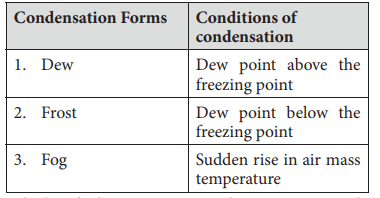
#43. With reference to different forms of condensation, consider the following pairs:
Which of the pairs given above are correctly matched?
Pair 1 is correct. The ideal conditions for formation of dew are clear sky, calm air, high relative humidity, and cold and long nights. For the formation of dew, it is necessary that the dew point is above the freezing point.
Pair 2 is correct. Frost forms on cold surfaces when condensation takes place below freezing point i.e., the dew point is at or below the freezing point. The ideal conditions for the formation of white frost are the same as those for the formation of dew, except that the air temperature must be at or below the freezing point.
Pair 3 is incorrect. When the temperature of an air mass containing a large quantity of water vapour falls all of a sudden, condensation takes place within itself on fine dust particles. The fog is a cloud with its base at or very near to the ground.
#44. This is a very low cloud, uniformly grey and thick, which appears like a low ceiling or highland fog. It brings dull weather with light drizzle. It reduces the visibility of aircraft and is thus a danger. It is
Option a is incorrect. Cirrus cloud look fibrous and appears like wisps in the blue sky. It is often called ‘mares tails’. It indicates fair weather and often give brilliant sunset.
Option b is correct. It is a very low cloud, uniformly grey and thick, which appears like a low ceiling or highland fog. It brings dull weather with light drizzle. It reduces the visibility of aircraft and is thus a danger.
Option c is incorrect. Cumulus cloud is a vertical cloud with a rounded top and horizontal base, typical ofhumid tropical regions, associated with up-rising convectional currents. It is great white globular mass, might look grey against the sun. But it is a fair-weather cloud.
Option d is incorrect. Cumulonimbus cloud is an overgrown cumulus cloud, extending from a base of 2000 feet to over 30,000 feet. It is a black and white globular mass. It is also referred to as a thunder cloud and brings convectional rain accompanied by lightning and thunder.
#45. It is formed wherever the saturated air mass is forced to ascend a barrier. The air expands, and the temperature falls. Consequently, condensation takes place forming clouds and eventually rain. The description describes which of the following types of rainfall:
Option a is incorrect Convectional rainfall. “The air on being heated, becomes light and rises up in convection currents. As it rises, it expands and loses heat and consequently, condensation takes place and cumulous clouds are formed. With thunder and lightning, heavy rainfall takes place but this does not last long.
Option b is correct. Orographic/Relief rainfall-When the saturated air mass comes across a mountain, it is forced to ascend and as it rises, it expands; the temperature falls, and the moisture is condensed. The chief characteristic of this sort of rain is that the windward slopes receive greater rainfall and leeward slopes remain rainless and dry.
Option c and d are incorrect. Cyclonic rainfall is independent of relief or convection. It is purely associated with cyclonic activity whether in the temperate regions or tropical regions. It is due to convergence of two different air masses with different temperatures and other physical properties.
#46. Consider the following conditions:
1. Presence of Coriolis force
2. A high humidity level in the middle troposphere.
3. Small variations in the vertical wind speed
4. Upper convergence above the sea level system
Which of the above conditions are favourable for formation and intensi cation of tropical cyclones?
Tropical cyclones originate and intensify over warm tropical oceans. The conditions favourable for the formation and intensification of tropical storms are:
1 Large sea surface with temperature higher than 270 C;
2.Presence of the Coriolis force;
3.Small variations in the vertical wind speed;
4.A pre-existing weak low-pressure area or low-level- cyclonic circulation;
5.Upper divergence above the sea level system.
6. A high humidity level in the middle troposphere from 3 to 6 km (1.8 to 3.7 miles) in height is more conducive to the production of deep cumulonimbus convection and therefore to stronger vertical coupling in the troposphere.
#47. With reference to Cyclones, consider the following statements:
1. Bomb cyclone is named so because of the severe lightning and thunderstorms associated with it.
2. Temperate Cyclones move under the influence of the Westerlies.
3. Cyclonic winds circulate in anticlockwise direction in southern hemisphere.
Which of the statements given above is/are incorrect?
Statement 1 is incorrect: If a storm is dubbed a bomb cyclone or “bombogenesis”, to refer to a rapidly intensifying area of low pressure. ‘The term bombogenesis comes from the merging of two words: bomb and cyclogenesis. All storms are cyclones, and genesis means the creation or beginning. In this case, bomb refers to explosive development. Altogether the term means explosive storm strengthening.
Statement 2 is correct: Temperate Cyclones are depressions with low pressure at the centre. These are generally steered by deep westerly winds in a general west to east motion across both the Northern and Southern hemispheres of the Earth.
Statement 3 is incorrect: During a cyclone, winds blow inwards into regions of low pressure in the centre. Winds circulate in the anticlockwise direction in the northern hemisphere and clockwise in the southern hemisphere.
#48. Consider the following statements:
1. A sudden rise in the pressure of an area signals the approach of a cyclone
2. Anticyclone is characterised by clear sky and calm air.
Which of the statements given above is/ are correct?
Statement 1 is incorrect — Cyclones are depressions, they are areas with low pressure at the centre. The approach of the cyclone is characterised by a fall in barometric reading (i.e. low pressure), dull sky, oppressive air and strong winds.
Statement 2 is correct – Anticyclones are areas with high pressure centres. Pressure gradient is gentle and winds are light. They are characterized by clear skies and calm air. The temperature is high in summer and cool in winter.
#49. “This is a hot. dry dusty windwith a temperature of over 105°F which originates in the Sahara Desert. It blows outwards in a southerly direction from the desert interiors into the cooler MediterraneanSea. Its scorching breath damages vegetation and crops.”
Identify the local wind from the information given above and select the correct option:
Sirocco is a hot. dry dusty wind which originates in the Sahara Desert. ‘Though it may occur at any time of the year, it is most frequent in spring and normally lasts for only a few days. The Sirocco blows outwards in a southerly direction from the desert interiors into the cooler Mediterranean Sea. It is usually associated with depressions from the Atlantic passing from the coast eastwards inland. After crossing the Mediterranean Sea, the Sirocco is slightly cooled by the absorption of the water vapour. Even then, it is still hot and dry with a temperature of over 1050F. Its scorching breath withers vegetation and crops.
Option a is Incorrect. The Fohn wind is experienced in the valleys of the northern Alps, particularly in Switzerland in spring. It is dry winds experienced on the leeward side of mountains when descending air becomes compressed with increased pressure.
Option c is Incorrect. Mistral is a cold wind from the north, rushing down the Rhone valley in violent gusts between 40 and 80 miles per hour.ln winter when the Mistral is most frequent the temperature of the wind may be below freezing-point, though the sky may be clear and cloudless.
Option d is Incorrect. On the eastern slopes of the Rockies in Canada and U.S.A. a local wind, similar to the Fohn in Switzerland, called the Chinook, comes in a south westerly direction to the Prairies and has a considerable effect on the local pastures.
#50. Consider the following statements:
1. During the day time, sea becomes warmer leading to blowing of wind from the land to the sea.
2. During the night time, the slopes get cooled and the dense air descends into the valley as the mountain breeze.
Which of the following statements given above is/are correct?
Statement 1 is Incorrect. During the day the land heats up faster and becomes warmer than the sea. Therefore, over the land the air rises giving rise to a low-pressure area, whereas the sea is relatively cool and the pressure over sea is relatively high. Thus, pressure gradient from sea to land is created and the wind blows from the sea to the land as the sea breeze.
Statement 2 is correct. During the night the slopes get cooled and the dense air descends into the valley as the mountain wind. The cool air, of the high plateaus and ice fields draining into the valley is called katabatic wind.
#51. Consider the following statements:
1. Air mass is a large body of air having little horizontal variation in temperature and moisture.
2. The contact zone between the cold and warm mass, as the cold air moves towards the warm air is called Cold front.
3. Warm Fronts brings cloudless skies and results into drought like situation.
Which of the following statements given above is/are correct?
Statement 1 is correct. When the air remains over a homogenous area for a sufficiently longer time, it acquires the characteristics of the area. ‘The homogenous regions can be the vast ocean surface or vast plains. The air with distinctive characteristics in terms of temperature and humidity is called an airmass. It is defined as a large body of air having little horizontal variation in temperature and moisture.
Statement 2 is correct. When two different air masses meet, the boundary zone between them is called a front. When the cold air movestowards the warm air mass, its contact zone is called the cold front, whereas if the warm air mass moves towards the cold air mass, the contact zone is a warm front.
Statement 3 is Incorrect. ‘The fronts occur in middle latitudes and are characterised by steep gradient in temperature and pressure. ‘They bring abrupt changes in temperature and cause the air to rise to form clouds and cause precipitation.
#52. With reference to ‘Tropical Cyclones’, consider the following statements:
1. A pre-existing weak low-pressure area is a required condition for development of tropical cyclones.
2. Landfall of the cyclone intensifies the storm with the continuous supply of the moisture.
3. Strong spirally circulating wind around the centre is the characteristic of a mature tropical cyclone.
Which of the following statements given above is/are correct?
Statement 1 is correct. Tropical cyclones originate and intensify over warm tropical oceans. The conditions favourable for the formation and intensification of tropical storms are: (i) Large sea surface with temperature higher than 270 C; (ii) Presence of the Coriolis force; (iii) Small variations in the vertical wind speed; (iv) A pre- existing weak low-pressure area or low-level-cyclonic circulation; (v) Upper divergence above the sea level system.
Statement 2 is Incorrect. “The place where a tropical cyclone crosses the coast is called the landfall of the cyclone. On reaching the land the moisture supply is cut off and the storm dissipates. The energy that intensifies the storm, comes from the condensation process in the towering cumulonimbus clouds, surrounding the centre of the storm. With continuous supply of moisture from the sea, the storm is further strengthened.
Statement 3 is correct. A mature tropical cyclone is characterised by the strong spirally circulating wind around the centre, called the eye. The diameter of the circulating system can vary between 150 and 250 km.
#53. Consider the following statements:
1.Thunderstorms are caused by intense convection on moist hot days.
2. Cirrus clouds are responsible for producing thunder and lightning during a thunderstorm event.
3. Tornadoes are spiralling winds with a low pressure at its centre.
4. Tornadoes occurs at only upper latitudes with high Coriolis force.
Which of the following statements given above is/are correct?
Statement 1 is correct. Thunderstorms are of short duration, occurring over a small area but are violent. Thunderstorms are caused by intense convection on moist hot days.
Statement 2 is Incorrect. A thunderstorm is a well-grown cumulonimbus cloud producing thunder and lightning. When the clouds extend to heights where sub-zero temperature prevails, hails are formed and they come down as hailstorm.
Statement 3 is correct. From severe thunderstorms sometimes spiralling wind descends like a trunk of an elephant with great force, with very low pressure at the centre, causing massive destruction on its way. Such a phenomenon is called a tornado.
Statement 4 is Incorrect. Tornadoes generally occur in middle latitudes.Most tornadoes are found in the Great
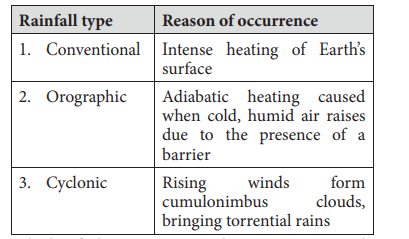
#54. Consider the following pairs:
Which of the pairs given above is/are correctly matched?
Pair 1 is correct — The, air on being heated, becomes light and rises up in convection currents. As it rises, it expands and loses heat and consequently,condensation takes place and cumulousclouds are formed. With thunder and lightning, heavy rainfall takes place but this does not last long. Such rain is common in the summer or in the hotter part of the day. It is very commonin the equatorial regions and interior parts of the continents, particularly in the northern hemisphere.
Pair 2 is Incorrect —Orographic precipitation occurs when warm, humid air strikes an orographic barrier (a mountain range).When the saturated air mass comes across a barrier, it is forced to ascend and as it rises, it expands;leading to adiabatic cooling. Sothe temperature falls, and themoisture is condensed. The surplus moisture falls as orographic rainfall along the windward slopes.
Pair 3 is correct — Cyclonic Rainfall is convectional rainfall on a large scale. The precipitation in a tropical cyclone is of convectional type while that in a temperate cyclone is because offrontal activity. In tropical cyclone, the zone of rising winds leads to formation of cumulonimbus clouds and bring torrential rains. Whereas in temperate areas, because of meeting of fronts, precipitation occurs.
#55. Which of the following is/ are the reason(s) behind the phenomenon of Twilight?
1. Tilt of Earth’s axis
2. Revolution of Earth around the sun
3. Rotation of Earth about its axis
4. Spherical shape of Earth
Select the correct answer using the code given below:
Twilight is a time between day and night when there is light outside, but the Sun is below the horizon. Morning twilight is called Dawn, and evening twilight is called Dusk
Statements 1, 3 and 4 are correct: Twilight occurs when the sun rays fall at angle below the horizon, and the light hits the upper layers ofthe atmosphere. The atmosphere in turn reflects and scatter this light in a diffuse manner onto the lower layers and the Earth surface. For this to happen, the Earth has to rotate on its axis, in order for the sun’s rays to hit at different angles at different times to create the phenomenon of day and night. For example, in the mornings and evenings they hit at an angle below the horizon, whereas at midday they are directly above the head. ‘The tilt of Earth on its axis, intensifies the angle of inclination of the sun’s rays. ‘The Spherical shape of the earth also ensures that the sun’s rays fall at an angle on the earth’s surface.
Statement 2 is incorrect: Revolution of Earth around Sun is responsible for the change in seasons, not for the phenomena of Twilight.
#56. With reference to the factors affecting the normal lapse rate, which of the following statements is/are correct?
1. Terrestrial radiation is absorbed by the greenhouse gases which heats up the atmosphere.
2. Fall in atmospheric pressure leads to decline in temperature at higher altitudes.
3. Temperature decreases with increasing heights due to increase in the concentration of greenhouse gases.
Select the correct answer using the code given below:
‘The rate of decrease of temperature with height is termed as the normal lapse rate. It is 6.50C per 1,000 m. The lapse rate of non-rising air — commonly referred to as the normal, or Environmental, Lapse Rate (ELR) — is highly variable, being affected by radiation, convection, and condensation.
Statement 1 is correct. The insolation received by the earth is in short waves forms and heats up its surface. The earth after being heated itself becomes a radiating body and it radiates energy to the atmosphere in long wave form. ‘This energy heats up the atmosphere from below. This process is known as terrestrial radiation. The long wave radiation is absorbed by the atmospheric gases particularly by carbon dioxide and the other greenhouse gases. ‘Thus, the atmosphere is indirectly heated by the earth’s radiation.
Statement 2 is correct. With increase in elevation, the atmospheric pressure falls. Fall in pressure implies that the temperature also falls as the pressure is directly proportional to temperature and vice versa.
Statement 3 is incorrect. With increase in elevation, the concentration of greenhouse gases decreases and not increases (Water vapour and carbon dioxide fall sharply with elevation). Hence the heat absorption capacity of atmosphere will also decrease.
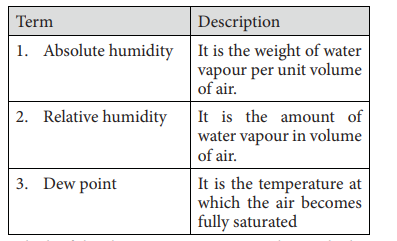
#57. Match the following pairs:
Which of the above pairs is/are correctly matched?
The amount of Water Vapour present in the air is known as humidity. It is expressed quantitatively in different ways.
Pair 1 is correct. The actual amount of the water vapour present in the atmosphere is known as the absolute humidity. It is the weight of water vapour per unit volume of air and is expressed in terms of grams per cubic metre.
Pair 2 is incorrect. Relative humidity is the ratio of the amount of water vapor actually in a volume occupied by air to the amount the space could contain at saturation. The percentage of moisture present in the atmosphere as compared to its full capacity at a given temperature is known as the relative humidity. ‘The relative humidity of an air at saturation point is hundred percent.
Pair 3 is correct. Dew point is the temperature at which the air becomes fully saturated (100 percent relative humidity). It is dependent on only the amount of moisture in the air.
#58. Consider the following statements with respect to the ice age:
1.The temperate zones are restricted to the lower equatorial latitudes during ice ages.
2. There can be colder and warmer periods during the overall ice-age period.
Which of the statements given above is/are correct?
An ice age is a long period of reduction in the temperature of Earth’s surface and atmosphere, resulting in the presence or expansion of continental and polar ice sheets and alpine glaciers.
Statement 1 is correct. Temperate and tropical zones do become restricted to the lower equatorial latitudes during ice ages. This is because ice ages change the Earth’s climatic belts. During the most recent glacial maximum (stadial, to 11,000 years ago), the avenge global temperature was about 8 degree Celsius, with polar regions experiencing average temperatures of -2 degree Celsius.
Statement 2 is correct. Ice ages are not uniformly cold. There can be colder and warmer periods during the overall ice-age period. Colder periods lead to more extensive areas of continental ice sheets, valley glaciers and sea ice, while warmer periods lead to reduced areas of ice.
#59. Consider the following statements: Statement
1: Earth’s temperature remains stable over long periods of time.
Statement 2: The oceans absorb most of the excess heat from greenhouse gas emissions.
Which one of the following is correct in respect of the above statements?
A heat budget refers to the balance between incoming heat absorbed by earth and outgoing heat escaping it in the form of radiation.
Option b is correct. The Earth’s temperature remains stable over long periods of time. This is because the earth receives almost all of its energy from the sun and in turn radiates back to space the energy received from the sun. This is termed as heat budget or heat balance of the earth. ‘Thus, the amount of heat received by different parts of the earth is not the same. This variation causes pressure differences in the atmosphere. This leads to transfer of heat from one region to the other by winds.
The oceans do absorb most of the excess heat from greenhouse gas emissions. However, this is not the correct reason for earth to maintain the heat balance. The absorption of greenhouse gases by oceans has led to rise in ocean temperatures.
#60. What will be the impact on insolation distribution on Earth if it is not tilted at an angle on its axis?
The energy received by the earth’s surface in the form of short waves is termed as Incoming Solar Radiation or Insolation.
The axis of Earth is tilted towards the ecliptic of the Sun at an angle of approximately 23.5 degree.
Statement a is incorrect: One half of the Earth being too ot with continuous insolation, while one wo frozen due to no insolation will occur only if the earth stopped rotating on its axis (not because of lack of tilted axis). If the earth stopped rotating, there would be no day and night for all places on earth. Then one half of the earth will continuously face the sun, and one half will be in perpetual darkness.
Statement b is incorrect: All the places on different latitudes will receive the same amount of insolation only when the earth is flat and no longer spherical in shape (not because of lack of tilt of the axis). As long as the earth is spherical in shape, the sun rays will have to travel varying lengths to reach them and the level of their directness and concentration upon unit area will vary, leading to uneven distribution of insolation. ‘The tilt of the axis only enhances the slant of the sun rays with an increase in latitude, so only the intensity of difference in insolation will change if the earth is no longer tilted.
Statement c is incorrect: Hot places becoming cold due to reduced insolation and vice versa will never happen as places in a more direct path to sun’s rays will always receive more insolation and will always be hotter than places on higher latitude.
Statement d is correct: The main effect of the tilt of earth on its axis, as it moves along its orbit around the sun, is that it brings one half of the earth marginally closer to the sun for half the year and makes one half marginally farther from the sun for half the year. This causes the temperatures to change seasonally in a place. Days are longer, there is more insolation and temperatures are hotter in the half tilted towards the sun and vice versa.
#61. With reference to the mechanisms of heat transfer in Earth’s atmosphere, consider the following statements:
1. Advection is the main mechanism of heat redistribution in the middle latitudes.
2. Convective transfer of heat energy is con ned only to the troposphere.
Which of the statements given above is/ are correct?
There are different ways of heating and cooling of the atmosphere like conduction, convection and advection. The earth after being heated by insolation transmits the heat to the atmospheric layers near to the earth in long wave form.
Statement 1 is correct: Advection refers to the horizontal movement of air, parallel to the surface of the earth. Advection is the main mechanism of heat redistribution in the middle latitudes. These winds blow from a region of high pressure (cooler) to low pressure (hotter). This helps dissipate some of the heat and affects the diurnal variation of temperature. This effect of advection on diurnal temperature ranges is most pronounced in the mid latitudes.
Statement 2 is correct: Heat within the earth’s atmosphere is also transferred through the process of convection. In this air, over intensely heated areas expand and becomes less dense and rises up, thus transferring heat from lower layers to the upper layers which are cooler. However, these convective currents are seen only within the first layer of the atmosphere, i.e., the Troposphere. The Tropopause (last limit of troposphere, about 10-12 km above earth surface) acts as a lid and prevents any convective currents from going beyond to the next layer of atmosphere, i.e., Stratosphere. ‘This happens because of the temperature inversion that occurs at tropopause.
#62. With reference to the planets of the Solar System, consider the following statements:
1. Mars does not experience any seasons.
2. Venus has a very hot and high-pressure atmosphere.
Which of the statements given above is/ are correct?
Mercury, Venus, Earth and Mars are called as the inner planets of the Solar System as they lie between sun and the belt of the asteroids. They are also called as Terrestrial Planets (earth like). The rest four are called as Jovian or Gas Giant planets. Jovian means Jupiter like.
Statement 1 is incorrect: Mars is tilted at an angle of almost 25 degrees. ‘This leads to the phenomenon of seasons as it completes its revolution around the Sun. On the other hand, Venus has a tilt of barely 2 or 3 degrees, so it does not experience seasons.
Statement 2 is correct: Venus has an atmosphere dominated by carbon dioxide as well as sulphuric clouds, which traps all the heat received from the sun. This leads to very hot temperatures (around 450 degrees celsius) as well as very high pressures (as much as 90 times that on Earth) on Venus.
#63. In which of the following ways do the oceans a ect climate and weather on earth?
1. It helps in absorbing solar radiation and releasing heat needed to drive the atmospheric circulation.
2. It helps in distributing the absorbed heat around the globe.
3. Carbon dioxide is dissolved in cold ocean water and the warm ocean water releases carbon dioxide back to the atmosphere.
Select the correct answer using the code given below.
The ocean is a significant influence on Earth’s weather and climate. ‘The ocean covers 70% of the global surface. This great reservoir continuously exchanges heat, moisture, and carbon with the atmosphere, driving our weather patterns and influencing the slow, subtle changes in our climate.
Statement 1 is correct. The oceans influence climate by absorbing solar radiation and releasing heat needed to drive the atmospheric circulation. It releases aerosols that influence cloud cover, by emitting most of the water that falls on land as rain, by absorbing carbon dioxide from the atmosphere and storing it for years to millions of years.
Statement 2 is correct. The tropics are particularly rainy because heat absorption, and thus ocean evaporation, is highest in this area. Hence, it helps to distribute heat around the globe When water molecules are heated, they exchange freely with the air in a process called evaporation. Ocean water is constantly evaporating, increasing the temperature and humidity of the surrounding air to form rain and storms that are then carried by trade winds. In fact, almost all rain that falls on land starts off in the ocean.
Statement 3 is correct. Carbon dioxide is also transferred through the air-sea interface. Deep water of the ocean can store carbon dioxide for centuries. Carbon dioxide dissolves in cold water at high latitudes, and is subducted with the water. It stays in the deeper ocean for years to centuries before the water is mixed back to the surface and warmed by the sun. The warm water releases carbon dioxide back to the atmosphere.
#64. With reference to Polar Vortex, consider the following statements:
1. It is a whirling cone of high pressure over the poles.
2. When the vortex becomes strong, a wave of cold air is always pushed southwards.
3. The term vortex refers to counterclockwise flow of air.
Which of the statements given above is/are correct?
A circumpo r vortex, or simp y po ar vortex, is a arge region of cold, rotating air that encircles both of Earth’s polar regions.
Statement 1 is incorrect. Polar vortex is described as a whirling cone of low pressure over the poles.
Statement 2 is incorrect. Normally, when the vortex is strong and healthy, it helps to keep a current of air (the jet stream) travelling around the globe in almost a circular path. This current keeps the cold air up north and warm air down south. When the vortex becomes weak there is a lack of a strong low-pressure system, resulting in jet stream losing the hold to keep it in line, and becoming wavy and all of a sudden, a river of cold air is pushed down south.
Statement 3 is correct. The term vortex refers to counterclockwise flow of air that keeps the colder air near the poles.
#65. With reference to frontal zones, consider the following statements:
1. Cold fronts are usually associated with thunderstorms and extreme weather.
2. The stationary fronts can be transformed into both warm and cold fronts.
3. An occluded front is formed when a cold front overtakes a warm front.
Which of the statements above is/are correct?
A front is a weather system that is the boundary separating two different types of air. One type of air is usually denser than the other, with different temperatures and different levels of humidity.
Statement 1 is correct. A cold front is defined as the transition zone where a cold air mass is replacing a warmer air mass. Cold fronts often come with thunderstorms or other types of extreme weather. They usually move from west to east. Cold fronts move faster than warm fronts because cold air is denser, meaning there are more molecules of material in cold air than in warm air.
Statement 2 is correct. Stationary fronts will either dissipate after several days or devolve into shear lines. But can change into a cold or warm front if conditions aloft change causing the stronger of the two fronts to win out. Else, the stationary front will be pushed in one direction by another stronger front pushing behind it.
Statement 3 is correct. An occluded front is formed during the process of cyclolgenesis when a cold front overtakes a warm front. When this occurs, the warm air is separated (occluded) from the cyclone centre at the earth’s surface. While frontogenesis is the atmospheric process that leads to the formation or intensification of fronts is Galled frontogenesis
#66. In context to Air Masses, which of the following statements is correct?
An air mass is a large volume of air in the atmosphere that is mostly uniform in temperature and moisture. A source region of air masses must have fairly homogeneous surface conditions of temperature and moisture content i.e., possessing homogeneous isolation throughout to impart homogeneity to the air mass.
Statement a is incorrect Air masses have fairly uniform temperature and moisture content in horizontal direction. Air masses form over large surfaces with uniform temperatures and humidity, called source regions. There are four categories for air masses: arctic, tropical, polar and equatorial.
Statement b is correct. Air masses can extend thousands of kilometers in any direction, and can reach from ground level to the stratosphere up to 16 kilometers into the atmosphere.
Statement c is incorrect. Air masses are formed in the polar region. There are four categories for air masses: arctic, tropical, polar and equatorial. Arctic air masses form in the Arctic region and are very cold. Polar air masses take shape in high-latitude regions and are cold.
Statement d is incorrect. Air masses move from one region to another under the influence of pressure gradients and upper-level wind patterns. They are sometimes pushed or blocked by high level jet streams. Air masses form an integral part of the global planetary wind system. Therefore, they are associated with one or other wind belt.
#67. The process where water vapor changes directly into snowflakes and frost is known as
The process of changing/turning vapour [Gases] directly into the ice [Solidl is called desublimation or Deposition.
Option b is correct. Deposition is the phase transition process in which gas (vapour) transforms into solid without passing through the liquid phase transition. Deposition is a thermodynamic process. The reverse of deposition is sublimation in which the solid directly transforms into gas(vapour) without passing through the liquid phase and hence sometimes deposition is called desublimation.
Sublimation is most often used to describe the process of snow and ice changing into water vapor in the air without first melting into water.
#68. These are the highest clouds in the Earth’s atmosphere, located in the mesosphere. They are normally too faint to be seen, and are visible only when illuminated by sunlight from below the horizon while the lower layers of the atmosphere are in the Earth’s shadow.
Above paragraph best describes which of the following types of cloud?
Noctilucent clouds are the highest clouds in the sky, however, they are not associated with weather like the rest of the clouds.
Option b is correct. Noctilucent clouds are formed due to the cold temperature of the mesosphere, where water vapour is frozen, forming ice clouds. Noctilucent clouds are the highest clouds in the Earth’s atmosphere, located in the mesosphere at altitudes of around 76 to 85 kilometers. They are normally too faint to be seen, and are visible only when illuminated by sunlight from below the horizon while the lower layers of the atmosphere are in the Earth’s shadow. Noctilucent clouds are not fully understood and are a recently discovered meteorological phenomenon.
In the early 21st century, because of increases in methane concentrations in the upper atmosphere, noctilucent clouds appeared with increasing frequency in lower latitudes.
#69. Which among the following cities has the longest day in the month of December?
‘The Earth’s axis of rotation is tilted at an angle of 23.50 to its orbital plane. ‘This tilt — combined with factors such as Earth’s spin and orbit — leads to variations in the duration of sunlight that any location on the planet receives on different days of the year. Amount of daylight hours depends on our latitude. These latitudes, are a measure of a location’s distance from the Equator. The following table talk about the latitude and approximate length of the day.
Option a is correct. Paramaribo is the capital city of Suriname on the banks of the Suriname River. It is near to Equator and its latitude is 5.80 N.
San Salvador is the capital and the largest city of EI Salvador. It is the country’s political, cultural, educational and financial center. It is near to Equator and its latitude is 13.70 N.
Malta is an archipelago in the central Mediterranean between Sicily and the North African coast. Its latitude is 35.90 N.
Lisbon is hilly, coastal capital city of Portugal. Its latitude is 38.70 N.
Hence the duration of day in these cities will be in this order- Paramarib0>San>Salvador>Malta > Lisbon
#70. Consider the following statements:
1.The factors that affect wind direction is pressuregradient force and the Coriolis force only
2. The friction force on the wind is more at the land surface than on the sea surface.
Which of the above statements is/are correct?
The air in motion is called wind. Wind is moving air and is caused by differences in air pressure within our atmosphere. Air under high pressure moves toward areas of low pressure. The greater the difference in pressure, the faster the air flows.
Statement 1 is incorrect. The horizontal winds near the earth surface is the result of the combined effect of three forces — the pressure gradient force, the frictional force and the Coriolis force. In addition, the gravitational force also acts downward. “The wind at the surface experiences friction which is responsible for limiting the speed of the wind. Along with that gravitational force is also responsible for wind direction, which acts downwards.
Rotation of the earth also affects the wind movement. The force exerted by the rotation of the earth is known as the Coriolis force. In the Northern Hemisphere, wind and currents are deflected toward the right, in the Southern Hemisphere they are deflected to the left.
Statement 2 is correct. The friction force on the wind is more at the land surface than on the sea surface. Frictional Force is greatest at the surface and its influence generally extends up to an elevation of 1 — 3 km. Over the sea surface the friction is minimal. Over uneven terrain, however, due to high friction, the wind direction makes high angles with, isobars and the speed gets retarded.
#71. Which of the following statements is/are correct regarding the ‘anti-cyclones’?
1. Anti-cyclones are the regions of high pressure around which air circulates.
2. Anti-cyclones always brought heavy rain, thus leading to flood like conditions.
3. Anti-cyclones are more frequent during the summer season.
Select the correct answer using the code given below:
An anticyclone is a weather phenomenon defined as a large-scale circulation of winds around a central region of high atmospheric pressure.
Statement 1 is correct. Anticyclones are regions of relatively high pressure on horizontal surfaces around which air circulates clockwise in the Northern Hemisphere and counterclockwise in the Southern Hemisphere.
Statement 2 is incorrect. Anti-cyclones are indicative of dry weather which mostly remain rainless. Anticyclones are largely rainless. The sky is free of clouds because of the fact that descending air in the centre of anticyclone is warmed up at dry adiabatic rate due to subsidence. This is why anticyclones are indicative of dry weather. This does not mean that anticyclones are always rainless. While passing over oceans sometimes they pick up moisture and yield light rains or drizzles with moderate clouds.
Statement 3 is correct. In summer, the clear settled conditions associated with anticyclones allow the Sun’s light to warm the ground. This is why anticyclones are more frequent in summers. This can bring long sunny days and warm temperatures. The weather is normally dry, although occasionally, very hot temperatures can trigger localized thunderstorms.
#72. With reference to the various forms of precipitation, consider the following statements:
1.Temperature inversion in the atmosphere helps in the formation of sleet.
2. Sleet generally forms in winter, while hail is a precipitation of warm season.
3. Size of pellets of hailstones is normally larger than the pellets of sleet.
Which of the statements given above is/are correct?
Sleet are small ice particles that form from the freezing of liquid water drops, such as raindrops. Hail is frozen precipitation that can grow to very large sizes through the collection of water that freezes onto the hailstone’s surface.
Statement 1 is correct. Sleet is formed under the conditions of temperature inversion. When the falling snow reaches the layer of warm air, it melts, then it hits the layer of cold air just above Earth’s surface and refreezes. This results into creation of tiny ice pellets called as sleet.
Statement 2 is correct. Sleet forms in winter storms, while hail is a warm-season type of precipitation. Sleet forms when snow melts in a warm layer and then refreezes into ice pellets as it falls though a cold layer. Hail, however, forms in spring, summer or fall thunderstorms.
Statement 3 is correct. Sleet pellets are normally smaller than hail. Due to repeated upliftment of frozen pellets by the upward air current of the air, the hailstones are made of many layers of ice which increases their size. Hence, hailstones are larger pellets than the pellets that make up sleet.
Hailstones are clumpsoflayered ice that form in updraughts (rising air) within thunderstorms. Hailstones form when an upward current of air generated by thunderstorms lift water droplets high in the troposphere. When the raindrops freeze in the upper atmosphere and fall down then they are again lifted by the upward air currents of the thunderstorm. This continues till the pellets become too heavy to be lifted by the air currents and fall to the ground as hailstone
#73. “A spacecraft witnessed a phenomenon where instead of water, rainfall of methane was observed on a celestial body. is discovery has led to a renewed interest of scientist about the possibility of life outside Earth in our solar system.”
Which one of the following celestial bodies is being talked about in the above given paragraph?
Titan is the largest moon of Saturn and The second-largest natural satellite in the Solar System. It is the only moon known to have a dense atmosphere.
Option c is correct. Earth and Titan are the only bodies in the Solar System where liquid rains on a solid surface – though on Titan, the rain is methane rather than water. On Titan, liquid hydrocarbons take the place of water as rainfall. On Titan, where the surface temperature averages -179C, it rains methane.
NASA’s Cassini orbiter captured the occurrence of rainfall on north pole of Titan, looking like a wet sidewalk after a bit of rain. “This rainfall also signifies a change in season on the Titan.
#74. Consider the following statements regarding grasslands:
1. A high annual range of temperature is found all over the temperate grasslands.
2. Savannas Grasslands are characterized by high diurnal range of temperature.
Which of the statements given above is/are correct?
Temperate grasslands are found in the regions with temperate and semi-arid to semi-humid climates. The Veldts of South Africa, the Puszta of Hungary, the Pampas of Argentina and Uruguay, the Steppes, and the plains and Prairies of Central North America are Temperate Grasslands
Statement 1 is incorrect. In the northern hemisphere, the climate of Temperate grasslands is continental with a high range of annual temperature. Temperate grassland in the northern hemisphere is extensive and continental.
In the southern hemisphere, the climate is never severe. It is mainly due to the narrowness of the temperate portions of the southern continents. Here, the annual range of temperature is very low. Temperate grassland in the southern hemisphere is restricted and less continental i.e., their annual range of temperature is very low.
Statement 2 is correct. The tropical savanna climate is also called the tropical wet and dry climate. It is the climate experienced in savanna or tropical grassland regions of the world. These places are located near the equator, and they lie between the Southern and the Northern Tropics.
Savanna (or Sudan) type of climate has alternate hot, rainy season and cool, dry seasons but has considerably less annual rainfall. It is confined within the tropics and is best developed in Sudan, hence its name the Sudan Climate. It is a transitional type of climate found between the equatorial rainforests and hot deserts. Other features of this climate are:
Mean annual temperature is greater than 180 C.
Highest temperatures do not coincide with the period of the highest sun (e.g. June in the northern hemisphere) but occur just before the onset of the rainy season, i.e. April in Northern Hemisphere and October in Southern Hemisphere.
‘This extreme diurnal range of temperature is another characteristic feature of this climate with days being hot and nights being cold.
“The prevailing winds of the region are the Trade Winds, which bring rain to the coastal districts.
#75. Arrange the following surfaces in increasing order of their albedo:
1. Fresh snow
2. Sand
3. Grass
4. Earth and Atmosphere
5. Thin Cloud
Select the correct answer using the code given below:
Albedo is the portion of solar energy reflected from the surface of the Earth back into space.
It is a reflection coefficient and has a value of less than one.
Option a is correct. When solar radiation passes through the atmosphere, a certain amount of it is scattered, reflected and absorbed. The reflected sum of radiation is called the albedo of the earth.
Albedo is an important concept in climatology, astronomy, and environmental management.
It plays a major role in the energy balance of the earth’s surface, as it defines the rate of the absorbed portion of the incident solar radiation
#76. With reference to ‘Geostrophic winds’, consider the following statements:
1. In geostrophic wind, the Coriolis force is balanced by horizontal pressure gradient force.
2. Geostrophic winds flow at great speeds due to low friction.
3. Jet streams are also a form of geostrophic winds.
Which of the statements is/are correct in the above context?
Geostrophic wind is a wind whose direction and speed are determined by a balance of the pressure-gradient force and the force due to the earth’s rotation. The Coriolis force is a result of the rotation of the Earth on its axis.
Statement 1 is correct. In geostrophic wind the Coriolis force is balanced by horizontal pressure gradient force. An air parcel initially at rest will move from high pressure to low pressure because of the pressure gradient force (PGF). However, as that air parcel begins to move, it is deflected by the Coriolis force to the right in the northern hemisphere (to the left on the southern hemisphere). As the wind gains speed, the deflection increases until the Coriolis force equals the pressure gradient force. At this point, the wind will be blowing parallel to the isobars. When this happens, the wind is referred to as geostrophic.
Statement 2 is correct. Geostrophic winds, flow at great speeds due to low friction and are subjected to greater Coriolis force. Upper-air winds are faster than surface winds because friction is atly reduced aloft.
Statement 3 is correct. The Jet Stream is a geostrophic wind blowing horizontally through the upper layers of the troposphere, generally from west to east, at an altitude of 20,000 – 50,000 feet.
Jet Streams develop where air masses of differing temperatures meet. So, usually surface temperatures determine where the Jet Stream will form.
#77. “Coriolis force is an apparent force caused by the earth’s rotation.” Which of the following statements is/are incorrect regarding Coriolis force?
Coriolis force is an apparent force caused by the earth’s rotation. The magnitude of the Coriolis force depends on the speed of the object and its latitude.
Statement a is correct. The Coriolis force is responsible for deflecting winds towards the right in the northern hemisphere and towards the left in the southern hemisphere. This is also known as ‘Ferrel’s Law’.
Statement b is correct. Coriolis force is absent at the equator and highest at the poles. ‘The Coriolis force acts perpendicular to the pressure gradient force. The pressure gradient force is perpendicular to an isobar. At the equator the wind blows perpendicular to the isobars. Thus, the Coriolis force is zero at equator and it increases moving towards poles.
Statement c is correct. Where a cyclone forms, the direction it spins and the general path it takes are determined by a range of factors including the Coriolis force. Cyclones are formed due to the presence of a low- pressure zone. As the low pressure intensifies over a period of time (depending on various factors) the surrounding air rushes in to fill it. As the air is rushing in it will rotate according to the Ferrel’s law and will cause cyclones to rotate anticlockwise in the northern hemisphere and clockwise in the southern hemisphere.
Statement d is incorrect. “The Coriolis effect bends the direction of surface currents to the right in the Northern Hemisphere and left in the Southern Hemisphere. This is true for the deep-water circulation as well.
#78. Which of the following statements regarding Fog and Mist is/ are correct?
1. Fogs are drier compared to mists.
2. Mists are prevalent where warm currents of air come in contact with cold currents.
Select the correct answer using the code given below:
Fog is a visible aerosol comprising tiny water droplets or ice crystals suspended in the air at or near the Earth’s surface.
Stateent 1 is correct: Fogs are drier compared to mists. Both are ground level clouds, formed when water condenses around nuclei in a large mass of air near the surface of earth. However, mist contains much more moisture, as in mist each nuclei contains a thicker layer of moisture around it, compared to a fog.
Statement 2 is incorrect: Fogs are generally prevalent where warm currents of air come in contact with cold currents. On the other hand, mists are generally formed on mountain as the rising warm air up the slopes meet a cold surface.
#79. Consider the following statements regarding Tropical Evergreen Forests:
1.The tropical evergreen forests usually occur in areas receiving more than 200 cm of rainfall.
2. These forests grow only in regions having temperature above 40 degrees Celsius. 3. e unique feature of these type of forest is that the trees are hardwood along with being tall.
Tropical evergreen forests are found in warm and humid areas. Tropical evergreen forests are well stratified, with layers closer to the ground and are covered with shrubs and creepers, with short structured trees followed by tall variety of trees.
Statement 1 is correct. The tropical evergreen forests usually occur in areas receiving more than 2M) cm of rainfall. Tropical evergreen forests of India are found in the western slope of the Western Ghats, hills of the north- eastern region and the Andaman and Nicobar Islands.
Statement 2 is incorrect. The areas having a temperature of 15 to 30 degrees Celsius are conducive for the growth of tropical evergreen forests. They occupy about seven per cent of the earth’s land surface and habours more than half of the world’s plants and animals. ‘They are found mostly near the equator.
Statement 3 is correct. Tropical Evergreen Forests are dense and multi-layered. They harbour many types of plants and animals. “The trees are evergreen as there is no period of drought. They are mostly tall and hardwood type. Leaves are broad and give out excess water through evapo-transpiration.
#80. “This type of climate is entirely confined to the western portion of continental masses, between 30° and 40° north and south of equator. The basic cause of this type of climate is shifting of wind belts. It is characterised by dry summer and wet winter.”
Which one of the following climatic regions is described in the above given paragraph?
Warm Temperate Western Margin climate, aka Mediterranean type climate is found in few areas of the world. It is entirely confined to the western portion of continental masses, between 300 and 400 north and south of equator. ‘The basic cause of this type of climate is shifting of wind belts.
The Mediterranean type climate is characterised by very distinctive climatic features — a dry and hot summer with off-shore trades and a concentration of rainfall in winter with on-shore westerlies.
#81. With reference to ‘British Type of Climate’, consider the following statements:
1. The amount of rainfall decreases eastwards with increasing distance from the sea.
2. There is only one uniform season throughout the year, which is usually not seen in the tropics.
3. The open nature of the forests in this type of climate promotes Lumbering industry.
Which of the statements given above is/are correct?
‘The Cool Temperate Western Margin climate is also known as the British type of climate. These are the regions which remains under the permanent influence of the Westerlies all-round the year. “They are also regions of much cyclonic activity. From Britain, the climatic belt stretches far inland into the lowlands of North-West Europe, including northern and western France, Belgium, the Netherlands, Denmark, western Norway and also northwestern Iberian Peninsula.
Statement 1 is correct. The British type of climate has adequate rainfall throughout the year with a tendency towards a slight winter or autunxn maximum from cyclonic sources. Since the rain-bearing winds come from the west, the western margins have the heaviest rainfall.
The amount decreases eastwards with increasing distance from the sea.
Statement 2 is incorrect. As in other temperate regions there are four distinct seasons in the British climate type. Light snowfalls can be expected in the winter months normally only of short duration because of the comparatively mild weather.
Statement 3 is correct. The open nature of the forests in British type of climate supports and promotes Lumbering industry. Unlike the equatorial forests, the deciduous trees here occur in pure stands and have greater lumbering value. The open nature of the forests with sparse undergrowth is useful in logging operations. Easy penetration means much cost can be saved in the movement of the logs. ‘The deciduous hardwoods are excellent for both fuel and industrial purposes.
#82. Which of the following will result from the absence of the ozone in the atmosphere?
1. Photosynthesis would become impossible
2. Extra-terrestrial objects like meteors would reach earth un ltered
3. Cataracts in eyes
4. Disruption in marine food chain
Select the correct answer using the code given below:
‘The ozone layer is a thin part of the Earth’s atmosphere that absorbs almost all of the sun’s harmful ultraviolet light. The ozone layer is found in the lower stratosphere at a height of roughly 20-40km.
Statement 1 is correct. Within days of the ozone layer’s disappearance, the intensity of the sun’s radiation would make photosynthesis — a process by which plants convert light energy into chemical energy to fuel their growth — an impossibility for all. And even these holdouts, primarily massive trees, would eventually die, too. Without plants, the food chain would collapse.
Statement 2 is incorrect. Mesosphere (and not ozone layer) takes care of extra-terrestrial objects like meteors which get burnt up while passing through this layer due to friction.
Statements 3 and 4 are correct. Stratospheric ozone is a naturally occurring gas that filters the sun’s ultraviolet (UV) radiation. A diminished ozone layer allows more UV radiation to reach the Earth’s surface. For people, overexposure to UV rays can lead to skin cancer, cataracts in eyes, and weakened immune systems. Increased UV can also lead to reduced crop yield and disruptions in the marine food chain.
#83. With reference to the carbon dioxide, consider the following statements:
1. It is found in all the layers of atmosphere.
2. Carbon dioxide remains in the atmosphere for hundreds of years.
3. Its concentration in the atmosphere has increased since the beginning of the industrial age.
4. European Space Agency’s (ESA) Copernicus Anthropogenic Monitoring mission is aimed at measuring atmospheric carbon dioxide.
Which of the statements given above is/are correct?
Carbon dioxide (C02) is an important greenhouse gas. It is naturally available and also released through human activities such as deforestation and burning fossil.
Statement 1 is incorrect. Carbon dioxide and water vapour are found only up to 90 km from the surface of the earth (and not all layers) as the proportion of gases changes in the higher layers of the atmosphere. Similarly, oxygen will be almost in negligible quantity at the height of 120 km.
Statement 2 is correct. Carbon dioxide is the most important of Earth’s long-lived greenhouse gases. Carbon dioxide is not destroyed over time, but instead moves among different parts of the ocean—atmosphere— land system. Some of the excess carbon dioxide is absorbed quickly (for example, by the ocean surface), but some will remain in the atmosphere for thousands of years.
Statement 3 is correct. The concentration of carbon dioxide in Earth’s atmosphere has been increasing since the beginning of Industrial Age. It is currently at nearly 412 parts per million (ppm) and rising. This represents a 47 percent increase since the beginning of the Industrial Age, when the concentration was near 280 ppm, and an 11 percent increase since 2000, when it was near 370 ppm.
Statement 4 is correct. The Copernicus Anthropogenic Carbon Dioxide Monitoring mission, or C02M is one of the missions of European Space Agency (ESA). The aim is to measure atmospheric carbon dioxide at high spatial resolution. These measurements will be used to eventually reduce uncertainties in estimates of emissions of carbon dioxide from the combustion of fossil fuel at local, national and regional scales.
#84. Consider the following statements with reference to El Nino-Southern Oscillation (ENSO):
1. ENSO is a periodic fluctuation in sea surface temperatures and the air pressure of the overlying atmosphere across the Atlantic Ocean.
2. El Niño events represent periods of belowaverage sea surface temperatures across the eastcentral Equatorial Pacific.
Which of the statements given above is/are correct?
Normally when the tropical eastern south Pacific Ocean experiences high pressure, the tropical eastern Indian Ocean experiences low pressure. But in certain years, there is a reversal in the pressure conditions and the eastern Pacific has lower pressure in comparison to the eastern Indian Ocean. This periodic change in pressure conditions is known as the Southern Oscillation (SO). The difference in pressure over Tahiti (Pacific Ocean, 180S/ 1490 W) and Darwin in northern Australia (Indian Ocean, 12030’S/1310E) is computed to predict the intensity of the monsoons.
Statement 1 is incorrect. ENSO is a periodic fluctuation in sea surface temperatures and the air pressure of the overlying atmosphere across the equatorial Pacific Ocean. ENSO has a major influence on weather and climate patterns such as heavy rains, floods and drought. El Niho has a warming influence on global temperatures, while La Niha has the opposite effect.
Statement 2 is incorrect. La Nina (not EI Niho) events represent periods of below-average sea surface temperatures across the east-central Equatorial Pacific. It is indicated by sea-surface temperature decreased by more than for at least five successive three-month seasons.
#85. With reference to Sedimentary rocks, which of the following statements is/are incorrect.
1. Sandstone is an example of organically formed sedimentary rocks.
2. Foliated rocks are a kind of sedimentary rocks.
3. Lithi cation is an important process in sedimentary rock formation.
Select the correct answer using the code given below
Statement 1 is incorrect. Sandstone is not an example of organically formed sedimentary rocks. It is an example of mechanically formed sedimentary rocks. Sandstone is formed from layers of sandy sediment that is compacted and lithified.
Statement 2 is incorrect. Foliated rocks are a kind of metamorphic rocks. Metamorphic rocks are classified into two major groups — foliated rocks and non-foliated rocks.
Statement 3 is correct. Lithification is the process found in sedimentary rocks. The process by which sediments are slowly compacted into rocks from the weight of overlying sediments is called lithification.
#86. Which of the following statements is/are correct with reference to Exogenetic forces?
1. They are generated from the atmosphere due to varying combination of temperature and moisture.
2. They are called destructional forces as they are engaged in the destruction of relief features.
Select the correct answer using the code given below
Statement 1 is correct: Exogenetic forces are called as leveler forces which are generated from the atmosphere due to varying combination of temperature and moisture. Erosion and weathering are its two principal processes.
Statement 2 is correct: Endogenetic forces are credited for creation of relief features, that’s why they are called variability developers. These variables are continuously destructed by exogenetic forces, reason why they are also called destructional forces.
#87. Which of the following process is used to define the gradual disintegration of rocks in-situ by atmospheric or weather forces?
Erosion is the process in which there is actual wearing away of the earth’s surface by moving agents like running water, wind, ice and waves. It is dynamic process of disintegration of earth’s surface which involves both, the removal of material and their transportation.
Option b is incorrect. Denudation is broader process of general lowering and leveling out of the surface. ‘This is done by process of wearing away of the earth. It is carried out in four phases: weathering, erosion, transportation and deposition. Deposition is a process in which sediments, soils and rocks are added to a lanform or landmass.
Option c is correct. Weathering is the process of gradual disintegration of rocks by atmospheric or weather forces. Opposed to erosion, it is a static process which involves disintegration and decomposition of rocks in- situ.
Option d is incorrect. Transportation is the process of shifting of the eroded debris to new positions.This is done by climatic and biotic factors.The material shifted new place then gets dumped in certain parts of earth, where it may accumulate to form new rocks, this is called as deposition.
#88. Which of the following statements correctly describes the term “Hydration”?
#89. Which of the following processes are associated with the chemical weathering of the rocks?
1. Dissolution
2. Carbonation
3. Oxidation
4. Hydration
Select the correct answer using the code given below:
Chemical weathering involves chemical decomposition of rocks and soil. This process includes dissolution, solution, carbonation, hydration, oxidation and reduction that act on the rocks to decompose, dissolve or reduce them to a fine state
•Dissolution is a process where a solute in gaseous, liquid, or solid phase dissolves in a solvent to form a solution
•Carbonation is a process in which atmospheric carbon dioxide leads to solution weathering. Carbonation refers to reactions of carbon dioxide to give carbonates, bicarbonates, and carbonic acid.
•Oxidation means a combination of a mineral with oxygen to form oxides (rusting in case of iron) or hydroxides. Red soils appear red due to the presence of iron oxides.
• Hydration is the chemical addition of water to the atoms and molecules of a mineral. When rock minerals take up water, the increased volume creates physical stresses within the rock.
#90. With reference to physical weathering of rocks, consider the following statements:
1.This type of weathering involves mechanical disintegration of rocks.
2. Temperature changes and water pressures does not have any effect on physical weathering.
Which of the statements given above is/are correct?
Statement 1 is correct: Physical Weathering involves Mechanical Disintegration of rocks due to temperature changes, freeze-thaw cycles, wet-dry cycles, crystallization of salts, animal and plant activity, etc.
Statement 2 is incorrect: ‘The applied forces could be:
Gravitational forces such as overburden pressure, load and shearing stress
• Expansion forces due to temperature changes, crystal growth or animal activity
•Water pressures controlled by wetting and drying cycles.
Many of these forces are applied both at the surface and within different earth materials leading to rock fracture.
#91. Consider the following statements about Biological Weathering:
1. Biological weathering is the process of removal of minerals from the weathering environment.
2. Anthropological activity contributes to biological weathering.
Which of the statements given above is/are correct?
Statement 1 is correct. Biological weathering is the process contribution to or removal of minerals and ions from the weathering environment and physical changes due to growth or movement of organisms.
Statement 2 is correct. Human beings by disturbing vegetation, ploughing and cultivating soils, also help in mixing and creating new contacts between air, water and minerals in the earth materials.
#92. Which of the following are effects of weathering of rocks?
1. Soil formation
2. Soil erosion
3. Loss of minerals
4. Reduction of reliefs
Select the correct answer using the code given below:
Statement 1 is correct. Soil formation – Weathering is the first step in the formation of soil from rocks. Weathering processes are responsible for breaking down the rocks into smaller fragments and preparing the way for formation of regolith and soils.
Statement 2 is correct. Soil erosion – Erosion cannot be significant if the rocks are not weathered. ‘That means, weathering aids mass wasting and erosion.
Statement 3 is correct. Loss of minerals – Weathering of rocks and deposits helps in the enrichment and concentrations of certain valuable ores of iron, manganese, aluminium, copper etc. It also results in transportation of minerals from one region to another resulting in the loss of minerals in a particular region.
Statement 4 is correct. Reduction of relief and changes in landforms are a consequence of weathering and erosion.
#93. With reference to the erosion phenomena, which of the following statements is/are correct?
1. It involves acquisition and transportation of rock debris.
2. Erosion is a degradational process.
3. Erosion is the consequence of deposition.
Select the correct answer using the code given below:
Statement 1 is correct. Erosion involves acquisition and transportation of rock debris. When massive rocks break into smaller fragments through weathering and any other process, erosional geomorphic agents like running water, groundwater, glaciers, wind and waves remove and transport it to other places.
Statement 2 is correct. By erosion, relief degrades, i.e., the landscape is worn down. That means, though weathering aids erosion it is not a pre-condition for erosion to take place. Weathering, mass-wasting and erosion are degradational processes.
Statement 3 is incorrect. Deposition is a consequence of erosion. The erosional agents lose their velocity and hence energy on gentler slopes and the materials carried by them start to settle themselves. The coarser materials get deposited first and finer ones later. The same erosional agents viz., running water, glaciers, wind, waves and groundwater act as depositional agents also.
#94. Consider the following statements regarding weathering of rocks:
1. Weathering influences enrichment of certain valuable ores.
2. Weathering is a pre-requisite for mass movements.
Which of the statements given above is/are correct?
Statement 1 is correct. Weathering of rocks and deposits helps in enrichment and concentrations of certain valuable ores of iron, manganese, aluminium, copper etc.
Statement 2 is incorrect. Weathering is not a pre requisite for mass movement though it aids mass movement. Mass movements are aided by gravity. No geomorphic agent like running water, glaciers, wind, waves and currents participate in the process of mass movements. This shows that mass movement do not come under erosion though there is shift of materials from one place to another.


