
Results
#1. With reference to the period of colonial rule in India, “Home Charges” formed an important part of drain of wealth from India. Which of the following funds constituted “Home Charges’’ ?
1. Funds used to support the India office in London.
2. Funds used to pay salaries and pensions of British personnel engaged in India.
3. Funds used for waging wars outside India by the British
Home Charges’ referred to the expenditure incurred in England by the Secretary of State on behalf of India. e following constituted the Home Charges:
Dividends on East India Stock, Interest on Public debt raised abroad, the salaries of the officers, establishments of the and building connected with the Home Department of Indian Government, furlough and pensions to British officers in Military and Civil departments in India. Charges of all descriptions paid to the British troops serving in India and portion of the cost of transporting the British troops to and from India.
#2. What was the purpose with which Sir William Wedderburn and W.S. Caine had set up the Indian Parliamentary Committee in 1893?
The British Committee of Indian National Congress was founded in 1889 by Sir William Wedderburn as Chairman and William Digby as it’s secretary to achieve political reforms in India by gathering support from British public. Dadabhai Naroji and W.S.Caine were some of its important members. Sir William Wedderburn entered House of Commons in British Parliament in 1893 as a Liberal member.
The British Committee of Indian National Congress decided to carry Indian Propaganda on three fronts:
• In House of Common by organising the Indian Parliamentary Committee
• On platform, by arranging meetings and lectures
• In the press, by founding the journal ‘India’ The role of Sir William Wedderburn and W.S. Caine were instrumental in setting up the Indian Parliamentary Committee in 1893. Wedderburn played a key role in passing the resolution for simultaneously conducting Civil Services Exam in India.
#3. Consider the following statements:
The most effective contribution made by Dadabhai Naoroji to the cause of Indian National Movement was that he
1. exposed the economic exploitation of India by the British
2. interpreted the ancient Indian texts and restored the self-con dence of Indians
3. stressed the need for eradication of all the social evils before anything else
Which of the statements given above is/are correct?
Naoroji’s major contribution to the Indian independence movement was his “Drain of Wealth” theory, a detailed analytical study of how the colonial rulers of the subcontinent pillaged its economic resources and shattered its industrial capacity. The theory was most cogently demonstrated in his 1901 work Poverty and UnBritish Rule in India.
Naoroji used the British imperial state’s own data to prove its historical impoverishment of the subcontinent by mapping Indian net profit alongside different ventures being undertaken by the British Raj. He calculated that drain of India’s wealth, resulted in a yearly loss of approximately £30-40 million with only £250,000’s worth of capital injected back into India per annum
#4. The Ilbert Bill controversy was related to the
The Criminal Procedure Code of 1873 laid down that except in Presidency towns no Magistrate or Sessions Judge could try a European British subject unless he himself was a European by birth. The Illbert Bill (1883) , proposed by viceroy Lord Ripon intended to give jurisdiction to Indian judges over Europeans. It sought to empower the Indian district Magistrates and sessions judges to try Europeans in criminal cases.
Ripon’s Government had sought to abolish “judicial disquali cation based on race distinctions” and to give the Indian members of the covenanted civil service the same powers and rights as those enjoyed by their European colleagues. Ripon had to modify the bill, thus almost defeating the original purpose, because of the stiff opposition from the European community.
#5. Who of the following was/were economic critic/ critics of colonialism in India?
1. Dadabhai Naoroji
2. G. Subramania Iyer
3. R. C. Dutt
Select the correct answer using the code given below.
Dadabhai Naoroji in his book titled Poverty and UnBritish Rule in India talked about the drain theory. R. C. Dutt, Ranade, Gokhale, G. Subramania Iyer were also critics of economic policies of British.
#6. Which one of the following movements has contributed to a split in the Indian National Congress resulting in the emergence of ‘moderates’ and ‘extremists’?
Surat split happened in the year 1907 just after the Swadeshi Movement. The Swadeshi movement has its genesis in the anti-partition movement which was started to oppose the British decision to divide Bengal. With the start of the Swadeshi movement at the turn of the century, the Indian National Movement took a major leap forward. Within the congress, there was rift between several members regarding the movement.
#7. Consider the following statements
1. The first woman President of the Indian National Congress was Sarojini Naidu.
2. The first Muslim President of the Indian National Congress was Badruddin Tyabji.
Which of the statements given above is / are correct?
Statement 1 is incorrect. Annie Besant who was instrumental in creation of Home Rule League presided over the 1917 session in Calcutta and became the first woman president of INC. Sarojini Naidu joined the Indian National Movement in the wake of the 1905 partition of Bengal. She was elected as the President of the Indian National Congress Party in 1925, Kanpur Session. us, Sarojini Naidu was the first Indian women President of INC.
Statement 2 is correct. Badruddin Tyabji came back to India from England in December 1867 and became the rst Indian barrister in the High Court of Bombay. Badruddin Tyabji became the rst Muslim president of the Indian National Congress. Overall, he was the third President of the Congress a er WC Bannerjee and Dadabhai Naoroji (1886).
#8. What was the main reason for the split in the Indian National Congress at Surat in 1907?
There was a fundamental difference between the political ideologies of the extremists’ and moderates which led to their split at Surat Session of Congress in 1907.
The veteran moderate politicians refused to accommodate the new extremist’s trend within the Congress policies and programmes, and this led to the split in the Congress in its Surat session in 1907.
The Extremists, during the Swadeshi Movement, decided to give a call for wide passive resistance and boycott of schools, colleges, legislative councils, municipalities, law courts, etc. The Moderates, encouraged by the news that council reforms were on the anvil, decided to tone down the scheme adopted at Calcutta Session.
The Extremists thought that the people had been aroused and the time had come for direct confrontation with the British. They considered the Moderates to be a drag on the movement and no longer have faith in the capacity of the moderates to negotiate with the British Government. They decided that it was necessary to Part Company with the Moderates, even if it meant a split in the Congress. On the other hand, the Moderates thought that it would be dangerous that stage to associate with the Extremists whose anti-imperialist agitation would be ruthlessly suppressed by the mighty colonial forces.
Both sides adopted rigid positions, which ultimately led to split. The moderates after the Surat Split in 1907 demanded colonial self-government, as against the extremist demand of complete independence.
#9. Which one of the following is not a political method of the moderates in the National Movement?
The national leaders like Dadabhai Naoroji, Pherozshah Mehta, D.E. Wacha, W.C. Bonnerjea, and S.N. Banerjea who dominated the Congress policies during this period were staunch believers in ‘liberalism’ and ‘moderate’ politics and came to be labelled as Moderates to distinguish them from the neo-nationalists of the early twentieth century who were referred to as the Extremists. The moderate political activity involved constitutional agitation within the con nes of law and showed a slow but orderly political progress. The Moderates believed that the British basically wanted to be just to the Indians but were not aware of the real conditions.
Therefore, if public opinion could be created in the country and public demands be presented to the Government through resolutions, petitions, meetings, etc., the authorities would concede these demands gradually. To achieve these ends, they worked on a two-pronged methodology one, create a strong public opinion to arouse consciousness and national spirit and then educate and unite people on common political questions; and two, persuade the British Government and British public opinion to introduce reforms in India on the lines laid out by the nationalists. Overthrow of Alien Rule was not a political method of the moderates in the National Movement.
#10. Which among the following group of people were all associated with the Bombay Association?
The Bombay Association was the rst political organization from the Bombay Presidency founded on 26 August 1852. Its main members were Sir Jamshedji Jijibhoy, Jagannath Shankar Sheth, Naoroji Furdunjee, Dr. Bhau Daji Lad, Dadabhai Naoroji.
#11. With reference to the changes made a er the Revolt of 1857, which of the following statements is/are correct?
Statement b is correct. rough ‘Queen’s proclamation’ the People of India were promised freedom of religion without interference from British officials.
#12. Which among the following classes showed low response in the Revolt of 1857?
1. Peasants
2. Merchants
3. Middle Class
4. Big Zamindars
Select the correct option using the code given below:
Statement 1 is incorrect: The Peasants, especially those of Awadh and Bengal were the backbone of the revolt along with the Sepoys of this region in Company Army.They were highly dissatisfied with the oppressive and alien land taxation system of the British.
Statement 2 is correct: The merchants, who often were also money lenders, had profited from british policies, especially land revenue policies which caused auction of Zamindaries (sunset clause) or forced ryots to borrow money to pay uneconomic rents. So, they did not resent the British and did not participate in the revolt.
Statement 3 is correct: The newly formed western educated middle class was the product of the British system of education and they believed mistakenly that the British would lead the country towards modernization. So, they didn’t participate.
Statement 4 is correct: Many big Zamindars, especially those outside Bengal’s Permanent Settlement system, who had not been evicted, remained loyal to the British who helped them maintain their local dominance, so they did not participate. Some of the dispossessed Awadh Taluqdars and Bengali Zamindars that did participate initially were also won back by the British by promising pardon and promising no eviction or alienation.
#13. Which of the following statements is/are the causes for the Revolt of 1857?
1. Rampant corruption in the Company’s administration.
2. Development of modern industries in India.
3. Imposition of high tariff duties on Indian-made goods.
4. Influence of outside events.
Select the correct option using the code given below:
Statement 1 is correct: Rampant corruption in the Company’s administration, especially among the police, petty officials and lower law courts, was a major cause of discontent.
Statement 2 is incorrect. The annexation of Indian states by the Company cut off the major source of patronage to the artisans and handicrafts people. The native rulers and the nobles could not afford to be patrons of the crafts workers now. Added to this, British policy discouraged Indian handicrafts and promoted British goods. The highly skilled Indian craftsmen were forced to look for alternate sources of employment that hardly existed, as the destruction of Indian handicrafts was not accompanied by the development of modern industries.
Statement 3 is correct. The Indian trade and mercantile class were deliberately crippled by the British who imposed high tariff duties on Indian-made goods. At the same time, the import of British goods into India attracted low tariffs, thus encouraging their entry into India.
Statement 4 is correct: The revolt of 1857 coincided with certain outside events in which the British suffered serious losses—the First Afghan War (1838-42), Punjab Wars (1845-49), and the Crimean Wars (1854-56). These had obvious psychological repercussions. The British were seen to be not so strong and it was felt that they could be defeated.
#14. Which of the following statements regarding the Revolt of 1857 is/ are incorrect?
1. The revolt took place during the governor generalship of Lord Canning
2.The real command at Delhi lay with Maulvi Ahmadullah.
3. Sindhia the ruler of Gwalior helped Rani Laxmibai acquire Jhansi.
Select the correct option using the code given below:
Statement 1 is correct: Lord Canning was appointed the Governor General of India in 1856. It was during his time that the revolt of 1857 took place.
Statement 2 is incorrect: At Delhi the nominal and symbolic leadership belonged to the Mughal emperor, Bahadur Shah, but the real command lay with a court of soldiers headed by General Bakht Khan who had led the revolt of Bareilly troops and brought them to Delhi. Maulvi Ahmadullah of Faizabad was a native of Madras. He fought a stiff battle against the British troops. He emerged as one of the revolt’s acknowledged leaders once it broke out in Awadh in May 1857.
Statement 3 is incorrect: The Rani of Jhansi and Tantia Tope marched towards Gwalior where they were hailed by the Indian soldiers. The Sindhia, the local ruler, however, decided to side with the English and took shelter at Agra.
#15. Which of the following is/ are reasons for the failure of the Revolt of 1857?
1. Poor ammunition and weaponry
2. Lack of Coordination
3. Communal disharmony
4. Lack of unifying ideology
Select the correct option using the code given below:
Statement 1 is correct: The peasants fought with axes and swords against the new latest rifles of British Army. The weapons raised by Indian sepoys too were limited and could not last long.
Statement 2 is correct: The sepoys and peasants did not have a well-formed communication network. So many times, allies were late to help comrades in other areas. is caused many defeats and losses.
Statement 3 This incorrect: is revolt was an example of Hindu Muslim unity in India’s history of struggle against the British. So, this was not a reason for weakening of the revolt.
Statement 4 is correct: The mutineers lacked a clear understanding of colonial rule; nor did they have a forward-looking programme, a coherent ideology, a political perspective or a societal alternative. The rebels represented diverse elements with differing grievances and concepts of current politics. The idea and concept of nationalism was non-existent at this time. People in various parts of India did not see a common identity and the British as an enslaving common threat to be eliminated.
#16. Which of the following is/ are the consequences of the Revolt of 1857?
1. Increase in the ratio of Indian to European soldiers in the Company’s army.
2. Community, caste, tribal and regional loyalties were encouraged among the sepoys.
3. End of Company’s rule in India.
4. Widespread con scation and redistribution of land in the North Western provinces.
Select the correct option using the code given below:
Statement 1 is incorrect: The ratio of Indian to Europeans in company army fell, i.e. the Europeans increased in number and the Indians decreased in number in Company’s army to avoid future chances of revolt.
Statement 2 is correct: The organization of the Indian section of the army was now based on the policy of “divide and rule”. Regiments were created on the basis of caste, community and region to prevent the development of any nationalistic feeling among the soldiers. Community, caste, tribal and regional loyalties were encouraged so as to obstruct the forging of the solidarity that was evident among the sepoys from Awadh in 1857.
Statement 3 is correct: The rule of Indian territories was taken from the hands of the East India Company and invested directly into the British government running in the name of Queen Victoria. is was done via a proclamation in the Act of Good Government, 1858.
Statement 4 is correct: In the North Western Provinces, the British made widespread confiscation and redistribution of land. Some incomplete gures show that land assessed at ₹17 lakhs was con scated and land assessed at ₹ 9 lakhs was given in reward. In making land rewards it was the larger landholders who were preferred.
#17. In the context of Indian history, consider the following statements:
1. It was only after 1858, the British followed a policy of free trade and unrestricted entry of British goods in India.
2. After the middle of the 19th century, large amounts of British capital were invested in India.
Which of the given statements is/are correct?
Statement 1 is incorrect. The East India Company’s monopoly of Indian trade was abolished in 1813. The Government of India now followed a policy of free trade or unrestricted entry of British goods. Indian handicrafts were exposed to the erce and unequal competition of the machine-made products of Britain and faced extinction. India had to admit British goods free or at nominal tariff rates. The free trade imposed on India was one-sided.
Statement 2 is correct. By the middle of the 19th century, British economic policy with India underwent changes. After 1850, a very large amount of British capital was invested in railways, loans to the Indian Government, and to a smaller extent in tea plantations, coal mining, jute mills, shipping industry, trade and banking. India now served as an area for investment of foreign capital.
#18. In the context of British rule in India, consider the following statements:
1. The British policy of relying on market forces worsened famine in India.
2. Deindustrialization and low wages forced the artisans to take up the profession of agriculture.
3. The Bengal famine of 1943-44 was the result of severe drought in the region
Which of the given statements given above is/are correct?
Statement 1 is correct. The British tended to rely on market forces to deal with famine problems, they did nothing to stimulate agriculture. Under British pressure, the government in India allowed unrestricted exports of foodgrains even during times of famine. The government made sure that foodgrain prices were determined by the market forces of supply and demand.
Statement 2 is correct. Deindustrialization led to the process of ruralisation of India. Many artisans, faced with diminishing returns and repressive policies, abandoned their professions, moved to villages and took the job of agriculture. is resulted in increased pressure on land. An overburdened agriculture sector was a major cause of poverty during British rule and this upset the village economic set-up. According to Census Reports, between 1901 and 1941 alone the percentage of population dependent on agriculture increased from 63.7 percent to 70 percent. us, British conquest led to the deindustrialization of the country and increased dependence of the people on agriculture.
Statement 3 is incorrect. The 1944 famine in Bengal was due to war conditions and transport diffculties rather than crop failure. Amartya Sen’s study (1982) on the Bengal famine of 1943-44 had emphasised that the famine was not preceded by any natural disaster, but rather because the agrarian economy of Bengal was highly commercialised and a large area was under cultivation for non-food crops for exports.
#19. Consider the following statements regarding the ‘drain of wealth’ theory:
1. Dadabhai Naoroji conceptualized the Economic Drain theory in his book Poverty and un-British Rule in India.
2. The concept of ‘unrequited exports’ argues that India’s export surplus produced no equivalent returns.
3. ‘Home Charges’ referred to the expenditure incurred in England by the Secretary of State on behalf of India.
Which of the given statements is/are correct?
Statement 1 is correct. The most sophisticated account of the economic drain was made by Dadabhai Naoroji in 1871 in his book, Poverty and un-British Rule in India. However, Dadabhai did not claim any originality as far as the genesis of the concept of drain was concerned. He borrowed the concept from the writings of the British authors.
To the British writers like Sir John Shore (in 1787), Mr. Frederik John Shore (in 1837), Mr. Sanile Marriot (in 1837), etc., the concept of economic drain involved:
1. Trade without equivalent returns,
2. Drain of wealth, and
3. Annual tribute.
Statement 2 is correct. The crux of the drain theory was the concept of “unrequited exports” which produced no equivalent returns. According to Dadabhai, the external economic drain was a drain because of unrequited exports. India’s export surplus, that is, the excess of exports over imports, was virtually ‘unrequited’.
Statement 3 is correct. ‘Home Charges’ which referred to the expenditure incurred in England by the Secretary of State on behalf of India. e Home Charges were annually remitted to England to pay interest on money expended in India on railways and irrigation works and for other purposes of the Government, to pay for stores, charges for effective and non-effective services of British troops on the Indian establishment, furlough and retired pay of Civil and Military -Offcers and servants of the Government and other expenditures.
#20. Who among the following were associated with the Landholders Society of British colonial India?
1. Dwarkanath Tagore
2. Radhakant Deb
3. Raja Ram Mohan Roy
Select the correct option using the code given below:
Statement 1 and 2 are correct: Zamindari Association is reckoned to be the rst political association of modern India. Formally launched in Calcutta in March 1838, it was renamed the Landholders’ Society shortly afterwards. Landed magnates like Raja radhakant dev, dwarkanath tagore, Prasanna Kumar Tagore, Rajkamal Sen and Bhabani Charan Mitra were its leading members.The promotion of landholders’ interests through petitions to government and discreet persuasion of the bureaucracy was its professed object. Among its aims were securing a halt to the resumption of rent-free tenures and an extension of the permanent settlement of land all over India, including the grant of lease of waste land to their occupants. The demand for reform of the judiciary, the police and the revenue departments was also on its agenda.
Statement 3 is incorrect: Raja Ram Mohan Roy was a socio-religious reformer and founder of the Brahmo Sabha (later called Samaj). He is not associated with Landholders society.
#21. What were the demands raised in the petition sent by the British Indian Association to the British Parliament?
1. Separation of executive from judiciary
2. Abolition of salt duty
3. Dominion status to India
4. Abolition of abkari and stamp duties
Select the correct answer using the code given below:
British Indian Association was founded in 1851 by merging both the Landholders’ Society and the Bengal British India Society at Calcutta with Raja Radhakanta Dev and Debendranath Tagore as its President and Secretary respectively.
It sent a petition to the British Parliament demanding inclusion of some of its suggestions in the renewed Charter of the Company, such as –
1. establishment of a separate legislature of a popular character
2. separation of executive from judicial functions
3. reduction in salaries of higher officers
4. abolition of salt duty, abkari and stamp duties
These were partially accepted when the Charter Act of 1853 provided for the addition of six members to the governor-general’s council for legislative purposes. Dominion status was not a demand of British Indian Association.
#22. With reference to the features of political associations in British India in the early half of nineteenth century, consider the following statements:
1. They were mostly dominated by wealthy and aristocratic elements.
2. They were local or regional in character.
3.Their demands were related to administrative reforms only.
Which of the statements given above are correct?
Statement 1 is correct. The Indian National Congress was not the rst political organisation in India. However, most of the political associations in the early half of the nineteenth century were dominated by wealthy and aristocratic elements. e political associations of the second half of the nineteenth century came to be increasingly dominated by the educated middle class—the lawyers, journalists, doctors, teachers, etc.
Statement 2 is correct. ey were local or regional in character. Example – The Bangabhasha Prakasika Sabha, Landholders’ Society, e Bengal British India Society etc. The political associations of the second half of the nineteenth century like the INC were national in nature.
Statement 3 is incorrect. They did not only demand administrative reforms. rough long petitions to the British Parliament most of them demanded –
1. administrative reforms
2. association of Indians with the administration
3. spread of education
#23. Which of the following were the limitations of the Indian National Congress in its initial phase during the British colonial era?
1. It primarily composed of urban elites, professionals and landed aristocrats.
2. They failed to expose the exploitative character of the colonial rule.
3.They had little faith in the masses.
Select the correct answer using the code given below:
Statement 1 is correct. Early Congress was primarily composed of urban elites, professionals and some landed gentry, who were high-caste Hindus. The disparity in representation and social composition had serious repercussions on the programme and performance of the Congress. Needless to say, freedom from colonial rule was nowhere on the agenda.
Statement 2 is incorrect. They exposed the exploitative character of colonial rule to an extent, thus undermining its moral foundations. The economic critique of colonial rule exposed the exploitative character of the Britishers.
Statement 3 is correct. Early congress during the moderate era did not take up the issues of the poor masses so as to not alienate the aristocrats and the landed zamindar members of the congress. The moderate phase of the national movement had a narrow social base and the masses played a passive role. is was because the early nationalists lacked political faith in the masses; they felt that there were numerous divisions and subdivisions in the Indian society, and the masses were generally ignorant and had conservative ideas and thoughts.
#24. Which of the following were the contributions of the moderate nationalists of the Indian National Congress?
1. They exposed England’s Providential mission theory.
2.They were able to transform the legislative councils into forums for ventilating popular grievances.
3.They were able to create national awakening among Indians.
4.They were able to secure voting rights to women.
Select the correct answer using the code given below:
Statement 1 is incorrect. Moderates believed in England’s Providential mission theory. It was extremists who rejected the providential mission theory.
Statement 2 is correct. The nationalists were able to transform these councils into forums for ventilating popular grievances, for exposing the defects of an indifferent bureaucracy, for criticising government policies/proposals, raising basic economic issues, especially regarding public nance.
Statement 3 is correct. The nationalists were able to enhance their political stature and build a national movement while undermining the political and moral influence of imperialist rule. is helped in generating anti-imperialist sentiments among the public. They were able to create a wide national awakening of all Indians having common interests and the need to rally around a common programme against a common enemy, and above all, the feeling of belonging to one nation.
Statement 4 is incorrect. Women got the right to vote in the Government of India Act 1919. It was not a direct impact of the moderate role in the Indian National Congress. The moderates had failed to widen their democratic base and the scope of their demands.
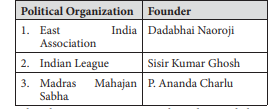
#25. With reference to the political organizations of British India, which of the following pairs are correctly matched?
Select the correct answer using the code given below:
Pair 1 is correctly matched. The East India Association was organised by Dadabhai Naoroji in 1866 in London to discuss the Indian question and influence public men in England to promote Indian welfare. Later, branches of the association were started in prominent Indian cities.
Pair 2 is correctly matched. The Indian League was started in 1875 by Sisir Kumar Ghosh with the object of “stimulating the sense of nationalism amongst the people” and of encouraging political education.
Pair 3 is correctly matched. The Madras Mahajan Sabha was founded in 1884 by M. Viraraghavachari, B. Subramaniya Aiyer and P. Anandacharlu. It is considered to be a predecessor of the Indian National Congress.
#26. Which of the following statements regarding Dadabhai Naoroji is/are correct?
1. He was associated with the newspaper called Voice of India.
2. He hoisted the first flag of independent India at the International Socialist Congress.
3. He was one of the founders of the London India Society.
Select the correct option using the code given below:
Statement 1 is correct: He published a monthly paper called Voice of India to secure justice (administrative and economic) for Indians under British rule. He sought to present the true state of matters in India to the influential and powerful people of Britain to gain redress.
Statement 2 is incorrect: Madame Bhikhaji Cama hoisted the first flag of independent India at the International Socialist Congress held in Stuttgart in 1907.
Statement 3 is correct: He founded the London India Society along with WC Banerjee to expose the true miserable conditions in India under British administration to the parliamentarians in London. He was a moderate and believed that the British were honorable and would take corrective measures once made aware of the true state of affairs in India.
#27. With reference to the revolt of 1857, which of the following was/were the causes of discontent of the sepoys against the British rule?
1. Non-payment of foreign service allowance.
2. Discrimination in payments and promotion.
3. Compulsion to ght overseas when required.
4. Abolition of sati.
5. Restriction on wearing caste and sectarian marks.
Select the correct answer using the code given below:
Leading to the revolt of 1857, there was rising discontent of the sepoys against the British rule due to the following reasons:
1. discrimination in payment and promotions
2. refusal of the government to pay foreign service allowance while ghting in remote regions.
3. Enlistment Act (1856) ordering all recruits to be ready for service both within and outside India.
4. Indian soldiers were not allowed to wear marks like Tilak, beard or turban.
5. abolition of practices like sati and the legislation legalizing widow remarriage, were believed as threats to the established Indian social structure.
#28. Consider the following statements regarding the revolt of 1857:
1.The revolt in Bihar was led by Kunwar Singh.
2. Tantia Tope was associated with the revolt in Gwalior.
Which of the statements given above is/are correct?
Statement 1 is correct. At Bihar, the revolt was led by Kunwar Singh.
Statement 2 is correct. Rani Laxmibai was joined by Tantia Tope, a close associate of Nana Saheb, after the loss of Kanpur. The Rani of Jhansi and Tantia Tope marched towards Gwalior where they were hailed by the Indian soldiers.
#29. Which of the following was/were the reasons behind the proclamation of Bahadur Shah Zafar as the Emperor of India by the rebels during the revolt of 1857?
1. Mughal dynasty had become the traditional symbol of India’s political unity.
2.The majority of leaders of the revolt were Muslims.
Select the correct answer using the code given below:
Statement 1 is correct. Delhi was the Centre of the Great Revolt and Bahadur Shah, its symbol. is spontaneous raising of the last Mughal king to the leadership of the country was a recognition of the fact that the long reign of Mughal dynasty had become the traditional symbol of India’s political unity.
Statement 2 is incorrect. During the entire revolt, there was complete cooperation between Hindus and Muslims at all levels—people, soldiers, leaders. Both Hindus and Muslims were well represented in leadership.
#30. With reference to the Revolt of 1857, which of the following are the reasons of failure?
1. Limited territorial spread.
2. Lack of support from Indian elite class.
3. Lack of a coherent ideology and a political perspective.
Which of the statements given above is/are correct?
Statement 1 is correct: The revolt failed to extend to all parts of the country. The eastern, southern, and western parts of India remained more or less unaffected.
Statement 2 is correct: Large sections of the population did not support it. And some sections in fact threw their support behind the British acting as “Break waters to storm.” Educated Indians viewed this revolt as backward looking. It received lukewarm response from Indian elite class.
Statement 3 is correct: The mutineers lacked a clear understanding of colonial rule; nor did they have a forward-looking programme, a coherent ideology, a political perspective or a societal alternative.
#31. With reference to White mutiny, which of the following is/are correct?
1. It took place during the governorship of Sir George Barlow.
2. It was organized by Queen’s Army on the issue of allowance.
Select the correct answer using the codes given below:
Statement 1 is incorrect. During governorship of Sir George Barlow, Vellore Mutiny took place. White Mutiny took place during the governorship of Lord Canning.
Statement 2 is incorrect. Prior to 1861, there were two separate military forces in India, operating under the British rule. One was the Queen’s army and the other comprised the units of the East India Company. The White mutiny was organized by Company’s troops.
#32. Which of the following measures were undertaken by British to reorganize their army after the Revolt of 1857?
1.The proportion of Europeans in the army was reduced.
2. Non-martial soldiers were recruited in large numbers compared to martial soldiers.
3. Indian troops were not employed in British possessions in Africa.
Which of the statements given above are incorrect?
Statement 1 is incorrect. After 1857, the domination of the army by its European branch was carefully guaranteed. The proportion of Europeans to Indians in the army was raised.
Statement 2 is incorrect. After the revolt, soldiers from Avadh, Bihar, Central India and South India, were declared non-martial. These group of soldiers were no longer taken in the army on a large scale. On the other hand, the Sikhs, Gurkhas, and Pathans who has assisted in the suppression of the revolt were declared to be martial and were recruited in large numbers.
Statement 3 is incorrect. Indian troops were not maintained for India’s defence alone, but were readily employed in British possessions in Asia and Africa.
#33. With reference to the British policy towards princely states, consider the following statements:
1.The policy of annexation was pursued after the Revolt of 1857.
2. Fowler Committee defined the paramountcy of British crown over princely states.
Which of the statements given above is/are correct?
Statement 1 is incorrect. British wanted to keep Princely States as a buffer against future political unrest. To reward them for their loyalty during the revolt of 1857, the policy of annexation was abandoned. The new policy was to depose or punish but not annex.
Statement 2 is incorrect. Butler Committee was set up to examine the nature of relationship between the princely states and government. It recommended that Crown’s paramountcy must de ne itself according to the shifting necessities of time and progressive development of states. us, it left the paramountcy of Crown undefined.
The Indian currency committee or Fowler committee was established in 1898 to examine the currency situation in India.
#34. Consider the following statements regarding relationship between British administration and Princely States:
1. British crown adopted the title of Kaiser-i-Hind in 1857.
2. Under British paramountcy, the British Government had the right to interfere in the internal affairs of states.
3.The British helped princely states in adopting modern administrative institutions.
Which of the statements given above is/are correct?
Statement 1 is incorrect. The Queen adopted the title of Kaiser-I-Hind (Queen Empress of India) in 1876, to emphasize British sovereignty over entire India
Statement 2 is correct. With paramountcy, the British Government exercised the right to interfere in the internal affairs of states through their residents or by appointing and dismissing ministers and officials.
Statement 3 is correct. The British helped these states to adopt modern administrative institutions. The motive for interference was also provided by the rise of nationalist, democratic sentiments in these states, the suppression of which, the British realized, was essential for their survival.
#35. Which of the following commissions was appointed after the Revolt of 1857 to look into the military affairs of India?
The Peel Commission (1859) was formed with the purpose of policy creation regarding the future composition of the Indian Army in post-Mutiny India. It comprised of high-ranking officers of the British and Indian armies and was headed by the Secretary of State of War, Major-General Peel,
It suggested several measures like –
• Increasing the ratio of Europeans in the Indian army
• Making regiments on caste lines initiating the policy of divide and rule
• Not promoting Indians to the higher ranks.
#36. In the context of Indian history, arrange the following associations in chronological order of their establishment:
1. Bengal British Indian Society
2. The East India Association
3. Indian National Association
4.The Landholders’ Society
Select the correct answer using the code given below:
Option 4. The Zamindari Association, more popularly known as the ‘Landholders’ Society’, was founded in 1837 to safeguard the interests of the landlords.
Option 1. e Bengal British India Society was founded in 1843 with the objective of “the collection and dissemination of information relating to the actual condition of the people of British India.
Option 2. The East India Association was organised by Dadabhai Naoroji in 1866 in London to discuss the Indian question and influence public men in England to promote Indian welfare.
Option 3. The Indian Association of Calcutta (also known as the Indian National Association) superseded the Indian League and was founded in 1876 by younger nationalists of Bengal led by Surendranath Banerjea and Ananda Mohan Bose.
#37. Consider the following statements:
1.The early nationalists gave the slogan ‘No taxation without representation’ in criticism of Indian Councils Act 1892.
2. A British committee of Indian National Congress was established in London in 1889.
Which of the statements given above is/are correct?
Statement 1 is correct. Indian Councils Act 1892 introduced reforms which were severely criticized at Congress sessions, where the nationalists demanded a majority of elected Indians and control over the budget, i.e., the power to vote upon and amend the budget. They gave the slogan— “No taxation without representation”. The slogan was raised for the Indian Councils Act 1892.
Statement 2 is correct. A British committee of the Indian National Congress was established in London in 1889 which had India as its organ. In 1890, it was decided to hold a session of the Indian National Congress in London in 1892 but owing to the British elections of 1891 the proposal was postponed and never revived later.
#38. In the context of the India’s struggle for independence, arrange the following events in chronological order:
1. Passing of the Indian Universities Act.
2. Setting up of Aitchison Committee on Public Services.
3. Formation of the East India Association in London.
4. Gopal Krishna Gokhale founded the Servants of India Society.
Select the correct answer using the code given below:
Option 3. Formation of the East India Association in London – 1866: Organised by Dadabhai Naoroji to discuss issues of Indian subjects and to influence public men in England to promote Indian welfare.
Option 2. Setting up of Aitchison Committee on Public Services – 1886: By Lord Dufferin.
Option 1. Passing of the Indian Universities Act: 1904 – Based on the recommendations of the Raleigh Commission, the Indian Universities Act was passed. In all, greater control was established over universities and this was condemned by the nationalists.
Option 4. Gopal Krishna Gokhale founded the Servants of India Society in 1905. The objective of the society was to prepare a cadre of selfless workers who could work for the country in true spirit.
#39. Consider the following statements regarding the Indian agriculture during British rule:
1.The Government of India Act of 1919 included agriculture in reserved list.
2. Scott-Moncrieff commission was appointed to draw up a comprehensive irrigation plan for India.
Which of statements given above is/are correct?
Statement 1 is incorrect. Agriculture was included as transferred subject in GOI act 1919.
Statement 2 is correct. Lord Curzon appointed a Commission chaired by Sir Colin Scott-Moncrieft in 1901 to draw up a comprehensive irrigation plan for India.
#40. With reference to the Welby Commission, consider the following statements:
1. It was set up by the British government to examine the working of Indian Universities act 1904.
2. Dadabhai Naoroji was the member of the Welby Commission.
3.The commission recommended the dominion status to India for the rst time ever.
Which of the statements given above is/are correct?
Statement 1 is incorrect. The Welby Commission was set up by the British Government to investigate wasteful spending in India. Established in 1895, its official name was the Royal Commission on the Administration of Expenditure of India. It had nothing to do with Indian Universities act 1904.
Statement 2 is correct. The Commission included Dadabhai Naoroji as the sole Indian member. Dadabhai Naoroji was the first Indian to sit on a Royal Commission (the Welby Commission) .
Statement 3 is incorrect. No recommendation of Dominion status was made by the commission.
#41. The Younghusband mission set up by Lord Curzon is related to which of the following?
Tibet was ruled by a theocracy of Buddhist monks (lamas) under nominal suzerainty of China. The Chinese suzerainty over Tibet was ineffective and Russian influence at Lhasa was increasing. There were reports of Russian arms and ammunition coming into Tibet. Curzon felt alarmed and sent a small Gorkha contingent under Colonel Younghusband on a special mission to Tibet to oblige the Tibetans to come to an agreement. The Tibetans refused to negotiate and offered non-violent resistance.
#42. Which of the following statements regarding the moderate leader Gopal Krishna Gokhale is/ are correct?
1. He was given the title of ‘the leader of the opposition’.
2. He was influenced by the British philosopher Edmund Burke.
3. He was a professor at the Fergusson College in Pune.
Statement 1 is correct: Gokhale was loved and recognised by the people. Proud of his legislative achievement they were to confer him the title of ‘the leader of the opposition’.
Statement 2 is correct: He was a protégé of Ranade and influenced by the British philosopher-parliamentarian Edmund Burke.
Statement 3 is correct: He joined as a professor at the Fergusson College in Pune, where he taught political economy and history. Gokhale studied at the Elphinstone College in Mumbai.
#43. Which of the following option is correct with reference to the ‘Indian National Association’?
Option a is correct: Number of young Indian intellectuals supported the peasants’ cause in Pabna agrarian league unrest. These included Bankim Chandra Chatterjee, R.C. Dutt and the Indian Association under Surendranath Banerjee.
Option b is incorrect: The Indian Association of Calcutta (also known as the Indian National Association) not a pro zamindar organization.
Option c is incorrect: The association was a forerunner of the Indian National Congress as an all-India nationalist organisation. It later merged with the Indian National Congress in 1886.
Option d is incorrect: It was the rst all India political association in the pre-Congress period. Branches of the association were opened in other towns and cities of Bengal and even outside Bengal. But it didn’t have any branches outside India.
#44. With reference to the early nationalists, which of the following statements is/are incorrect?
1.They trained people in political work and helped to spread modern ideas.
2.They lacked political faith in the masses.
3. They received a strong support from United Indian Patriotic Association.
4. Lord Dufferin supported A.O. Hume in the foundation of Congress.
Select the correct answer using the code given below:
Statement 1 is correct. The early nationalists made efforts to train people in political work and to spread modern ideas. us, they were able to create a wide awareness among the masses regarding political questions. They represented the most progressive forces of the time.
Statement 2 is correct. The early nationalists lacked political faith in the Masses.
Statement 3 is incorrect. The early nationalists did not receive the support from United Indian Patriotic Association. In fact, it was created by Sir Syed Ahmed Khan and Raja Shiv Prasad Singh of Benaras to counter Congress’ activities.
Statement 4 is incorrect. Lord Dufferin never supported A.O. Hume in the foundation of Congress. Lord Dufferin even called the Congress ‘a factory of sedition’.
#45. Consider the following events:
1. British India Association
2. Bangabhasha Prakshika Sabha
3. The Indian League
4. Poona Sarvajanik Sabha
Which of the following is the correct chronological sequence of the above events?
Option 1. British India Association was created in 1851 with the merger of Landholder’s Society and British India Society. It also sent a petition to British parliament demanding inclusion of some suggestions in the Charter Act of the Company.
Option 2. Bangabhasha Prakashika Sabha was formed in 1836 by associates of Raja Rammohan Roy.
Option 3. The Indian League was created in 1875 by Sisir Kumar Ghosh with the object of “stimulating the sense of nationalism amongst the people’ and encouraging political education.
Option 4. Poona Sarvajanik Sabha was founded in 1867 by M.G. Ranade and others, with the object of serving as a bridge between the government and the people.
#46. In the context of Indian history, moderates demanded Indianization of government services, on which of the following grounds?
1. To save the expenditure of the government.
2. To reduce economic drain.
3. To promote equality.
Select the correct answer using the code given below:
Statement 1 is correct. As British civil servants expected very high salaries, Indianization of the government services could have reduced the burden on government expenditure. is in turn would have saved taxpayers money.
Statement 2 is correct. Most of the British servants remitted their salaries back home and their pensions were also paid in England. is had resulted in economic drain of India. Hence, Indianization of the services could have stopped this drain.
Statement 3 is correct. On moral grounds, Indians were discriminated against by keeping them away from important offices. Hence, Indianization of the civil services could have led to more equality.
#47. With reference to the objectives of Indian National Congress in early years (1885-1905) , which of the following statements is correct?
Option c is correct. Unifying the people over a common economic and political programme was a major goal of the Congress during its initial years. In this they tried to politicise and politically educate the people.
#48. Consider the following events in the history of India:
1. Royal Titles Act passed.
2. Setting up of the High Courts at Calcutta, Bombay and Madras.
3. Appointment of Hunter Commission for education.
4. Appointment of Richard Strachey Commission on famine.
What is the correct chronological order of the above events, starting from the earliest time?
The correct chronological order of the events is as follow
1. 1865 – The High Courts at Calcutta, Bombay and Madras were set up by merging of Supreme Court and Sadar Adalats.
2. 1876 – Royal Titles Act was passed.
3. 1878 – Appointment of a Famine Commission under the presidentship of Richard Strachey.
4. 1882 – The Hunter Commission was appointed to review the progress of education in the country since the Wood’s Dispatch, 1854.
#49. Consider the following statements regarding Dadabhai Naoroji:
1. He was elected as a Member of Parliament in the United Kingdom.
2. He organized the East India Association in London.
3. He presided over the rst session of the Indian National Congress.
Which of the statements given above are correct?
Statement 1 is correct. In the 1892 Parliamentary Elections in Britain, Dadabhai Naoroji was elected from the Finsbury Central seat as a candidate of the Liberal Party. Naoroji was the first Asian to be a British Member of Parliament (MP) .
Statement 2 is correct. The East India Association was organized by Dadabhai Naoroji in 1866 in London to discuss the Indian question and influence public men in England to promote Indian welfare.
Statement 3 is incorrect. Dadabhai Naoroji presided over the Indian National Congress thrice – in 1886, 1893 and 1906. W. C. Bonnerjee presided over the first session of the Indian National Congress in 1885.
#50. Consider the following statements with respect to Surendranath Banerjee:
1. He was the first Indian journalist to be imprisoned.
2. He founded the Voice of India newspaper to protest against British policies.
3. He established the Indian National Association.
Which of the statements given above is/are correct?
Statement 1 is correct. In 1883, Surendranath Banerjea became the first Indian journalist to be imprisoned.
Statement 2 is incorrect. Surendranath Banerjee founded the newspaper “ The Bengalee” in 1879 to launch powerful press campaign against the British policies. Voice of India was launched by Dadabhai Naoroji.
Statement 3 is correct. The Indian Association of Calcutta (also known as the Indian National Association) was founded in 1876 by Surendranath Banerjee and Ananda Mohan Bose.
#51. Consider the following statements regarding the East India Association (1866) :
1. It superseded the London Indian Society.
2. Its first President was Dadabhai Naoroji.
3. Its branches were started in many Indian cities.
Which of the following statements given above is/are correct?
Statement 1 is correct. The East India Association was founded by Dadabhai Naoroji in 1866, in collaboration with Indians and retired British officials in London. It superseded the London Indian Society.
Statement 2 is incorrect. The Association’s first President was Lord Lyveden.
Statement 3 is correct. The East India Association was organised in London. Later, branches of the association were started in prominent Indian cities.
#52. Which of the following statements regarding Madras Mahajan Sabha is/are correct?
1. It was the first organisation in the Madras Presidency to agitate for the rights of Indians.
2. It adopted a moderate policy in its early days.
3. It was established by G. Subramania Iyer and P. Anandacharlu.
Select the correct answer using the code given below:
Statement 1 is incorrect. The first organisation in the Madras Presidency to agitate for the rights of Indians was the Madras Native Association which was established by publicist Gazulu Lakshminarasu Chetty in 1849.
Statement 2 is correct. The Sabha adopted a moderate policy in its early days. However, still, its aims and objectives were considered seditious.
Statement 3 is correct. In May 1884, M. Veeraraghavachariar, G. Subramania Iyer and P. Anandacharlu established the Madras Mahajan Sabha
#53. Who among the following suggested that the Congress ‘was a product of Lord Dufferin’s brain,’ and it was started with the object of saving the British Empire from danger than with that of winning political liberty for India?
In his Young India published in 1916, the Extremist leader Lala Lajpat Rai used the safety-valve theory to attack the Moderates in the Congress. Having discussed the theory at length and suggested that the Congress ‘was a product of Lord Dufferin’s brain,’ he argued that ‘the Congress was started more with the object of saving the British Empire from danger than with that of winning political liberty for India. The interests of the British Empire were primary and those of India only secondary’.
#54. Which of the following statements regarding the approach of Moderates during Freedom Struggle is/are not correct?
1. Extra-constitutional means of agitation became their core policy towards British.
2. Public meetings and processions emerged as major methods of mass mobilization.
3. Emphasis to Self-Reliance was given a priority by them.
4.They Believed in England’s providential mission in India.
Select the correct answer using the code given below:
Statement 1 is incorrect. Constitutional agitation within four walls of law was the core policy of Moderates. It was an Extremist who adopted an Extra-Constitutional means of agitation.
Statement 2 is incorrect. Moderates believed in Creating public opinion in India and campaign for support to Indian demands in England. It was the Extremists who emphasized on Public meetings and processions as major methods of mass mobilisation.
Statement 3 is incorrect. The moderate phase of the national movement had a narrow social base and the masses played a passive role. is was because the early nationalists lacked political faith in the masses. It was the Extremists who emphasized on Self-Reliance of masses.
Statement 4 is correct. Moderates believed in England’s providential mission in India and also believed political connections with Britain to be in India’s social, political and cultural interests.
#55. Which of the following statements is/are correct with reference to moderates?
1.The British Colonial Government was not hostile to the Congress during the moderate phase.
2. Moderates failed to garner a broad social base.
3. Moderates could not create a wide national awakening of Indians.
Select the correct answer using the code given below:
Statement 1 is incorrect. The British Indian Government was hostile to the Congress from the beginning despite the latter’s moderate methods and emphasis on loyalty to the British Crown.
Statement 2 is correct. The moderate phase of the national movement had a narrow social base and the masses played a passive role. is was because the early nationalists lacked political faith in the masses.
Statement 3 is incorrect. The early nationalists (moderates) did a great deal to awaken the national sentiment. They were able to create a wide national awakening of all Indians having common interests and the need to rally around a common programme against a common enemy, and above all, the feeling of belonging to one nation.
#56. Consider the following statements:
1. Romesh Chandra Dutt was a prominent economic critique of the British rule in India.
2. Pherozeshah Mehta was among the first to promote militant nationalism.
3. Kadambini Ganguly was the first woman graduate of the Calcutta University.
Which of the statements given above is/are correct?
Statement 1 is correct. The early nationalists, led by Dadabhai Naoroji, R.C. Dutt, Dinshaw Wacha were the economic critiques of colonial rule in India. ey carefully analysed the political economy of British rule in India, and put forward the “drain theory” to explain British exploitation of India.
Statement 2 is incorrect. Pherozeshah Mehta was not a proponent of militant nationalism. He was a moderate leader.
Statement 3 is correct. Kadambini Ganguly was the first woman graduate of Calcutta University. She addressed the Congress session in 1890.
#57. The contributions made by Surendranath Banerjee to the cause of Indian National Movement include which among the following?
1. He was among the main architects of the Indian National Conference.
2. He founded the Indian National Association in 1876.
Select the correct answer using the code given below:
Statement 1 is correct. Surendranath Banerjea and Ananda Mohan Bose were the main architects of the Indian National Conference. As a prelude to INC, two sessions of the Indian National Conference had been held in 1883 and 1885, which had representatives drawn from all major towns of India.
Statement 2 is correct. The younger nationalists of Bengal, led by Surendranath Banerjea and Anand Mohan Bose, founded the Indian National Association in 1876.
#58. The theory of ‘Economic Drain’ was put forward by Dadabhai Naoroji in his book ‘Poverty and UnBritish Rule in India’. The major components of this drain include which among the following?
1. Interests on loans taken by the Indian Government from abroad.
2. Profits on foreign investments made by British capitalists in India.
3. Salaries and pensions of civil and military officials.
Select the correct answer using the code given below:
The major components of the economic drain were
• salaries and pensions of civil and military officials,
• Interests on loans taken by the Indian Government from abroad,
• profits on foreign investment in India,
• stores purchased in Britain for civil and military departments,
• payments to be made for shipping, banking and insurance services which stunted the growth of Indian enterprise in these services.
#59. Consider the following statements regarding United India Patriotic Association:
1. It was launched by Sir Syed Ahmed Khan as a reactionary step to counter congress propaganda.
2. Its main objective was to advocate Muslim interests.
3. Only Muslims were allowed to be its member.
Which of the above statements is/are correct?
Statement 1 is correct: UIPA was launched by Sir Syed Ahmed Khan and Raja Shiv Prasad Singh of Banaras in 1888. Its formation was supported by British officials as its main aim was to counter congress propaganda.
Statement 2 is correct: After formation of congress, it was feared by Aligarh School that Muslims might get affected by congress propaganda and to put them back in favor with British UIPA was formed. It tried to become the flagbearer of Muslim interests.
Statement 3 is incorrect: Its membership was open to even reactionary Hindus who were against congress.
#60. With reference to the events that happened during the term of Lord Canning, which of the following is/are correct?
1. Hindu Widow Remarriage Act was passed during his term.
2. Indian Penal Code was prepared.
3. Universities at Calcutta, Madras and Bombay were established.
Select the correct answer from the codes giving below:
All the given events happened during the term of Lord Canning (1856-62)
• Establishment of three universities at Calcutta, Madras and Bombay in 1857.
• Hindu Widow Remarriage Act 1856 was passed.
• Revolt of 1857.
• Transfer of control from East India Company to the Crown,
• the Government of India Act, 1858.
• ‘White Mutiny’ by European troops in 1859.
• Indian Councils Act of 1861.
• Indian Penal code was prepared
#61. With reference to Indian Civil Services Agitations which of the following statement is/are incorrect?
1. It was organized against the reduction in maximum age for appearing in the Indian Civil Services.
2. British Indian Association launched this movement in 1877.
Select the correct answer using the codes given below:
Statement 1 is correct: Indian Civil Service agitation was an attempt to create a fair play field for Indians in civil services. During Lord Lytton’s term maximum age to appear was reduced to 19. In reaction to this Indian Civil Service Agitation was launched.
Statement 2 is incorrect: It was organized by Indian Association of Calcutta which was created by Surendranath Banerjee and Anand Mohan Bose. They were discontent by pro-landlord policies of British Indian Association and took up the question of decreasing maximum age for appearing in the exam.
#62. Which of the following events are associated with Lord Ripon:
1. Repeal of the Vernacular Press Act.
2. Government resolution on local selfgovernment.
3.The Ilbert Bill.
Which of the statements given above is/ are correct?
Contributions of Lord Ripon (1880-1884)
1. Repeal of the Vernacular Press Act (1882).
2. The rst Factory Act (1881) to improve labour conditions.
3. Continuation of nancial decentralization.
4. Government resolution on local self-government (1882) .
5. Appointment of Education Commission under chairmanship of Sir William Hunter (1882) .
6. The Ilbert Bill controversy (1883-84) . 7. Rendition of Mysore.
#63. Which of the following statement is/are correct with reference to sessions of Indian National Congress?
1. In 1936, for the first time there were two sessions held in a year.
2. At Calcutta session 1928, All India Youth Congress came into existence.
3. No foreigner was elected as the President of INC for more than one term.
Select the correct option from the codes given below:
Statement 1 is correct: In 1936, for the rst time in history two congress sessions were held in a year. In April and December 1936, both were held under the presidency of J.L. Nehru. December session was held at Faizpur (first session to be held in a village)
Statement 2 is correct: Under the presidency of Motilal Nehru at Calcutta in 1928 for the first time All India Youth Congress Came into existence.
Statement 3 is incorrect: ere were total 5 foreigners who were elected as a president, George Yule was the first. Only foreigner to get elected more than once was William Wedderburn during the session of 1889 and 1910.
#64. With reference to Tibet Frontier Commission which of the following statements is/are correct?
1. It was established during the term of Lord Curzon.
2. As part of it, Chumbi valley was occupied by British forces.
3. Sikkim was adopted as a frontier between India and Tibet.
Select the correct answer using the code given below:
Statement 1 is correct: To tackle the increasing Russian influence over Tibet, Curzon sent a special mission under Young Husband which was formally called as Tibet Frontier Commission.
Statement 2 is correct: With British forces occupying Lhasa and fiight of Dalai Lama from there, Younghusband dictated terms to the Tibetan officials which provided that Tibet would pay an indemnity of Rs 75 lakh. As a security of payment, Chumbi valley was occupied by British.
Statement 3 is correct: As part of Treaty of Lhasa, Sikkim was identified as the frontier between India and Tibet.
#65. With respect to “Dual Control” of military member in the Viceroy’s Executive Council, which of the following statement is/are correct?
1. Military member was under the direct control of Commander-in-chief.
2. It led to Curzon-Kitchener controversy which resulted in resignation of Lord Curzon.
Select the correct answer from the codes given below:
Statement 1 is incorrect: The Military member in the executive council was under the control of Viceroy. He acted as eyes and ears of viceroy in matters of military affairs. It was called as dual control because Military member in the council was from the military but was also under executive control of Viceroy.
Statement 2 is correct: Kitchener was a respected general in Britain and when he was appointed as Commander-inChief, he demanded that the post of Military member to be abolished. is led to a conflict and ultimately Lord Curzon had to resign.
#66. With respect to Police Commission of 1902 which of the following statement is/are correct?
1. It was setup under the chairmanship of Sir Andrew Frazer.
2. It recommended the setting up of Criminal Investigation Department (CID) in each province.
Select the correct answer from the codes given below:
Statement 1 is correct: Lord Curzon is credited with development of basic structure of domestic intelligence. As part of it he established Police Commission under Sir Andrew Frazer.
Statement 2 is correct: This commission recommended that CID is to be established at every province and a Central Bureau of Investigation at the centre.
#67. with reference to the white superiority maintained by British during colonial rule, which of the following statements is/are correct?
1.The Charter act of 1833 introduced the Indianization of covenanted civil services.
2. No Indians were allowed in the commissioned ranks in military service till 1918.
3.The Ilbert bill controversy exposed the white superiority during British rule.
4. It was under the Cornwallis that the European subjects in both civil and criminal cases could be tried by Indian Judges.
Select the correct answer using the code given below:
Statement 1 is incorrect. e Charter act of 1833 attempted to introduce Indianization in civil services, but it was opposed from the court of directors.
The Charter act of 1853 introduced open competition system of selection of civil servants and thus convenanted civil service were thrown open to Indians as well.
Statement 2 is correct. No Indians were allowed in the officer rank and the highest rank an Indian cold reach till 1914 was that of a Subedar. Only from 1918 onwards Indians were allowed in the commissioned ranks.
Statement 3 is correct. In Ilbert bill, the racial attitude of the British in India was highlighted by their opposition to equality in the trial of European and Indian prisoners.
Statement 4 is incorrect. Cornawallis brought the European subjects under the Indian Jurisdiction. Government servants were made answerable to the civil courts. However, in criminal cases, they could be tried by European judges only
#68. Whom amongst the following Indian nationalists provided economic critique of colonialism in India?
1. Gopal Krishna Gokhale
2. G. Subramaniya Iyer
3. Prithwishchandra Ray
Select the correct answer using the code given below:
The economic impact of colonialism in India was analysed by Gopal Krishna Gokhale, G. Subramaniya Iyer, and Prithwishchandra Ray.
Gopal Krishna Gokhale provided an analysis of the nancial condition of India to the Welby Commission. His speeches on budget in Central Legislative Council examined the Indian economy and the effect of the British policies through statistical analysis.
Other prominent analysts were Dadabhai Naoroji (Poverty and UnBritish Rule in India) , Romesh Chandra Dutt ( The Economic History of India) and Justice Mahadeo Govind Ranade.
#69. Which of the following are the reasons which contributed towards the deindustrialization of India in the 19th century?
1. Introduction of the Charter Act of 1813.
2. Introduction of railways in India.
3. British policies of conquest in India.
Select the correct answer using the code given below:
Statement 1 is correct. The Charter Act of 1813 ended the trading monopoly of the East India Company in India except for trade in tea and trade with China. The abolition of exclusive rights to trade enabled a flood of cheap and machine-made imports from England. Now, Indian products found it difficult to compete within India and abroad.
Statement 2 is correct. The rail network facilitated swift movement of cheap European products within the country while Indian products failed to expand their reach to remote regions in the country.
Statement 3 is correct. The British policies of conquest like doctrine of lapse, subsidiary alliance etc. contributed to deindustrialization and loss of livelihoods. As patronage of Indian kings vanished, it led to decline of many cities. In that scenario, many artisans and craftsmen found it difficult to sustain their livelihood and turned towards agriculture.
#70. With reference to the development of modern industry in India during the British rule, consider the following statements:
1.The first cotton textile mill was set up in Bombay.
2.The development of heavy industries was preferred by the British over consumer industries.
3. Most of the modern industries were foreignowned.
Which of the statements given above are correct?
Statement 1 is correct. ‘Bombay Spinning and Weaving company’ was the first cotton textile mill was set up in 1854 in Bombay by Cowasjee Nanabhoy Davar.
Statement 2 is incorrect. The industrial development during the British rule was characterized by a lopsided pattern. There was a total neglect of core and heavy industries. Indian industries came up in cotton textiles and jute in the nineteenth century and in sugar, cement etc. in twentieth century.
Statement 3 is correct. The modern industries that came up in second half of the nineteenth century were mostly foreign-owned and controlled by British managing agencies.
#71. With reference to the state of Indian agriculture during British rule, consider the following statements:
1. During the latter half of nineteenth century, commercial crops became more remunerative than food grains.
2.The plantation sector was mostly owned by Europeans.
3. Commercialization of agriculture was an outcome of Indian peasant’s demand to improve the conditions of agriculture.
Which of the statements given above are correct?
Statement 1 is correct. In the 19th century, agriculture began to be influenced by commercial considerations. Commercial crops like cotton, jute, groundnut, oilseeds etc. were more remunerative than food grains.
Statement 2 is correct. The commercialization trend was witnessed in the plantation agriculture in most conspicuous manner. The plantations of tea, coffee, rubber, indigo etc. were mostly owned by Europeans who bene tted from the sale of plantation crops in international market.
Statement 3 is incorrect. Commercialisation of agriculture was forced upon the Indian peasants. They hardly had any surplus to invest in commercial crops given the subsistence level at which they lived.
#72. Consider the following events:
1. Vernacular Press Act
2. Age of Consent Act
3. First Indian to qualify for Indian Civil Services
4. Ilbert Bill Controversy
Which of the following is the correct chronological sequence of the above events?
Statement 1. Vernacular Press Act was passed in 1878 during the term of Viceroy Lord Lytton. The act was brought to curb the seditious activities of vernacular press.
Statement 2. As a result of Rukhmabai case, the Age of Consent Act was passed in 1891 which forbade the marriage of girl below age of 12.
Statement 3. In 1863, Satyendra Nath Tagore became the first Indian to qualify for the Indian Civil Services.
Statement 4. Ilbert Bill controversy happened in 1884 under Viceroy Ripon. The bill sought to abolish differences between Indian and European civil servants.
#73. Which of the following introduced the “Lahore Gate Improvement scheme “in 1888?
An extension scheme called ‘Lahore Gate Improvement’ was started in 1888 by ‘Robert Clarke’ for the walled cities residence. The idea was to draw the residence away from the old city to a new type of marked square with a mosque in the centre and shops around the edges. e main idea behind this was to persuade a flow of population from the crowded parts of the town of delhi to certain other areas and relief congestion within the walled city.
#74. Which of the following could be considered as the reasons for the rise of Indian nationalism?
1. Indian Renaissance
2. Reaction to British imperialist policies
3. Modernization initiated in India by the British
4. Effect of French Revolution
Select the correct answer using the code given below:
Statement 1 is correct. Indian renaissance is a result of nineteenth century intelligentsia class which searched for its model in European ‘middle class’, which was learnt through western education. It brought a new leadership which worked toward upliftment of society and in this process started the process of nationalism.
Statement 2 is correct. Indian nationalism grew partly as a result of colonial policies and partly as a reaction to colonial policies. ere was a strong reaction toward the British imperialist policies in India.
Statement 3 is correct. With getting connected to European society through trade links and modern practices initiated by British like telegraph, printing, local self-government. Indian intelligentsia realizes the picture of a stagnant civilization and a static and decadent society. The modernization introduced by British helped in the growth of nationalism.
Statement 4 is correct. Indian nationalism was also affected by the world-wide upsurge of nationalism and right of self-determination initiated by the French Revolution.
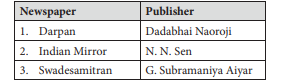
#75. Consider the following pairs:
Which of the pairs given above are correctly matched?
Pair 1 is incorrectly matched. Darpan was started by Balshastri Jambhekar (and not Dadabhai Naoroji) in 1832. Jambhekar used the Darpan to awaken the people to awareness of social reforms, such as widow remarriage, and to instil in the masses a scienti c approach to life. In 1840, he started Digdarshan which published articles on scienti c subjects as well as history.
Pairs 2 and 3 are correctly matched. Many newspapers emerged during 1870 to 1918 under distinguished and fearless journalists. ese included The Hindu and Swadesamitran under G. Subramaniya Aiyar, The Bengalee under Surendranath Banerjea, Voice of India under Dadabhai Naoroji, Amrita Bazar Patrika under Sisir Kumar Ghosh and Motilal Ghosh, Indian Mirror under N. N. Sen, Kesari (in Marathi) and Maharatta (in English) under Balgangadhar Tilak, Sudharak under Gopal Ganesh Agarkar, and Hindustan and Advocate under G.P. Verma. These newspapers were established to form and propagate nationalist ideology and train, mobilise and consolidate public opinion. Newspapers depicted almost all aspects of life in colonial India from around the 1870s onwards. From the 1920s onwards, they tracked the major events during the freedom struggle.
#76. Which of the following factors are responsible for the outbreak of the revolt of 1857?
1. Unpopular revenue settlement policy of British
2. Policy of doctrine of lapse
3. Passing of the General Service Enlistment Act
4. Refusal of the government to pay foreign service allowance for ghting in remote regions.
5. Legislative measure declaring that a change of religion would not debar a son from inheriting his father’s property.
6. Passing of the Calcutta Corporation Act
Select the correct answer using the code given below:
Statement 1 is correct. The revenue settlement policy of British burdened the peasants by heavy taxation. Peasants resorted to loans from moneylenders at exorbitant rates. ey also faced evictions due to non-payment of debt dues on time. Thus, colonial policy of revenue collection was a signi cant factor of discontent among the people.
Statement 2 is correct. The use of policy of annexation like subsidiary alliance and doctrine of lapse created suspicion in the minds of the princes of the states. Under the doctrine of lapse, the right of succession was denied to Hindu princes. These policies resulted in loss of prestige for British.
Statement 3 is correct. Lord Canning’s General Service Enlistment Act (1856) ordered all army recruits to be ready for service both within and outside India. To this, high caste Hindu sepoys raised objections. For them, crossing the sea would mean loss of their caste status and religion. Hence, religious objections were also a contributing factor. The reports about mixing of bone dust and the introduction of the new En eld rifle enhanced the growing disaffection and acted as the spark to the revolt.
Statement 4 is correct. The refusal of the government to pay foreign service allowance (Bhatta)for ghting in remote regions was the immediate cause of the sepoy’s dissatisfaction. The Indian sepoy was made to feel subordinate at every step compared to his British counterpart.
Statement 5 is correct. The legislative measure in Religious Disabilities Act, 1856 sought to modify the Hindu customs. It declared that a change of religion did not debar a son from inheriting the property of his heathen father. is was seen as an attempt to promote religious conversions.
Statement 6 is incorrect. The Calcutta Corporation Act was passed during the tenure of Lord Curzon in 1899. It reduced the number of Indian members in the Calcutta Corporation.
#77. With reference to the revolt of 1857, consider the following statements:
1.There was cooperation between Hindus and Muslims.
2. Maulvi Ahmadullah led the revolt from Faizabad.
3.The introduction of telegraph was decisive in tracking the strategy of the leaders of the revolt.
4. Colin Campbell was the commander-in-Chief during the time of revolt.
Which of the statements given above are correct?
Statement 1 is correct. During the entire revolt, cooperation between Hindus and Muslims was observed. All rebel leaders acknowledged Bahadur Shah Zafar as the Indian Emperor. Moreover, even in leadership, both Hindus and Muslims were well-represented.
Statement 2 is correct. Maulvi Ahmadullah was a native of Madras who had moved to Faizabad, where he fought with the British troops. He emerged as one of the acknowledged leaders of the revolt.
Statement 3 is correct. The Indian rebels were poorly equipped and the revolt was unorganized. However, the British were well-equipped to suppress the revolt. One of the important services that helped tackle the revolt was that of telegraph. Telegraph was introduced in India in the early 1850s. In May 1857, one of the first intimations of the outbreak of the rebellion at Meerut came from two telegrams sent to Agra on the day the uprising erupted. The electric telegraph kept the Commander-in-chief informed about the movements and strategy of the rebels.
Statement 4 is correct. Colin Campbell was the Commander-in-chief during the 1857 mutiny. He was made the Commander-in-chief in July 1857 to replace General George Anson, who had just died then.
#78. With reference to the Indian National Congress in Indian history, consider the following statements:
1. Its first session was presided by A.O. Hume in 1885.
2. It was formed to put forward the demand of dominion status for India.
3. From the initial years of the formation, it largely included social reforms in its agenda.
Which of the statements given above is/are incorrect?
Statement 1 is incorrect. Indian National Congress (INC) was given its nal shape by a retired English civil servant, A.O. Hume who mobilized leading intellectuals of the time and with their cooperation the rst session of INC was organized. The first session of the INC was organized at Bombay in 1885. It was attended by a total of 72 delegates and presided over by Womesh Chandra Bannerjee.
Statement 2 is incorrect. The objective of the INC was to create a platform for democratic, nationalist movement. In the early years, the INC strived for political education of the masses. The members of the INC believed that the British wanted to be just to the Indians but were not aware of the real conditions. Hence, they adhered to constitutional agitation within the con nes of the law to seek political reforms. The INC limited itself to demanding expansion of councils and reform of councils. There was no mention of dominion status until the Nehru Report (1928) demanded it.
Statement 3 is incorrect. The INC did not want to include social reforms in its agenda. To undertake social reforms, M.G. Ranade and Raghunath Rao formed Indian Social Conference in 1887. The organisation was virtually the social reform cell of the INC. Its meetings were organised at the same venue as Conggress every year, and focused attention on social reforms.
#79. With reference to modern Indian history, ‘ e Azamgarh Proclamation’ is related to which of the following events?
The Azamgarh Proclamation, 25 August 1857 was one of the sources of what rebels wanted during 1857 revolt. It contained ve sections, one each for Zamindars, Merchants, Civil servants, Artisans, Pundits and Other learned persons.
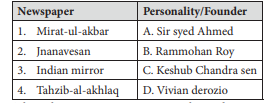
#80. Match the following sets of pair(s):
Select the correct answer using the code given below:
#81. With reference to ‘Phadke’s Ramosi Uprising’, consider the following statements:
1. It was led by Bishnu Biswas Phadke.
2. It was against the high taxes on farmers.
Which of the statements given above is/are correct?
Statement 1 is incorrect. Ramosi Uprising (1877-1887) was led by Balwant Phadke (not Bishnu Biswas Phadke).
Statement 2 is incorrect. Ramosi uprising was against the British failure to take up anti-famine measures (not high taxes on farmers).
#82. With reference to the Indian National Congress (INC), which of the following statements is/are correct?
1. Surendranath Banerjee couldn’t attend the 1st session of INC due to conflict of ideologies with other prominent leaders of INC.
2. Indian Association of Calcutta was renamed as Indian National Congress.
3. Lord Lytton was the Viceroy of India when INC was formed.
4. A.O. Hume was the first general secretary of INC.
Select the correct answer using the code given below:
The first session of the Indian National Congress was attended by 72 delegates and presided over by Womesh Chandra Bonnerjee.
Statement 1 is incorrect. Surendranath Banerjee couldn’t attend the 1st session of INC because the Second National Conference of the Indian Association was held during December 25-27, 1885 in Kolkata. The dates clashed with the first session of the Indian National Congress held in Bombay (Mumbai). The two events were planned without any coordination between the organizers. is prevented Banerjee from attending the Bombay Congress.
Statement 2 is incorrect. Indian Association of Calcutta also known as Indian National Association was founded in 1876 by Surendranath Bannerjee and Anand Mohan Bose. On 28 December 1885, 72 social reformers, journalists and lawyers congregated for the first session of the Indian National Union at Gokuldas Tejpal Sanskrit College, Bombay. us, Indian National Union was renamed as the Indian National Congress.
Statement 3 is incorrect. Lord Dufferin was the viceroy when INC was formed.
Statement 4 is correct. AO Hume was one of the leading spirits in the founding of the INC. He served as general secretary of the Congress for its first 22 years.
#83. Arrange the following events in the correct chronological order.
1. Passing of Arms Act.
2. Ilbert bill controversy.
3. Formation of Indian National Association.
4.The first Delhi Durbar.
Select the correct answer using the code given below:
Option 3. Indian national association was formed in 1876 by Surendra Nath Bannerji and Anand Mohan Bose as they were getting discontented with the pro-landlord policies of the British Indian Association. It was formed to unify Indian people in a common political programme.
Option 4. The first Delhi Durbar was held in the year of 1877. Here decision was taken about the creation of privy council.
Option 1. The Arms Act was passed in 1878, disallowing Indians from possessing arms. In the same year the Vernacular Press Act was also enacted in an effort to silence those who were critical of the government.
Option 2. In 1883, there was an outcry over the attempt by the government to introduce the Ilbert Bill. The bill provided for the trial of British or European persons by Indians, and sought equality between British and Indian judges in the country
#84. Which of the following economic issues was not raised by Indian National Congress (INC) in its initial stage?
The early congress raised a number of economic issues. ey declared that British government had led to poverty and famines and also the increased land revenue had impoverished peasants and zamindars. The early congress therefore demanded:
• reduction in land revenue, • cut in military expenditure • more fund for irrigation. • reduction in cotton import duties
It passed many resolutions on salt tax, treatment of Indian laboureres abroad and suffering of forest dwellers caused by interfering forest administration. Zamindari system was abolished much after the independence. They only demanded the reduction in land revenue, not the abolition of zamindari system in its initial stage.
#85. With reference to contributions of Jagannath Shankar Seth, consider the following statements:
1. He revived the Bombay Association established by Naoroji Furdonji.
2. He was one of the founders of the Elphinstone College in Bombay.
3. He was the first Indian to be nominated to the Legislative Council of Bombay.
4. He played an important role in establishment of the Indian Railway Association.
Which of the statements given above is/are correct?
Jagannath Shankar Seth (fondly called as Nana) was an educationist, philanthropist, social reformer, quasipolitical representative of Indians in British India.
Statement 1 is incorrect. Bombay Association was established by Jagannath Shankar Seth in 1852 to represent traders and businessmen. It was later revived in 1867 by Naoroji Furdoonji.
Statement 2 is correct. Jagannath Shankar Seth cofounded the Elphinstone College and Native School of Bombay that became the Board of Education, an English school, a girls’ school and Sanskrit library. He was an active promoter of girls’ schools in Maharashtra and donated to setting up museums and gardens.
Statement 3 is correct. Jagannath Shankar Seth was the first Indian to be nominated to the Legislative Council of Bombay and a member of the Asiatic Society of Bombay, when Indians were not welcome there.
Statement 4 is correct. With Jeejeebhoy, Jagannath Shankar Seth helped set up the Indian Railway Association, which was later incorporated into the Great Indian Peninsula Railway, now the Central Railway.
#86. With reference to the Mohammedan Anglo Oriental Defence Association, consider the following statements:
1. It was founded by Sir Syed Ahmed Khan in 1893.
2. Its main objective was to create a nationalistic consciousness among Muslims in India.
3. Only Muslims could become its member.
Which of the statements given above is/ are correct?
Statement 1 is correct: Mohammedan Anglo Oriental Defence Association was founded in 1893 by Sir Syed Ahmed Khan, as a part of the Aligarh Movement.
Statement 2 is incorrect: Creating a nationalistic consciousness among Indian Muslims was not the main agenda of this association. Its main objective was uniting the Muslims in India. Its secondary objective was ensuring the Indian Muslims became educated in Western science and philosophy and got better jobs.
Statement 3 is incorrect: Apart from Muslims the British too were its members, as the founder – Sir Syed Ahmed Khan believed that being in the good graces of powerful Britishers would help uplift the members of his community. For example, eodore Beck was one of the secretaries of this association. The Britishers, too, encouraged the formation of this association as they wanted to use it as a buffer and a counter against rising sentiments of Indian Nationalism, led by the Indian National Congress.
#87. Which of the following is/ are factors that contributed to the growth of Indian Nationalism?
1. Introduction of Western education.
2. Ancient traditions of democracy among Indians.
3. Racial arrogance of the British in India.
4. Unintended side effect of modernisation of India by the British.
Select the correct option using the code given below:
Indian nationalism grew partly as a result of colonial policies and partly as a reaction to colonial policies. In fact, it would be more correct to see Indian nationalism as a product of a mix of various factors.
Option 1 is correct: New modern western education in sciences, humanities and philosophy given to Indians (wealthy educated ones who were leaders in their respective communities) introduced them to modern political ideas like fundamental rights, self-determination, liberty, social contract between citizens and state, etc. is made them question the way Indian was being ruled then by Britishers and desire a better governance, suited to their collective interests, thus contributing to ideas of nation, territory, citizenship, i.e., nationalism.
Option 2 is incorrect: India had always seen the rule of monarchs and not democracy in Ancient and Medieval times. There were a few exceptions as in the oligarchic republics (Gana Sanghas) or tribal chiefdoms such as those of the Sangam Age and Vedic Age, where popular assemblies did have quite many powers. But overall, there had been a tradition of monarchy and not democracy in India and such modern notions of governance and nationalism were not pre-existing among the Indians before the arrival of the British.
Option 3 is correct: The British considered themselves superior civilisation and regarded Indians with contempt as an uncivilised lot. Even the more benevolent among the Britishers believed that it was their divine right to rule the inferior race of Indians so that they may improve them (White man’s burden theory). us, this attitude of racial arrogance was visible in all of their actions and policies. For example, Indian part of towns was physically separated from the colonies of the white people. Lytton’s Vernacular Press Act targeted publications of Indian languages only, similarly Lytton’s Arms Act, and later the Ilbert Bill controversy, etc all made Indians realise how deeply they all were despised and ill-treated by the British. is consolidated an Indian national identity in their minds against a common enemy and oppressor.
Option 4 is correct: The British introduced many modern elements in Indian life, not as benevolent rulers, but in order to make their lives more comfortable and administering India easier. Some of these like • railways meant to exploit Indian raw materials, helped people visit all parts of India thus creating closer ties • the common English language introduced for ease of administration, helped the diverse Indian people nd a common language for communication and planning. • Press, helped people from various parts of Indian know what was happening elsewhere, and how all people, no matter their region, were being oppressed by the British for their sel sh interests ese and other such modernisation measures had the unintended side effect of bringing diverse Indian people closer to each other and creating a common identity of people being oppressed by a single enemy.
#88. With reference to the British Indian Association, consider the following statements:
1. Its main objective was to raise the political consciousness and nationalism among Indians.
2. It was formed by the merger of Landholder’s Society and Bengal British India Society.
3. Establishment of a popular legislature was one of its demands.
Which of the statements given above is/ are correct?
British Indian Association was established in Kolkata (1851). Radhakanta Deb was its first President and Debendranath Tagore, the rst general secretary of the association.
Statement 1 is incorrect: Its main objective was to promote interests of the Indian Zamindari class, by getting concessions from Britishers. However, a few common issues like abolition of salt duty, etc were also raised by it. However, most of its interests and agendas were overwhelmingly concentrated on the zamindari class.
Statement 2 is correct: It was formed in 1851 by combining the Landholder’s Society and Bengal British India Association. is was done as both the individual associations had limited agendas and resources, and combining them helped increase their combined influence.
Statement 3 is correct: is association believed that a separate Legislature should be established to carry out government in India by the British. They felt that this would make the Executive accountable for its policies and decisions, and ensure that the interests of Indians, including the Zamindari class to which they belonged, would be protected. They wanted this legislature to be popular in character so that some people from among them could gain membership and represent their interests in policy making.
#89. With reference to the British Committee of Indian National Congress, consider the following statements:
1. It was established to acquaint the British government in London with Indian issues.
2. Its headquarters was in London.
3. Voice of India acted as its organ.
Which of the statements given above is/ are correct?
A British committee of the Indian National Congress was established in 1889 which had India as its organ.
Statement 1 is correct: Its main objective was to acquaint the British government in London with the reality of Indian issues and misgovernance there. A section of Indians believed in the moral uprightness of the British, and they believed that if they revealed the true state of affairs to the British government to which the Government of India was responsible, then the situation in India would improve.
Statement 2 is correct: It was founded as a branch of the Indian National Congress in Britain, closer to the main British Government, which was its target. So its headquarter was located in London itself.
Statement 3 is incorrect: It had INDIA as its organ (not Voice of India which was published by Dadabhai Naoraoji) in order to spread its message. Knowledge Base: It was founded in 1889.
#90. With reference to the contributions of the moderate nationalists, consider the following statements:
1.They created unity and political consciousness among Indians.
2.They trained people in political work and imparted modern political ideas.
3.They mobilised the masses throughout India to protest against the British.
Which of the statements given above is/ are correct?
Statement 1 is correct: The early nationalists created political associations and ran many magazines and newspapers in order to unite Indians by making them aware of how all were suffering under the colonial rule of the British. They also used these platforms to introduce modern political ideas like social contract, rights, self-determination, etc thus making them politically conscious.
Statement 2 is correct: The moderates believed in asking for their rights in a constitutional manner. So they taught people to organise public meetings, carry out propaganda drives, and draft petitions. And since their demands for separate legislatures with some Indian representation was granted, carrying out work in legislatures also trained Indians in modern political ideas and work.
Statement 3 is incorrect: The moderates did not mobilise the masses for any protest against the British using extraconstitutional methods like passive resistance, etc. is was one of their biggest limitations. However, their work did help prepare the ground for mass protests in the future.
#91. Who among the following were the founders of Madras Mahajan Society?
1. M. Viraraghavachari
2. Subramania Siva
3. Subramaniya Aiyer
4. P Ananda Charlu
Select the correct option using the code given below:
Option 1, 3 and 4 are correct: M. Viraraghavachari, Subramaniya Aiyer as well as P Ananda Charlu are remembered for being the founders of Madras Mahajan Society in 1884. It worked to raise political consciousness among Indians and get grievances of Indians in Madras Presidency addressed in upcoming Charter Acts.
Option 2 is incorrect: Subramania Siva was a neo nationalist belonging to Tamil Nadu who is also known as the author of the patriotic song ‘Swades Geethangal’.
#92. Who among the following was associated with East India Association as its founder?
Statement a is incorrect: Poona Sarvajanik Sabha, was an important association. It was established by M.G. Ranade, G.V. Joshi, S.H. Chiplunkar and his associates in 1870. It was founded with the object of serving as an important bridge between the government and the people.
Statement b is correct: The East India Association was an important that was established outside India. It was founded by Dadabhai Naoroji in 1866 in London. Its object was to discuss the Indian question and influence public men in England to promote Indian welfare. In later period, its branches were spread in different Indian cities.
Statement c is incorrect: The Indian League was established by Sisir Kumar Ghosh. It was started in 1875. It’s main object was to “stimulate the spirit of nationalism amongst the people across the country” and of encouraging political education.
Statement d is incorrect: The Madras Mahajan Sabha was an important pre-congress political association. It was founded in 1884 by M. Viraraghavachari, Subramaniya Aiyer and P. Anandacharlu.
#93. Which of the following foreigners were elected as the President of the Indian National Congress (INC) since its inception?
1. George Yule
2. Henry Cotton
3. Alfred Web
4. A.O. Hume
Which of the statements given above is/are correct?
Indian National Congress (INC) was one of the political association which was founded in the later period of 19the century. A.O. Hume, a retired English civils servant, was the leading of gure in its formation. He gave a nal shape to this idea. He mobilised big personalities or the leading intellectuals of the time and, along with their cooperation, he organised the first session of the Indian National Congress which was presided by W.C. Banerjee at Gokuldas Tejpal Sanskrit College in Bombay in December 1885.
#94. With reference to the ‘Indian Association of Calcutta’, consider the following statements:
1. It emerged due to discontentment with the policies of the British Indian Association.
2. It aimed for the political, intellectual and material advancement of the people
Which of the statements given above is/are correct?
‘Indian Association of Calcutta’ was the most important pre- Congress associations. It sponsored and organized an all-India conference at Calcutta in 1883. us, it was a forerunner of the Indian National Congress (INC) as an all-India nationalist organisation. However, It later merged with the Indian National Congress in 1886.
Statement 1 is correct. The Indian Association of Calcutta (also known as the Indian National Association), was a superseding organization of the Indian League. It was established in 1876 by Surendranath Banerjea and Ananda Mohan Bose. ey were disillusioned with the pro-landlord and conservative policies of the British Indian Association. It opposed the reduction of age limit in ICS examination in 1877. It also raised demand for simultaneous holding of civil service examination in England and India as well as Indianisation of higher administrative posts. It led a campaign against the repressive arms act and the vernacular press act.
Statement 2 is correct. The Indian Association was the most important of political association in pre- Congress era. It aimed to “promote by every legitimate means the political, intellectual and material advancement of the people.” It worked to create a strong public opinion on political questions and unify Indian people in a common political programme.
#95. Consider the following statements regarding development of modern industries in British India:
1. Britishers encouraged the growth of Indian steel industry in order to ful l the supply gap in the international markets.
2. Heavy industries and power generation were neglected during British period in India.
Which of the statements given above is/are correct?
e loss of traditional livelihood was not accompanied by
a process of industrialisation in India, as had happened
in other rapidly industrialising countries of the time.
is resulted in deindustrialisation of India at a time
when Europe was witnessing an intensi ed Industrial
Revolution
Statement 1 is incorrect: e British did not allow the
Indian steel industry to grow. Industries like the Tatas
which began to produce steel a er a lot of trouble getting
the required permissions were restricted by being forced
to produce a higher standard of steel for British use. e
rms were not able to produce the lower standard of steel
at the same time, so they were le out of the larger market
that demanded the lower quality of steel. As restrictions
were placed by Britain on Indian steel imports, this steel
could only be used in India. Obviously, the growth of the
industry was hampered.
Statement 2 is correct: e colonial factor caused certain
structural and institutional changes. e industrial development was characterised by a lopsided pattern—
core and heavy industries and power generation were
neglected and some regions were favoured more than
the others—causing regional disparities. ese regional
disparities hampered the process of nation-building.
#96. Consider the following statements:
1. Under Britishers rule, India became the importer of nished goods and exporter of raw materials and foodstufls.
2. Charter Act of 1813 allowed free trade from India to Britain leading to high returns for Indian products in European markets.
Which of the statements given above is/are correct?
Statement 1 is correct: British policies relegated India to a position of importer of finished goods and exporter of raw materials and foodstuffs. e development of
railways was not coordinated with India’s industrial needs
and it ushered in a commercial rather than an industrial
revolution.
Statement 2 is incorrect: Charter Act of 1813 allowed
one-way free trade for the British citizens. It resulted
into cheap and machine-made imports flooding the
Indian market. On the other hand, Indian products found
it more and more difficult to penetrate the European
markets.
#97. Consider the following statements:
1. A.O. Hume organised the first session of the Indian National Congress in Bombay in December 1885.
2.The first session of the Indian National Congress was presided over by Surendranath Banerjee with 72 delegates.
3. Kadambini Ganguly became the first women graduate to preside over Indian National Congress in 1890.
4.The Lucknow session of Congress that led to reuni cation of moderate and extremist faction was presided by Ambika Charan Mazumdar.
Which of the statements given above is/are correct?
Statement 1 is correct: A.O. Hume mobilised leading intellectuals of the time and, with their cooperation, organised the rst session of the Indian National Congress at Gokuldas Tejpal Sanskrit College in Bombay in December 1885. Statement 2 is incorrect: e rst session of the Indian National Congress was attended by 72 delegates and presided over by Womesh Chandra Bonnerjee (not by Surendranath Banerjee). Statement 3 is incorrect: In 1890, Kadambini Ganguly, the rst woman graduates of Calcutta University, addressed the Congress session, which symbolised the commitment of the freedom struggle to give the women of India their due status in national life. e rst women to preside INC was Annie Besant in 1917, Calcutta session. Statement 4 is correct: e Lucknow session of the Indian National Congress, presided over by a Moderate, Ambika Charan Majumdar readmitted the Extremists led by Tilak to the Congress fold. Various factors facilitated this reunion: (i) Old controversies had become meaningless now. (ii) Both the Moderates and the Extremists realised that the split had led to political inactivity. (iii) Annie Besant and Tilak had made vigorous e orts for the reunion. To allay Moderate suspicions, Tilak had declared that he supported a reform of administration and not an overthrow of the government. He also denounced acts of violence. (iv) e death of two Moderates, Gokhale and Pherozshah Mehta, who had led the Moderate opposition to the Extremists, facilitated the reunion.
#98. With respect to Constitutional Developments in British India, which of the following were the features of Indian Councils Act, 1892?
1.The act gave the legislative councils the power of discussing the budget and addressing questions to the executive.2. It empowered the Viceroy to make rules and orders for the more convenient transaction of business in the council. 3. For the rst time, the term ‘election was used in context of selection of some of the non-o cial members to the council. 4. It provided for the association of Indians with the executive councils of the Viceroy and Governors. Select the correct answer using the codes given below:2. It empowered the Viceroy to make rules and orders for the more convenient transaction of business in the council. 3. For the rst time, the term ‘election was used in context of selection of some of the non-o cial members to the council. 4. It provided for the association of Indians with the executive councils of the Viceroy and Governors. Select the correct answer using the codes given below:
In 1885, the Indian National Congress was founded.
e Congress saw reform of the councils as the “root of
all other reforms”. It was in response to the Congress demand that the legislative councils be expanded that the
number of non-o cial members was increased both in
the central (Imperial) and provincial legislative councils
by the Indian Councils Act, 1892.
Statement 1 is correct:
e features of Indian Councils Act of 1892 were:
• It increased the number of additional (non-o cial)
members in the Central and provincial legislative
councils, but maintained the o cial majority in them.
• It increased the functions of legislative councils and
gave them the power of discussing the budget and
addressing questions to the executive.
• It provided for the nomination of some non-o cial
members of the (a) Central Legislative Council by
the viceroy on the recommendation of the provincial
legislative councils and the Bengal Chamber of
Commerce, and (b) that of the provincial legislative
councils by the Governors on the recommendation of
the district boards, municipalities, universities, trade
associations, zamindars and chambers.
Statement 2 is incorrect: Indian Councils Act of 1861
empowered the Viceroy to make rules and orders for
the more convenient transaction of business in the
council. It also gave a recognition to the ‘portfolio’ system,
introduced by Lord Canning in 1859.
Statement 3 is incorrect: e term ‘election’ was rmly
avoided in the Indian Councils Act of 1892; an element
of indirect election was accepted in the selection of some
of the non-o cial members.
Statement 4 is incorrect: Indian Councils Act, 1909
provided (for the rst time) for the association of Indians
with the executive councils of the Viceroy and Governors.
Satyendra Prasad Sinha became the rst Indian to join
the Viceroy’s executive council. He was appointed as the
Law Member.
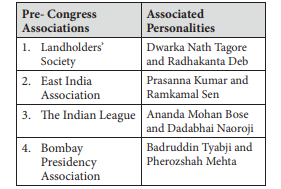
#99. Consider the following pairs:
Which of the pairs above given is/are correctly matched?
e Indian National Congress was not the rst political
organisation in India. However, most of the political
associations in the early half of the nineteenth century
were dominated by wealthy and aristocratic elements.
ey were local or regional in character.
Pair 1 is correctly matched: e Zamindari Association
(Landholders’ Society) was formed in March 1838 as
a political organization for zamindars. e founders
of the association were prominent zamindars of Bengal;
such as Bhabani Charan Bandyopadhyay, Dwarkanath
Tagore, Prasanna Kumar Tagore, Radhakanta Deb,
and Ramkamal Sen. e association campaigned for
Permanent Settlement to be implemented all over India. It
also maintained close ties with the British India Society in
London. It was able to secure concession from the British
that allowed tax exemption status to temples and lands
for Brahmans. British citizens in India were allowed to
become members of the association.
Pair 2 is incorrectly matched: e East India Association was organised by Dadabhai Naoroji in 1866 in London
to discuss the Indian question and in uence public men
in England to promote Indian welfare. Later, branches of
the association were started in prominent Indian cities.
Prasanna Kumar and Ramkamal Sen were the members
of Zamindari Association.
Pair 3 is incorrectly matched: e Indian League was
started in 1875 by Sisir Kumar Ghosh with the object of “stimulating the sense of nationalism amongst the
people” and of encouraging political education.
Pair 4 is correctly matched: e Bombay Presidency
Association was started by Badruddin Tyabji,
Pherozshah Mehta and K.T. Telang in 1885. Badruddin
Tyabji, Pherozeshah Mehta and Kashinath Telang were
popularly known (in that order) as ‘ e Triumvirate’ or
‘ e ree Stars’ of Bombay’s public life.


