
Results
#1. Ghasiti Begum, Sahukat Jang, Rajballabh and Yar Latif Khan were sore enemies of

#2. Which of the following statements regarding Permanent Settlement is/are correct?
#3. English was made the medium of instruction in India in the year of:
#4. Lord Cornwallis has been criticized for not destroying Tipu Sultan when he had the chance to do so after the third Anglo-Mysore war. Which one of the following considerations was not a factor taken into account by Cornwallis in taking his decision?
#5. Which one among the following thinkers argued that Maratha rule in general and Shivaji in particular represented early nationalist consciousness in India?
#6. Haider Ali was originally
#7. Haider Ali established his authority over the Mysore state by overthrowing
#8. Under the dual government in Bengal, the administration was carried on by –
#9. Which Nawab of Bengal shifted his capital from Murshidabad to Monghyr?
#10. In 1856, Awadh would not have been annexed with the British empire if the Nawab of Awadh had
#11. Haider Ali’s administration is remembered for its:
#12. Tipu Sultan was defeated and killed in the Fourth AngloMysore War (1799). Who of the following did not give a share in Tipu’s territories?
#13. Tipu Sultan was a man of complex character. He was an innovator, which of the following was not one of his innovations?
#14. Identify the name of the wife of the Mughal Emperor who is believed to have sabotaged the work of the rebels by acting as an informer to the British.
#15. Between 1765 and 1800 the Sikhs brought the whole of Punjab and Jammu under their control. At that time they were organized into:
#16. Identify the Englishman, who gave all the information about the “Black-Hole Episode”, though in a single-sided way.
#17. Indicate the importance of the treaty of Amritsar (1809) signed between Ranjit Singh and the English?

#18. Which of the following statements above Ryotwari settlement is/are correct?
#19. What was the most important reason for the First AngloSikh War (1845-46)?
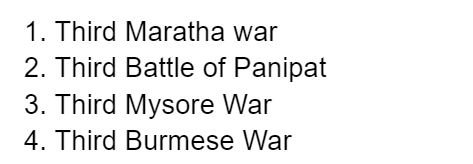
#20. What is the correct sequence of the following events?
#21. What was the worst part of the permanent settlement of Bengal?
#22. ‘The Musalman’, the handwritten daily newspaper in circulation since 1927, is published from which one of the following places?
#23. During whose Peshwaship was the second and third Anglo-Maratha fought resulting in the abolition of the Peshawaship by the English?
#24. Under which one of the following systems of assessment, the British Government collected revenue directly from the farmers?
#25. Haider Ali declared war on English, thereby starting the second Anglo-Mysore war on the ground that
#26. Which one among the following was the result of the First Anglo-Maratha War of 1775–1982?
#27. Which one among the following was the immediate cause of the attack by Nawab Siraj-ud-Daula on Calcutta in 1756?
#28. Give the location of the decisive battle of the second Anglo-Sikh war?

#29. Identify the positive effects of the beginning of European Commerce in India.

#30. Bring out the correct statement about British expansion in Madras
#31. An Indian ruler of the 18th century who planted “the Tree of liberty” at his capital, enrolled himself as a member of the Jacobin club of France and loved himself to be called ‘Citizen’, was

#32. What was/were the object/objects of Queen Victoria’s Proclamation (1858)?
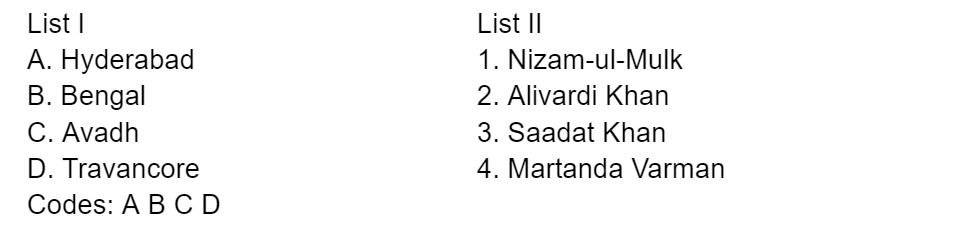
#33. Match List-I with List-II and select the correct answer by using the codes given below the lists.

#34. Which of the following statements about Permanent Settlement are correct?
#35. Who led the Maratha forces in the 3rd Battle of Panipat in 1761?

#36. Consider the following statements about Shivaji’s military acumen
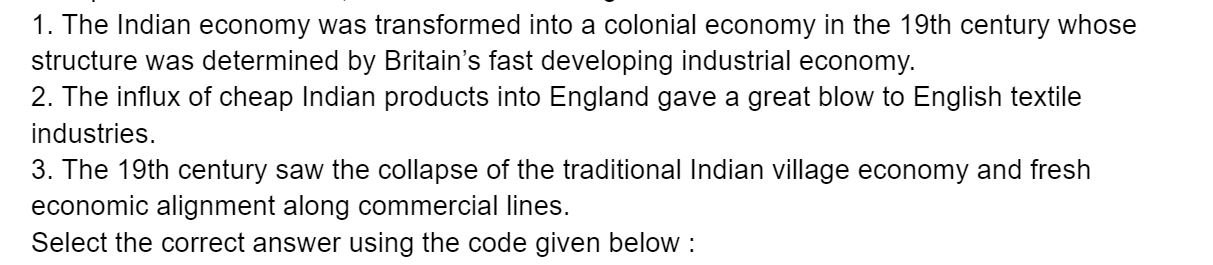
#37. Under the forceful thrust of British rule, a rapid transformation of the Indian economy took place. In this context, which of the following statements is/ are correct?
#38. The fortification of Calcutta by the British in 1756 was regarded by the Nawab of Bengal, Siraj-ud-Daulah, as

#39. The following questions consist of two statements, Statement I and Statement II. You are to examine these two statements carefully and select the answers to these questions using the codes given below Codes

#40. The following questions consist of two statements, Statement I and Statement II. You are to examine these two statements carefully and select the answers to these questions using the codes given below Codes
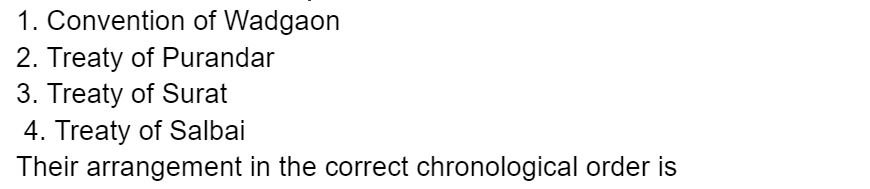
#41. The following are connected with the First AngloMaratha War 1779-82:

#42. Match List-I with List-II and select the correct answer by using the codes given below the lists.
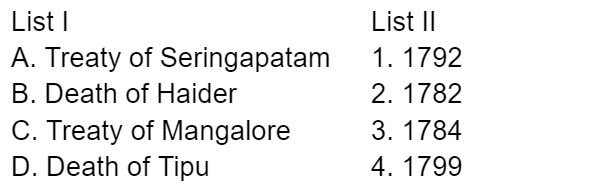
#43. Match List-I with List-II and select the correct answer by using the codes given below the lists.

#44. Match List-I with List-II and select the correct answer by using the codes given below the lists.
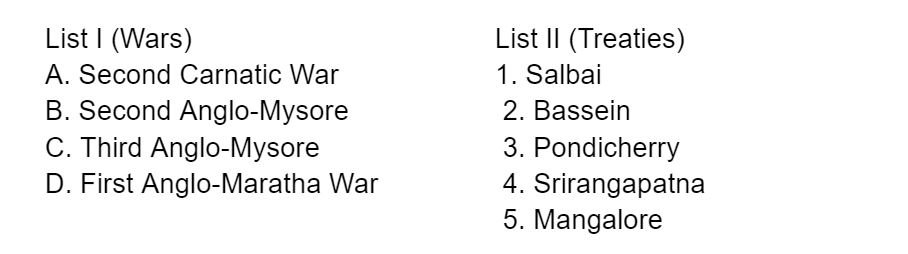
#45. Match List-I with List-II and select the correct answer by using the codes given below the lists.

#46. Consider the following statements



