
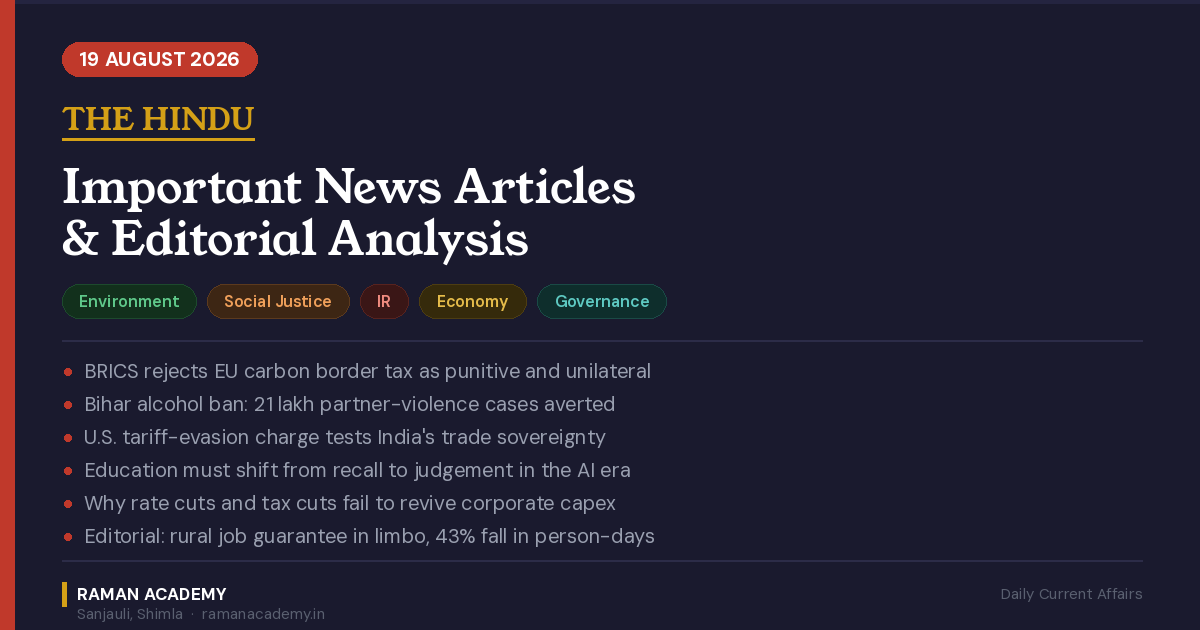
Wednesday, 19 August 2026 · Edition: International
The Hindu – Important News Articles & Editorial
Daily current affairs analysis covering Environment, Social Justice, International Relations, Indian Economy and Governance
Today’s Coverage
- BRICS Calls the EU’s Carbon Tax ‘Punitive and Unilateral’GS III – Environment
- Bihar’s Alcohol Ban: What the Data Shows on Social WellnessGS II – Social Justice
- Time to Push Back: The U.S. and Its Rising Demands on IndiaGS II – IR
- Education Must Change to Account for AIGS II – Social Justice
- What Drives Corporate Investment?GS III – Economy
- Editorial: Employment Guarantee Has Slipped Into LimboGS II & III – Governance
BRICS Calls the EU’s Carbon Tax ‘Punitive and Unilateral’
The 12th BRICS Environment Ministers’ Meeting in New Delhi, held under India’s chairship, culminated in a joint declaration condemning unilateral climate measures. The coalition strongly criticised the European Union’s Carbon Border Adjustment Mechanism (CBAM) as unilateral, punitive, discriminatory and protectionist.
As CBAM enters its definitive financial phase, this collective response highlights a deepening friction between developed-market regulations and the economic realities of the Global South.
Key Issues & Deep Analysis
CBAM acts as a tariff on carbon-intensive imports such as steel, aluminium, cement and fertilizers. For India — where iron and steel constitute roughly 90% of affected EU exports — this reduces export competitiveness and threatens revenues.
BRICS nations argue that CBAM undermines the Common But Differentiated Responsibilities and Respective Capabilities (CBDR-RC) principle. It shifts the financial burden of climate action onto developing nations without accounting for historical emissions.
Designed by the EU to prevent “carbon leakage,” the mechanism is perceived by developing states as disguised green protectionism, aimed at safeguarding domestic industries.
The joint statement highlighted that developed nations must fulfil their UN commitments to triple adaptation finance by 2035 via grants and non-debt, concessional funding.
Related Static Dimensions
| Dimension | Core Content |
|---|---|
| Multilateral Diplomacy | Conflict between WTO rules (the Non-Discrimination principle) and the EU’s unilateral trade-climate policy. |
| Global South Coalition | BRICS acting as a unified voice to advocate equitable global trade frameworks. |
| Climate Finance | Historical liability versus present emissions; funding adaptation versus mitigation strategies under the UNFCCC and Paris Agreement. |
| Impact on Indian Industry | Transition costs for heavy industry (for example, Green Steel technology) to comply with international carbon accounting standards. |
India Implications
- Steel is the pressure point: with iron and steel making up around 90% of India’s CBAM-affected EU exports, the mechanism concentrates its impact on a single strategic sector rather than spreading it thinly.
- Chairship leverage: India holds the BRICS chair, giving it a platform to convert a bilateral grievance into a Global South negotiating bloc position.
- Green steel becomes urgent, not aspirational: domestic decarbonisation of steel shifts from a climate goal to an export-survival requirement.
- FTA design: India will need carbon-accounting offsets and mutual-recognition clauses written into future trade agreements, not negotiated after CBAM bites.
Core Arguments & Strategic Imperatives
Climate policy must not create trade barriers that stifle growth in developing economies.
Adaptation funding needs to be new, additional, accessible and transparently tracked.
Countries like India must accelerate clean-technology adoption while negotiating carbon-accounting offsets in bilateral free trade agreements.
The BRICS declaration underscores that climate action cannot come at the expense of equitable economic development. Rather than punitive measures that penalise developing economies, global climate governance must rely on technology transfers, predictable adaptation finance and collaborative decarbonisation. For India, balancing green industrial transformation with firm diplomatic negotiation remains crucial to safeguarding its trade interests.
The term “carbon leakage”, frequently used in discussions on CBAM, refers to:
- A. Release of carbon dioxide due to forest fires
- B. Relocation of carbon-intensive production to jurisdictions having relatively weaker climate regulations
- C. Leakage of carbon dioxide from underground carbon-storage facilities
- D. Transfer of carbon credits between countries
Click to reveal answer
Answer: (B). Carbon leakage describes the shifting of emission-intensive production to countries with laxer climate rules, so that global emissions do not fall even though the regulating country’s domestic emissions do. Option C describes a physical leak from carbon capture and storage — a different concept that is often used as a distractor.
The growing use of unilateral trade measures in the name of climate action poses a challenge to the multilateral trading system. Discuss with reference to the European Union’s Carbon Border Adjustment Mechanism.
10 Marks · 150 WordsBihar’s Alcohol Ban: What the Data Shows on Social Wellness
The debate surrounding Bihar’s alcohol ban — enacted in 2016 — has resurfaced following a recommendation by the India Policy Forum 2026 advocating its repeal. The proposal cites fiscal revenue losses, estimated at around 14% of state revenue, and a lack of significant reduction in reported crimes against women.
Public health epidemiologists, however, argue that relying solely on macro police data presents an incomplete picture, masking positive social, health and domestic outcomes.
Key Issues & Deep Analysis
National Crime Records Bureau statistics measure reported severe crimes, not total violence. An increase in reported cases often reflects improved legal access, reduced social stigma and better policing rather than an actual surge in violence.
Quasi-experimental studies, including research published in The Lancet Regional Health, indicate that the prohibition prevented over 21 lakh cases of intimate partner violence in Bihar relative to control states, alongside a noticeable decline in physical assaults.
Beyond domestic safety, the policy contributed to measurable health gains among men, including reductions in non-communicable disease risk factors such as hypertension and overweight/obesity.
While the state forfeits excise tax revenue, these losses must be weighed against the broader societal and economic costs of alcohol consumption — healthcare burdens, lost productivity and social harm that draw down substantial GDP.
Related Static Dimensions
| Dimension | Core Content |
|---|---|
| Article 47 (DPSP) | Mandates the State to endeavour to bring about the prohibition of the consumption of intoxicating drinks and drugs injurious to health. |
| Impact on Vulnerable Groups | Influence of substance control on domestic well-being, gender-based violence and household financial stability in rural and low-income settings. |
| Social Reform vs State Regulation | The historical and constitutional context of state-driven social engineering. |
| Policy Evaluation Metrics | The necessity of nuanced, quasi-experimental research over blunt administrative indicators when assessing complex social welfare interventions. |
| Fiscal Federalism vs Social Welfare | Balancing state revenue requirements (excise duties) against public health costs and societal externalities. |
India Implications
- Prohibition is a State subject: alcohol sits in the State List, so Bihar’s experiment functions as a natural policy laboratory for Gujarat, Nagaland, Mizoram and any state weighing similar measures.
- The measurement lesson generalises: using reported-crime counts to judge a welfare intervention can invert the finding, since better reporting and less violence can move the same number in opposite directions.
- Excise dependence is structural: with liquor revenue outside GST and a major own-tax source for most states, any prohibition debate is simultaneously a fiscal federalism debate.
- Enforcement externalities: bootlegging, hooch tragedies and jail overcrowding are the recognised costs of a blanket ban, which is why calibrated regulation rather than repeal is the middle path under discussion.
Core Arguments & Strategic Imperatives
Policy choices are not restricted to a total ban versus complete deregulation. The World Health Organization advocates intermediate alcohol control frameworks, including rationing systems, availability restrictions, dynamic pricing and targeted taxation.
Any transition in alcohol policy must be accompanied by expanded mental health infrastructure, accessible de-addiction centres, public awareness initiatives and economic opportunities.
Governance decisions should rely on rigorous causal evaluations rather than purely descriptive economic or crime metrics.
The discussion around Bihar’s prohibition highlights the friction between immediate state revenue imperatives and long-term socio-health benefits. While administrative and enforcement challenges remain, an abrupt repeal risks reversing documented gains in domestic safety and public health. Sustainable governance requires moving past a simple “ban or no ban” binary toward calibrated, evidence-backed regulation supported by strong public health infrastructure.
Which of the following best describes the “externality” associated with alcohol consumption?
- A. The difference between the wholesale and retail price of alcohol
- B. Costs imposed on third parties that are not fully reflected in the private cost of consumption
- C. The revenue earned by the government through excise duty
- D. The difference between domestic and international alcohol prices
Click to reveal answer
Answer: (B). A negative externality is a cost borne by someone other than the buyer or seller and not captured in the market price — here, healthcare burdens, road accidents and domestic harm absorbed by families and the state. Excise duty (option C) is in fact the standard corrective instrument used to internalise such an externality, not the externality itself.
Alcohol prohibition is not merely a question of individual choice; it has significant implications for family welfare, gender relations and social stability. Discuss.
10 Marks · 150 WordsTime to Push Back: The U.S. and Its Rising Demands on India
The United States has escalated trade rhetoric against India, with a White House report accusing New Delhi of ranking among the top “enablers” of China’s U.S. tariff evasion. The core accusation alleges that Indian firms import Chinese goods, make minor or cosmetic modifications, and re-export them to the U.S. under lower tariff rates.
A closer look at industrial data, however, reveals that Indian manufacturing is undergoing a structural shift — moving from importing finished items to sourcing intermediate goods needed for domestic assembly and value creation under initiatives like Make in India.
Key Issues & Deep Analysis
The U.S. frames India’s imports from China as “transshipment” or “tariff circumvention.” In reality, the rising share of intermediate components reflects domestic assembly and industrial integration rather than cosmetic packaging.
Chinese inputs — ranging from active pharmaceutical ingredients (APIs) to electronics and solar cell components — serve as critical inputs for Indian manufacturing and export competitiveness.
Historical precedent shows India repeatedly conceding to unilateral U.S. trade demands:
- Tariffs on high-end motorcycles cut from 60–75% to 50% in 2018, and further to 40% in February 2025.
- Import duty reductions on agricultural and seafood inputs such as shrimp feed, frozen duck and turkey.
- Diversification away from discounted Russian crude under American pressure.
- A softening stance on Foreign Direct Investment in e-commerce inventory models.
Repeated unilateral concessions without reciprocal trade benefits have emboldened Washington to expand its demands on Indian domestic and foreign economic policy.
Related Static Dimensions
| Dimension | Core Content |
|---|---|
| India–U.S. Strategic vs Economic Friction | Managing the contradiction between strong strategic and security alignment (for example, the Quad) and persistent trade disputes. |
| Strategic Autonomy | Balancing energy security and industrial supply-chain dependencies against foreign geopolitical pressure. |
| Structure of Indian Manufacturing | The transition from simple assembly to high-value-added manufacturing under Make in India and the PLI schemes. |
| Rules of Origin & Tariff Frameworks | WTO norms on substantial transformation versus simple transshipment. |
| Global Value Chains | India’s integration into regional and global supply chains and its dependence on primary industrial hubs like China. |
India Implications
- Rules of origin become a defensive tool: a clear, WTO-compliant domestic standard for substantial transformation is what converts the transshipment accusation from a political charge into a testable legal question.
- The China dependence is not optional in the short run: APIs, solar cells and electronic components have no immediate domestic substitute at scale, so cutting imports would damage the very manufacturing base the U.S. is asking India to build.
- Concession fatigue has a cost: each unilateral accommodation without reciprocity raises the expected return on the next demand, which is the moral-hazard dynamic the article identifies.
- Energy sovereignty: pressure on Russian crude sourcing links trade policy directly to India’s import bill and current account, making this a GS II and GS III question simultaneously.
Core Arguments & Strategic Imperatives
India must defend its sovereign right to source raw materials and intermediate inputs globally in order to build domestic manufacturing capability.
Define transparent, WTO-compliant rules on “substantial transformation” to legally disprove claims of minor modification or transshipment.
Accelerate domestic component manufacturing to gradually reduce over-reliance on single-source suppliers for key intermediate goods.
While maintaining strategic and economic ties with the United States is essential, accommodating unilateral trade demands compromises India’s industrial policy and economic sovereignty. As Chinese intermediate imports remain central to building domestic manufacturing infrastructure, India must establish firm diplomatic boundaries and resist external interference in its supply chain integration.
The term “substantial transformation” in international trade is primarily associated with:
- A. Determining the country of origin of a product
- B. Calculating the exchange rate between two currencies
- C. Determining the amount of foreign exchange reserves required
- D. Measuring the carbon content of an imported product
Click to reveal answer
Answer: (A). Substantial transformation is the rules-of-origin test that decides which country a good legally originates from — typically judged by a change in tariff classification, a value-addition threshold, or a specified processing operation. It is precisely the standard that determines whether a re-export counts as genuine manufacturing or mere transshipment.
“Strategic partnership does not necessarily imply convergence of economic interests.” Examine in the context of India–US relations.
10 Marks · 150 WordsEducation Must Change to Account for AI
A commentary by K. VijayRaghavan, former Principal Scientific Adviser to the Government of India, highlights the critical imperative to restructure India’s educational paradigm in response to Artificial Intelligence.
As AI agents and automation transform both intellectual labour (such as “vibe coding”) and high-end manufacturing (generic drugs, biosimilars, vaccine production), traditional educational models built on rote learning and information accumulation have reached a dead end. The essay argues for a fundamental shift toward adaptability, deep domain expertise and problem-solving through practical apprenticeship.
Key Issues & Deep Analysis
AI and robotics are automating routine tasks across IT, pharmaceuticals and manufacturing. This eliminates traditional entry-level positions, creating a dilemma: industry still requires deep domain experts, but young professionals have fewer entry-level avenues through which to build that expertise.
Historically, technological shifts were met by lengthening formal education, from primary school through to master’s degrees. With AI retrieving and processing vast amounts of information instantaneously, simply storing more knowledge in human memory is no longer a viable strategy.
- Thinning out the curriculum: reducing dense, static syllabi to focus on foundational principles.
- Learning on the fly: cultivating core cognitive skills — selection, synthesis, critical judgment and rapid adaptation to unfamiliar scenarios.
The National Education Policy 2020 introduces a four-year undergraduate degree with a dedicated research pathway in the final year. However, residual coursework often dilutes this immersive experience.
Related Static Dimensions
| Dimension | Core Content |
|---|---|
| Development & Management of Education | Transitioning from content-heavy curricula to skill-based, competency-led frameworks. |
| National Education Policy 2020 | Structural reforms including four-year undergraduate degrees, multiple entry and exit options, and research integration. |
| Globalisation & Automation on Employment | Structural unemployment risks, jobless growth and changing employment profiles due to AI and Industry 4.0. |
| S&T Developments & Applications | AI deployment in biotechnology, advanced robotics, automated bioreactors and drug discovery. |
| Skill Development Initiatives | Bridging the industry-academia gap through apprenticeships, industrial training and laboratory immersions. |
India Implications
- The demographic dividend is conditional: a large young workforce becomes an asset only if entry-level pathways survive automation — otherwise it converts into a structural unemployment liability.
- NEP’s fourth year is the lever already available: the reform does not require new legislation, only genuine de-cluttering of final-year coursework so the research and apprenticeship pathway can function as designed.
- Assessment must follow curriculum: examinations that continue to reward recall will quietly defeat any shift toward judgment and synthesis, however the syllabus is rewritten.
- Industry-academia gap: scalable apprenticeships need employer participation and institutional capacity, both of which remain thin outside metropolitan and elite institutions.
Core Arguments & Strategic Imperatives
Education must prioritise teaching students how to evaluate information, discern relevant data and apply critical thinking rather than memorising facts.
Universities should move remaining final-year coursework online, freeing students for full-time immersion in industry, university laboratories or national research facilities.
Use the fourth year of the NEP undergraduate framework as an institutionalised apprenticeship model to help students “practise entering the unknown.”
The rapid advancement of AI necessitates a pivot in India’s education ecosystem from knowledge consumption to adaptive problem-solving. Preparing the nation’s youth for an unpredictable economic landscape requires thinning out rigid curricula and institutionalising real-world experience. By fully leveraging the research and practical pathways under NEP 2020, India can build an agile, expert workforce capable of driving innovation in an AI-dominated world.
The four-year undergraduate programme introduced under the National Education Policy (NEP) 2020 is significant primarily because it:
- A. Eliminates the need for postgraduate education across all disciplines
- B. Provides multiple entry and exit options along with a dedicated research pathway in the final year
- C. Makes industrial apprenticeship legally mandatory for every undergraduate student
- D. Restricts students to a single discipline for the full duration of the degree
Click to reveal answer
Answer: (B). NEP 2020 restructures undergraduate education with multiple entry and exit points — certificate, diploma, bachelor’s and a four-year degree with research — and embeds a research or specialisation pathway in the fourth year. Option D inverts the policy, which explicitly promotes multidisciplinary and flexible course combinations.
The rapid development of Artificial Intelligence necessitates a shift from content-based education towards competency-based learning. Discuss.
10 Marks · 150 WordsWhat Drives Corporate Investment?
Corporate investment as a proportion of GDP in India experienced a secular decline following the 2016 demonetisation shock. Despite supply-side fiscal and monetary interventions — slashing corporate tax rates from 30% to 22% in 2019 and maintaining low interest rates — private capital expenditure lagged behind broader recovery expectations.
Economists Rohit Azad and Indranil Chowdhury provide a theoretical framework explaining this asymmetry: private investment is determined by expected profitability, confidence (animal spirits) and the cost of credit, with distinct structural constraints governing small versus large enterprises.
Key Determinants & Theoretical Framework
Industrial manufacturing relies heavily on economies of scale: larger equipment and factories yield higher profit rates per unit of investment. However, every firm faces a market demand ceiling, represented by its maximum market share. Investing beyond this capacity leads to underutilised capital and plummeting profit rates.
Future returns are discounted by economic uncertainty. Exogenous policy shocks — such as demonetisation or global disruptions — shift the profitability curve inward by dampening consumer demand and eroding regulatory predictability. For small firms operating on thin margins, severe shocks push expected profitability below the cost of capital, leading to insolvency.
Firms rely on external credit when investment exceeds internally generated funds. Under Michal Kalecki’s Principle of Increasing Risk, borrowing costs rise as the proportion of debt to equity increases. Small firms, possessing lower internal capital reserves, encounter rising interest costs much earlier than large conglomerates.
The Firm-Size Asymmetry: Why Rate Cuts Fail to Revive Capex
| Parameter | Small & Medium Enterprises (MSMEs) | Large Corporations |
|---|---|---|
| Primary Constraint | Credit-constrained: limited internal funds force reliance on high-cost debt early in the investment cycle. | Demand-constrained: high internal capital keeps borrowing costs low, but investment is capped by total market demand. |
| Effect of Interest Rate Cuts | Marginal impact: rate cuts shift borrowing costs down slightly, but elevated risk premiums and demand shocks keep profitability below the threshold. | Ineffective: large firms already hold cheap credit and liquidity; lowering borrowing costs does not resolve weak consumer demand. |
| Effect of Tax Cuts | Limited benefit: tax cuts do not generate immediate consumer demand or improve market access for smaller players. | Cash accumulation: corporate tax cuts increase retained earnings without incentivising new capacity creation when factories operate below full output. |
Related Static Dimensions
| Dimension | Core Content |
|---|---|
| Determinants of Private Capex | Gross Fixed Capital Formation (GFCF), capacity utilisation rates and the crowd-in effect of public expenditure. |
| Monetary Policy Transmission | Limitations of repo rate cuts and liquidity injection in stimulating investment under conditions of demand deficiency. |
| Fiscal Policy & Fiscal Federalism | Debates surrounding fiscal consolidation versus autonomous public spending to boost aggregate demand. |
India Implications
- Diagnosis determines the instrument: if the binding constraint is demand rather than cost, then rate cuts and tax concessions are the wrong tool regardless of how aggressively they are applied.
- The 2019 tax cut as evidence: reducing corporate tax from 30% to 22% raised retained earnings without triggering proportionate capacity creation — a natural experiment supporting the demand-constraint reading.
- MSMEs need a different instrument entirely: credit guarantee frameworks address the risk premium that rate cuts cannot touch, which is why blanket monetary easing leaves small firms behind.
- Public capex as a crowd-in device: government capital expenditure expands market capacity and shifts profitability expectations outward, linking this debate directly to Union Budget allocation choices.
Core Arguments & Strategic Imperatives
Tax cuts and low interest rates address cost constraints rather than revenue expectations. In a demand-constrained economy, supply-side interventions fail to stimulate capital formation.
The government must act as an autonomous agent of demand creation through capital expenditure on infrastructure, public works and employment schemes. Public investment crowds in private investment by expanding market capacity.
Mitigate systemic risk for smaller firms through credit guarantee frameworks and subsidised capital access, cushioning them against high debt costs.
A persistent decline in private corporate investment cannot be remedied solely through monetary easing or corporate tax concessions. Because large firms are constrained by market demand and small firms struggle with risk-adjusted credit access, sustainable revival requires strategic public expenditure. By stimulating aggregate demand and bolstering employment, targeted fiscal policy shifts expected corporate profitability outward, crowding in private capital formation across both small and large enterprises.
Which of the following best describes the crowding-in effect of public investment?
- A. Public investment completely replaces private investment
- B. Public investment reduces private investment by absorbing all available financial resources
- C. Public investment creates infrastructure and demand conditions that encourage additional private investment
- D. Public investment necessarily reduces interest rates
Click to reveal answer
Answer: (C). Crowding in occurs when public spending raises demand and builds enabling infrastructure, making private projects viable that otherwise would not be. Option B describes the opposite phenomenon — crowding out — which operates through competition for loanable funds and is the standard distractor in this pairing.
Why may monetary easing fail to generate a significant increase in private investment during a period of weak aggregate demand? Explain.
10 Marks · 150 WordsEmployment Guarantee Has Slipped Into Limbo
Context: Rural employment in India faces a critical juncture. The transition from the landmark Mahatma Gandhi National Rural Employment Guarantee Act (MGNREGA), 2005 to its successor — the Viksit Bharat–Guarantee for Rozgar and Ajeevika Mission (Gramin), or VB-G RAM G Act — has triggered an unprecedented slump in employment generation.
Data from April to July 2026 reveals a 43% drop in person-days generated compared to the average of the preceding two years, with several low-income states experiencing near-total disruption during the peak summer slack season. This raises fundamental questions about administrative readiness, fiscal federalism and the constitutional guarantee of the Right to Work.
Key Issues & Findings in the Transition
Employment during April–July 2026 fell to 70 crore person-days, down from 128 crore in 2024–25 and 119 crore in 2025–26. These four months normally account for close to half of annual employment generation, since they fall in the agricultural slack season.
Ten out of 19 major states saw declines between 60% and 85%. Key states including Uttar Pradesh, Madhya Pradesh and Jharkhand witnessed a virtual standstill in work allocation.
Though passed in Parliament in December 2025 with an intended rollout of 1 April 2026, the Rules were not finalised until late June. Functionaries halted work during the peak summer months because of systemic ambiguity, and MGNREGA continued by default in the interim.
Despite an increased overall allocation — projected at nearly ₹1.5 lakh crore inclusive of the new 40% state contribution, an increase of roughly 70% over MGNREGA expenditure in 2025–26 — real ground-level expenditure and employment generation plummeted. The central allocation alone in the 2026–27 Union Budget stands at ₹95,692 crore.
Employment Decline by State, April–July 2026
Percentage change in person-days against the average of the previous two years for the same months. The decline was universal across major states but far from uniform:
| State | Change | State | Change |
|---|---|---|---|
| Andhra Pradesh | −1.9% | Odisha | −62.2% |
| Assam | −7.7% | Karnataka | −68.3% |
| Telangana | −9.2% | Madhya Pradesh | −68.8% |
| Tamil Nadu | −17% | Uttar Pradesh | −74.3% |
| Chhattisgarh | −29% | Haryana | −75% |
| Kerala | −32% | Jharkhand | −75.5% |
| Bihar | −43.5% | Punjab | −76.9% |
| Rajasthan | −46.2% | Uttarakhand | −80% |
| Maharashtra | −47.3% | Himachal Pradesh | −84.6% |
| Gujarat | −60% | — | — |
Himachal Pradesh recorded the steepest fall of any major state at 84.6%, with neighbouring Uttarakhand next at 80% — making the transition a particularly sharp issue for the Himalayan states, which also fall under a different cost-sharing category.
Policy Analysis & Structural Challenges
Passing legislation without fully framed execution rules created a regulatory vacuum. Ground functionaries halted project approvals and muster roll generation while awaiting operational directives, defeating MGNREGA’s core demand-driven ethos.
Under VB-G RAM G, states must bear 40% of the financial burden for non-Himalayan and non-North-Eastern states. This strains state budgets — especially in poorer states — leading to delayed fund releases, wage disbursement bottlenecks and reduced local willingness to open new worksites.
Mandatory Facial Recognition Technology (FRT) at worksites introduces digital exclusion risks. Weak connectivity in remote rural pockets frequently stalls attendance logging and delays wage payments.
Constitutional & Legal Framework
| Provision | Key Mandate |
|---|---|
| Article 39 (DPSP) | Mandates that the State secure adequate means of livelihood for citizens. |
| Article 41 (DPSP) | Directs the State to secure the right to work, to education and to public assistance in cases of unemployment. |
| Article 21 | Right to Life and Dignity, which the Supreme Court has repeatedly expanded to include the right to a basic livelihood. |
Scheme Comparison: MGNREGA vs VB-G RAM G
| Parameter | MGNREGA (2005) | VB-G RAM G (2026) |
|---|---|---|
| Funding Ratio (Centre:State) | Roughly 90:10 — the Centre bore 100% of the wage cost | 60:40 standard cost-sharing model |
| Core Structure | Rights-based, demand-driven legal guarantee | Enhanced budget target linked to state contributions |
| Authentication Standard | Aadhaar-based Payment System (ABPS) / NMMS | Worksite Facial Recognition Technology (FRT) |
India Implications
- Himachal Pradesh is the worst-affected state in the country at −84.6%, ahead of Uttarakhand at −80% — a direct hit to rural wage income in a state where hill agriculture and off-season work already carry thin margins.
- A rights-based guarantee has become a budget-linked target: the shift from demand-driven entitlement to allocation-driven targets is the deepest structural change, and it weakens the legal character that made MGNREGA distinctive.
- Cost-sharing hits the poorest hardest: requiring a 40% state share means the states with the largest demand for rural work are precisely those least able to fund it — an inversion of the equalisation logic of fiscal federalism.
- Technology as a gatekeeper: mandatory FRT in low-connectivity terrain converts an administrative tool into an eligibility barrier, raising Article 21 concerns about denial of livelihood by technical failure.
- Timing compounded the damage: the rules vacuum coincided with the summer slack season, when rural distress peaks and the scheme is most needed.
Key Action Steps Going Forward
Issue clear, binding operational guidelines to block-level functionaries so work demand is registered without reliance on pending rules.
Provide short-term fiscal buffers or variable matching ratios for high-poverty states struggling with the 40% contribution requirement.
Maintain manual or offline muster logs alongside FRT so that technology failures do not deny work or delay wages to vulnerable labourers.
Enforce regular social audits to monitor attendance logging, asset creation quality and timely wage delivery.
The transition to VB-G RAM G was intended to modernise India’s rural safety net, but structural confusion, altered cost-sharing rules and hasty implementation have instead disrupted livelihood security for millions. To fulfil the constitutional promise of the Right to Work, the government must address these operational bottlenecks promptly, streamline funding channels with states, and ensure that technology acts as an enabler rather than a barrier to rural welfare.
Article 41 reflects the constitutional commitment towards livelihood security, but translating this principle into an effective right to work requires institutional capacity and fiscal support. Discuss.
10 Marks · 150 WordsNever Miss a Daily Update
Get daily current affairs, magazine releases and exam alerts directly on your phone.
Join WhatsApp Join Telegram